Bareilly, 29th-31st of May, 1857
The troops stationed at Bareilly consisted of the 18th and 64th BNI, the 8th Regiment of Irregular Cavalry and a native artillery battery. Close by, in Moradabad, the 29th BNI was posted, at Shajahanpore, the 28th BNI were stationed, and at Budaon, where Mr. Edwards was sweating it out, he only had a sepoy regiment. Brigadier Sibbald commanded the brigade, and his second-in-command was Colonel Colin Troup. Troup, by all accounts he was an able soldier and gallant officer. He had served during the 1st Afghan War and had been one of the British captives, and he went on to serve in the Sikh Wars. He wasn’t one to sit out a fight or shirk responsibility. After the news of the outbreak in Meerut, things had been reasonably quiet in Bareilly, even though a small group of the 29th BNI broke out on the 19th of May in Moradabad and broke open the jail, letting loose swathes of prisoners into the countryside. The impact of this, however, was not felt immediately in Bareilly. At the time, Brigadier Sibbald was still out of his station, on a tour of inspection. The 18th and the 68th BNI were evidently restless, but under the “unremitting exertions of Colonel Troup and Mr. Alexander, the Commissioner of Rohilcund, the uneasiness was temporarily allayed.” He felt he had nothing to worry about. However, as a precaution, most of the women and children had been sent off to Naini Tal at the first news of the uprising in Meerut while the roads were still passable, leaving the officers and civilians unhindered and free to prepare for the storm that was certainly coming. The officers further agreed that, in case they needed to flee, they would assemble at the camel sheds in the cavalry lines.
The 18th BNI and the 8th Irregular Cavalry did not seem to share in the excitement of the sepoys of the 68th, and it was decided that they should be used as guards and pickets to protect the station and defend the guns, treasury and the gaol. They were also entrusted to give “instant alarm to the authorities and to their Corps, kept ready saddled and armed, should they observe the least sign of an outbreak.” The commander of the 8th Irregulars, Captain Alexander Mackenzie, had been ordered to increase the number of his regiment to 1000 Sowars, “and numbers who had been waiting for entertainment were immediately enrolled.” The 8th Irregular Cavalry had gained their laurels by displaying “splendid discipline… (when) The 38th Regiment of Native Infantry had refused to go to Pegu because they considered a sea voyage would destroy their caste. The 8th volunteered to cross the ‘black waters.’ They marched a thousand miles to the port of embarkation, and not a single man deserted.” Captain Alexander Mackenzie was rightly proud of his men. He had been their adjutant and their second in command, and he knew his regiment thoroughly. He was stern in matters of discipline but he “also the power of winning the confidence and affection of those he ruled.” The men under his command were all from ancient families; they carried pride in their regiment and their record.
Brigadier Sibbald returned from his tour of inspection, and on the 21st of May, he ordered a general parade of the Bareilly troops. In an emotional address, he ” begged them to dismiss from their minds the causeless dread that prevaded them.” Mr. Alexander threw in his bit, stating, “in the name of the Lieutenant Governor assured them that the intentions of the Government towards them were the same they had ever been.” In their turn, the men assured Brigadier Sibbald that “We have commenced a new life.”
They then appealed to the Brigadier to recall the women and children from Naini Tal. Pleased with the calm and outwardly joyous appearance of his men, Sibbald wrote a dispatch to the Government on the 23rd of May. “From the cheerful and obedient spirit now envinced by the troops I auger the happiest results, and am convinced that should their services be required they will act as good and loyal soldiers.”
On the 29th of May, the Havildar-Major of the 68th Regiment came to Colonel Troup to report in a most agitated stated, that “he had been sent by the Soobadore-Major to inform me that whilst bathing at the river in the morning the men of both regiments, the 18th and the 68th had sworn to rise at 2pm and murder their European officers.” Troup quickly warned the officers of the 18th BNI and the 8th Irregular Cavalry of what he had been told.
As soon as Mackenzie received Troup’s message, he ordered his men to saddle up; by all accounts, they “appeared in good heart and quite prepared for any emergency.”
Nothing happened.
Sunday, the 31st of May, started quietly. Major Pearson, commanding the 18th BNI, reported to Troup, assuring him “that his men were alright, and that he had every confidence in them.” He was not alone. Captain Kirby of the artillery – 6th Company, 6th Batallion – trusted his men without any doubts, while Captain Brownlow, the brigadier-major, simply refused to believe a mutiny would happen in Bareilly.
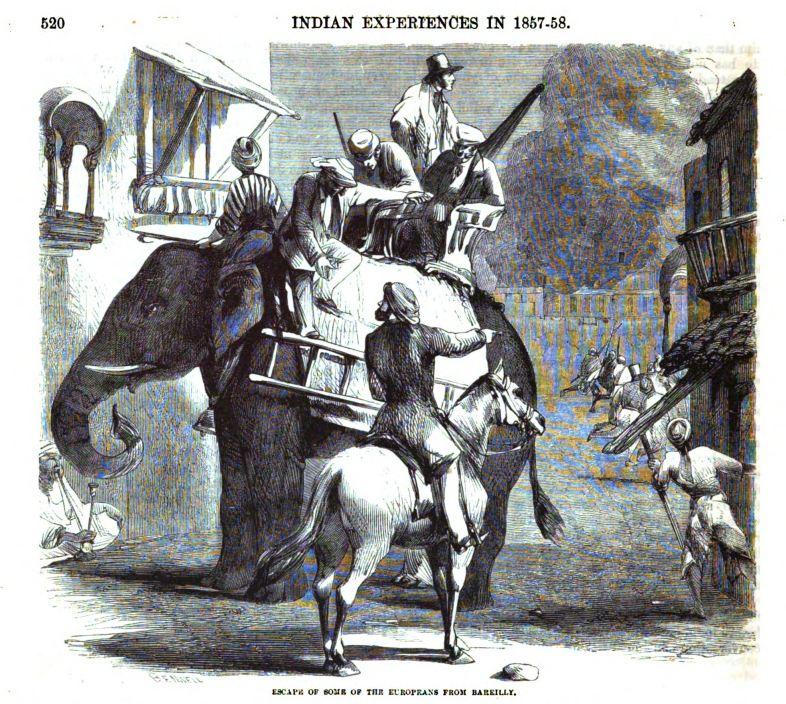
Two hours later, as the regimental gong struck 11am, the sudden roar of guns and the rattle of musketry broke the silence. Screams and yells from every direction erupted as flames scoured the sky from burning bungalows.
Brigadier Sibbald, on hearing the battery guns, quickly mounted his horse and rose to the cavalry lines escorted by two mounted orderlies. On the way, he was shot in the chest, but he managed to hold on, riding onwards towards the camel sheds in the cavalry lines, as agreed. Barely there, he fell off his horse, dead. Lieutenant Tucker, too, was ready to leave for the rendezvous point when he was stopped by Sergeant Jennings, whose horse had been shot. Advising Jennings to “hold my horse’s tail or the stirrup and run along,” Tucker set off with Jennings holding on. Moments later, a ball entered the back of Tucker’s head and came out of his forehead, covering Jennings in blood. As the dead man rolled off his horse, Jennings climbed on the animal’s back and he escaped, “through the heavy fire..one ball shattered the pommel of his saddle, and another went through the upper part of his horse’s neck, which threw him down and caused the loss of his cap…”
Commissioner Alexander and Colonel Troup, amongst others, reached the cavalry lines. Here, they waited for the remaining loyal troops to assemble – as the station dissolved into chaos around them – they decided it made no sense to stay in Bareilly but was infinitely wiser to retreat to Naini Tal. The right wing of the cavalry corps fell in and appeared willing to follow Colonel Troup, who had now assumed command. As for Captain Mackenzie, he had been told that very morning that the Irregular Cavalry – his men – had determined to stay neutral in case of revolt. As much as he wanted to believe them, he chose to err on the side of caution and warned his adjutant, Lieutenant Becher and Surgeon Currie to put on their uniforms and saddle their horses. Within moments of these preparations, Brigadier Major Captain Brownlow dashed into Mackenzie’s quarters with the news that the mutiny had begun. Mackenzie and Becher immediately rode out to the cavalry lines to turn out their men. Without any hesitation, the right wing immediately drew up in line in front of the quarters, but the left wing dawdled.
“Mackenzie went among them, and had turned them out and was forming them up when he perceived the right wing was in motion. He rode after them, and on overtaking them, halted them,and said to Colonel Troup ” that the men wished to have a crack at the mutineers, to which he replied,
“I do not think it is any use, but just do as you please.”
Colonel Troup, from the information he had received, had lost all faith in the goodwill of the cavalry. Mackenzie clung to his belief in the loyalty of his men. He told the right wing that he was going to take them to recover the guns. Accompanied by Mr Grant, the magistrate, and some officers, Mackenzie rode at the head of his men to the parade. He found to his surprise the left wing of his regiment drawn up side by side with the infantry. Leaving his right wing under the charge of Becher, he at once rode up to them and spoke to them. The words of their gallant commander began to tell on them. A slight movement was noticed. There arose from the ranks of the infantry a loud cry calling on them to be true to their religion. A green flag, the symbol of the Moslem faith, was hoisted, and the two wings ranged themselves around the banner. To stay any longer would have been an act of folly.
Mackenzie and Becher, accompanied by twenty-three of his men, rode off and overtook the party of surviving Europeans who were on their way to Nynee Tal. “Thank God,” said Troup to Mackenzie, as the latter rode up, ” I feared you had gone to certain death.”
For sixty-two miles, they rode on without a halt in the scorching month of June, and Nynee Tal was safely reached. Among the twenty-three faithful troopers who accompanied Mackenzie, twelve were native officers. Muhammad Nazeer Khan, a native officer, was told by Mackenzie to go back and look after his three motherless boys who were left in the regimental lines. The old soldier grasped the hand of his commander and, with tears in his eyes, said,
“No, I will go with you and do my duty.”
Captain Gowan of the 18th was presumed dead, but he managed to flee Bareilly only to find himself unable to get anywhere. Shunted from place to place, he was finally taken in by a kindly landowner and protected at great risk to the man, his family and his village, until the end of October when it was finally deemed safe for the captain to be sent to Meerut.
Killed at Bareilly:
- Brigadier Sibbald
- Judge Raikes
- Dr Buch, Government College
- Dr Hay, Superintending Surgeon
- Dr Hansbrow, Gaol Surgeon
- Mr Robertson, Civil & Sessions Judge
- Ensign Tucker, 68th BNI
- Sergeant Staples, murdered while fleeing from Bareilly
- Mr Robert Orr, Deputy Collector
Robertson, Orr and Hay Will Die
No sooner than the Europeans had left Bareilly behind them, the mutineers burned and looted their bungalows and released the prisoners. These, in their turn, plundered the town and the shops in the bazaar. They declared the subadar of the artillery, Bakht Khan brigadier, and he freely rode around Bareilly in the murdered Sibbald’s carriage, surrounded by his staff. Khan Bahadur Khan, “a venerable man of dignified manners and considerable ability, much respected by both Europeans and native,” was appointed Viceroy of Rohilkhand. He had collected his pension from the EICo, and he had on more than one occasion loudly declared his indignation at the behaviour of the Delhi mutineers; as a result, he was trusted by the Commissioner and the Collector, who had only recently declared their implicit faith in his honesty. What they had failed to take into account was that Khan Bahadur Khan had been a Rohilla chieftain from the old days and was a retired judge from one of the native courts. His list of grievances against the British was long.
His first act as viceroy was to order that any Indian found sheltering Europeans and any European found be put to death. An intense search of Bareilly and the surrounding countryside was undertaken, which flushed out Judge Robertson and five other Europeans. They were taken before Khan Bahadur Khan, judged in a mock trial and hung in the Kotwal Square. After the mutiny, a civil court magistrate or munsiff came forward with a statement regarding the deaths of Judge Robertson, Deputy Collector Orr and Doctor Hay. It also disputes the very notion of a trial, mock or otherwise.
On the fateful day, the munsiff had been at his home and had not heard anything unusual. The first inkling of anything wrong was when Judge Robertson burst into his house and pleaded for shelter. Although admitting he did not have enough men in his service to protect the judge, the munsiff agreed to hide him. He had scarcely finished speaking to Robertson when Deputy Collector Orr appeared.
Robert Orr had not had an easy time of it. He had intended spend his Sunday returning visits, so he was all ready in his buggy when his butler came and quite breathlessly informed him that “the Sepoys were in open mutiny, and had murdered some of their officers; that they were taking the guns to knock down the jail and liberate the prisoners, that they would pass by the house, and for him to leave the house immediately..” Not waiting for any further intimations, Orr made off to the Sibbald’s bungalow, but on his way was informed that Sibbald was dead, so he set off instead for the Commissioner Alexander’s house, only to find Alexander had already fled. He tried the Collector’s house and the Joint Magistrate’s but was informed they were well on their way to Naini Tal. While dashing around Bareilly, Orr came across Doctor Hay, whom he took into his buggy, and they set off to find Judge Robertson. Unfortunately for them, the mutineers had got there first – firing at Orr and Hay, they succeeded in frightening Orr’s horses by firing at them. Unmanageable, the horses fled, running the buggy against a tree. On foot, Orr and Hay made their way to the munsiff’s house.
Judge Robertson, however, did not seem to grasp the situation. He demanded the munsiff call the kotwal (chief police officer) of Bareilly, that he desired most urgently to speak to him. The munsiff tried to dissuade him but to no avail. Going up to the roof of his house, he called out to the nearest policeman he could see and asked him to bring the kotwal to him. The policeman insolently replied that the kotwal was in hiding and that Khan Bahadur Khan would come in person to demand the three men the munsiff was hiding, so he may as well just give them up now.
Denying he was hiding anyone, the munsiff quickly went back down and informed his guests. Alarmed, Orr and Hays decided to flee, while Robertson now demanded to be hidden elsewhere. Begging Orr and Hay to at least wait until dark before leaving, the munsiff noticed how frightened the men were and even offered, as a last resort, to hide them in his zennana (ladies’ quarters, off limits to any man, except a husband and close relatives). They declined. Running out of options, the munsiff decided to keep the men under his care. Robertson was hidden in one room and given a knife with which to protect himself in case he was discovered; the door was then locked. As for Orr and Hays, they were put in another room and given a pistol and sword and likewise, locked in.
The munsiff then returned to the roof.
To his horror, he found his house was surrounded by the town’s troublemakers, all calling loudly that he give up the fugitives. Swearing by all that was holy he was not hiding anyone, they proceeded to abuse him with vile language and, producing hatchets, they started breaking open the gate to his house. When the gate didn’t give way, they procured a ladder and scaled the wall and ended up in the apartments of the munsiff’s brother. Alarmed by their audacity, the munsiff ran down from the roof to the gateway but, by doing so, ended up their prisoner. The badmashes were now over the walls and in the house – after severely beating the munsiff, they broke open every door they could find. It was not long before Robertson, Orr and Hay were dragged out into the street. According to the munsiff, they were murdered right then and there; no mock trial and no hanging.
The munsiff implored the kotwal to be allowed to bury the bodies, but the request was refused. He returned home only to find his house had been plundered, the ladies in the zenanna had fled for their lives, and he had nothing left but the clothes he stood in. Nor was Khan Bahadur Khan particularly pleased with the munsiff – by the time Rohilkhand was retaken, he had been reduced to a state of absolute poverty. He wrote his statement and hoped “a generous Government would me redress.” Whether anyone did is sadly not mentioned, and the munsiff vanishes into history.
On the same day that Bareilly rose, the mutiny started in Shajahanpore and quickly spread to Sitapur and to Fatehgarh. Needless to say, by mid-June, Rohilkhand and most of the North Western-Provinces was no longer under EICo control, while the disease of mutiny was still spreading, this time towards Central India.
Sources:
Chick, Noah Alfred. Annals of the Indian Rebellion. Calcutta: Sanders, Cones, and Co., 1859.
Forrest, G. W. A History of the Indian Mutiny, Reviewed and Illustrated from Original Documents. Vol. 3. Edinburgh: William Blackwood and Sons, 1912.
Malleson, Colonel G. B. History of the Indian Mutiny, 1857-1858. Vol. 3. London: Wm. H. Allen and Co., 1880.
Phillips, A. L. M. [Alfred Lisle March]. Anecdotes and Reminiscences of Service in Bengal. London: Privately Printed, 1859.
Thomas, William [Madras Military Male Orphan Asylum]. Narrative of the Indian Mutinies of 1857. Madras: Asylum Press, 1858
 Mutiny Reflections