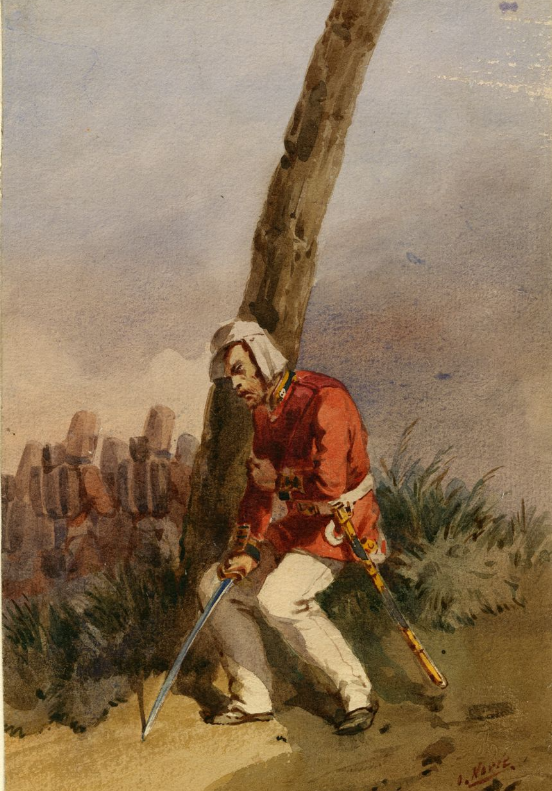
“Every moment, the heat became more fearful. More than one European soldier was carried past me, fainting or dead. Major Metcalfe had kindly given me two bottles of French wine of the Chief’s. I gave a cupful to one of those poor fellows who was laid down by my dooly, getting it down his mouth with difficulty, for his teeth were partially set; his tongue sticking in his throat. He recovered a little — looked at me, and said, “God bless you”—then tried to get to his feet, gave a sort of gasp, and fell down dead.” (Russell)
Return of Killed and Wounded which took place in the Roorkee Field Force in action with the Enemy, on the 5th and 6th of May, 1858, near and at Bareilly.
Mooltanee Regiment of Cavalry—1 rank and file killed; 1 native non-commissioned officer, 4 rank and file, wounded; 6 horses killed; 8 horses wounded; 1 horse missing.
Cavalry attached to 1st Punjaub Infantry— rank and file, wounded 1 horse killed; horses wounded.
1st Battalion 60th Royal Rifles—1 non-commissioned officer, killed; 1 non-commissioned officer, 4 rank and file, wounded.
Sergeant Henry Bailey – killed in action, 6 May
Corporal P. O’Shaughnessy – severely wounded, 6 May
Private Valentine Bambrick – slightly wounded, 6 May
1st Punjaub Infantry—1 rank and file, wounded.
17th Punjaub Infantry—3 rank and file, wounded.
Affghan Horse —1 rank and file, killed; 1 native commissioned officer, 5 rank and file, wounded; 1 rank and file, missing; 2 horses killed ; 3 horses wounded.
Total—1 European non-commissioned officer, killed; 1 European non-commissioned officer, 4 European rank and file, wounded; 2 native rank and file, killed; 1 native commissioned officer, 1 native non-commissioned officer, 15 native rank and file, wounded; 1 native rank and file, missing; 9 horses killed; 14 horses wounded; 1 horse missing.
JOHN JONES, Brigadier-General, Commanding Roorkee Field Force.
D. D. MUTTER, Major,
Deputy Assistant Adjutant-General, Roorkee Field Force.
Numerical Return of Killed, Wounded, and Missing, of the Field Force under Command of his Excellency the Commander-in-Chief, in Action with the Enemy near Bareilly, on the 5th May, 1858.
General Staff
Major H. W. Norman, Deputy Adjutant-General of the Army, General Staff, wounded, severe contusion by round shot.
Divisional Staff
Brigadier-General R. Walpole, C.B., commanding Field Force, Divisional Staff, wounded, sword cut on right hand.
Artillery
2nd Troop 1st Brigade Horse Artillery—2 non-commissioned officers, rank and file, 1 horse, killed; 1 non-commissioned officer, rank and file, wounded.
Corporal William Hopworth – killed in action 5 May
Gunner John Ashton -killed in action, 5 May
Gunner William Ferguson – died of sunstroke
3rd Troop 3rd Brigade Horse Artillery—1 non-commissioned officer, rank and file, 1 horse, wounded.
1858.
Corporal Charles Williams – wounded, 5 May
23rd Company Royal Engineers—2 non-commissioned officers, rank and file, died from sunstroke.
Cavalry Brigade
H.M.’s 6th Dragoon Guards—1 horse, killed.
H.M.’s 9th Lancers—1 non-commissioned officer, rank and file, wounded.
Private James Goff – wounded. Died of wounds, 3 June 1858
17th Irregular Cavalry—1 horse, wounded.
2nd Punjaub Cavalry—2 non-commissioned officers, rank and file, 1 horse, killed ; 6 non-commissioned officers, rank and file, wounded.
Mooltanee Horse—2 horses, killed.
Infantry
H.M.’s 42nd Royal Highlanders — 1 non-commissioned officer, rank and file, killed; 2 European officers, 12 non-commissioned officers, rank and file, wounded
Lieutenant-Colonel A. Cameron, wounded slightly, sword cut on wrist.
Assistant-Surgeon A. T. Thornhill, wounded slightly, sword cut on foot.
Colour-Serjeant William Garden, wounded slightly, sword cut on thigh.
Privates
Clunie, James – slightly wounded
Docherty, Patrick slightly wounded
Holland, Joshua – severely wounded
Hutton, Peter – severely wounded
Hyland, Martin – severely wounded
McKay George – severely wounded
McNeil, John – severely wounded
Martin, John – severely wounded
Ritchie, William – severely wounded
Smith, William – severely wounded
Souter, Andrew – severely wounded
Spilling, John – dangerously wounded. Died of wounds
H.M.’s 79th Highlanders—2 rank and file died of sunstroke; 2 rank and file wounded.
Sergeant John Sutherland – died of sunstroke, 7 May.
Privates
Lafferty and M’Keown – the latter had his fingers slashed by a tulwar during the attack by the Ghazis, 5 May
“Early in the forenoon, part of the 79th, under Major Butt, with the 42nd and the 4th Punjaub Rifles, was again ordered to advance, and sweeping through the empty lines in front of them, our men pushed forward for about a mile and a half and occupied the old cantonment.
“The remainder of the 79th, under Colonel Taylor, with the 93rd Highlanders, was left halted in the sun for many hours. By ten o’clock, the heat was intense, and a number of cases of sunstroke and heat apoplexy occurred, Privates John Balmain and Alexander Thomson of the 79th dying on the spot. No order came for these halted companies to move until nearly dusk, when they marched on to the old cantonments and bivouacked, the other companies of the regiment being already by this time on picquet there. The men in this action wore their dyed ship’s smocks, their kilts, and their feather bonnets, the tails of which were turned towards the sun as a protection from its fierce rays. Quite a large number of men were admitted to hospital
in the evening, and many more were thoroughly knocked up.” (Historical Records of the Queen’s Own Cameron Highlanders)
H.M.’s 93rd Highlanders—1 rank and file died from sunstroke.
Colour-Sergeant Mackie – suffered from the effects of sunstroke on 6 May and died the next day.
When I saw the enemy’s cavalry galloping down in the direction of our line of baggage, I was alarmed for the safety of the sick, and especially of two brother officers, Lieutenants Burgoyne and Grimstone, who were both ill with fever, the latter very ill. At the close of the day, however, I had the satisfaction of seeing all my patients brought safely into camp. They had suffered much during the day from want of proper attention and nourishment, from the discomfort of long exposure in dhoolies, the thin cotton coverings of which afforded very inadequate protection against the intense heat of the sun and the force of the withering hot wind. It appeared that Lieutenant Burgoyne, on becoming aware of the approach of the enemy, had wisely directed the sick-bearers to seek shelter within the line of baggage carts, and there he and the other helpless sick were comparatively safe.
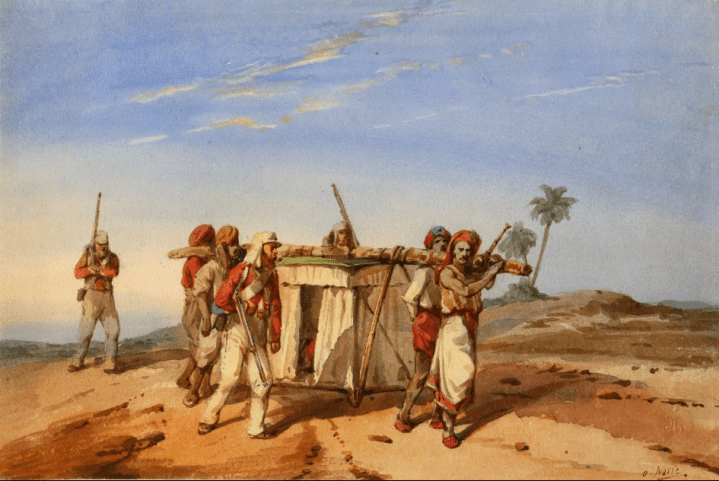
I have great pleasure here in bearing my testimony to the courage and devotion of the Indian dhooly-bearers. I always found them faithful to their duty, and never knew them shrink from the dangers of the battlefield, or neglect or forsake a sick or wounded European. I have several times seen one of these bearers killed and many of them disabled while carrying a wounded soldier out of action. (Munro)
According to accounts by both Forbes-Mitchell and Surgeon Munro, the 93rd had several men wounded during an attack by the Ghazis on 7 May and one man, Private William McDonald, was killed.
H.M.’s 82nd Regiment—3 non-commissioned officers, rank and file, died from sunstroke.
4th Punjaub Infantry—5 non-commissioned officers, rank and file, killed; 13 non-commissioned officers, rank and file, wounded.
Total —18 non-commissioned officers, rank and file, 5 horses, killed; 4 European officers, 36 non-commissioned officers, rank and file, 2 horses, wounded.
H. W. NORMAN, Major, Deputy Adjutant-General of the Army.
Adjutant-General’s Office, Head Quarters,
Camp Bareilly, May 8, 1858.
“That 5th of May was one of the most intensely hot days that I have ever experienced, and yet the men in the ranks did not appear to feel it; at least they did not suffer from the heat. True, they were lying down for the greater part of the day, but out on the open plain, where we had no shelter from the tremendous power of the sun or the withering hot wind which was blowing. By good fortune, we were in the vicinity of several wells, from which we obtained a plentiful supply of water. The sick, however, suffered greatly, and, on going back to see what could be done for them, I found one of the officers (Lieutenant Grimston), who was ill with fever, in a deplorable state. He was lying in his dhooly on his back, almost in a state of unconsciousness, with his tongue — dry, black and hard, and breathing slowly and heavily. I bathed his head and face freely with cold water, poured a little brandy-and-water down his throat, and then, as he revived, opened his eyes, and recognised me. I sat down beside him and fed him with the pulp of a watermelon (bought from a native), cool and grateful as ice to his parched tongue and throat. I believe this saved his life, and I know that he thinks so too.” (Munro)
Our Special Is Still Alive
As for William Howard Russell (Our Special), the remainder of the battle on 5 May passed by without his being consciously aware of it. The men of the 42nd, whom Forbes-Mitchell had entreated to find a doolie for Russell, had been wholly unaware that the reporter had fallen off his horse and reported to their commanding officer they had sent a doolie “for a dead officer who had been stript” for, besides a bloody shirt, Russell was wearing nothing at all. However, the doolie bearers seemed to know better, and instead of taking Russell to the grave, they brought him to a grove of trees where a servant of his friend, Baird, poured a liberal amount of brandy down his throat. After these ministrations, his manservant, Simon, who had finally found Russell again, proceeded to rub his chest, arms and legs vigorously, but until now, even though he was parched with thirst, no one thought to offer Russell a drink of water. As it was, none of the surgeons approached Russell that day, and when the news of the battle became paramount, he was completely ignored by his friends, something which he believes saved his life. Russell was completely unaware of what Simon was doing for him, but he does recall he insisted on Russell gulping down some vin ordinaire, once again, not exactly the best remedy for heat apoplexy, but it is likely there was more water than wine. The doctors, Tice and Mackinnon, well after nightfall, when Simon had seen to it that Russell’s tent had been put up and he was settled on his bed, finally came in to take a look at him. Neither expected him to live through the night, as they believed the reason he was coughing up so much blood was due to pulmonary apoplexy. They were most probably wrong, for Russell was very much alive the next day. The doctors now believed that, due to the fact they quite excessively used both leeches and blisters on Russell in the days before he fell from the horse, he was so weak from blood loss that there was no chance the apoplexy could kill him! Although they recommended Russell remove himself to either Naini Tal or Simla for a full recovery, as we shall see, Our Special will continue to march in his doolie for some weeks to come.
Sources:
Behan, T. L. Bulletins and Other State Intelligence for the Year 1858, Part III. London: Harrison & Sons, London Gazette Office, 1860.
Burgoyne, Roderick Hamilton. Historical Records of the 93rd Sutherland Highlanders. London: Richard Bentley & Son, 1883.
Forbes-Mitchell, William. Reminiscences of the Great Mutiny. London: Macmillan & Co., 1894.
Forrest, G. W. A History of the Indian Mutiny. Vol. 3. London: William Blackwood & Sons, 1912.
Gordon-Alexander, W. Recollections of a Highland Subaltern. London: Edward Arnold, 1898.
Groves, Percy. History of the 42nd Royal Highlanders – “The Black Watch”. Edinburgh: W. & A.K. Johnston, 1893.
Mackenzie, T. A., J. S. Ewart, and C. Findlay. Historical Records of the 79th Queen’s Own Cameron Highlanders. London: Hamilton, Adams & Co.; Devonport: A.H. Swiss, 1887.
Munro, William. Records of Service and Campaigning in Many Lands. Vol. 2. London: Hurst & Blackett Ltd., 1887.
Munro, William. Reminiscences of Military Service with the 93rd Highlanders. London: Hurst & Blackett Publishers, 1883.
Russell, William Howard. My Diary in India. Vol. 2. London: Routledge, Warne & Routledge, 1860.
Tavender, I. T., comp. Casualty Roll for the Indian Mutiny, 1857-59. Suffolk: J.B. Hayward & Son, 1983.
 Mutiny Reflections