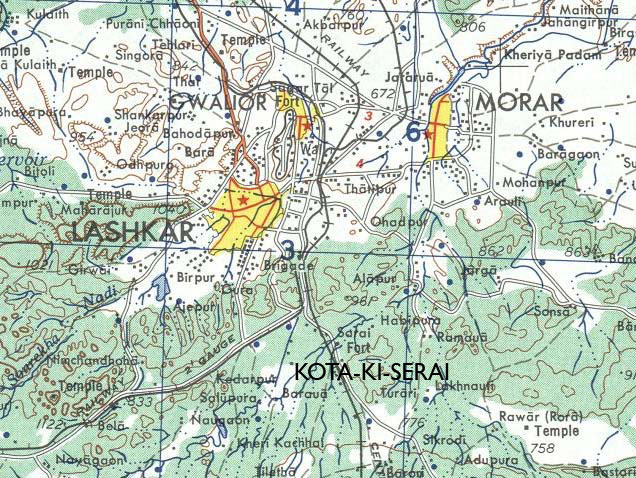
On the evening of 17 June, Sir Hugh Rose received a report from Brigadier Smith regarding the action he had fought at Kotah-ki-Serai, which he ended with a request for reinforcements. Smith’s force was exhausted from the day’s exertions, and the night that followed gave them little repose. While the rebels did not openly attack the camp, they satisfied themselves by sending shot into it from their position in the hills opposite. Mrs. Duberly found the scenario, at first, absurd, and then annoying.
“I could not help laughing at the effects of the first one that came. It hurt nobody but pitched in the middle of a cluster of camels and their drivers, causing the most direful confusion and dismay. One fled one way, another ran another. The dooley-wallahs seized their loads and ran for their lives. But when it became dark, and the shot still came, it was not quite so amusing. Everything was avoided that could attract notice of the enemy; no tents were pitched, no fires were lighted, and no fires entailed no dinners.”
Towards dawn, the rebels left off firing, if only to allow Smith’s camp to pitch their tents.
“About eleven o’clock, as soon as the enemy saw that we had made ourselves comfortable, down came a shot close to our tent. Another and another followed; then they fired from another gun at the horses of the artillery, and afterwards at some carts in a nullah close by. For two hours they kept harrassing us in this way, until at last an 18-pounder gun, with two elephants, was sent on to our advanced height. I was not sorry when I heard his glorious voice, for it was too bad to allow the enemy to knock our camp about as they pleased.”
The 18th of June
As soon as Sir Hugh Rose had received Smith’s report, he ordered Lieutenant-Colonel Robertson to join him with three troops of Light Dragoons, four guns No. 4 Light Field Battery and the 25th Bombay Light Infantry. By the morning of the 18th, the troops who had been left to garrison Kalpi arrived and by the afternoon of the same day, Sir Hugh Rose was ready to march to Kotah-ki-Serai with
Two Troops 14th Light Dragoons.
No. 18 Light Field Battery,
Madras Sappers and Miners.
Wing Her Majesty’s 71st Highland Light Infantry.
Her Majesty’s 86th Regiment.
Wing 5th Hyderabad Infantry.
Two 18-pounders and 1 8-inch Howitzer.
Brigadier General Napier was left with enough troops to not only protect Morar, but invest Gwalior and pursue the rebels when they fled.
It was only 20 miles to Kotah-ki-Serai, but the march took a toll on the men. From the 86th Regiment alone, nearly 100 men collapsed from the heat and had to be carried in dhoolies. However, every single one of these men would insist on fighting the next day.
Sir Hugh Rose found “ Smith’s position was cramped and commanded by a battery of 9-pounders, which the enemy had erected on a ridge on the highest of the series of heights which rose on the other side of the canal from a narrow plain and were intersected by ravines. To protect the battery and the position, the enemy had concentrated a numerous force of all arms on the ridge, as well as a large body of Cavalry in rear of it. The General also discovered that about a mile and a half further back and about the same distance from the left of the road was stationed, in a gorge of the hills, a large body of the enemy’s Infantry with guns. They guarded a road which branched off from the ford southwards to Gwalior.”
Rose ordered the camp to be pitched on some uneven, rocky ground not far from Smith. Meanwhile, the Madras Sappers were ordered to build a bridge across the canal some way to the left rear of his position – it had to be completed by sunset as he determined to cross over with a force of all arms at nightfall to get on the south road to Gwalior through the hills. If he succeeded, he would then be in place between Gwalior and the two rebel positions; the intention was that by daybreak of the 19th, the 86th and 95th Regiments, supported by the remainder of Smith’s column, who were concealed in the ravines, would be ready to fall on the rebels. Sir Hugh Rose, with his usual thoroughness, had spent the 18th reconnoitring the various positions held by Rao Sahib and the Nawab of Banda – he estimated he was facing a combined force of 15’000 mutineers, most of them from the Bengal Army. However, he soon found his plan was flawed.
The 19th of June
The rebels had not been idle. The story that ran through the camp was that a prisoner, who had escaped from Smith’s camp, had fed his intelligence regarding Rose’s position to the rebel leaders, and they accordingly determined to attack Rose’s on his weakest point – his left flank. They were observed pouring out of Gwalior in large numbers, accompanied by their artillery.
The Central India Force was worse for wear after their harassing march to Kotah-ki-Serai and the uncomfortable night they then had to spend in their rocky bivouac. The Madras Sappers were still hard at work constructing the bridge as ordered, but it was still not ready by sunset on the 18th. As such, Sir Hugh Rose was not prepared to engage the rebels just yet. He also surmised that the position in the narrow pass was, in fact, a false one, and it now became necessary to prevent any serious attack; he thus changed the entire plan from a defensive to an offensive one. Rose directed Brigadier Stuart with the 86th, which was encamped between the pass and the Morar River, to move from the left rear, and supported by the 25th Bombay NI, to cross the canal, “crown the heights on the other side of it” and attack the rebels in their left flank, masking the fire of the battery. At the same time, Brigadier Smith, with the 95th, supported by the 10th Bombay Native Infantry, would act as a diversion. Smith was directed to move from his right front across the canal in skirmishing order, and advance obliquely over the shoulder of the hill on which was the rebels’ battery against their left front. Rose then ordered up 3rd Troop, Bombay Horse Artillery, with the support of the 8th Hussars, to the entrance of the pass towards Gwalior. The remainder of the force was to act in support of the attacking columns and ensure the defence of the camp.
“Let the boy sleep, he is dead tired,’ were the first words I heard as I came to semi -consciousness soon after daylight on the 19th June; there seemed to be a busy hum of voices round me, some of them familiar, and after a time I realised that Sir Hugh Rose and his staff were with us; before they moved away I had an opportunity of asking one of his staff, whom I had known before, what was going to be done. ‘Well, I can tell you what is intended to be done; we are to bridge that water-course you came across on the 17th, and make a road over this nullah, then cross the hill opposite to-morrow, and thence attack the town; meantime, we shall send our cavalry round to the east of the fortress and catch them in a net; on the third day the Union Jack is to wave over the fortress. That is our intention, but my impression is that Gwalior will be ours by sunset today.‘ (Crealock)
The 86th Regiment was sent down to the nullah, and for a time it a strange hush fell over the scene – however, instead of the quiet morning Crealock was hoping for, the covering parties appeared to be spoiling for a fight and by the by, the few shots that had fallen in their general direction, turned into a volley. Sir Hugh Rose was hesitant to reinforce the covering parties at the moment, correctly surmising that if he did so, this would be perceived by the rebels as the start of a general attack, something he was still not ready for. For Crealock, the words were a relief – he settled himself down on the “shady side of a recumbent camel, and promptly went back to sleep. His slumber was rudely disturbed by the ‘call sound’ of the 95th and the order for the left wing to fall in – an hour later, after two or three more companies had begun their advance, the 95th followed on. As soon as they crossed the nullah, they found the entire force marching along the crest of the hills that ran in a semicircle to the left front of the camp towards the Lashkar.
So Brigadier Smith crossed the canal in a steady ascent with the 86th under Lieutenant-Colonel Lowth on the heights. The rebels, realising their left was about to be turned quickly, rushed back to their battery, pressed closely by the skirmishers of the 86th. Under their batteries was an entrenchment, but they did not stand to hold it. Instead, they rapidly withdrew across it to their guns. The skirmishers, seeing their advantage, pressed on and, with a cheer, dashed over the parapet and took the guns that defended the ridge, which turned out to be three 9-pounders of English make.
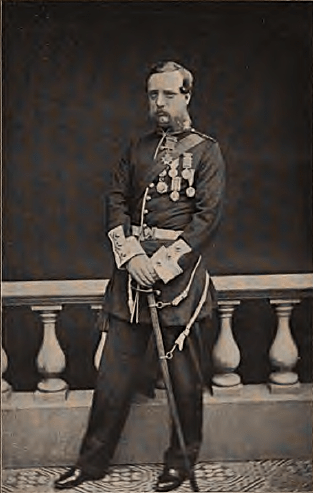
Now up came Lieutenant Colonel Raines with a wing of the 95th; he ordered the guns to be turned on the rebel cavalry and infantry whom he had spotted in detached bodies on the plain beneath him. Lieutenant Roome of the 10th Bombay NI, who was moving up in support of the 95th and the right, now found himself exposed to the fire of artillery and musketry from the rebels’ extreme left. He rapidly advanced with half his regiment in skirmishing order, leaving the rest in support, and cleared the next two heights of rebel infantry and captured two brass field pieces and three mortars from the plain on the second height.
“We were the rearmost company of the array; below us in the basin to our right front, were scattered bodies of the enemy rapidly disappearing towards the city; we passed some guns, lately belonging to the enemy, being worked by Lieutenant Brockman, of the 86th, Lieutenant Budgen, 95th, our Adjutant, Lieutenant Sexton, and some others; a mishap occurred to some ammunition, and, besides other casualties, I remember Lieutenant Sexton was terribly burnt. A request to permit our company to go off to the low ground to our right was granted by Major Vialls, who was at the moment in command, for he saw there was a chance for us to do some work; but we were cautioned against the enemy’s cavalry who were still hovering around, but these appeared to be far more cautious of us, for after a few shots we found ourselves enabled to push on and do rather a good stroke of business, viz., to locate ourselves on the right and most advanced knoll of the position held by Sir Hugh Rose’s forces, for as they traversed the semicircle of hills we nipped across the arc.”
Sir Hugh Rose’s force was now in possession of the highest range of hills, and Gwalior lay at his feet.
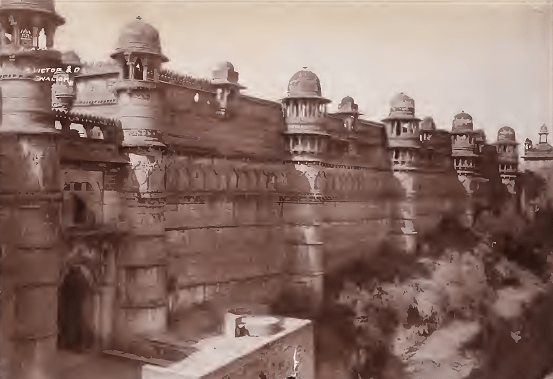
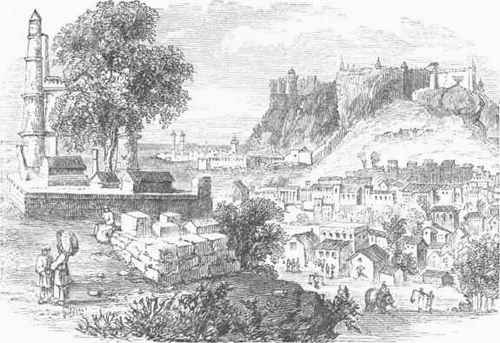
“The sight,” says Sir Hugh, “was interesting. To our right was the handsome palace of the Phoolbagh, its garden and the old City, surmounted by the Fort, remarkable for its ancient architecture with lines of extensive fortifications round the high and precipitous rock of Gwalior. To our left lay the ‘Lushker’ or new city, with its spacious houses half hidden by trees.”
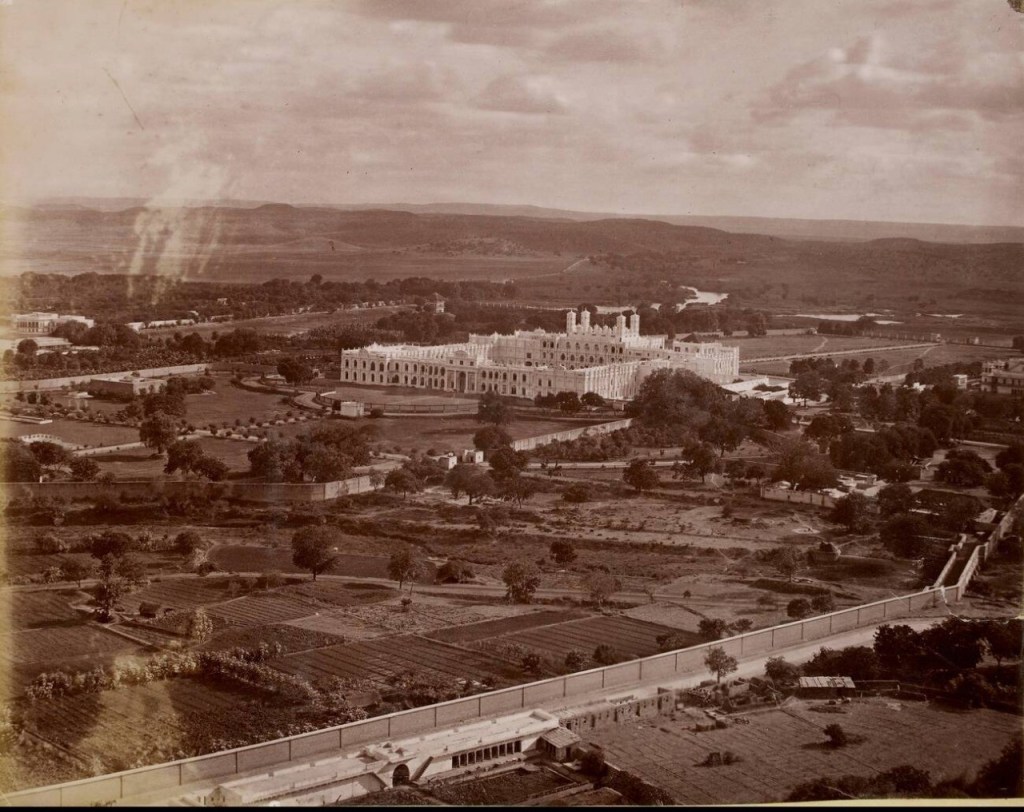
Rose had planned to leave off his attack here and had sent word to Napier at Morar to attack Gwalior together with him the next morning. However, as he now saw that the slopes on which he stood gradually descended towards Gwalior and the rebels who had been driven from the hills were now trying the find shelter in the houses and the groves of trees outside the city, he changed his mind. He would take Gwalior after all, before sunset.
Colonel Owen of the 18th Bombay Lancers was told to descend the hills and take the road which led to the grand parade of the Lashkar; the 3rd Bombay Horse Artillery with a squadron of the 8th Hussars were directed to cover his extreme right parallel together with the troops detailed to attack Gwalior. No. 4 Light Field Battery with two troops of the 14th Dragoons was ordered to cover Rose’s advance line and reply to the rebel battery positioned in front of Gwalior. With everyone in place, Rose gave the order for the general attack.
Due to the terrain of the hills, the infantry moved forward in an irregular line, the 86th in advance, formed the left, but the 95th was unable to form the right. Two rebel guns were found hidden in a tope of trees some 1200 yards ahead of their position and occasionally “knocked up some dust” but did not damage. Raines could hardly mask his delight at finding himself and his men now not at the tail end of the force but at the head of it; however, despite the pleading of his men, he refused to allow them to take the two guns until the cavalry arrived to their support.
“Those who remember – who does not? – Lieut.-Colonel Norton Knatchbull, the senior subaltern of No. 1 Company, as he stood in that June sun; a black velvet hunting-cap covered with a towel, a torn canvas coat ornamented by a ragged sash, with the usual ragged blue trousers and a small remnant of boots. But he was 6ft. 2in ., as strong as Wiltshire Downs could make him, with a voice like a gong; added to this, he was, at that time, probably the fastest runner in the British Army – to him was deputed the duty of trying to get up a howitzer and tumbril, that were lying some three hundred yards below us, towards the enemy; it had been hastily abandoned, but the bullocks were still there. Knatchbull took eight or ten unarmed men with him, while we kept up a smart fire on the enemy to cover the adventure. It is difficult to say which was the most disagreeable–the enemy’s fire or the conduct of their cattle, for the bullocks of ’57 had the same dislike to a white face as we find to be the case now; they for a time defended the gun nobly, but eventually, breaking away, galloped off to the enemy. This was embarrassing, but the brawny men of No. 1 laid on with a will, and soon we had our artillery in position. Now we found a new difficulty; deeply versed in the theory and practice of rifle shooting as Mr. Gravity undoubtedly was, he hesitated when he was asked for directions on how to load the gun; luckily, a Militia Artillery recruit had joined us a few days before.”
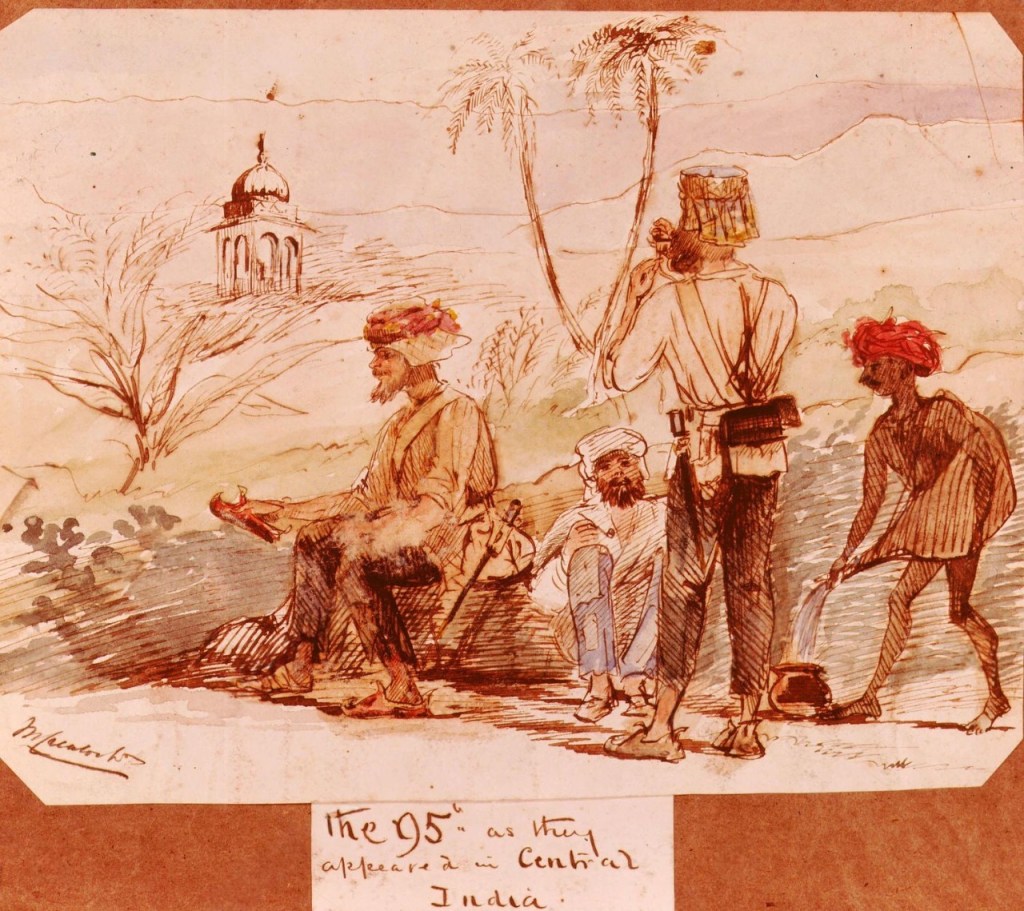
As the other companies now became aware of what the 95th was up to, they greeted them with a cheer. Now, a precarious game of long bowls commenced against the rebel guns. After a few ineffectual but certainly entertaining shots which all proved to be either short, too long or too high, causing some laughter from the rebels, who, though somewhat discomfited by this manoeuvre, nevertheless, played along, Raines put an end to the proceedings. The Bombay Lancers had now come up, and the 95th was called to take the rebel guns.
“If the way in which they supported us is the usual assistance given to charging Infantry by Cavalry, I should prefer less support! It was a narrow road deep in dust, we charged in columns of sections, and when, within sixty or seventy yards of the guns, these blue-coated troopers charged through us, the writer, who was as small then as now, was knocked over, but was at once picked up and put on the shoulders of two men with the remark-‘ We’ll not leave the little officer behind ‘ and truly they did not, and after a dusty hustle I found myself on one of the guns. Norton Knatchbull was lying across its breach, panting, and white with dust. It was a vexed point as to who took the guns, but Knatchbull was the first of ours in, and he it was who, if I remember rightly, scratched ‘ 95 ‘ on one of the guns with his sword. As soon as we had pulled ourselves together, the cavalry were taken off to the right, while the infantry battalions poured down the hills onto the city.“
Regardless of what Crealock had to say about the Bombay Lancers, their charge was a magnificent one. They rushed across the open plain, Lieutenant Mill at their head, their sabres flashing as they cut their way through the Lashkar. Up a narrow street, the gallant lieutenant was shot, but the man who had ended his life did not have long to live as Captain Lock swiftly took up the pursuit and cut him down. Lieutenant Colonel Owen, realising his men ran a serious risk of becoming embroiled in some very desperate street fighting, quickly withdrew the Lancers from the town.
Behind them, however, came Sir Hugh Rose, who was now determined to cross the plain and force his way through the Lashkar and take Scindia’s palace. With him came Captain Meade, who had, a few days previous, brought Scindia himself back to Gwalior from Agra, and now offered to act as a guide. Rose instructed Raines to form four companies of the 95th, anticipating he would now face the same bitter street fighting he had seen at Jhansi. With Meade at his side, Rose placed himself at the head of the force and, with his pistol at full cock in his hand, marched the mile of streets until he was standing before the palace. The defences were strong, consisting of tall buildings built of solid masonry with each terraced roof screened by parapets. To take each building would have meant putting his men at risk, which he was not prepared to do. While he considered his options, Captain Meade volunteered to ride forward alone and treat with the mass of rebels assembled in the courtyard, with the hope of forcing a surrender.
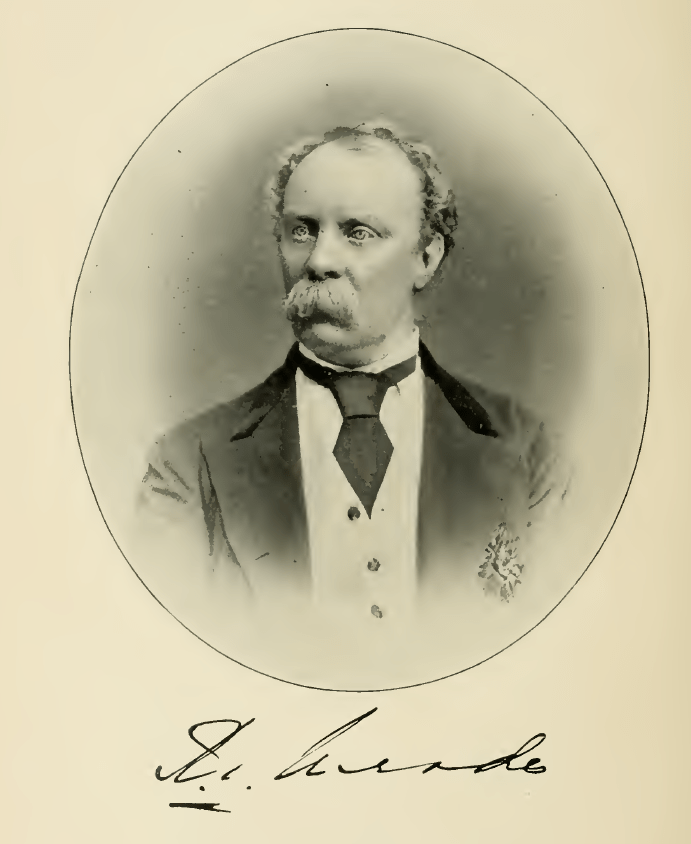
Meade rode forward and stopped. There was no gate as such, only a heavy wooden beam across the gateway to prevent horsemen from passing through. An uncomfortable silence ensued, Meade on his horse, well covered by several muskets from the walls.
“The delay in getting inside the courtyard was most embarrassing, for I felt that every moment was precious; but such was the confusion that I could not for some time get anyone’s attention, beyond menaces of the nature already stated. At length, to my great relief, a little wizened Mussulman, who was close to the gateway, recognised me, and shouted out three or four times, ‘This is Meade Sahib,’ and hearing this, three or four men at last complied with my repeated demand to remove the barrier, and I dashed into the courtyard, up to a group of some five or six men whom I had previously noticed as being evidently the leaders of the party. Taking one of these — a tall powerful man, who appeared to be the chief, and who I afterwards learnt was one of the palace hijras (or attendants), who, with his companions generally, had joined the rebels — by the shoulder, I told them I would save their lives if they would obey my orders, but that there must be no delay, as the British force outside was prepared and eager to attack them. After a moment’s consultation, they said they would hold the palace for the Maharaja and would give it up to him on his coming to it, but that they would not surrender it to the English. I replied that this was impossible, that the Chief was away at Morar, and that the palace must be at once given up, or it would be stormed forthwith, in which event not a man of them would escape. They again spoke together, and the tall man at last said: ‘We will do what you order’.
As a large number of men had now gathered not just in the courtyard but in the buildings surrounding it and on the roofs, Meade endeavoured to “get them out of sight” to avoid any chance of fighting breaking out between them and Rose’s men. He ordered every man to get inside the palace and quietly stay there until they were given either permission to leave or orders were issued for their further movements. With some reluctance, the men were harangued by their leaders to obey, until Meade was finally alone in the courtyard with the four leaders. “I then told the tall man that he and his fellow leaders would be held responsible for the conduct of the men who were with them, and for the preservation of the interior of the palace buildings, so long as they remained in the latter; and then, after a few words of earnest warning to them, I rode back to report the result to the General, and begged that I might have a party of Europeans and sepoys to post for the due security of the place. A company each of the 95th Foot and 25th Bombay N.I. were ordered forward with me for this purpose, and I placed the sepoys inside the courtyard, posting sentries from them over the treasury entrance and at some other points, and the Europeans in and outside the gateway.”
While Meade was in discussions inside, outside, Rose had moved the column up to the open space outside the palace and ordered the men to pile arms. Then, at Rose’s request, Meade rode a short distance up the main street to the homes of the city bankers – the men appeared in the street, with fear on their faces – Meade informed them that the Lashkar had been cleared of the rebels and they were now called upon to attend Sir Hugh Rose and pay their respects.
“Numbers of them at once repaired to the gateway, where Sir Hugh Rose was seated, and in a short time the street was full of well-dressed men of this class, all vociferating their gratitude for the expulsion of the rebels and their release from the terror under which they had been labouring during the period (nearly three weeks) of their occupation of the city. Some champagne and brandy were produced from one of the palace storehouses, and those who had the fortune to get a share of the same thoroughly enjoyed the grateful liquids.”
After half an hour of pleasantries, arrangements were made for the security of the palace, and Meade was sent off to ascertain what Brigadier Smith had been up to after he had turned the rebel left. He found Smith had captured the palace at Phool Bagh after some stiff fighting. He had then pursued the rebels, who had taken flight around the Gwalior rock towards the Residency, covering their retreat with artillery. Undaunted, Smith followed them and, after a valiant resistance “which did credit to the enemy’s artillery,” Smith took their guns and chased the fleeing rebels until well after dark. As for the 8th Hussars, eager to redeem themselves after their inactivity at Kotah had made a good fight of the day and had chased the rebels right up to the steep walls of Gwalior Fort.
Sources:
The Revolt in Central India 1857-59, Compiled in the Intelligence Branch (Simla: Government Monotype Press, 1908)
Bulletins and Other State Intelligence for the Year 1858, Vol II – T.L. Behan (Harrison & Son, London Gazette Office, 1860)
Rulers of India – Clyde and Strathnairn – Maj.Gen. Sir Owen Tudor Burne KCSI (Oxford: Clarendon Press, 1892) Campaigning Experiences in Rajpootana and Central India during the Suppression of the Mutiny, 1857-58 – Mrs. Henry Duberly (London: Smith, Elder & Co., 1859)
Selections of Letters, Despatches and other State Papers Preserved in the Military Department of the Government of India 1857-58, Vol IV – edited by George W. Forrest (Calcutta: Superintendent Government Printing India, 1912)
Historical Record of the 14th (King’s) Hussars from 1715 to 1900 – Col. Henry Blackburne Hamilton (London: Longmans, Green & Co., 1901)
History of the Royal Irish Rifles – Lt. Col. George Brenton Laurie (London: Gale & Polden, 1914)
History of the Indian Mutiny, commencing from the close of the 2nd Volume of Sir John Kaye’s History of the Sepoy War, Vol. III – Col. G.B. Malleson (London: W.H. Allen & Co., 1888)
The 95th (The Derbyshire) Regiment in Central India – General Sir Julius Raines, KCB (London: Swan Sonnenschein & Co., 1900)
Recollections of the Campaign in Malwa and Central India under Major General Sir Hugh Rose – Asst. Surgeon John Henry Sylvester (Bombay: Smith, Taylor & Co., 1860)
General Sir Richard Meade and the Feudatory States of Central and Southern India: A Record of Forty-Three Years of Service – Thomas Henry Thornton (Longmans, Green & Co., 1898)
 Mutiny Reflections