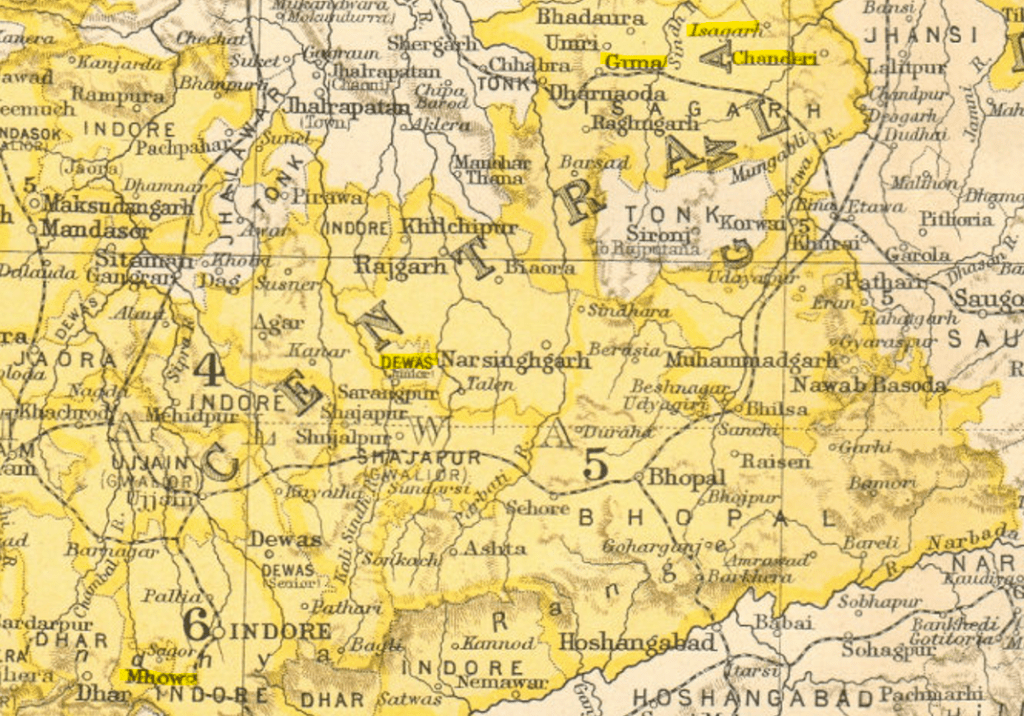
The Mhow Brigade, or 1st Brigade of the Central India Field Force, had remained at Mhow, awaiting the arrival of the 21st Company, Royal Engineers, one British artillery battery and a further 600 men of HM’s 86th. They were finally ready to march on 6 February 1858. Their orders were to proceed in parallel to Sir Hugh Rose and the 2nd Brigade, keeping in line with the Agra Road as far as Guna. A short halt was called at Dewas to await the siege train, which had taken on a life of its own and now ran several miles in length.
Major Orr, with the greater part of the Hyderabad Contingent Cavalry, had at first formed the advanced guard of the 1st Brigade and had been assisting to keep communication open between the two brigades. From his base in Guna, he had been able to restore telegraphic communications along the road and keep a clear line for the advancing 1st Brigade. Ordered to join Sir Hugh Rose, Orr left Guna and advanced to Barole, made short work of a small rebel force on 18 February and joined the 2nd Brigade on 1 March, near Rajwas. Having carried out an extensive reconnaissance, the information he brought Rose would help him decide which of the hill passes to cross on his march to Jhansi.
The direction Brigadier Stuart was taking would take him to Isagarh, to then join Sir Hugh Rose on his advance to Jhansi; however, he received a report that the rebels, who had been dispersed by Sir Hugh, had mustered again at Chanderi. If reports were correct, they were manufacturing guns and powder in the fort and were planning to oppose the river passage close to the town. As such, Stuart changed direction and moved on to Chanderi, 50 miles east of Guna.
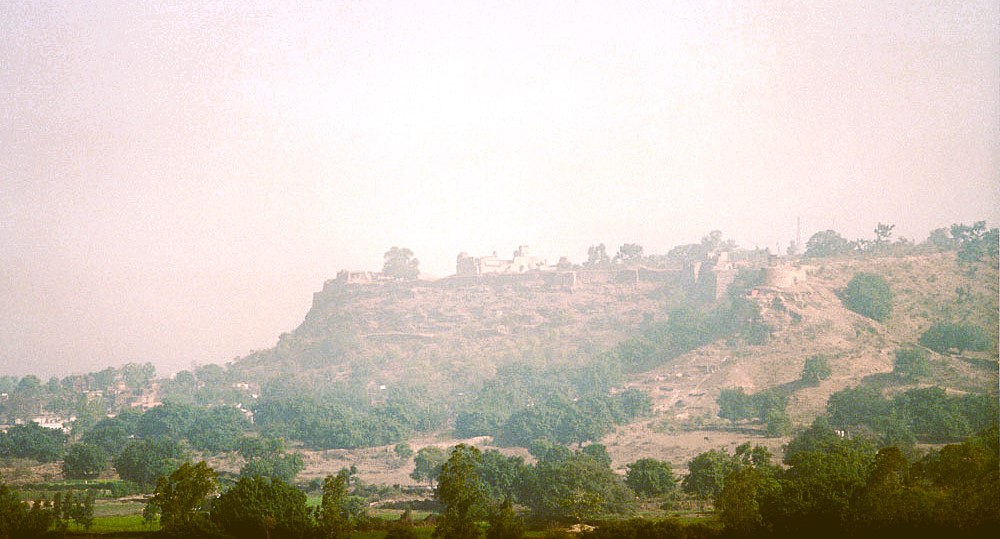
Chanderi Fort was not a mere stronghold on a random hill – it had a long and famous history and was built back in the 11th century by King Kirti Pal of the Pratihara dynasty, who called it Kirti Durg. Situated as it was on the major trade routes of the time, Chanderi was captured by Ghiyasuddin Balban for the Nasiruddin Mahmud, Sultan of Delhi, in 1438. However, Rana Sanga of Mewar, who was busy conquering much of Malwa, took Chanderi from the Delhi Sultanate. The Bundlea Rajputs captured Chanderi only to relinquish it in 1528 to the Mughals, but a year later, Raja Puran Mal defeated Babur’s army and occupied Chanderi Fort. By 1543, there was a change of management when the fort was taken by Sher Shah Suri, who had recently added Malwa to his empire. Since everyone wanted Chanderi, the Bundlea Rajputs decided to take it back in 1586 and kept hold of it for nearly 300 years, when in 1811, it was wrested from their control by a French adventurer in the pay of the Maratha ruler, Daulat Rao Scindia of Gwalior. So Chanderi passed into Scindia’s domain. In 1844, Chanderi was transferred into British hands, who lost control of it in 1857; now, a year later, they wanted it back.
The question was, how to take it?
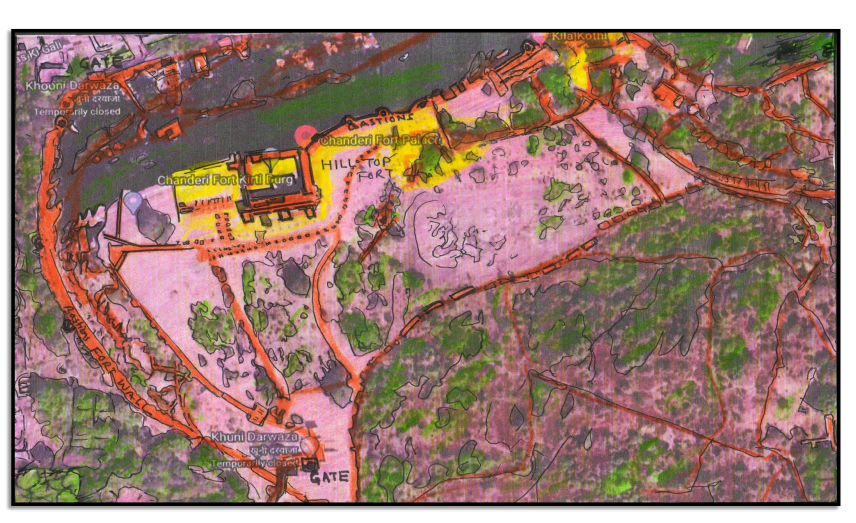
Positioned as it was on a hill over 200 feet above the town, with only three gates, and a wall 100 feet high, bastioned at intervals and spanning a distance of 2 miles in circumference, Chanderi could not be taken by storm. The only option left for Brigadier Stuart would be to breach the walls, yet this again presented a difficulty. The approaches to Chanderi were well defended, and unlike Rahatgarh, which had open ground on one side, Chanderi presented no such convenience.
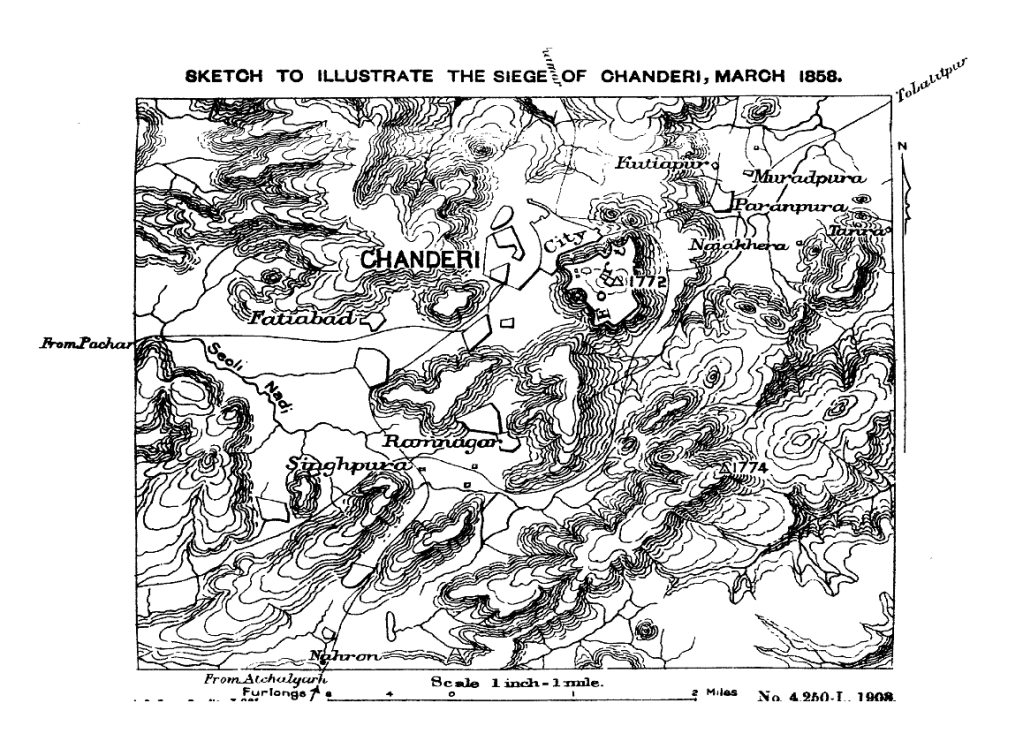
On 5 March, Stuart reached Khukwasas, and the next day encamped at Kursara, a small village just six miles from Chanderi. Without delay, he sent out a party to reconnoitre, consisting of a party of Dragoons and irregular horse, accompanied by Captains Gall and Fenwick of the Royal Engineers, Richard Harte Keatinge, Bombay Artillery but attached to the political department and Assistant Surgeon Sylvester, who had joined the campaign in no particular capacity initially, but on a mere lark.
They proceeded through the jungle in the direction of the fort, but every half mile, columns of smoke “towered in the air,” lit by hidden rebels as a signal of their approach until a regular line of these signals extended up to Chanderi Fort itself, as a warning to the garrison. The party finally reached a gorge running through sandstone hills, covered in trees and undergrowth from which, had they emerged out of it to take the view from a small temple nearby, they could have caught a glimpse of the fort. Instead, they received a volley of musketry. The men wisely decided to return and report to Stuart that they had ascertained the rebels were indeed present.
The next morning, Stuart sent the infantry forward, with the HM’s 86th on the right and the 25th Bombay Infantry extending the line to the left. As soon as they were seen, the rebels opened up a brisk fire as soon as they reached the gorge. The infantry continued their advance, in skirmishing order, ascending on both sides of the defile and covering the sides up to the summit of the sandstone hills, observed Sylvester, “The red coats dotted among the green foliage rendered it far more picturesque than martial.”
As they gained the level ground just beyond the jungle, they now saw a “great number” of rebels in the temple and a few ruined houses in front. Stuart ordered the artillery to open fire with round shot and shell, which quickly sent the rebels back into yet another tract of jungle. The infantry continued to drive forward, while the rebels took up a new position behind a temple called Fatiabad, and a wall that was nowhere near as old as the fort. It extended from one ridge of hills to the next one, with only the valley intervening. It was not only loopholed but well furnished with bastions, some fourteen feet high and several feet thick.
“It was a grand position, and ought to have held out against us for some time, especially as our field pieces made no impression on the masonry, and it completely held us from any advance on the fort and town in that direction. But the Infantry rushed on with an impetuosity not easily checked, and gained the wall in a moment. The enemy retreated to the town and fort, about half a mile distant. The wall was destroyed, a force was left at the spot, and the brigade skirted round one of the ranges of hills which commanded the fort, and encamped.”
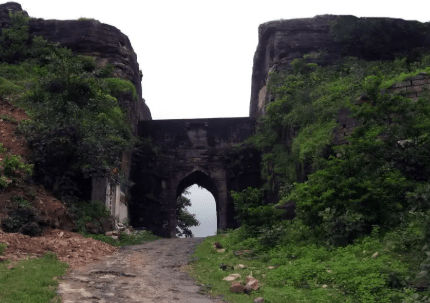
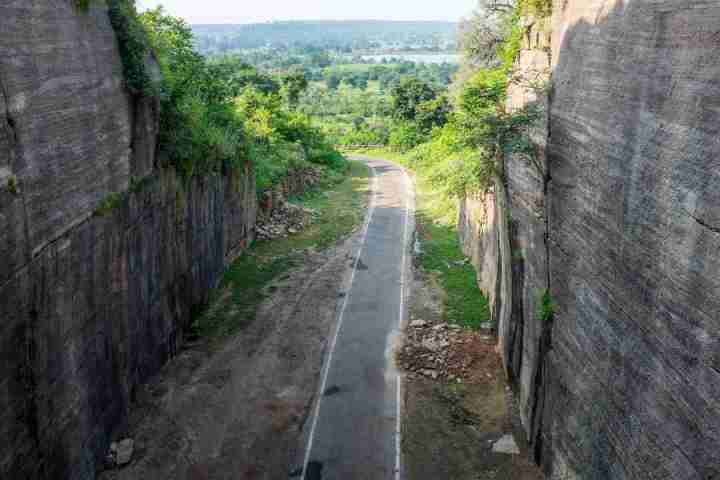
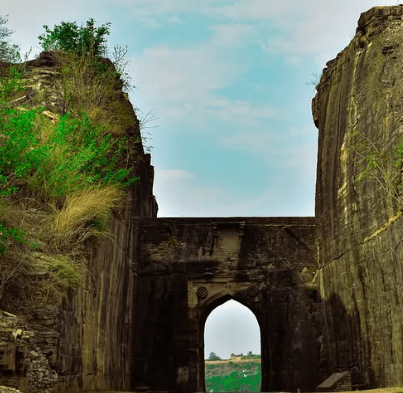
On 7 March, the troops continued to clear the rebels from the ridge, taking in the process the Kati Ghati, a gateway cut through the sandstone. Through this extraordinary structure, the fort was clearly visible.
According to an inscription on the gate, it was commissioned in 1480 by Jiman Khan, one-time governor of Chanderi, to welcome the Sultan of Malwa. If the legend is to be believed, the gate was carved out of the rock in one night, a feat any mason should rightly have been proud of. While he completed the task, Khan could not help noticing there were no hinges on which to hang an actual gate and the mason, whom Khan refused to pay, was so distraught by his shortcoming that, killed himself on the site of his great work. Things went as badly for the few rebels who now tried to stay Stuart’s advance, like the mason, they found their graves at Kati Ghati, and the small village of Ramangar, at its foot, was taken.
From the top of the gateway, Brigadier Stuart now had a clear view of the country that spread out beneath him. The fort he wanted to besiege was at nearly the same altitude as the ridge, and the two positions were only separated from one another by a jungle-clad ravine, “about as broad as the range of a nine-pounder.” While Chanderi Fort might look impregnable at first glance, it was not without its weaknesses. At one spot, a ridge of rock ran through the valley, forming a road. “Across this was evidently the vulnerable part, but the fortifications had been strengthened at the spot where the ridge joined the fort hill, by means of two towers and a bastion of solid masonry. This curtain was chosen for breaching.” It would seem that forty years earlier Scindia’s Frenchman, Baptiste, had the same idea when he blockaded Chanderi. The remains of his old road for hauling guns up the hill were still visible, and it would be used again by Stuart’s artillery. After considerable difficulty, the first guns and mortars were brought into place, and Stuart, to keep the rebels occupied, opened fire.
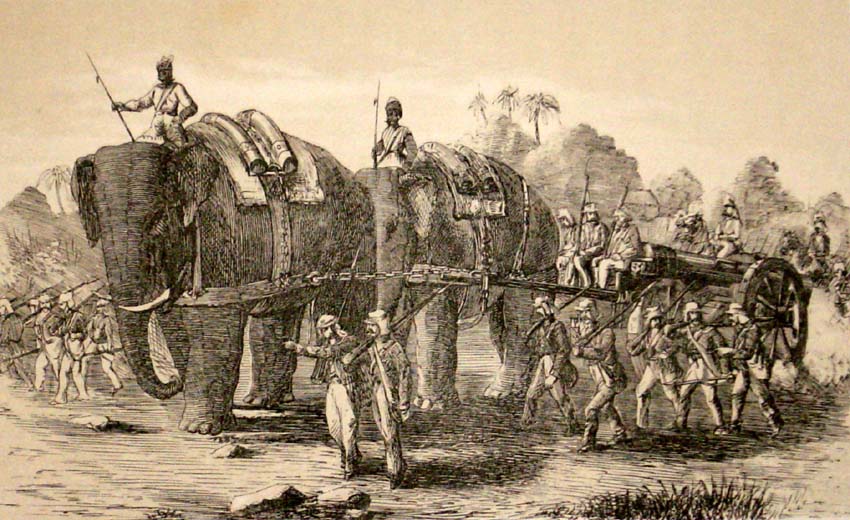
His guns opened up on the palace, which towered towards the sky, but the rebels were having none of Stuart’s insults and replied in kind. Well covered, it proved impossible to silence them. Stuart still had something else to throw back at them. He ordered a road cut along the ridge’s crest for his heavy guns to be brought into position for the breach. Much of the work was carried out at night, for the rebels, once they noticed what Stuart was up to, began sending shots towards the workers. With no protection besides trees, it was not the most pleasant way to spend the next days. The road was not ready until 10 March, when it was finally deemed possible for the elephants to bring up the 24-pounders. Meanwhile, the cavalry had spent much of their time in reconnoitring, but owing to the nature of the ground, it was not the most convenient area for horses. As such, they were unable to prevent the rebels from closing in and taking back Fatiabad and the wall during the night, chasing away the handful of Indian troops Stuart had placed there. Not to be outdone, Stuart sent the 25th Bombay NI to take care of things and to hold the positions, and they performed both tasks admirably the next morning.
The firing commenced with the range being very short, one and point blank. As the battery was on a forward slope, anyone approaching it had to run the gauntlet of the rebels’ return fire. However, Sylvester, who was not working the guns, had time to take in the scene.
It was evident that Chanderi had not been so disturbed for many a year. Most of the trees were of a flowering description and covered with gorgeous blossoms, while flights of parrots screamed among them, monkeys chatted at the soldiery, an occasional panther was turned out of his lair, and wild ducks wheeled overhead. But the sun was fierce and hot, and it was a very thirsty tour of duty in all the batteries, which were five in number. The breaching battery being nearest the fort was the object of the enemy’s special attention, and they kept up an incessant fire upon it, both from their cannon and small arms. One individual who possessed a European rifle and had learnt to use it caused much annoyance and many wounds, and the bullocks bringing up ammunition afforded him excellent marks. They appeared to have an unlimited number of guns and wall-pieces extending completely round the fortifications. Our shells fell thick and fast into the fort and did them much damage, but as it was so large they had plenty of space and shelter to escape from them, and an underground passage down the rock into the town close beneath, whereby they got both provisions and water and occasionally stole the baggage animals which had left camp to graze, on one occasion killed some camp followers when foraging, and on the night of the 13th they ascended a hill overlooking our camp and fired a regular volley into it but did us no damage.”
The work was immensely trying for the young soldiers of the Royal battery, many of whom had but lately arrived in India. Unused to the climate and above the heat, their situation was made all more unpleasant by spending twelve hours of each day behind sandbags, surrounded by noise, smoke and and dust which flew up from the sandstone from the gun’s recoil, with “one’s head – dress ventilated by a bullet, or one’s toes smashed by the guns, it was indeed an agreeable change to descend into camp, though one looked like a potter, and felt half baked.” As it was, the battery was so dangerous, even the servants were loath to approach it; they hastily tossed in a culdron of tea and a pile of plates with food on them into the battery and then ran for their lives. Unlike at Delhi, where they had been seen calmly walking along the paths, seemingly unaware of the shots aimed at them to bring their employers their dinners, at Chanderi, the servants, most of whom were Portugese Goans who had never been under fire in their lives, certainly saw no reason to remain stoic.
The breaching was proceeding very slowly. On the 15th, the wall, though damaged, still showed no signs of coming down – the tower which had been chosen was not only solid but faced the rock, and its masonry was composed of very large stones, defying whatever the 24-pounders tossed at it. What conditions were like in the fort was anyone’s guess – some reports came in stating the rebels were fleeing, others contradicted those statements and said they were daily being reinforced.
The same night, a detachment of Hyderabad Cavalry, some 30 sowars under Lieutenant Dowker, arrived, bringing despatches from Sir Hugh Rose. Rose had taken the hill pass and was waiting now before Jhansi for the 1st Brigade.
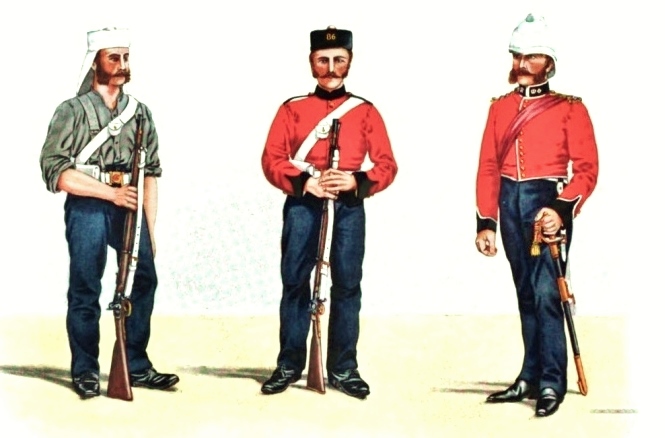
The next morning, the rest of HM’s 86th marched into the camp. The total strength of the regiment in India at the end of February 1858 had been 31 officers and 1009 men of other ranks; however, thirteen officers, at this juncture, were “on leave,” including their colonel, who was awaiting his retirement. During 1857 alone, the regiment had lost 51 men, 7 women and 28 children, and a further 86 had been invalided, with ten more sent home on the expiration of their service; three had chosen to transfer to different corps. Those that had not been attached to the Malwa Field Force had been distributed between Surat and Poona. Only in December, when the 56th relieved the 86th at Poona, were they free, not to move to Mhow, but sent off to Gujerat to “keep the troops of different native princes from rebelling.” A draft of 98 men arrived in November, three companies were still in Vengurla, south of Bombay – however, the detachments were being recalled and sent off towards Mhow.
28th of January- Lieutenant Coates and 43 other ranks
29th of January -Lieutenant Coran and 43 other ranks
30th of January – Brevet-Major Mayers and 43 other ranks
31st of January.-Major Stuart and 43 other ranks
1st of February.-Lieutenant Ord and 43 other ranks
3rd of February – A lieutenant (apparently an attached officer) and 20
other ranks
4th of February -Lieutenant and Adjutant Cochrane, Paymaster Heatley,
Surgeon Stack and 17 other ranks.
This last party arrived at Mhow on the 12th of February. Here the four Companies from Gujarat were awaiting them, and the whole force started to join the 1st Brigade at Chanderi.
When an urgent message from Brigadier Stuart reached them on 15 March, they were still 30 miles from Chanderi. They would need to cover the remaining distance in forced marches, but it would turn out to be quite an interesting adventure. During the night, they became entangled in a village, quite unaware they were lost – their guides had used the cover of darkness to run off, leaving Major Stuart to call a halt. After spending the night on open ground, with what was left in the haversacks for their dinners – half-ration bread and meat. By morning, they were able to find the road, but they had a new guide – the sound of the guns battering Chanderi Fort.
“The sound had a most magical effect upon the men; some, who were almost “ beaten down ” with this terrific march, seemed to derive new life and energy from it, and as the artillery reverberated through the morning air he thought the last seven miles of the march were the quickest on record. His horse had to
break into a regular amble to keep up with the light-hearted soldiers. When they arrived at the encampment, the whole force turned out to meet them, and the cheering that greeted them was immense.” The 86th did not disappoint – their band struck up the British Grenadiers and, with much fanfare, made their entrance. The same day, the breach was reported to be practicable.
Under the cover of darkness, though why Sylvester insists the man was barefoot, Captain Keatinge volunteered to inspect the breach. Passing cautiously along the rock scarp that connected the ridge with the fort, he arrived unseen within a few yards of the debris of the bastion. While the breach was there, sure enough, so was an obstacle. It was a deep trench cut into the rock that extended right across it, no less than fourteen feet wide and just as deep. Despite this, the attack would commence the next morning.
Brigadier Stuart had already drawn up his plans well before the arrival of the remaining men of the 86th and read thus:
Advance Post
50 Rank and File H.M. 86th Regt. , under an Officer.
50 Rank and File H.M. 25th Regt ., Bombay N.I., under an Officer. The senior officer to command the whole.
Brigadier Stuart and his staff were in this party.
Column of Assault
50 Rank and File 21st Comp. R.E., under an Officer, half carrying ladders, half implements to burst doors, etc.
25th Regiment Bombay N.I.
Detachment H.M. 86th Regiment.
Reserve
Remainder of 21st Company R.E., under an officer
2nd Company Bombay S. & Miners
70 Rank and file 25th Regt. Bombay N.I., under an Officer.
The Senior Officer to command the whole. Regiments to form under further instructions, which will be issued on the Plateau near the Breaching Battery, in column of sections right in front. The camp to remain standing, and it will remain in charge of Major Gall, H.M. 14th L.D., under whose orders the Field Officer and Subaltern of the Day will act. All guards and picquets to remain at their posts, all available men of H.M. 14th L. Dragoons, 3rd Regt. C.H.C., and Detachments 3rd E. Regiment to form up under Major Gall’s instructions.
Further orders will be issued as to Field Artillery.
By Order, (Signed) I. C. COLEY, CAPT. , M.B.
Assistant Surgeon Sylvester was ordered to accompany one storming party and Surgeon Cruickshank the other.
Now, with the 86th complete, Stuart altered his plans. He decided he had sufficient men to make a feint attack at a point directly opposite the Kati Ghathi, where the rock could be climbed with ease and the wall was not too high. Part of the cavalry would now remain in camp, which he now ordered to be struck. The remaining cavalry had already been sent off on the 12th to keep an eye on a smaller fort nearby, in case the rebels from Chanderi decided to join their comrades there.
The Storming of Chanderi – 17 March
At 3 am on 17 March, the attacking parties formed up. And after a short and rapid fire from the breaching batteries, the guns fell silent, and the storming parties rushed towards the fort under the sound of the 86th’s band, playing out “St. Patrick’s Day.” The rebels were not asleep – they opened with their guns, but their aim was too high and hit no one. In the dark, “it was perfect guesswork” for everyone, and the men, as they climbed up the steep precipice, “stumbling and tumbling at every step over the broken ground, both parties reached the breach at the same time. Keatinge’s warning of the trench had been heeded – scaling ladders were laid over it, and the men crossed over. Keatinge himself was with one of the leading parties – he was not allowed, due to his being in political employ to command it, this was left to Captain Gosset, but he managed to convince Brigadier Stuart that the interpreter of the column did not understand the local dialect and fearing the guide might mislead them, convinced Stuart to allow him to go as far as the foot of the breach for he knew the ground well.
In the rush to reach the breach, no one was particularly concerned about Keatinge’s position – everyone clambered through it, with Sylvester claiming the honour belonged to Captain Little and others attributing it to Keatinge, who fell severely wounded at the top of it. Gosset managed to get past with only two shots through his helmet. Major Stuart, of the 86th, who, aware of the portly nature of his figure, had decided he would only lead his men to the foot of the breach, climbing it was impossible in his state; however, his men were having none of it. The men of his company hoisted the major up and carried him over. Recalling the incident later at Jhansi, he vowed never to go through such a scene again, “No, not if they made me Archbishop of Canterbury for it!”
Inside the fort, there was now blood to spill.
“Each gun was carried in rapid succession, much fighting going on with the bayonet. Many of the rebels driven back against the wall were dashed over it down the precipice into the ravine below.” Within the fort, a magazine suddenly exploded, blowing up seven men of the 86th. “The poor victims were a most piteous sight, as their clothing was either on fire or burnt off completely, whilst their bodies were shockingly burnt, and all died from their injuries.” Somewhere in this fracas, Private Roger Matthews saved the life of Lieutenant Lewis by bayonetting the man who was trying most sincerely to kill him. The palace and the buildings on the opposite end of the fort still remained to be cleared, but by the time the storming parties reached, many of the rebels had effected their escape down to the town and were seen running, in full flight, towards the jungle. Anyone found in the fort now was shot or bayonetted. A hundred dead were counted in the fort – the cavalry intercepted those who had chosen to flee towards the other fort. Seeing the fate of their comrades, the fort was rapidly abandoned on the following morning.
“The work of dismantling the fort was now commenced by Captain Fenwick and the Royal Engineers. Fortifications were thrown down, gates broken up, guns burst, but nothing valuable was found the usual number of charpoys, water-vessels, heaps of grain and salt, with old, blood-stained clothes-this was all our prize, save the guns, which were of the rudest country manufacture: two brass ones were worth their metal. “
A detachment of Scindia’s personal troops from Isagarh was placed to hold the fort – they would do so until the rebels turned up some months later and sent them packing. Chanderi would need to be taken a second time, but for now, it remained in Scindia’s power. With the way cleared by Sir Hugh Rose and the 2nd Brigade, there was nothing left to do but make their way to Jhansi. With the cavalry sent on in advance, the brigade marched on 21 March and arrived there four days later, to face some of the bloodiest battles of 1858.
Sources:
A History of the Hyderabad Contingent – Major Reginald George Burton (Calcutta: Government of India Central Printing Office, 1905)
The Revolt in Central India 1857-59, Compiled in the Intelligence Branch (Simla: Government Monotype Press, 1908)
Selections of Letters, Despatches and other State Papers Preserved in the Military Department of the Government of India 1857-58, Vol IV – edited by George W. Forrest (Calcutta: Superintendent Government Printing India, 1912)
History of the Royal Irish Rifles – Lt. Col. George Brenton Laurie (London: Gale & Polden Ltd., 1914)
History of the Indian Mutiny, commencing from the close of the 2nd Volume of Sir John Kaye’s History of the Sepoy War, Vol. III – Col. G.B. Malleson (London: W.H. Allen & Co., 1888)
Recollections of the Campaign in Malwa and Central India under Major General Sir Hugh Rose – Asst. Surgeon John Henry Sylvester (Bombay: Smith, Taylor & Co., 1860)
The Life of General Sir H.N.D. Prendergast, R.E., V.C., G.C.B. (The Happy Warrior) – Col. Henry M. Vibart (London: Eveleigh Nash, 1914)
https://franpritchett.com/00glossarydata/places/chanderi/chanderi.html
 Mutiny Reflections