“The good result of the defeat of the Rebels at Barodia exceeded my expectations; not only were my communications with the West and Saugor completely opened, but the Rebels, flying from Barodia to
Koraye, left in their panic that place, although it is a Fort, in a strong position, and Krulassa, which is between thirty and forty miles to the North-West of Saugor, Nureeawallee, their fortified Camp, was also abandoned; all these places and the Country about them had been in their hands for the last eight months. The Rebels also left at Koraye their Guns, which they had at Barodia.” (From Major-General Sir Hugh Rose, K.C.B., Commanding Central India Field Force, To Colonel Green, C.B., Adjutant General of the Army)
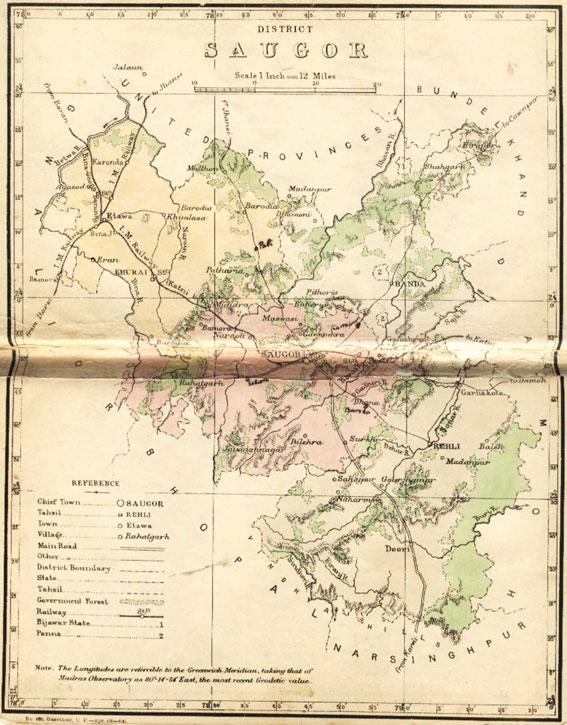
For the rebels, their defeat at Barodia had been brutal. Their losses (according to themselves, and not the British) were estimated at 400 dead and wounded; the Raja of Banpur had been injured, and the nephew of Fazil Khan, Anant Singh, was dead. His loss was most lamented, being one of their ablest commanders. Besides losing Barodia, they had also left behind their baggage, stores, and equipment. Things were not looking up.
For Sir Hugh Rose, the road was now open for the relief of Sagar.
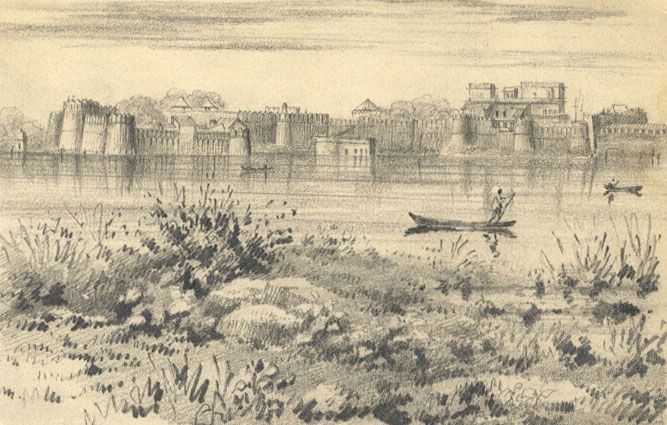
On the morning of the 3rd of February, Sir Hugh Rose marched into Sagar. Along the road from Rahatgarh, there had not been a mutineer, rebel, Walayati or indeed anyone of a fighting countenance met with. It was a bright, pleasant day.
On approaching Sagar, the force was surprised that the first people they encountered were Europeans. They had come out on elephants, in buggies and on horseback to greet them at the entrance of the town — like on the road, Sagar itself had been vacated by the mutinous elements. Even the local population turned out to line either side of the road as the Central India Field Force strode into Sagar, cheering as they passed. As the force marched through town, their regimental bands played jovial and cheerful tunes; from the fort, a salute was fired.
The town itself was crowded with people, and “sauntering about the streets were the sepoys of the 31st Bengal N.I., the only regiment of the Bengal army which have remained faithful… In some streets, there were a good many sullen, diabolic-looking fellows who seemed to wish us anywhere else. As we marched past the fort, which is situated on a hill in the town in a commanding position, its walls were crowded with Europeans, men, women, and children.”
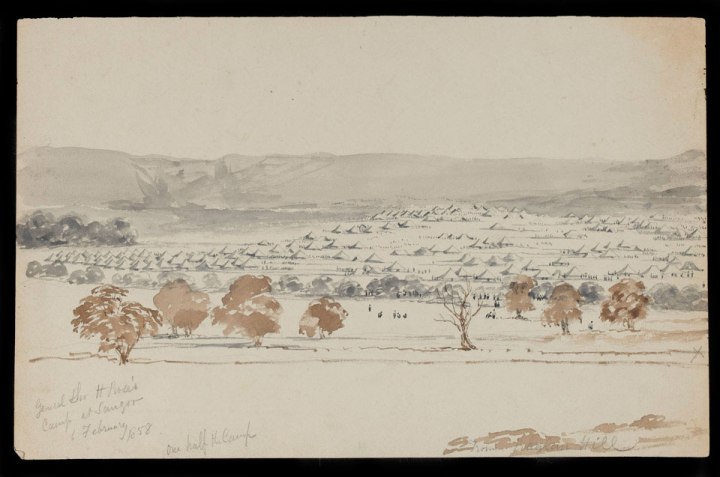
The Europeans looked care-worn, pale and thin; twenty-two of their garrison had died in the past eight months.“For many a week, during eight weary and anxious months, we had heard of relief being near, till we grew sick with expecting and watching for its realisation. Then there came the faint sound of distant guns. After three days, it grew sharper and quick, and they knew that Rathghur was being bombarded. The rebels could not have had a wink of sleep from this constant booming, which we distinctly heard at Saugor. To us, it brought sweet slumbers and a happy sense of approaching security. At last, to our joy, it was reported that the fort had been taken and that Sir Hugh Rose was close at hand.” Brigadier Sage, for his part, had done his work well. The fort had been well stocked with six months of provisions; he had been able to procure more through the faithful sepoys of the 31st BNI. The fort was in good repair, and thanks to the work of the sepoys, the town itself had been spared the worst of the ravages a plundering population was apt to do. The cantonments had not been touched at all. Sir Hugh Rose encamped his force beneath a barren belt of hills on the other side of Sagar. As smallpox was raging in the town, he forbade his troops from visiting it.
Sanoda
He now had time to plan his next advance.
The relief of Sagar had opened communication towards the west and the north. Major Orr and the 1st Brigade would shortly leave Mhow, and marching parallel to the 2nd Brigade, would advance on the Mhow and Agra Road. It only remained now for the 2nd Brigade to open communication from Sagar towards the east and, in the process, cut the rebel line between Jhansi and the Narbada. To open up the eastern flank, both the small fort at Sanoda and the fortress of Garhakota would need to be taken. Both positions were still in rebel hands.
On 8 February, Captain Hare with a detachment of the Hyderabad Contingent, all arms, and a detachment of sappers, advanced on Sanoda, ten miles from Sagar. Hare, if he was expecting any resistance, he was mistaken. The rebels, on hearing of his approach, had decided to flee precipitously, leaving behind their supplies and a large quantity of grain. After removing its contents, the sappers destroyed the fort. What horrified Dr. Lowe and the men, however, was the pitiful condition of the villagers. They had been relentlessly plundered for months by the Bundelkhand rebels and mutinous sepoys; their own kotwal, instead of attempting to protect the people, had “given the enemy every assistance in his power and had exercised most undue severity towards the unoffending peasants about.” After Lowe observed the poor people wandering through the camp, searching for undigested grain to eat in the dung of cattle, it was decided that something had to be done. Taking the grain seized from the fort, Hare distributed it liberally to the starving villagers. Meanwhile, the kotwal attempted to ingratiate himself with Hare. Bartering information, which the kotwal said was not only true but accurate, Hare promised to spare his life. The condition, however, was that the kotwal present his information in the morning, so Hare could then send his men out to verify it. By morning, however, the kotwal denied knowing anything at all — Hare gave him three hours to “reconsider the value of his existence,” but the man remained silent, stating only he knew nothing at all. “He was accordingly marched to a tree, an empty bullock car was driven under it, into which he mounted, and, blindfolded, waited for the horrid moment of strangulation. The noose was arranged around his neck, the bullock’s tail screwed and away went the cart, and he dropped dangling from a mimosa branch, and thus died. Probably, he discredited such summary punishment.”
The sappers swiftly accomplished their task to cut a road for the siege train to cross the River Beas. While there was a suspension bridge across the river, the engineer deemed it too weak to handle the weight of the guns, so the plan to use it for that purpose was swiftly abandoned. Their work done, the road to Garhakota was open.
The Siege of Garhakota
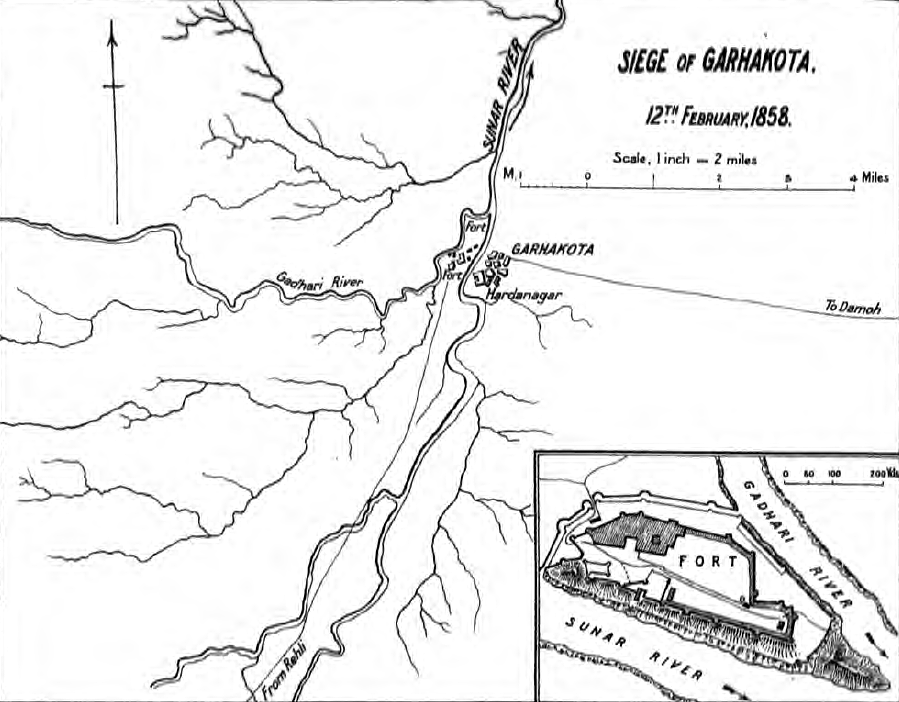
Leaving Sagar on the 9th, Rose marched his force the first ten miles to Sanoda, and the next day, made a double march of 21 miles to Baseri, close to Garhakota, arriving in the afternoon. It had been a trying two days. After leaving the high road between Sagar and Damoh at Saorpur, the jungle had become so dense, and the path carried them up through the hills. It was also not without its surprises. Clearing one hill and then skirting along another, the skirmishers stumbled into a party of rebels, who, as startled as the skirmishers, scattered into the jungle, leaving their baggage behind them. Then, in a clearing, the force waited for the return of Hamilton’s spy, who had been sent to Garhakota.
When he returned, he stated the mutinous sepoys were in their lines near the ford that ran under the fort, but the Bundleas, some 1000 strong, were in the fort itself. They were still unaware of Rose’s approach but had, just in case, posted a guard on a spur near the fort. As the force approached what would shortly be their camping ground at Bassari, the skirmishers took another picket.
The fort was a strong one, well situated between the Gidari and Sonar Rivers, and surrounded, except on its eastern side, by forest, and the towns of Garhakota and Hardanagar. The fort itself formed a semicircle, no more than 900 yards long and 300 yards in breadth. The interior wall was built of stone, and stood 29 feet high and at its thickest, measured 24 feet. A deep ditch, some twenty feet deep and thirty wide, covered the north and the west faces. At 1600 yards from the ditch, a wall had been built to extend between the two rivers, and it continued along for a few hundred yards along the Sunar River. The British knew what they were up against — in 1818, during the Pindari War, Brigadier Watson had laid siege to Garhakota. After eleven days, his guns had managed to breach one of the walls, but the occupants asked for terms. They were allowed to march out with arms and private property, and the British could then take possession of the fort in the name of Scindia of Gwalior. Since then, much had happened at Garhakota, and now it was squarely in the hands of Raja Mardan Singh with the rebels of Bundelkhand, a handful of mutineers from different regiments, and the remnant of the 52nd BNI.
The 52nd Regiment of Bengal Native Infantry (Hindree Ka Paltan)
Raised in 1804. Late 2nd Btn., 26th BNI
Battle Honours: Punjab, Mooltan, Gujerat.
Following the mutiny of the regiment, only 530 men remained. These joined in the general plundering of the countryside in and around Sagar. They pillaged Damoh, released the prisoners from the local jail, and after pledging their services to various petty rebel chiefs, took up their position at Garhakota Fort, from whence they continued to raid the countryside.
Taking Garhakota
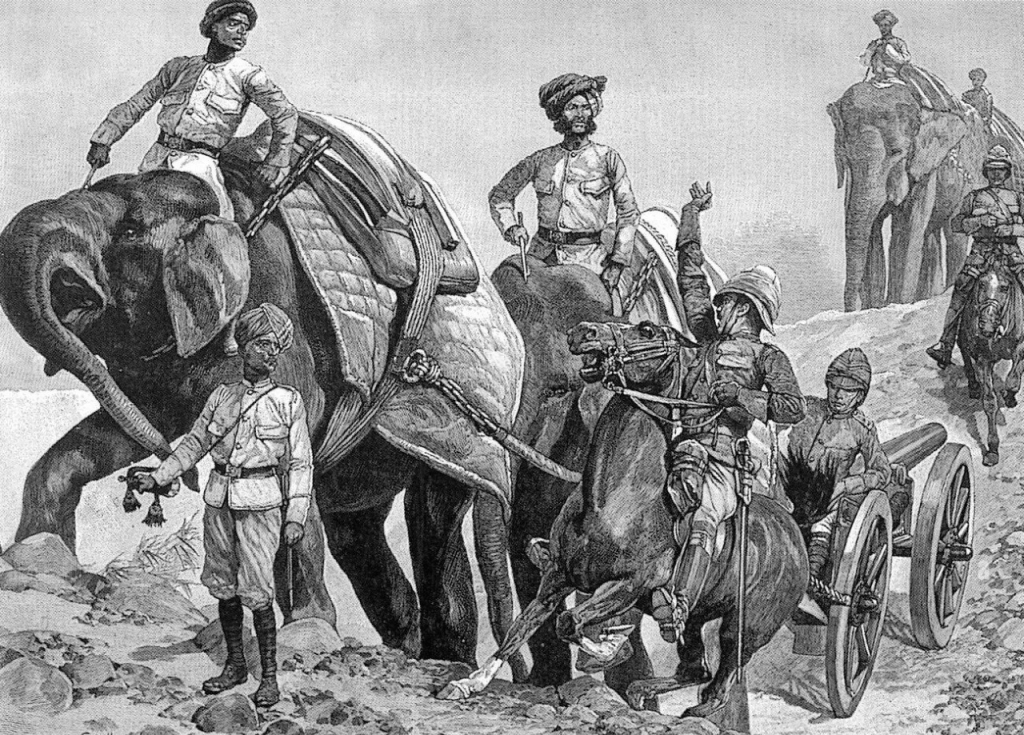
While his men rested and the camp was being set up, Sir Hugh Rose and his escort, which, like at Rahatgarh, included an engineer, used the remaining daylight hours to reconnoitre the position he intended to besiege the next day. It was found that the rebels had been most industrious and had set up earthworks on the road to the south by which they had expected Rose to arrive; the village of Baseri, too, close to his camp, was occupied. Determined he would have the village the same night, Sir Hugh Rose returned to camp well after dark and ordered the Horse Artillery to shell Baseri. Taking up their position on a small mound in front of the camp, the artillery poured a devastating fire on the village. The rebels, undeterred, sounded their bugles and advanced in force at the double towards the guns; the 3rd Europeans drove them back. They formed up again and “advanced with unabated vigour,” but as soon as they were within reach of the guns, the 3rd Europeans, once again, took up the challenge. This time, it was enough for the rebels to rush, in some disorder, back to the fort.
Dr. Lowe, who had not been called up for this fight, was enjoying a rough dinner and waiting for his tent to arrive when the rebels began to send round shot into the camp. As soon as the tents were pitched, they renewed their efforts and threw a few rockets at the British, just for good measure. Thus occupied, they missed the engineers and sappers, who, under cover of darkness, were building a breaching battery, directly opposite the west face of the fort.
The next morning, the shelling of Baseri continued. With the breaching battery complete, the 24-pounder opened fire on the fort and continued its relentless work through the day. It was answered ably by a large gun on the embrasure, worked, as far as Lieutenant Strutt could see, by mutineers still in their red coats, loading and firing. It would take Strutt considerable effort to finally knock the gun over, and sadly for the gunner, the shot also took off his head and killed the two sepoys next to him. Strutt would later find his adversary still had his medals pinned to his coat, with two clasps intact.
As the battle began to gain momentum, a reconnaissance was pushed through Hardanagar to support Lieutenant Dickens and his company of the 31st BNI. The reconnaissance, believing Dickens could hold his own, circled around the fort, leaving detachments of all arms in positions on the north-east, east, and south-east, leaving Dickens to hold the south. who had intended, initially intended to hold the ford at one of the ghats. Being too close to the rebel defences, Dickens wisely chose not to hold it, but skirmishers were sent forward to the ford to prevent anyone from crossing it. Those who tried were swiftly sent back, and Dickens was able to carry the rebel entrenchments.
Baseri was quickly taken, but with considerable energy, the rebels determined to get it back. They streamed out in numbers from the fort and from an entrenched camp to the south, grimly determined to hold back the advance of the 3rd Europeans. The men who had come out had once been Bengal army sepoys – they had kept their coats, their muskets, their order, and, above all, their buglers were repeating the English skirmishing calls. Unfortunately, the 3rd Europeans were grimly determined to have their advance, and the sepoys rapidly vanished to the rear. Meanwhile, towards evening, the artillery opened fire on the fort with two 18-pounders and played on the fort throughout the night.
Thinking Dickens was holding the ford to the south, Sir Hugh Rose did not send any further troops in that direction. However, as soon as night fell and he returned to camp, realising that Dickens was not at the ford, he sent Captain Hare to guard the south. Before he arrived, the garrison of Garhatkota, seeing that Dickens had withdrawn, began fleeing through the south gate under cover of darkness. They then turned northwards towards Shahgarh. If the rebels had had better intelligence, they would have known Sir Hugh Rose had not turned up at their doorstep with his full force. He had left a troop of the 14th Dragoons and two companies of the 24th Bombay Infantry at Sagar; the 31st BNI and a detachment of the 42nd BNI were at Kurai. In fact, Rose only had enough troops with him to guard the camp and the artillery. The rebels had no less than 13 serviceable guns of large calibre, and sufficient provisions to hold out; they were not lacking in men, but unfortunately, their leadership had failed them, erroniously building earthworks down the one road Rose was not marching on.
By morning, the remaining rebels had had enough. Leaving everything behind that they could not carry, they abandoned the fort. Sir Hugh Rose ordered the firing to cease, the 3rd Europeans rushed in and, finding the fort deserted, declared it taken. As soon as was practicable, Sir Hugh ordered the pursuit. Captain Hare, with the Hyderabad Cavalry, two troops of the 14th Light Dragoons under Captains Need and Brown, and Lieutenant Crowe with 2 Horse Artillery guns, set off after the rebels who were fleeing in a body towards the Beas River. The cavalry crossed over and continued the chase until after dark, cutting up no less than 70.
The fort was found to be abundantly provisioned with grain, flour, spices, cloth and a variety of commissariat articles. They also found bags filled with bangles, bracelets and rings; boxes filled with, of all things, “miniature mariner’s compasses,” steel pens and plenty of paper. Surprisingly, there was very little in the way of munitions, just a few small heaps of bullets and gunpowder, but all the guns were loaded. The dead represented seven different Bengal regiments, identified by the buttons on their red coats. Several of the sepoys wore their medals around their necks, others, like the dead havildar who had worked the gun to the last, had pinned theirs to their chests. Under strict directions from Sir Hugh Rose, looting was not the order of the day – the dead sepoys retained their medals.
The Madras Sappers were given the task of rendering Garhakota indefensible – until their task was complete, Lieutenant Dickens and his company of the 13th BNI remained behind, organising the transportation of the fort’s stores to Sagar. One man of the Bombay Sappers was caught leaving the fort with a little ghee, flour and a few trifles which he had secreted in the pouches of his camel saddle. Dickens placed him under arrest and sent him under a guard to Sagar to await his trial. Dickens had held his company of the 31st for eight long months at their tasks, and true to their salt – if he was going to continue doing so, there could be no exception to orders, even for a little flour and clarified butter.
Back in Sagar
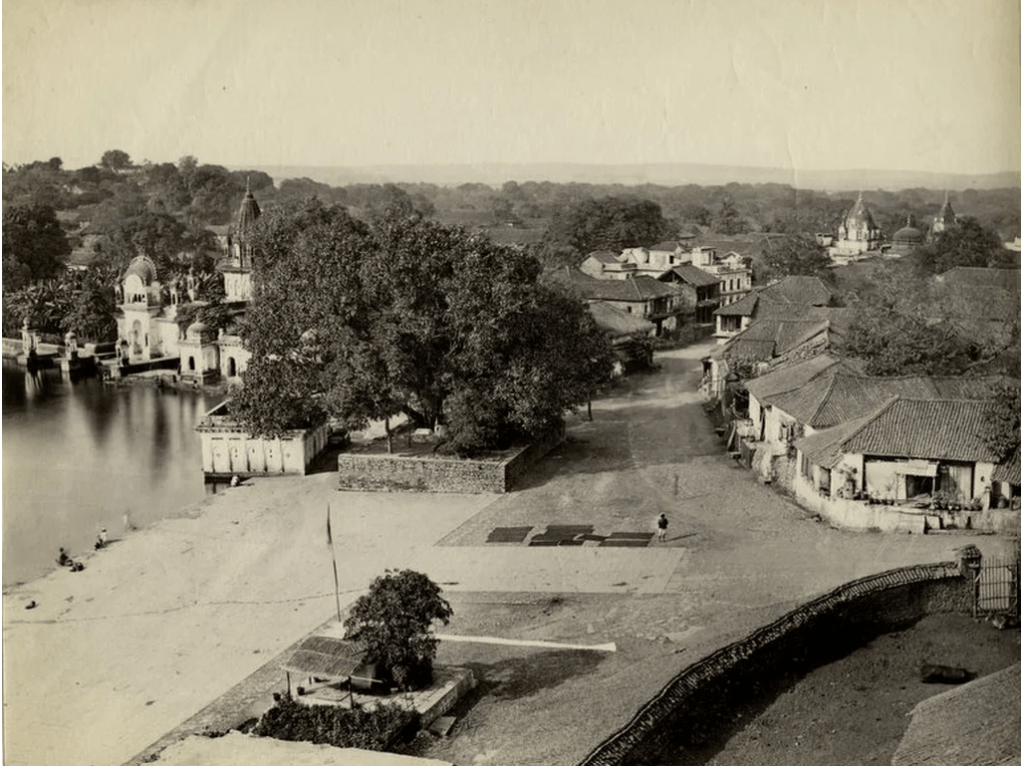
By the 17th of February, with Garhakota now in ruins, the remainder of the force rejoined Sir Hugh Rose at Sagar. It would be a long wait before he would march again. He was anxious to move on Jhansi without delay and wanted, above all, to strike another blow at the rebels before they had a chance to recover not just their morale, but place themselves in yet another fort. However, his siege guns needed repairs, supplies were hard to come by, and transport was lacking. On 29 February, he wrote to the
Governor of Bombay :
“ I am unfortunately detained by want of supplies and carriage, to the great disadvantage of the public service: I have lost nine precious days, doubly precious not only on account of the time at a season when every hot day endangers the health and lives of the European soldiers, but because every day has allowed the rebels to recover the morale they had lost by my operations, which I had made as rapidly and efficiently as possible, knowing that any success with orientals produces twice as good a result if one acts promptly and follows up one success with another. Nothing requires a system so much as transport. Laying in supplies, as it is called, is perfectly easy in a fertile and peaceful country, but this will not do in my case, where a country has been devastated or is in the hands of the enemy. Then appears all the risk of a civil or occasional system of supply.”
However, the time was not completely wasted. The siege train was supplied from the Sagar arsenal with a plentiful supply of ammunition, and he added to it other heavy guns, large mortars and howitzers. More elephants were obtained and he looked to it that the Ordnance and Engineering Parks were strengthened. The 3rd Europeans, who had hitherto been marching in heavy uniforms, were supplied with loose, summer garb, khaki in colour, consisting of loose blouses and trousers and matching pugrees for their heads. As for the officers, knowing the march ahead of them would be long, laid in stocks of private provisions, and those who could, ordered spare boots to be made up; the messes took the time to provide themselves with beer, soda, wine and as many English goods as were procurable.
Sheep, goats and oxen were bought up, while flour and grain were bought at exorbitant rates, to satisfy the needs of the army. For the sick and wounded, the doctors scrambled about laying in provisions of soda water and large supplies of tea. A military train, too, had been established from Bombay, which would shortly follow and aid the force.
The rebels took this lull in hostilities as a chance to strengthen their positions in the hill passes that Sir Hugh Rose would inevitably need to cross. They had also occupied the forts of Serai and Maraora. However, two other forces were moving – the 1st Brigade, Central India Field Force was marching from Mhow, and Brigadier Whitlock had finally decided to leave Jabalpur. The campaign had barely begun.
Sources:
Central India during the Rebellion of 1857-1858 – Thomas Lowe (London: Longman, Green, Longman & Roberts, 1860)
A History of the Hyderabad Contingent – Major Reginald George Burton (Calcutta: Government of India Central Printing Office, 1905)
The Revolt in Central India 1857-59, Compiled in the Intelligence Branch (Simla: Government Monotype Press, 1908)
History of the Thirtieth Lancers, Gordon’s Horse, formerly 4th Nizam’s Cavalry, 4th Cavalry, Hyderabad Contingent, 4th Lancers, Hyderabad Contingent – Major E.A.W. Stotherd (Aldershot: Gale & Polden, Ltd., 1911)
Selections of Letters, Despatches and other State Papers Preserved in the Military Department of the Government of India 1857-58, Vol IV – edited by George W. Forrest (Calcutta: Superintendent Government Printing India, 1912)
Robson, B. (1997). THE UNKNOWN GENERAL: A REASSESSMENT OF SIR HUGH ROSE. Journal of the Society for Army Historical Research, 75(302), 93–105. http://www.jstor.org/stable/44225468
 Mutiny Reflections