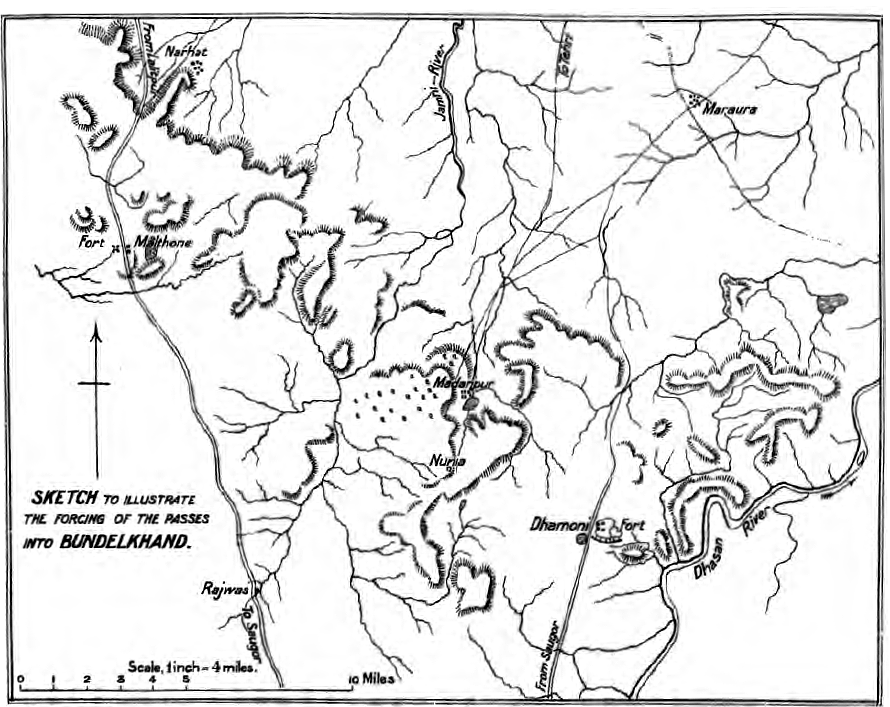
Sir Hugh Rose had now, for some weeks, been held back in Sagar. While the siege guns were being repaired, he ordered several days’ supplies to be collected, for the country he would now be advancing had been utterly devastated by rebel raids. There would be little hope of replenishments along the way. He further had no organised military train — everything would have to be taken from Sagar.
The objective was to proceed as rapidly as possible to Jhansi, however, the question was how to get there. The country he would now be passing was well-suited to ambushes by the rebels; Rose’s force was weak in infantry but strong in guns, much of which was heavy artillery. He would therefore take the more open country road to Jhansi, skirting the most dangerous parts of Bundelkhand and falling, when at all possible, on the rear of any rebel positions. Then, with the Mhow Brigade, he would attack Jhansi.
His delay at Sagar, however, had given the rebels a chance to regroup. Not perceiving any further movement from Rose, they had begun occupying in force positions in Shahgarh and the adjoining districts, the forts of Surahi and Maraura and had lodged themselves in the mountainous ridges that separated Shahgarh from Sagar. There were, in all, three such passes: Narhat with Karnalgarh Fort near Malthone, Madanpur and Dhamoni. With resistance anticipated at Surahi, Maraura and Talhebat, the latter place occupied by the Raja of Banpur, Sir Hugh Rose ordered Brigadier Stuart to move westwards towards Guna and take Chanderi, while he forced his way northwards, crossed the Betwa River, before forming a junction with Stuart.
While all of this sounded fine in theory, Rose knew the length of his line of march would be long – he was taking an abundant supply of reserve ammunition and a convoy transporting no less than 2 weeks’ supplies. This, with the usual additions of camp followers, baggage animals and dhoolies, would certainly present a formidable problem. In all, he would have 10’000 mouths to feed daily, exclusive of the Hyderabad Contingent.
As such, he now relied on Major Orr and the Hyderabad Contingent Cavalry to decide which pass would be the least distressing for his column. It was determined that Narhat Pass was the most difficult, but it was also the most direct one to Jhansi; the rebels had already concluded Rose would undoubtedly cross it. They had spent their time barricading the road with abatis and 15-foot-thick parapets constructed from large boulders. As the sides of the road were practically impassable due to the nearly precipitous hills covered with thick jungle, the Raja of Banpur had stationed nearly 10,000 of his men here to ensure Rose a warm welcome. His efforts, though most ingenious, were for nought. Sir Hugh Rose would never set foot on Narhat Pass.
Taking Madanpur Pass
Major Orr had already advanced with some of the Hyderabad Contingent Cavalry to Barole. On 18th February, he received information that a party of Bundelas in the service of the Banpur Raja had advanced from Dhamoni and taken possession of a small fortified post only five miles from Barole itself. As the surrounding country was impractical for cavalry, Orr requisitioned a detachment of 150 Burkandazes in the employ of the Customs Police. These men had been working out of Banderi under Mr Bartie and Verrier of the Customs Department to secure the roads from plunderers – now they would be put to the work of flushing out the Bundelas. They came across them four miles down the road from Barole and their post.
The fortifications had been well-thought-out – the ridge was covered with thick jungle, and they had erected stone breastworks, using the small stream which crossed the road, as part of their defences. As such, on seeing Orr and the Burkandazes approaching, the Bundelas opened a heavy fire on the head of the column: Bertie and Verrier, however, rallied their men and, without any hesitation, charged. The Burkandazes rushed the ridge and carried the post, killing ten Bundelas and taking two prisoners. These were ordered shot on the spot.
Orr now took on the task of reconnoitring the passes. As already suspected, Narhat would prove impossible, but Madanpur was open — it would, however, be necessary to distract the Banpur Raja from sending a force to meet the oncoming column.
Sir Hugh Rose was ready to march on 27 February. As they left Sagar, the sky was suddenly illuminated by rockets shooting high up into the dark night from the centre of the town. The rebels, though routed from Sagar, had left their spies behind, and these were now “telegraphing the departure of our troops to their friends north of us.” After clearing a belt of hills through a narrow pass, a halt was called. As soon the march recommenced, the rockets were once again observed shooting up into the sky, this time at regular intervals in front of them. As they moved on,
“…a bright fire shone out of the masses of jungle on the different hills, first on our right, then on our left untl the morning rendered them useless. Around each of these fires were three or four native, suspicious-looking men, but they swore they were only preparing for a feast when captured by the dragoons. No doubt this was a well-devised means of warning the enemy of our approach; nothing could be better than a chain of these fires for the purpose, as few things carry an air of such simplicity and innocence, for what more natural than that men should make fires in the jungles in the cold hours of the morning, or one for a feast!”
Along the way, a small fort was taken with much firing of artillery, but when the gate was forced, it was found that only two men were left inside, and they were both dead. The rest had decamped into the jungle through an opening on the far side. Leaving a small levy of Gonds to hold the fort under Lieutenant Prendergast to hold it, the force marched onto Rajwas. By now the sun had set, and dark clouds were rolling thick over the sky; soon, flashes of lightning, followed swiftly by peals of thunder, rent the air, and the rain began to fall in merciless streams. It soon became apparent how difficult such a long train was going to be. As darkness set in, the rear lost their road. Although close to Rajwas now, Surgeon Lowe and the men of his company found themselves stumbling through nullahs and bushes, “while sheets of lightning flashed over us, frightening the horses and rendering the path doubly difficult to find. The cavalry and artillery bugles were sounding in various directions…” they could see the camp fires, hear the horse neighing but somehow, it was proving impossible to actually reach the camp. Finally, around 9 o’clock that night, they passed the sentries and found their tents, but could still hear “the imploring cries of cavalry bugles from those who could not find their way home.”
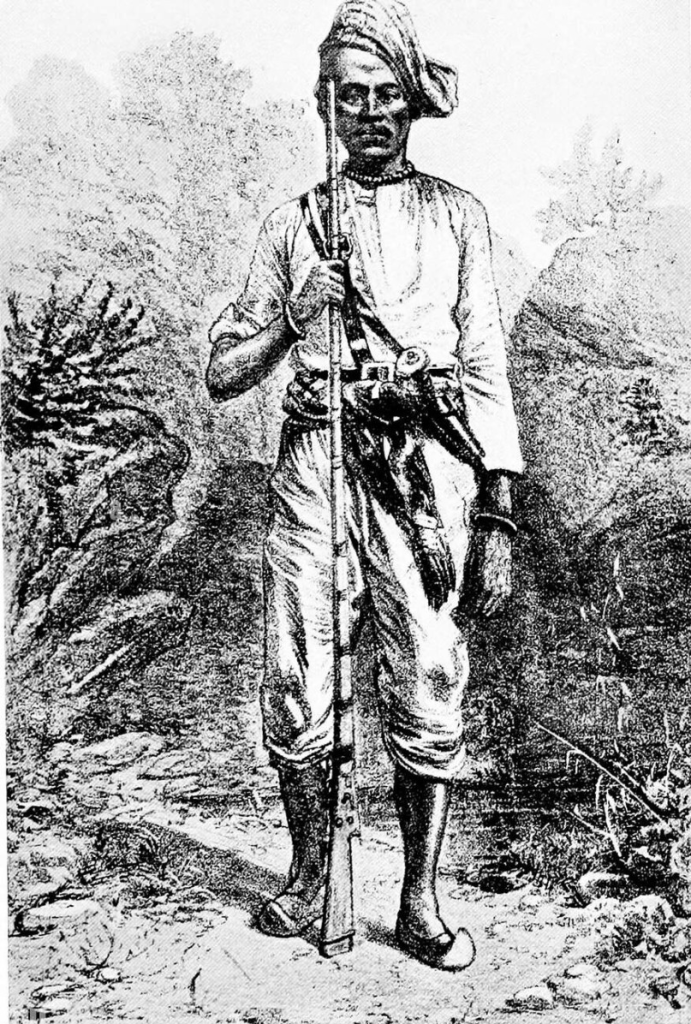
For Prendergast with the Gonds, it was an interesting night. The Gonds themselves were “the most extraordinary fellows. When they marched they seemed to keep on the jog-trot, laughing and joking, and carrying their arms as one would imagine of a wild Irish mob: they seemed to possessed of no scruples of caste and were always willing to go anywhere and anything where there was a chance of looting a rag or lots.” With a few sappers, detached to take the fort apart, Prendergast posted guards of the Gonds. As he did his rounds, he found they were sleeping quite soundly, apparently without a care in the world for rebels, Bundaleas, or, for that matter, anything else. They were inside a fort, one sleepy Gond explained, the gate was closed, and really, Prendergast was worrying about nothing. He was hardly sorry when the next day, he rejoined the rest of the force.
At Rijwas, the camp was pitched on a flat surrounded on three sides by hills – here Major Orr reported back to Sir Hugh Rose, who swiftly put together a new strategy. The Madanpur Pass, twenty miles from Narhat, was little known except that an ordnance map described it as “good for guns.” It was, however, defended by the Shahgarh Raja. Sir Hugh Rose remained undeterred. On 3 March, at 2 in the morning, Major Scudmore, commanding HM’s 14th Light Dragoons, with two troops of that regiment, one troop 3rd Light Cavalry, 100 Irregular Cavalry one 24-pounder howitzer, three Bhopal 9-pounders and the 24th Bombay Native Infantry marched to Malthone, just above Narhat while Sir Hugh Rose marched with the main body to Madanpur, three hours later. While Major Scudmore distracted the Banpur Raja, Sir Hugh Rose launched the real attack on Madanpur.
Advanced Guard:
500 Hyderabad Cavalry
200 Hyderabad Infantry
Four Guns Artillery;
One company, the 3rd Bombay Europeans.
Centre :
1 troop H.M.’s 14th Light Dragoons
Sappers and Miners
Four guns, Horse Artillery
Right Wing 3rd Bombay Europeans
3 9-pounder Guns, Captain Lightfoot’s Battery
Two 51/2-inch mortars
One 8-inch mortar
One 1-inch howitzer
Left Wing 3rd Bombay Europeans
Siege Train
3rd Bombay Light Cavalry; baggage and convoy.
Rear Guard :
125 Hyderabad Infantry
One howitzer and Gun Horse Artillery
One troop, H.M.’s Light Dragoons
50 Hyderabad Cavalry.
For some six miles, the force moved along the front of a long range of hills before entering an almost “pathless route” which led to the pass. As they approached the gorge, rebel skirmishers opened fire on the advanced guard from hills to the right but were quickly driven back by a party led by Mr. Bartie of the Customs Department.
The column with the batteries continued to move forward. At some 800 yards from the edge of the plateau, where the thickly wooded road suddenly descended towards a gorge, the rebels could now be seen posted on the steep, rocky hills that lined the left of the defile. Major Orr ordered the artillery to open fire with round shot and spherical case, making a “good practice” on their position but,
“The ardour of an excellent officer induced him, at this time, to make an incautious movement with his guns to his right front, with the view to pour an enfilading fire into the enemy. But he had not taken into consideration that this movement brought him to within fifty or sixty yards of the edge of the glen, in which lay concealed some hundred sepoys, who, before he could unlimber, opened a very heavy fire on his guns, which he was unable to depress on them. The sepoys fortunately fired too quick, and too high, and the officer retired his guns out of the range of their musketry, with only a few casualties. The sepoys hailed this little reverse with shouts. But their success had only brought on their more rapid defeat.“
The rebels held their cover with considerable firmness and their firing was so galling that even after the artillery moved back, the gunners had to take cover behind their guns, several were wounded, and Rose’s horse was shot. The bullets continued to fall like hailstones but the artillery opened up with shell on the masses in the jungles to the left. Sir Hugh Rose now knew the exact position¨of the rebels and seeing he had the advantage to show them that, ” a calm retreat was only the prelude of a rapid offensive,” he advanced 100 of the Hyderabad Contingent Infantry under Captain Sinclair at double time. They charged into the glen, bringing “their right shoulders forward,” and swept down towards the road. Rose followed the charge with a company of the 3rd Europeans against the rebel front, and the men of the Customs Department from the extreme right, against their rear. The artillery continued to pour shell down on the rebels’ heads. “To still further discomfit them, I sent a troop of Her Majesty’s’14th Light Dragoons to a knoll, quite in rear of the glen, and commanding a view of the lake and the other end of the pass.”
The rebels were now driven out of the glen. They crossed the road that ascended the hill on its left, intending to join a larger body of their brethren who still occupied the hills divided by ravines on the left of the road. The Horse Artillery should have made short work of them with grapeshot, but the commanding officer mistook them for the men of the Customs Department, whose uniforms bore a striking similarity to those worn by the rebels.
Without giving the rebels a chance to catch their breath, Rose ordered Captain Macdonald to storm the hill to the left of the road with two companies of the 3rd Europeans. Macdonald, in good form, conducted the men up the steep hill; he then extended the Grenadier Company from the right and, supporting them with the other company, drove the rebels from this line of hills to the next. Lieutenant Colonel Liddell came up now with the rest of the 3rd Europeans, up the hill in support of the two companies. Under Rose’s directions, he now advanced and continued driving the rebels from all the hills that commanded the pass. The main body of the rebels fled through the pass with their guns and to the village of Madanpur with Captain Abbott and the 4th Hyderabad Cavalry still in pursuit.
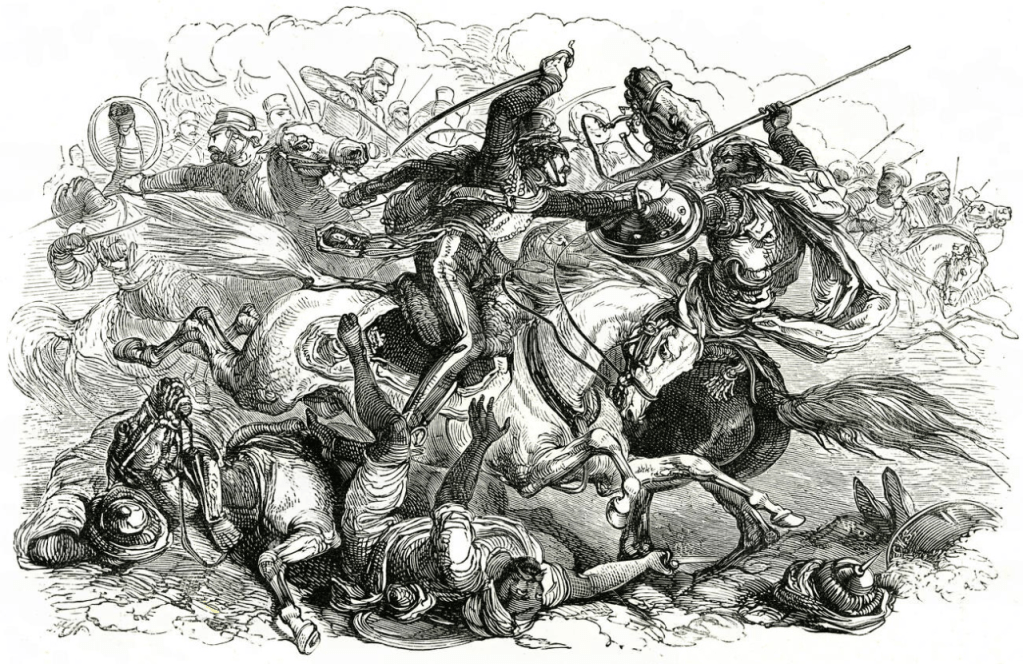
The rebels, repulsed in flank and front, now retired to the rear of the village, by the lake. The village itself had been fortified by formidable earthworks, “in the shape of a bund of great thickness of earth and solid masonry, which dammed up the lake. The enemy placed the few guns they had in rear of the bund, and had been firing them on the 3rd Europeans on the hill.” With the pass now in Rose’s hands, he sent orders for Brigadier Steuart, whom he had halted in the rear of the pass with the reserve and siege train, to advance through it and occupy the head of the lake. As soon as they arrived, he opened up with the 8-inch howitzer with the 9-pounders in advance to silence the rebel guns. It was about as much as the rebels could stand – they turned and fled. However, the day was not quite won. The officer commanding the rear guard reported he and the baggage had been fired on from the range of hills running to Narhat pass. Thinking it likely that the Raja of Banpur would try to come to the aid of the Shahgarh Raja as soon as he figured out that Major Scudmore’s movements were, in fact a ruse, Rose sent a troop of 14th Light Dragoons and a regiment of Hyderabad Cavalry to cover the rear.
However, the tail end of their force was swiftly caught by the Hyderabad Cavalry, who followed them some miles over hills and through the jungle, capturing in the process the Raja of Shahgarh’s astrologist. They chased them up to the fort of Sorai; Major Orr and Captain Abbott found that the rebels consisted mainly of mutineers of the 52nd BNI. They killed a good many of them, including Lal Turbadio, who, when Havildar Major of the 52nd, had instigated the mutiny. He had since then been acting as their commander, but being tremendously fat and his horse not very large, had been unable to evade the cavalry swords. Orr’s men gathered up the medals still pinned to the tunics of the dead sepoys and turned back toward camp.
“As we marched through the pass, many of their bodies lay about; some were those of sepoys, some of bundeelahs. While the fighting in the jungle was going on, several characteristic incidents relating the Khoonds (Gonds) occurred. No sooner did one of them or anybody else shoot down a rebel, than threee or four of them them rushed upon the fallen foe, threw down their muskets, and commenced forthwith to scramble for the belt and pouch, the pagree, the jacket, the waistband, and the pice it might contain; and there they were in the midst of the fighting, bawling away and laughing, like human vultures; then they shouldered arms and trotted off with a couple of pouch belts, perhaps, over their shoulders, and two or three pagrees on their heads.”
As for the village, it had been abandoned. All that was found in the cottages, which Rose’s men ungraciously broke into, were broken pots and piles of rags. The Shahgarh Raja had escaped, but his hapless astrologer, now a prisoner, confessed he had been mistaken in his prediction that this was a fitting day for the annihilation of the firengis. The stars, he said, had been wrong.
As soon as the troops were rested, they moved off again, until they reached the village of Pepeeria, before which the artillery, infantry, dragoons, camels, carts and followers became entangled in one confused mass as they attempted to cross a narrow but deep stream, all trying to gain solid ground on the other side. It was night before the camp markers finally drew out the camp just above the village, leaving everyone to grope about in the dark, trying to find their respective places. It was not until midnight that the last baggage cart trundled in.
From Sorai Fort to Jhansi
Pepeeria happened to be within sight of Sorai Fort, only three miles distant, on the top of a solitary hill. The sappers marched to the fort in the morning with Sir Hugh Rose and his staff coming up behind to examine the place.
The fort was well built and commanded an extensive view of the surrounding plain. At its foot was a deserted village to the north of which was “a beautiful garden and the serai of the Shahgarh Raja.” While the sappers destroyed the fort, the force camped under the shade of the numerous fruit trees. Lowe took time to admire this veritable Elysium, which he called the most beautiful place in India. Its bowers of roses and jasmine, the little plots of fragrant herbs through which partridges and peacocks strutted, accompanied by the loud voices of monkeys. In the garden was a pretty temple and a large tank from whence water could be drawn by bullocks to irrigate not just the groves of trees but the myriads of vegetables growing in neat rows. “This garden was the pleasantest spot we ever had the good fortune of pitching in during the campaign. We were cool all day, enjoyed all that the garden produced for table ad libitum; the wood doves cooing in the early morning; then the songs of other birds…” For the Raja, it was a sore blow – he had taken to manufacturing shot and powder in the fort, using the dyes of the old Sagar Mint to make balls; these all fell now into Rose’s hands.
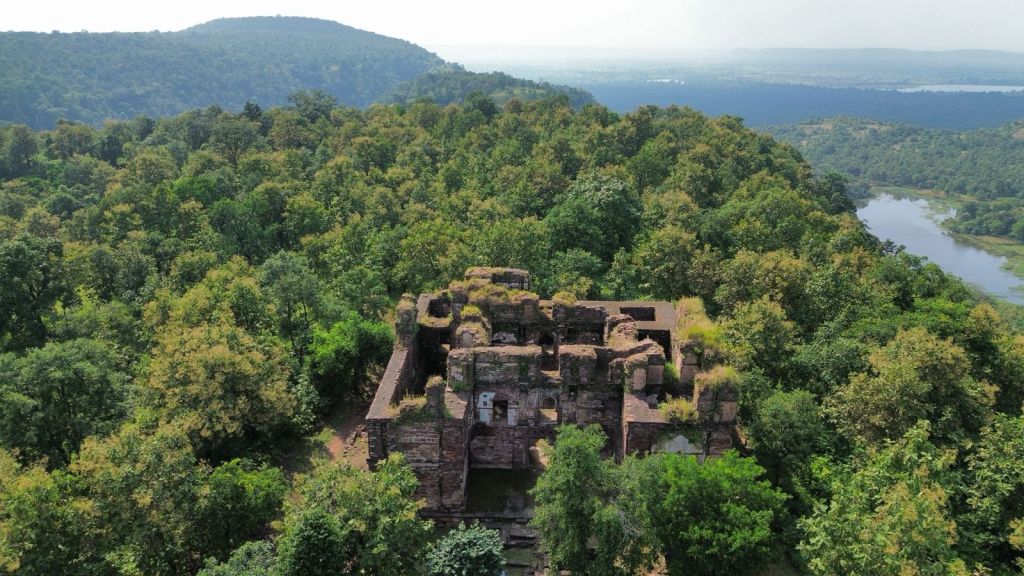
One day later, Rose marched to Murrowra, twelve miles to the north, where there was another fort, already deserted and an abandoned village. On the 7th of March, the British standard was hoisted on the bastion of the fort, and a proclamation announcing the annexation of the territory was read, disinheriting the Shahgarh Raja, with the bands playing “God Save the Queen.” Rose now held a double line of defences on the road from Sagar to Jhansi and from Shagarh to Malthone. Scudmore’s force had had a slight engagement with the rebels at Malthone pass, but the defeat of the Shahgarh Raja had been communicated early to his allies at Malthone. These reconsidered their options and fled through the jungles, leaving but a few to oppose Scudmore. As it turned out, there was dissension in their ranks. The sepoys, mostly of the 52nd, had quarrelled with the Bundelas, the former declaring the latter were cowards who had left them to fight the passes alone; the Bundelas left in a huff, and the sepoys faced Scudmore without their help. Realising he was in a precarious position, the Banpur Raja swiftly abandoned Narhat and Dhamoni; Sir Robert Hamilton set up a police post at Malthone. To protect the friendly rani of Terai from any threats, the Hyderabad Contingent now marched on Shahgarh itself to be ready to offer the rani and assistance she might require. As such, Rose had taken the whole line of the rebel defences in the rear, allowing now for free passage for British forces over not only the Bina but the Betwa.
On the 9th of March, they started for Banpore. The villages they passed were wholly abandoned – the few villagers they met stated they had fled from Chanderi, who declared the British were besieging the fort, forcing them to run in fear for their lives. As they neared the camping ground opposite Banpore, Hugh Rose could clearly hear the siege guns at Chanderi, which would continue battering the walls for another week.
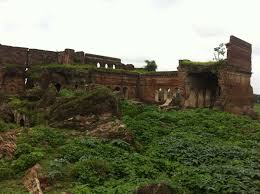
Banpore, like the villages, was deserted, although some townspeople cautiously peered out from their homes as Sir Hugh Rose marched through their streets, right up to the fort. While the Banpore Raja was nowhere in sight, it was clear, by the property found in his fort, that he had had visitations from various mutinied regiments. Property of their one-time officers was found in the rooms, their boxes and clothes, books and surveying instruments, private letters and even their furniture. Dr. O’Brien, formerly of the Gwalior Contingent, now doing duty with the 3rd Europeans, discovered his own property, including a camphor wood box, his mathematical instruments and a box of his letters which he had left behind on his flight from Lalitpur.
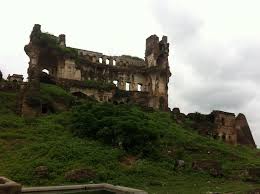
“One of the rooms of the palace was covered all over with allegorical pictures painted upon the plaster; some of them were historical and fierce enough, others highly obscene, others eminently childish. The relics of women and children always abound in these places; no room was without some plaything or bangle, or hand punkah; and reams of native paper and manuscripts lay strewn about everywhere. The atmosphere of the place smelt strongly of frankincense and myrrh, aniseed, benzoin and other delicate perfumes.”
To ensure the Banpore Raja would have no fort to return to, Sir Hugh Rose ordered Major Boileau to level it. Boileau and the sappers laid their charges and early in the evening of the 11th of March, part of the fort was blown down, “and huge fires lighted in other apartments; by nighfall it was burning brilliantly, like a grand bonfire.” When the force left Banpore the next day, it was still burning.
Their destination now was Talhebat. With the Hyderabad Contingent leading the advance, the force arrived before the fort on the 14th. They found Major Orr encamped on the plain just west of the fort. Orr reported he had found the rebels determined to hold Talhebat, and had greeted his arrival with a few well-aimed shots from the walls. But to his astonishment, instead of buckling down, they chose the cover of darkness to flee. It was a strange decision. The fort occupied the entire hill on which it stood; it had two strong lines of works strengthened by bastions and loopholes, above which was a citadel, the fort buildings, a score of temples and towers. the lowest line skirted along the lake and surrounded the entire hill. Between the second line and the fort proper were gardens, more temples and the jungle; the citadel commanded the town to the north west and provided an unbroken view of the surrounding country. Besides this, Talhebat was in a good state of repair and had the rebels had any sense, they could have prevented Sir Hugh Rose from advancing on Jhansi; at the very least, they could have stopped his progress while he took time to besiege them. It would appear his advance had thrown them into some confusion – instead of holding Talhebat, they had decided to leave it for him to take without a fight.
Once again, Sir Hugh Rose would make sure they would not occupy it again. A breach was blasted in the north side of the fort and all the guns inside were burst. Whoever he found still inside was hanged.
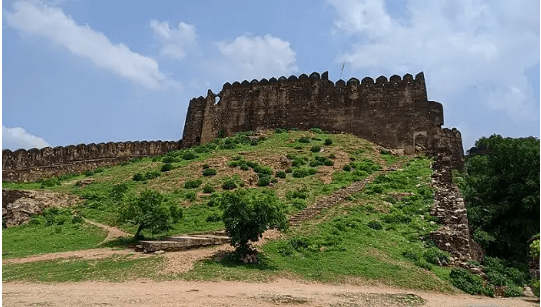
While the force remained encamped close to Talhebat, the Madras Sappers and Miners with the Hyderabad Contingent marched off on the 16th to the left bank of the River Betwa, some eight miles distant. Major Boileau was ordered to construct a bridge over the river as he had been informed it was impossible for the artillery to cross. However, careful reconnaissance proved this was false; the river was fordable, with a “capital shingly bottom,” so the men only had to construct a road to and from the river bank and pitch a camp on the opposite bank. The whole force crossed the Betwa on 17 March, the same day Stuart and the Mhow Brigade took Chanderi Fort. Sir Hugh Rose received the news the next day that the Chanderi had been taken; the rebels who had fled from that citadel were, on Rose’s orders, intercepted by the Hyderabad Contingent as they tried to run for Jhansi. He returned to camp with their horses and camels. Some rebels, thinking they would be better off giving themselves up rather than dying in the field, turned themselves in to Sir Robert Hamilton. One, a young man of Armenian descent and a Christian, volunteered that he had led the Bhopal Contingent to mutiny; he then proclaimed that he had helped loot the treasury and had since been marching with them. After listening to him with some patience, Sir Robert ordered him hanged at sunset, along with his compatriots. Pardon, it would seem, was not the order of the day.
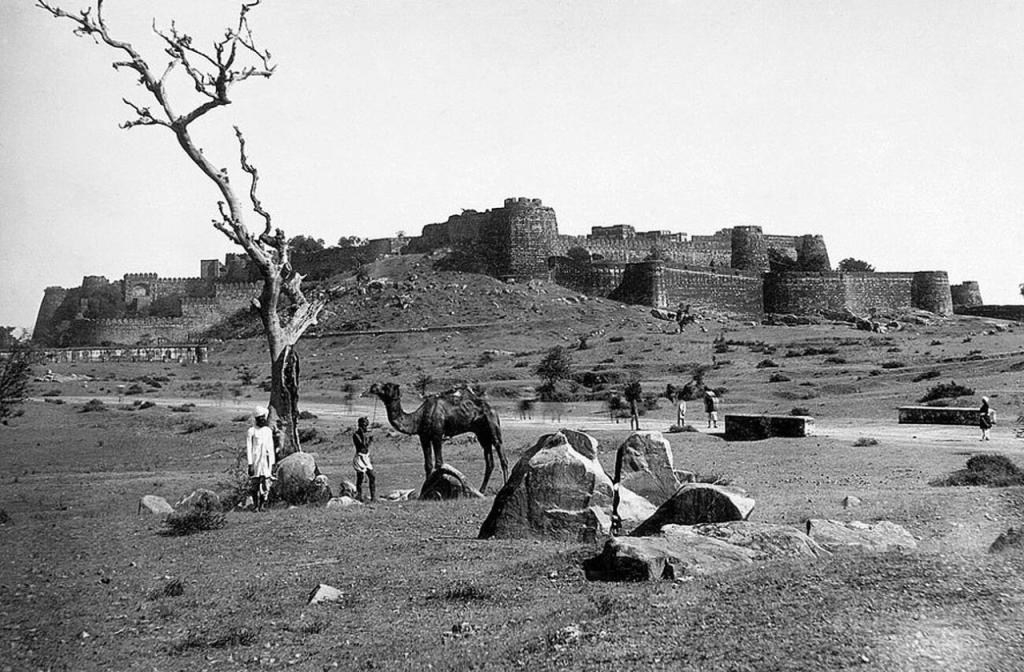
On the evening of the 19th, the force marched at midnight to Chuchunpore, a distance of 15 miles and only eight from Jhansi. With the temperature during the day reaching a staggering 40° in the shade and his men suffering from its effects, taking Jhansi would prove to be one of his hardest and longest fights.
Sources:
Central India during the Rebellion of 1857-1858 – Thomas Lowe (London: Longman, Green, Longman & Roberts, 1860)
A History of the Hyderabad Contingent – Major Reginald George Burton (Calcutta: Government of India Central Printing Office, 1905)
The Revolt in Central India 1857-59, Compiled in the Intelligence Branch (Simla: Government Monotype Press, 1908)
History of the Thirtieth Lancers, Gordon’s Horse, formerly 4th Nizam’s Cavalry, 4th Cavalry, Hyderabad Contingent, 4th Lancers, Hyderabad Contingent – Major E.A.W. Stotherd (Aldershot: Gale & Polden, Ltd., 1911)
Selections of Letters, Despatches and other State Papers Preserved in the Military Department of the Government of India 1857-58, Vol IV – edited by George W. Forrest (Calcutta: Superintendent Government Printing India, 1912)
Robson, B. (1997). THE UNKNOWN GENERAL: A REASSESSMENT OF SIR HUGH ROSE. Journal of the Society for Army Historical Research, 75(302), 93–105. http://www.jstor.org/stable/44225468
 Mutiny Reflections