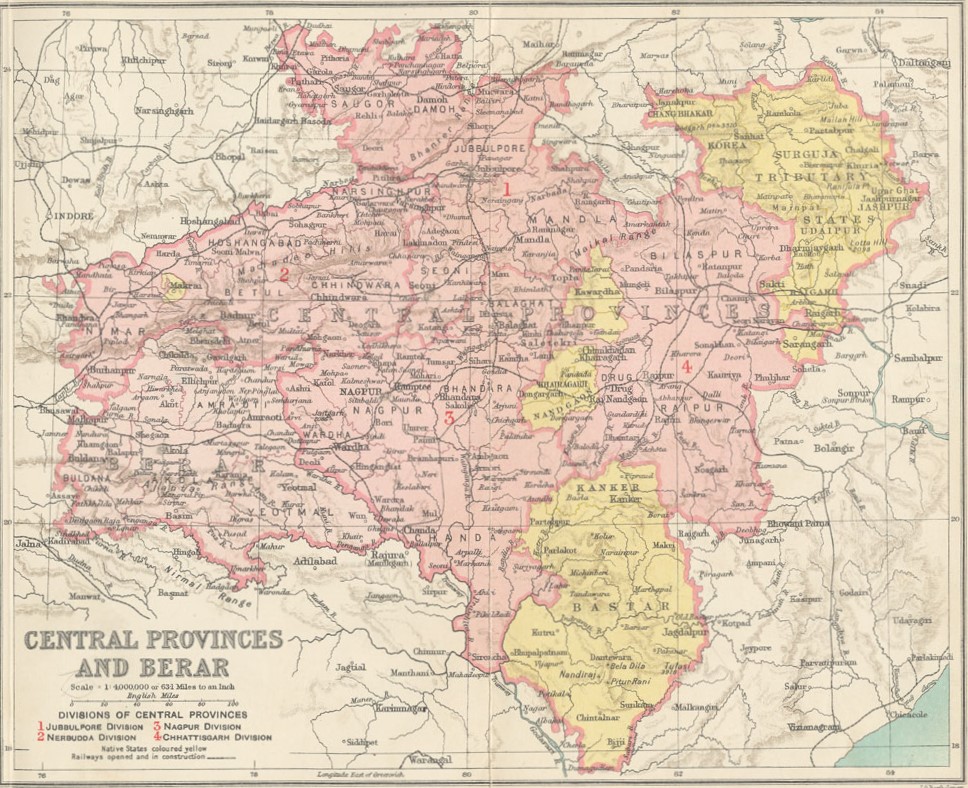
The Europeans at Sagar had been confined to the fort now for eight months — 173 men, 67 women and 130 children. Unlike Lucknow, they were not facing daily assaults, nor did they have hordes of mutinous regiments baying for their blood. Brigadier Sage and the others remained in the fort because, quite simply, they could not leave. The rebels of Bundelkhand, Shahgarh, the Sagar-Narbada Districts had invested Sagar, and occupied the forts of Sanoda and Garhakota to the east, and Narioli and Kurai to the northeast. The only exception was the fort at Rehli, which was still being held by Lieutenant Dickens with a detachment of the 31st BNI. Sage could not fight his way out, and above all, he could not allow the arsenal at Sagar to fall into rebel hands.
The majority of the 42nd BNI had mutinied at Sagar in July: 40 sepoys of the 31st had chosen to rebel, but the bulk of the 31st BNI, 50 men of the 42nd and 60 sowars of the 3rd Irregular Cavalry had chosen to remain loyal. When the rebellion happened, it was fought out between the two regiments alone; the 31st had chased their rebellious brethren from the station, without the support of their European officers, who Sage had ordered to remain in the fort. Since then, the 31st had been guarding the cantonments with the remaining sowars of the 3rd Irregulars and the 50 sepoys of the 42nd. “The men, during this trying period, cut off from all communication, and with the knowledge that succour could be sent them for many weeks, performed their duty well, and nobly maintained the character of their country, adding another to the many instances of devotion and firmness which the sepoys’ mutinies elicited.”
Unfortunately, there was little left to incite further loyalty in his men in the cantonments when, to Sage’s intense worry, the rebels from the surrounding countryside were now marching en masse on Sagar to drive him out of his fort. Among those rebels were mutinied Bengal regiments — “The importunities of their deluded comrades, who were wild with bigotry and flushed with success, the dread of being outcasts if their masters were driven into the sea, were incentives strong enough to draw the most faithful into the vortex of rebellion. No praise is too high for the sepoy who remained true to his colours.” That Sagar needed to be relieved was beyond question, but it was as much to save Sage as it was to save the sepoys of the loyal 31st BNI.
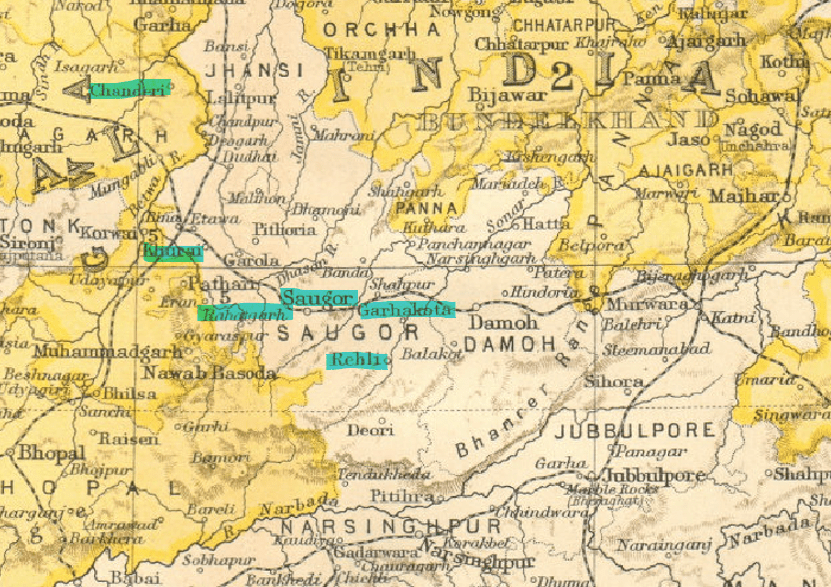
The loss of Rahatgarh had consequences for the rebels— the fort of Kurai had likewise been abandoned, those who had retired to Chandrapur and others from across Bundelkhand had decided to amass at Barodia. They were swiftly joined by the garrison that had fled Rahatgarh. Their objective now was to prevent Sir Hugh Rose from advancing on Sagar and cut off all his supply lines from Gwalior; failing that, they still had the option of placing themselves in the rear of Rose’s force, retaking Rahatgarh, and cutting off the supply line from Bhopal by taking the Bhopal-Sagar Road. If they could stop Sir Hugh from relieving Sagar, they also had the opportunity to prevent his further march to Jhansi.
Barodia
At midday on 31 January, Sir Hugh Rose marched from Rahatgarh. His objective was still the relief of Sagar; however, he would face the rebels again on what was proving to be a troublesome road. Situated 12 miles from Rahatgarh and 29 miles north of Sagar, on the left bank of the Bina River, was a small fort, surrounded by thick jungle, in the village of Barodia. His information had come from a supply escort of sepoys of the 31st BNI, who had arrived the night before in his camp the night before. They had seen rebels amassing along the road, and from what they had gathered, these were to collect at Barodia before moving on to Sagar. There was no time to be lost. Marching with Sir Hugh Rose were three troops of the 14th Light Dragoons, two troops of the 3rd Bombay Light Cavalry, twenty-five men of the Madras Sappers, the 3rd Europeans, and a detachment of the Hyderabad Contingent Field Force. For artillery, he had five guns of the Horse Artillery, four guns of Captain Lightfoot’s battery, and two 5 1/2 inch mortars with fifteen men of Captain Woolcomb’s battery under the command of Lieutenant Strutt (who was no longer under arrest). The remaining troops would stay behind under Brigadier Steuart to hold Rahatgarh.
Not to be taken unawares by either ambush or dangerous ground, Sir Hugh Rose deployed a line of the 14th Dragoons as flankers on either side of the road. The advanced guard with a file of irregulars kept an eye on the guides. Another line of cavalry remained 150 yards in echelon in front of the outward flanks of the 14th — in the event of thick jungle bordering the road, a company of infantry, in extended order, was sent on each side of it to support not just the 14th but the advanced guard. Rebel spies, lying concealed along the road and beyond it, were quickly flushed out and seized. As they approached the Bina River, Sir Hugh’s intuition regarding surprises proved correct — his flankers reported that they had perceived rebels, in force, well-hidden in the tall grass and the ravines off to the left of the river. Without hesitation, Sir Hugh ordered Lieutenant-Colonel Turnbull with his two guns to come into action; before Turnbull could get off a single shot, the rebels opened up with a crash of musketry fire, killing Turnbull’s horse with the first volley. Lightfoot’s battery was called up in support, and it quickly answered the rebels’ fire with grapeshot and round shot, the distance being too close for shrapnel. The 3rd Europeans, now in skirmishing order in front of the flanks of the guns, answered with their Enfields, momentarily quieting the rebels but not silencing them completely.
Turnbull, with the Horse Artillery, now took ground to the right in an attempt to enfilade the rebels; while he could not get a good shot at them, from his position he could see a body of rebel sowars, carrying their red standard, attempting to gain the jungle and outflank Rose’s right. Rose directed the cavalry against them, but as their officer could not find a passage down the steep slopes of the river, two rounds of spherical case were sent in the sowars’ direction. The bursting of these at close quarters caused them to rethink their endeavours and choose flight instead.
Seeing that artillery and a prolonged musketry duel were not having the desired effect, Sir Hugh Rose ordered the 3rd Europeans to charge. With Lieutenant-Colonel Liddell in front, the men swiftly took the rebels’ advanced position, then drove them from the jungle, through the ravines and away from the riverbank, which was now in Roses’ possession. It was not an easy fight. “The Afghans and Pathans fought with their accustomed courage, several of them, even when dying, springing from the ground and inflicting mortal wounds with their broad swords…”
However, driven back they were, and Rose could now see Barodia Fort. With the advantage gained by the 3rd Europeans, Sir Hugh immediately sent the Hyderabad Cavalry, supported by the 3rd Bombay Light Cavalry under Captain Forbes, across the ford, covered by skirmishers. Then Rose himself followed with the four guns of the Horse Artillery, a troop of the 14th Dragoons, with Turnbull in support. The rest of the force was ordered to advance, except Captain Hare and the Hyderabad Contingent Artillery, who remained at the ford to protect the rear.
Captain Forbes found the rebel flanks posted in the thick jungle, but they had left their centre unprotected in open ground. Without any hesitation, he charged and broke the centre, causing the rebels to retreat behind their guns, which were well-positioned in front of Barodia village. Forbes was a very wide-awake officer, observing a body of rebels retreating at no great haste towards the village; he tried to cut them off. For their part, realising Forbes intended them no goodwill, they put spurs to their horses and galloped off to momentary safety behind the guns.
On three sides, Barodia was protected by the jungle, in which matchlock men were posted; in front was a water-filled ravine, where rebel infantry lined the banks. It was work for Turnbull. He rapidly drove his guns across the ford, unlimbered directly in front of the village, and opened fire. They replied with guns and rockets. Unfortunately, Rose’s ADC, Captain Neville of the Royal Engineers, was hit in the head by the first volley of roundshot and fell dead from his horse. To assist Turnbull, Captain Lightfoot with his battery joined in the answer.
With the artillery unrelenting in the fire, the rebels were driven from their position and rapidly retreated across a wall and open ground, into the village and the surrounding jungle. Captain Lightfoot swiftly took ground to the left with his guns, and “gave them before they reached cover an enfilading and destructive fire: the 5 1/2 inch mortars threw shells into the small fort of the village and jungle into which the rebels had retired.”
With daylight rapidly fading, Sir Hugh Rose crossed the wet ravine and now seized the wall around the village, surrounding it with the skirmishers of the 3rd Europeans and the Bombay cavalry. Without any substantial resistance, Liddell could now take the village and occupy the fort. Except for a few Walayatis who stood their ground to the end, the remaining rebels had fled through the jungle, back towards Kurai, leaving their unpacked baggage behind.
Leaving Liddell and a detachment of troops to hold Barodia, Rose decided, instead of marching onwards to Sagar, he allowed his men a little rest and then returned the same night to Rahatgarh. In all, they were 15 hours on their feet, either marching or fighting, but it was a necessary move. With only a small body of troops to protect them, the siege artillery and stores were his first concern – with rebels in full flight towards Kurai, Rose could not be sure they would not stop off at Rahatgarh first. So ended the 31st of January.
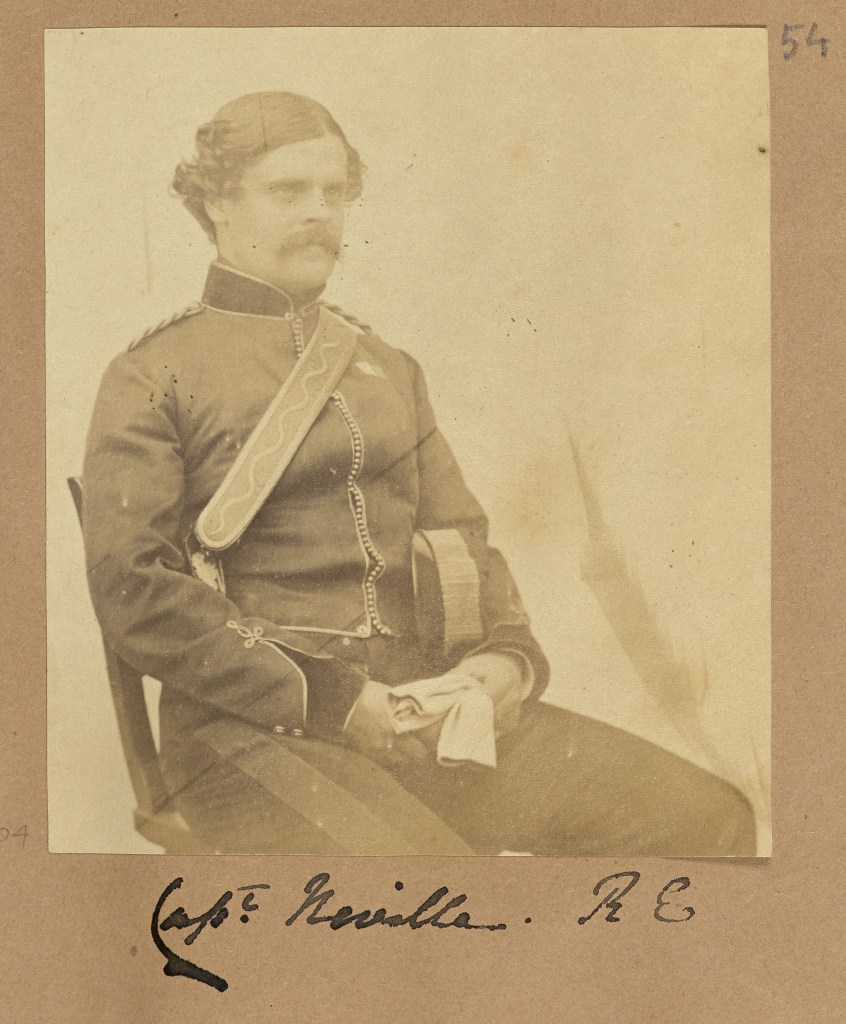
Close to Rahatgarh camp, Captain Glastonbury Neville was laid in his grave the next day – the entire force turned out for his funeral. A little mound was raised to mark the spot where now reposed his mortal remains. An honourable soldier who had come through the Crimean War without a scratch had written to his mother, the night before marching to Barodia, that he expected this would be his last battle. He was 28 years old.
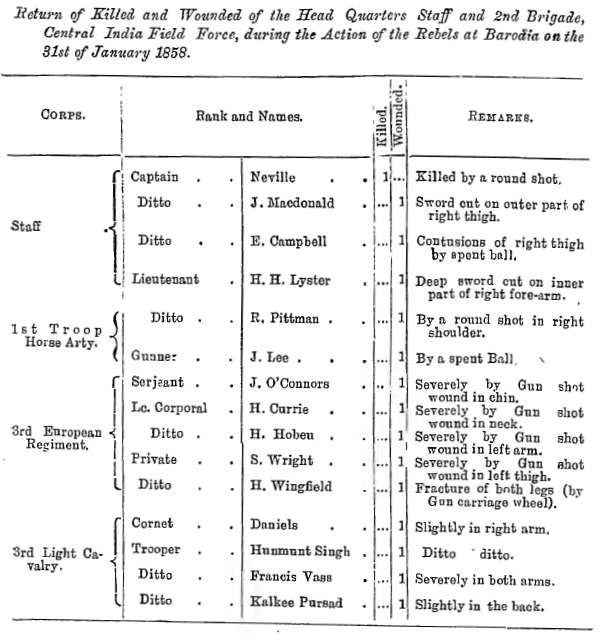
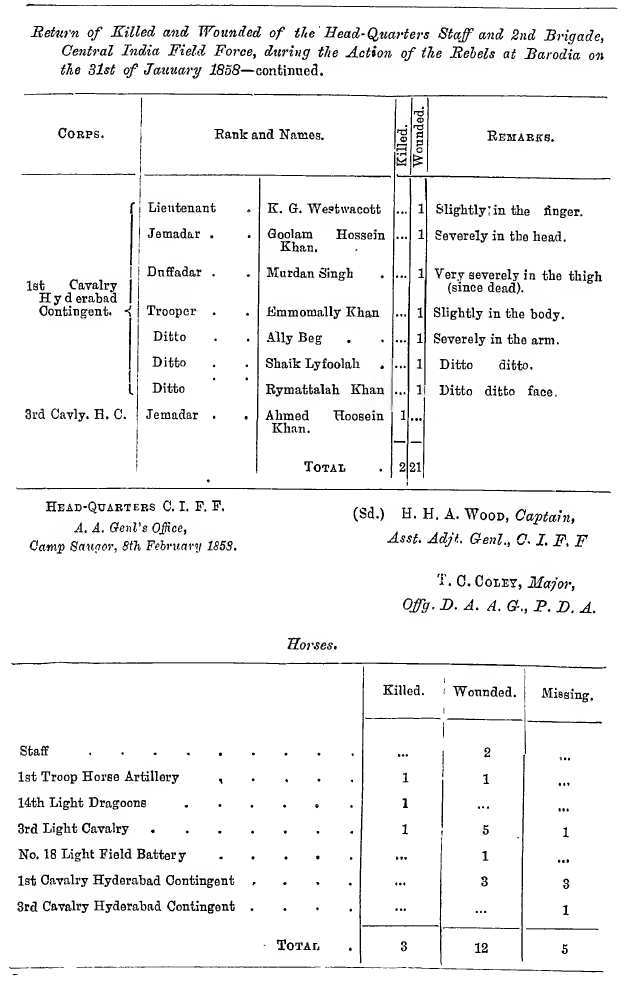
RETURNS FOR BARODIA
“The Troops behaved at Barodia with discipline and courage, keeping in very bad ground their formation and obeying with eager alacrity any orders which brought them closer to the Enemy. The 3rd Europeans, although very young and now for the first time in the Field, have qualified themselves for a career of honour; and Lieutenant-Colonel Liddell is sure to lead the way.
“I am much obliged to Captain Wood, my Assistant Adjutant General and my Staff, for the assistance which they gave me on this occasion as well at Rathghur, and I ought to add that the Officers of
my Divisional Staff, whose duties are non-combatant, still in their zeal accompany me to the Field. Captain Campbell, Baggage Master, who was hit, was very useful and intelligent in conveying my orders, and Lieutenant Lyster, my Interpreter, of the 72nd Regiment Bengal Native Infantry, was wounded when engaging the nephew of Mahomed Fazil Khan, whom he killed.
I have the honour to enclose a list of the Casualties at Barodia, as also a list of Sappers and Miners, whom Major Boileau, Commanding Engineer, wishes to be mentioned for having inspected the ditch and the breach of the Fort of Rathghur.” (From Major-General Sir Hugh Rose, K.C.B., Commanding Central India Field Force, to Colonel Green, C.B., Adjutant General of the Army)
Yes; this was the hour, and that was the spot,
And the mute trees know who fired the shot,
But the secret well they're keeping;
How they beckon and bend in the gathering gloom
O'er the sloping mound where the roses bloom!
Can that be an old forgotten tomb,
Is it there that the Colonel's sleeping? - A.C. Lyall, “Retrospection.”
Sources:
Burton, Reginald George. A History of the Hyderabad Contingent. Calcutta: Government of India Central Printing Office, 1905.
Crofton, O.S. List of Inscriptions on Tombs or Monuments in the Central Provinces and Berar. Nagpur: Government Printing, C.P., 1932.
Forrest, George W., ed. Selections of Letters, Despatches and other State Papers Preserved in the Military Department of the Government of India 1857-58. Vol. IV. Calcutta: Superintendent Government Printing India, 1912.
Intelligence Branch, comp. The Revolt in Central India 1857-59. Simla: Government Monotype Press, 1908.
Lowe, Thomas. Central India during the Rebellion of 1857-1858. London: Longman, Green, Longman & Roberts, 1860.
Lyall, Alfred. Verses Written in India. London: Kegan, Paul, Trench, Trübner & Co., 1901.
Stotherd, E.A.W. History of the Thirtieth Lancers, Gordon’s Horse, formerly 4th Nizam’s Cavalry, 4th Cavalry, Hyderabad Contingent, 4th Lancers, Hyderabad Contingent. Aldershot: Gale & Polden, Ltd., 1911.
 Mutiny Reflections