August 1857 dawned in the Ridge. The drenching monsoon rain had turned much of the area into a swamp; cholera continued to take its toll and the fighting, unabated, carried on.
Major Charles Reid wrote in his diary, for the 3rd of August:
“The engagement commenced at sunset on the 1st, lasted the whole night, and until 4 p.m. yesterday. The mutineers tried hard to get in our rear. They managed to erect a bridge across the Canal at Bussie, but it was carried away by the flood; their guns were for some time left on one side and their Infantry and Cavalry on the other. This report was sent to me by the General at about 4 p.m. on the 1st. About half an hour later, I saw the whole force returning—guns, mortars, etc.; it was joined by about 3000 or 4000 from the city, and the whole force, in all about 20,000, came straight at my position. I was prepared for them. The General sent up my supports, sharp, as he always does, and we commenced work. The ‘ Sammy House ’ was attacked first by about 5000. At this time, I had only 150 of Coke’s men in it, under Travers, and 50 of the Guides. I at once sent them reinforcements from the Rifles and the 61st (Queen’s).
“At dusk, the enemy brought up their guns, supported by a very large force, and then commenced the sharpest fire I have ever heard on the whole of my position. They were very desperate indeed. Before midnight, we had driven them back a dozen times. The firing then ceased for about a quarter of an hour, and I began to think I had got rid of my friends, but, shortly after, the moon rose, for which they apparently had been waiting, and up came fresh troops from the city, bugling and shouting on all sides. I passed the word from right to left to allow the enemy to come up close and to keep a dead silence in the ranks. On came the enemy with their light guns, up the Grand Trunk Road, as also up the Kishanganj Road. My three light guns, which were in Battery across the road, were all loaded with grape, and when the enemy were close up, they opened fire. Round after round, with volleys of musketry from the Sammy House, had the effect of driving them back again. Still, there they were, within four hundred yards of me, making preparations for another attack, whilst their light guns kept up one continuous blaze, as also their heavy guns from the Mori and Burn Bastions. This sort of thing went on the whole night: 900 men against at least 20,000! My troops behaved admirably; all were steady and well in hand, and 1 never for one moment had any doubt about the results.
“At daybreak, more troops were seen in the Kishanganj buildings, and on they came again at the Sammy House. I accordingly sent Sir E. Campbell with a Company of the 60th Rifles to reinforce the troops at that post. At 8 a.m., they gave us time to get a little breakfast, but before 9 o’clock on they came again, and it was not before 5 p.m. last evening that I had the satisfaction of seeing them in full retreat, guns and all. Thus ended the great attack, being number twenty-four on my position ! . . . I have had no return as yet of killed and wounded, and I dread looking at the reports; the enemy’s loss must have been very severe. The escapes I have had are perfectly wonderful! People look at me after every engagement and say, ‘What, are you still unwounded ?’ Thank God for thus sparing me! I hope to keep my old head on my shoulders for some time yet! Anyhow, until I have seen the Imperial City fall! These persevering villains seem determined to wear us out; our spies say they are coming out again; all ready for them!”
In the meantime, Hodson and his spies had acquired quite a reputation on the Ridge. Rumours flew hard and fast regarding his exploits, that he had disguised himself and had gone within the walls of the city, which filled the men on the Ridge with admiration; they watched his exploits with growing enthusiasm.
Although his spies were prone to exaggerating the actual state of the city behind its formidable walls, Hodson was able to correctly ascertain how much damage the force was actually inflicting on the mutineers – although it was never substantiated, it was widely believed when the rebel magazine blew up in August, it was Hodson’s doing. Having reported to him that the mutineers were manufacturing their own powder and informing him it would be possible to blow it up, Hodson supposedly promised the men 1000 rupees if they succeeded. On the 7th of August, the magazine did indeed blow up, but since no one ever returned to claim the reward, it could not be affirmed by anyone that it was Hodson’s doing. For his part, he does not mention it in any letters.
Delhi Quarrels
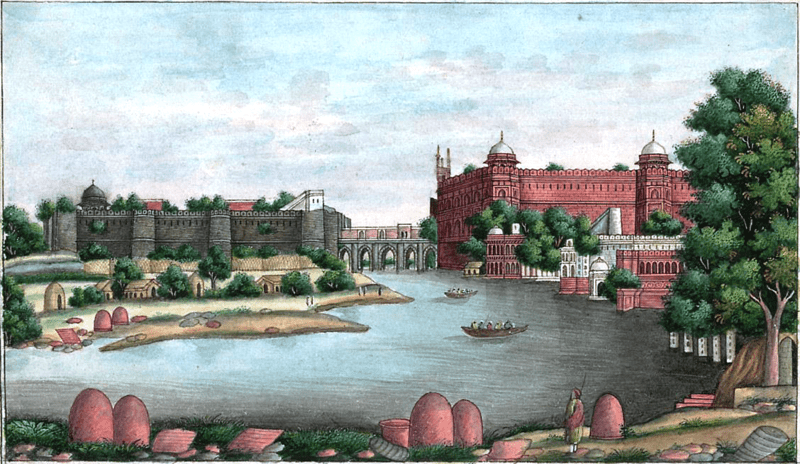
The state of affairs within the walls was anything but tranquil. The sepoys of the various mutinied regiments, instead of covering themselves in glory, were reduced to squabbling for pay with the king, and as August rolled along, they became harder and harder for General Bakht Khan to control. When he complained to the king, he replied the general should send them away. Meanwhile, Bahadur Shah, his coffers emptying faster than he could fill them, was disgusted at his impromptu army. They had failed to take the Ridge, they had not even come close to securing him the victory he had envisioned. With 60’000 men at his disposal, they had not even “won a clod of dirt from the English.” while the ever-enthusiastic Jihadis complained they were the only people who were earnestly fighting the English, everyone else were like “people sitting down and making no exertions.” Meanwhile, the explosion of the magazine only added to Bahadur Shah’s worries – rumours soon flew around Delhi that he had orchestrated it in an attempt to kill off the sepoys. In their turn, they decided to attack the king, plunder his house and take his head instead. Nothing came of it.
The harassment of the citizens of Delhi continued unrelentingly. One day, as an excuse to plunder their houses, they were accused of harbouring Englishmen; on another, they were accused of spying for the English. Extortion was the last resort, with several citizens rounded up in August and told they were to pay up or face imprisonment. The residents of Sabzi Mandi had had enough and sent a petition of their own to Theophilus Metcalfe, telling him of their utter destitution, to which Metcalfe had replied they should not fret, for the English would be with them soon.
As for the army, many disillusioned sepoys quietly left the city, abandoning their arms as they headed for home. General Bakht Khan was coming to his wits’ end – unable to convince the king that he was receiving bad advice, he proclaimed he would no longer run the army but satisfy himself by commanding the Bareilly Brigade, something the King would not hear of. Meanwhile, the sepoys complained they were starving. When the King ordered they be fed, the commissariat officer claimed he could not do so; he had no money.
In all this time, there was no one leading the army. General Bakht Khan was embroiled in petty politics, surrounded by wily courtiers and scheming princes. Jealousy was rife between the various regiments, each one accusing the other of transgressions, of spying, of not pulling its weight, and in the middle of it all sat a King staring at the ruins of his empire.
The 12th of August
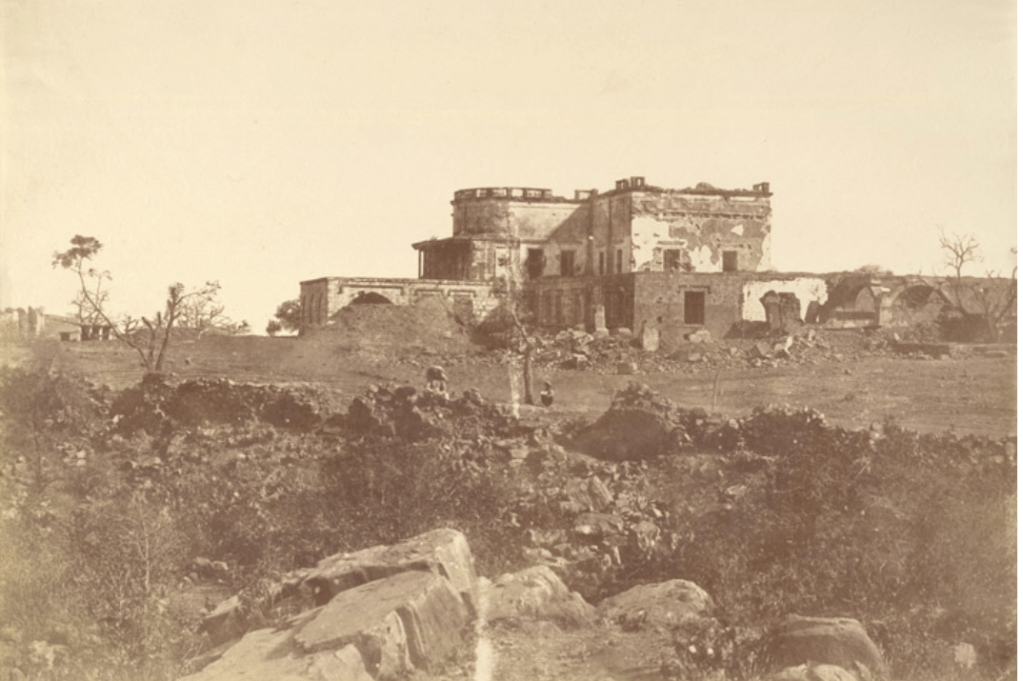
August was not quiet on the Ridge. The cycle of attack and repulse continued undaunted, and the losses on the side of the British, although less than July, did not cease. In one attack alone, on the 6th, four officers were killed or wounded, among them Lieutenant J.H. Browne lately of the 33rd BNI, now attached to the Kumaon Gurkhas. On the 8th, the mutineers attempted to build a battery at Ludlow Castle and continued a harassing fire on the Metcalfe piquet. It was therefore decided to capture Ludlow Castle and capture the guns that were causing such a nuisance.
To achieve this, a strong body of men was assembled on the night of the 11th, consisting of 200 men of the Guides Cavalry, 1200 of infantry from the 8th, 75th and the 1st and 2nd Fusiliers, eight guns, a squadron of HM’s 9th Lancers, Coke’s Rifles, and the Kumaon Battalion of Gurkhas, all under the command of Brigadier G. Showers, sufficiently recovered from a wound sustained on the 23rd of July.
By four o’clock in the morning, they were ready to advance.
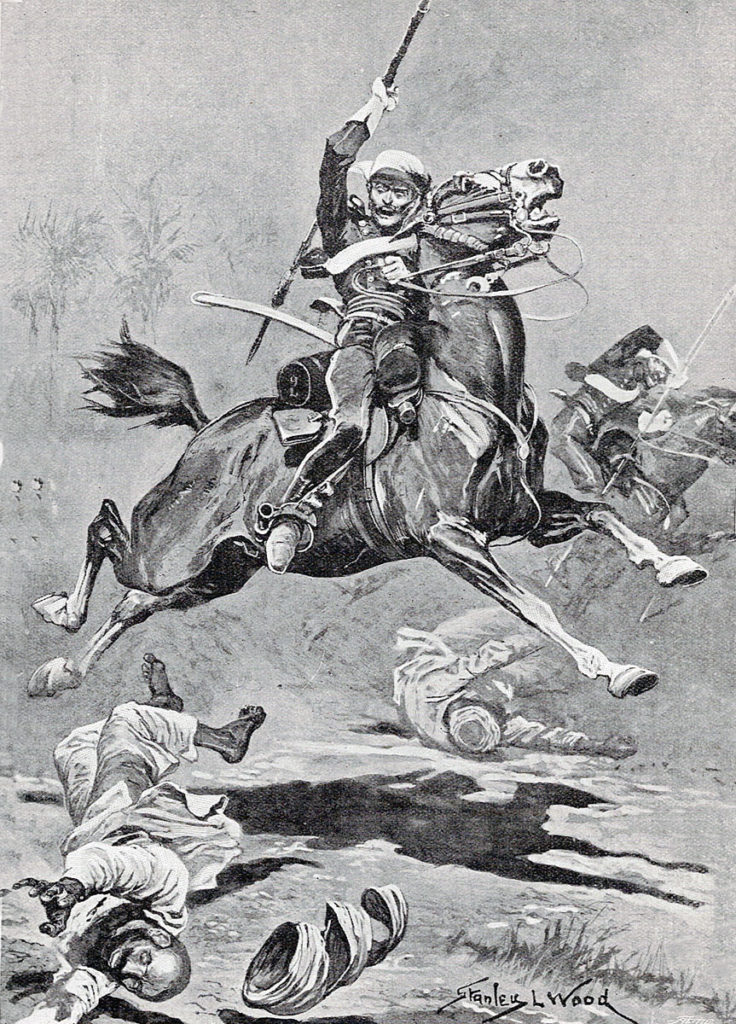
As ordered, the column, with infantry on either side and the artillery on the road, moved as silently as possible on the rebel’s position. As plans go, this one was a rousing success. The British succeeded in sneaking up to the rebel post and, sending a volley of musketry fire into the lines, which the mutineers had no chance of returning with any effect, being caught completely off guard, the British rushed the battery. The rebels managed to fire off two guns, but the third was stopped by Private Reegan, who dashed forward and bayonetted the artilleryman, who fell with his lighted portfire. The rest of the gunners put their backs to the waggons, fighting furiously until they too fell dead. For half an hour, a murderous fire raged, but the rebels had no chance. After a spirited fight, they turned and fled.
The 9th Lancers, although called to the column, were held back. Forced to sit mounted under fire, Brevet Major Octavius Anson observed,
“Strange to say, what between Pandy’s fright and his having been caught napping, he fired so high and badly that we had only two men wounded and five or six horses. One man was wounded close to me, young Whelan, by a spent ball. The ball did not go through him, but lodged in his side, inflicting a dangerous wound.”
The objective was achieved – all four guns were captured, and the Metcalfe picquet was saved from their fire, while Ludlow Castle now became part of the Ridge defences. The fight, though short, cost the British heavily. Brigadier Showers was once again wounded, suffering a long slash on the surface of his chest and a smashed finger on his right hand. Coke too was wounded as was Lieutenant Greville, who had captured one of the four guns with a handful of men, and a young lieutenant named Sheriff was killed. A further eight were wounded and one hundred and ninety men “hors de combat”.
However, they still came back to camp triumphant.
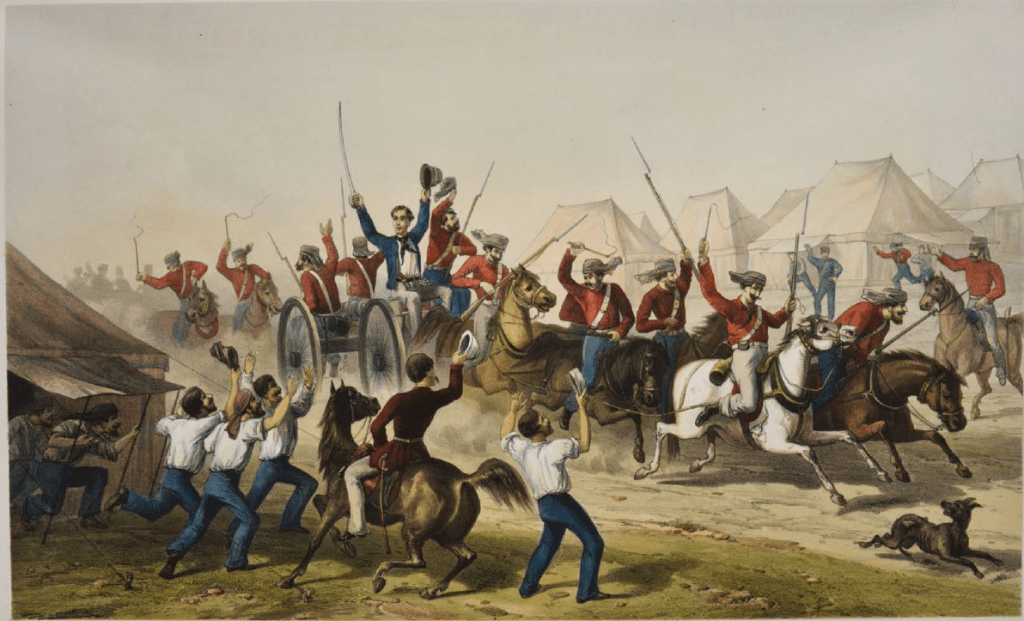
“The return to camp was a scene worth witnessing, the soldiers bringing home in triumph the guns they had captured, a soldier with musket and bayonet fixed riding each horse and brave young Owen astride one gun, and dozens clinging to and pushing it, or rather them, along with might and main, and cheering like mad things.”
Rohtak
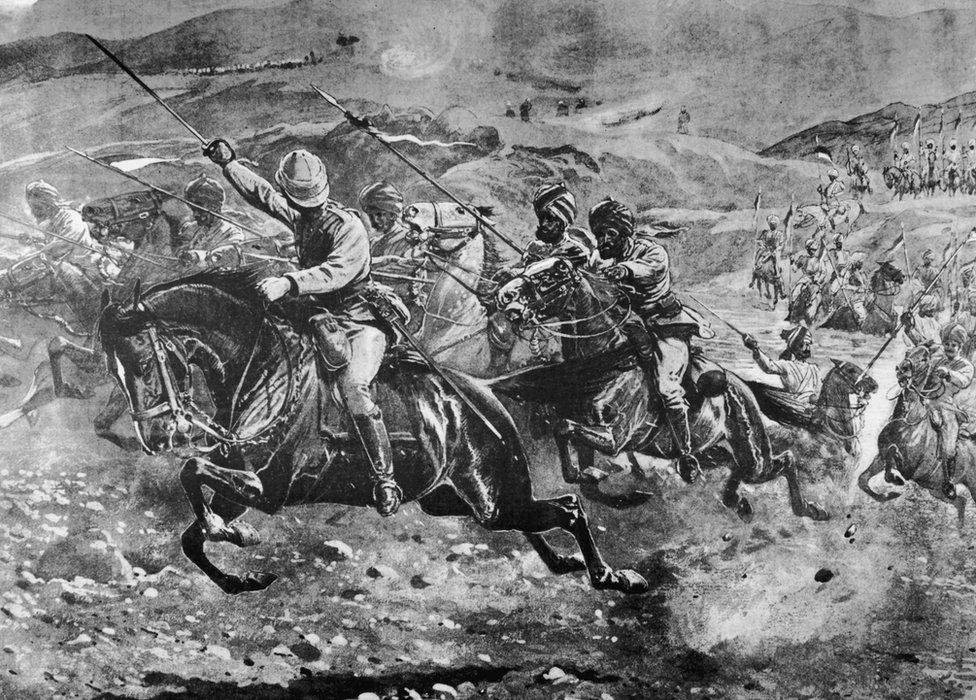
The very day the long-awaited siege train from the Punjab arrived on the Ridge, intelligence was received that a body of mutineers, mostly cavalry, had been sent out to cut off communication with the Punjab. The task of “watching” them was given to William Hodson. For this mission, Hodson took with him six European officers, a hundred Guides Cavalry, 25 Jhind horsemen and his own corps of 233 men who, in his estimation, were
“…merely an aggregation of untutored horsemen, ill-equipped, half-clothed, badly provided with everything, quite unfit for service in the usual sense of the term, and only forced into the field because I have will that it shall be so…”
Their warlike appearance, however, impressed those who saw them leave the Ridge – dressed in their khaki tunics with a scarlet sash and scarlet turbans, “the wild brave men from the border, ready to die for the one who knew how to command and lead them.” Hodson was taking a great personal risk leading his untried corps into battle, but if he was to prove their mettle, it was now. They left Delhi on the night of the 14th of August. The objective was to secure communications with the Punjab and teach the rebels a lesson. The first stop was the village of Khurkundah, where Hodson had been informed a troop of the Irregulars had taken refuge. Surprised by Hodson, the mutineers put up a spirited fight, but ultimately, Hodson prevailed, and the Irregulars were destroyed to a man. He then set his force to “reconnoitre and harass” a large body of cavalry and infantry, with two guns, who had been moving away from Delhi, willfully plundering villages in their path, though the ultimate goal was to attack Hansi. For their part, the mutineers were aware Hodson was not far behind, and they, believing “discretion the better part of valour”, quickly disappeared before Hodson could catch up.
The incident at Khurkundah was mired in some controversy, but only later – this can be read in full in T.R.E. Holmes, Appendix N, III p. 603 in the 4th edition. As it is currently not in the scope of this post to address it, this too shall be looked at in more detail in a different post.
Hodson’s objective, however, was Rohtak, and he wrote the following letter to Colonel Becher, Quartermaster General:
My dear Colonel,—We are getting on very well. I hope to take Rohtuck today, and I trust the arrangements
will be made for keeping it. The country will then be quiet from Hansie to Delhi. The Jheend Rajah should be told to take care of the district. I believe Greathed did make this arrangement, but Barnes put some spoke in the way so that the Rajah is uncertain about how to act. Please tell Greathed from me that there is nothing now to prevent the restoration of order here. I wish I had a stronger party, for though I feel quite comfortable myself, yet I should like more troops, for the sake of the men, who are not quite so easy in their minds.
The road by Alipore, Boanah, and Khurkundah is the best. The canal is easily fordable at Boanah, and just below that place (at the escape), it is quite dry, the banks having given way. We polished off the Khurkundah gentry in style, though they showed fight to a great extent. It has had a wonderfully calming effect on the neighbourhood. I hope the Jheend troops, or some troops, may be sent here. The Jheend men would more than suffice.—Yours very sincerely,
W. S. R. Hodson.
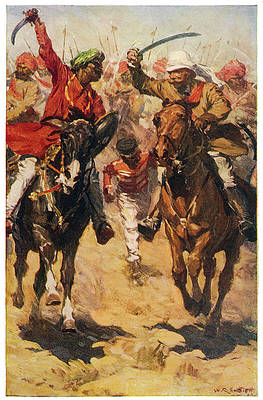
Hodson had a plan, and now he intended to carry it out.
Reaching Rohtak on the 17th, Hodson found a large part of the population had turned out with a crowd of Irregulars, “drawn up on the walls,” while the rest waited on a mound outside. He rode forward with Captain Ward and a few orderlies to take a lay of the land, when the mutineers fired and dashed towards Hodson.
Hodson sent word for his cavalry to come up while he rode back slowly, intending to draw as many of the insurgents out into the open field as possible. As soon as the leading troop came up, Hodson swung around and ordered the charge. “We dashed at them and drove them helter-skelter into the town, killing all we overtook.”
He then encamped his men in what was left of the kutchery compound for what would turn out to be a quiet night. The rest of the population, better disposed than others, slowly approached Hodson, offering his men food and supplies and food for their horses. The morning, however, proved less restful.
During the night, word had been sent to 300 irregular horsemen of the mutineers – the 1st, 13th and 14th – headed, as they had been the night before, by Babar Khan, the chief of the Ranghar tribe. Accompanying them were no less than 1000 infantrymen. Their intention had been to attack Hodson before he had time to prepare his men; they were outwitted by his spies. Hodson had received notice earlier of the intended attack – as such, he had ordered his men to keep their horses saddled, and as the rebel cavalry came at a gallop down the road, Hodson and his men were ready. His strategy was simple.
“To drive them scattering back to the town was the work of only as many more, and I then, seeing their numbers, and the number of matchlocks brought against us from gardens and embrasures, determined to draw them out into the open country; and the ‘ ruse’ was eminently successful. I had quietly sent off our little
baggage unperceived half an hour before so that I was, as I intended, perfectly free and unfettered by
impedimenta of any sort. I then quietly and gradually drew off troop after troop into the open plain about
a mile to the rear, covering the movement with skirmishers.
“My men, new as well as old, behaved coolly and admirably throughout, though the fire was very annoying, and a retreat is always discouraging, even when you have an object in view. My officers, fortunately, first-rate ones, behaved like veterans, and everything went on to my complete satisfaction.
“Exactly what I had anticipated happened. The enemy thought we were bolting and came on in crowds, firing and yelling, and the Sowars brandishing their swords as if we were already in their hands, when suddenly I gave the order, ‘Threes about, and at them.’ The men obeyed with a cheer; the effect was electrical; never was such a scatter. I launched five parties at them, each under an officer, and in they went, cutting and firing into the very thick of them.
“The ground was very wet, and a ditch favoured them, but we cut down upwards of fifty in as many seconds. The remainder flew back to the town, as if not the Guides and Hodson’s Horse but death and the devil were at their heels. Their very numbers encumbered them, and the rout was most complete. Unfortunately, I had no ammunition left and therefore could not, without imprudence, remain so close to a town filled with matchlock men, so we marched quietly round to the north of the town and encamped near the first friendly village we came to, which we reached in the early afternoon. Our success was so far complete, and I am most thankful to say, with very trifling loss, only two men were rather severely wounded,
eight in all touched, and a few horses hit. Macdowell did admirably, as indeed did all. My new men, utterly untrained as they are, many unable to ride or even load their carbines properly, yet behaved beyond my most sanguine expectations for a first field, and this success, without loss, will encourage them greatly.”
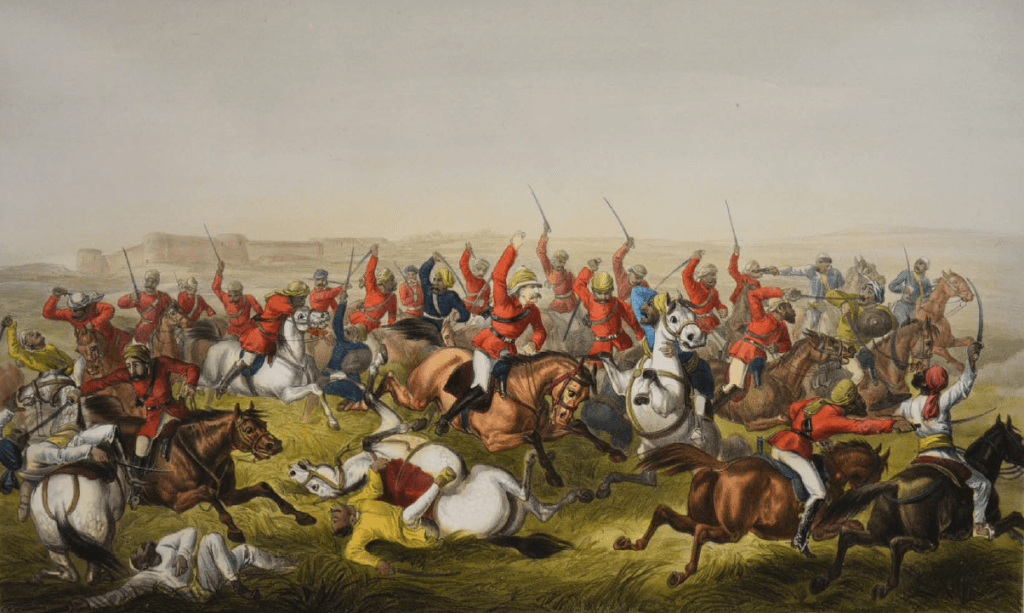
Hodson was soon joined by reinforcements sent by his friend, the Jhind Raja, who supplied him with an additional 400 men and ammunition. In three days, he had frightened away a force no less than 2000 strong and had set an example that sent shock waves through the immediate countryside, a taste of what was to come if they stirred up trouble in the future. It was, however, a small lesson compared to what Nicholson would do at Najafgarh.
Sources:
Letters Written During the Siege of Delhi by H.H. Greathed Esq, -edited by his Widow (1858)
Twelve Years of a Soldier’s Life in India Being Extracts from the Letters of the Late Major W.S.R. Hodson, B.A . – edited by his brother, the Rev. George H. Hodson, M.A. (1859)
History of the Siege of Delhi by an Officer Who Served There – W.W. Ireland (1861)
The Indian Mutiny of 1857 – Colonel G.B. Malleson, C.S.I. (1891)
With HM’ 9th Lancers During the Indian Mutiny – the Letters of Brevet Major O.H.G.S Anson – edited by his son, Harcourt S. Anson ( 1896)
The Siege of Delhi in 1857, A Short Account – compiled by Major-General A.G. Handcock C.B. (1897)
Two Native Narratives of the Mutiny in Delhi, Translated from the Originals – Charles Theophilus Metcalfe, C.S.I., (1898)
Delhi-1857 – edited by General Sir Henry Wylie Norman and Mrs Keith Young (1902)
Delhi Past and Present – H.C: Fanshawe, C.S.I. (1902)
A History of the Indian Mutiny – T. Rice Holmes (1904)
Richard Baird Smith – the Leader of the Delhi Heroes in 1857 – Colonel H.M. Vibart, R.E. (1907)
The Punjab and Delhi in 1857 Vol II- Rev. J. Cave-Browne M.A. (1911)
The Red Fort – An Account of the Siege of Delhi – James Leasor (1956)
Delhi in 1857 – N.K. Nigam, M.A. (1957)
The Great Mutiny, India 1857 – Christopher Hibbert (1980)
The Siege of Delhi -Mutiny Memories of an Old Officer – Richard Barter, (London, the Folio Society, 1984)
 Mutiny Reflections