Only Fit to Lead Italian Banditti — William Hodson
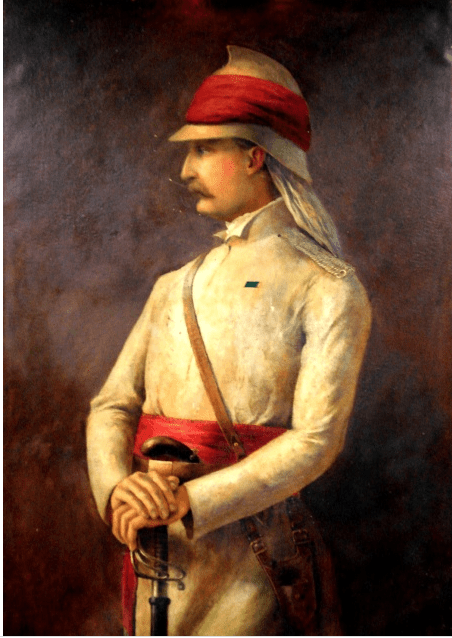
As we shall meet William Hodson on a few occasions on our journey through the Indian Mutiny, it is only fair we meet the man himself.
The son of a clergyman, William Hodson had been schooled at Rugby and then at Trinity College, Cambridge. After taking his degree in 1844, he joined the EICo army. In 1845, Hodson arrived in India. He started his career with the 2nd Grenadiers. Just before the commencement of the Battle of Sobraon, he changed to the 16th Grenadiers (as his regiment had been sent to the rear to guard the roads, Hodson put in for a transfer) and finally landed a posting in June 1846 with the 1st Bengal European Fusiliers. Sir Henry Lawrence viewed the 25-year-old Hodson with much interest and stated he had “seldom met so promising a young fellow.” Lawrence took Hodson with him in October to Lahore and Jammu, initiating him into the work of a political officer. It was a stepping stone many coveted, but few received under the tutelage of Henry Lawrence himself. In 1847, Hodson once again proved himself of service to his mentor, building the first Lawrence Asylum. Lawrence had other ideas for Hodson’s career — the same year, Hodson found himself second in command of the newly raised Corps of Guides and assistant to the resident at Lahore. In 1849, Hodson transferred again — this time into civilian life, as Deputy Assistant Commissioner, on the advice of Henry Lawrence. It was a byway of completing Hodson’s education to be what Lawrence wanted, well-rounded fighting men who were as at home in the saddle as at a desk. Men who thought nothing of living months under canvas administering districts larger than England, single-handedly if they had to, men who could think on their feet and carried on their shoulders the courage of lions.
In 1852, when Lumsden left for England, the command of the Corps of Guides was given to William Hodson.
Taking the lead in December that year, Hodson found himself once again on active service. Covering the Guides as he says, “in glory and dust”, Hodson was praised for his fine handling of the men and, above all, his cool bravery under fire. His career was heading for finer heights than even he had ever expected.
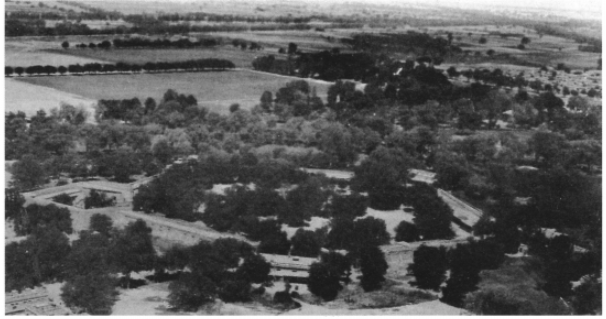
In 1854, Hodson was entrusted to build a fort for his “876 wild men and 300 wild horses,” despite being “in charge of the civil administration of a district as lawless as Tipperary.” However, he threw himself into the project with his accustomed enthusiasm and in less than six months, he had built the new home of the Guides, which would remain their headquarters for another 90 years.
However, fate was unkind to William Hodson. Following his marriage to Susan Henry, the widow of John Mitford, in 1852, the couple was blessed with a daughter, whose little being, writes Hodson, won their hearts with her extreme sweetness. At her untimely death at the age of 18 months, Hodson felt he and his wife had lost everything. Shortly after, the tides turned against him in more ways than one. His rapid appointment to the commander of the Guides and his unswerving support from Henry Lawrence and then from Colonel Mackeson, the Resident at Peshawar, had given Hodson more enemies than he cared to admit. Petty jealousy of position by men less talented than him Hodson could brush away, but their attack on his very character was harder to ignore.
The Long Fall of William Hodson
He had assumed command of the Guides at the behest of Harry Burnett Lumsden, the man who had raised the corps in 1847 – Hodson had received the posting by the merit of his actions with the Guides and not as supposed favouritism. However, as John Lawrence pointed out, ” Hodson is, I believe, very unpopular, both in the Guides and with military men generally. I don’t know exactly why this is. It cannot be that he has got promotion too early, for, though a young soldier, he is almost a middle-aged man. He is an officer of first-rate ability and has received an excellent education. He is gallant, zealous, and intelligent, and yet few men like him. It is the case of the famous Dr Fell, whom the young lady did not like but could not tell why she did not do so.”
His promotion to the command of the Guides had ruffled a few feathers, mainly those of men who felt their claims to the post were higher than his, including two officers in the Guides- One, Lieutenant Turner showed Hodson such enmity he was only too relieved when Turner transferred to the Punjab Cavalry. The rumours around Hodson continued – John Lawrence felt he was implementing changes within the regiment with too much haste. “I don’t think that Pathans can bear a very strict system of drill and setting up at any time. For all these reasons, therefore, I would introduce my reforms very slowly and carefully, carrying them out in a way as little vexatious as possible.” It is very likely that Hodson, in his zeal to impose his own characteristic ideas of military discipline, had acted in a manner seen as ruthless by his superiors. One such case was that of Fathi Khan, a hot-headed sowar in the Guides, who even Lumsden admitted finding the “retired freebooter very hard to manage.” Described by Lawrence as “a perfect devil when his blood is up, and this is very often. At such a moment, he would murder his nearest and dearest relative or friend,” but it was Hodson who felt that Fathi Khan had no place in the Guides. He then infuriated his English subalterns by getting rid of many Pathans and Afridis as well, on grounds of finding them faithless. Yet it was the arrest of one Khadar Khan that sealed Hodson’s fate in the Guides.
Already under investigation for embezzling regimental funds, Hodson now arrested the border chieftain, Khadhar Khan, on the charge of plotting the murder of Mackeson and the attack on Lieutenant Godby of the Guides. Frederick Mackeson had been the Deputy Commissioner at Peshawar and a personal friend of Hodsons when he was stabbed to death on his verandah by a religious fanatic. Although the assassin was caught and hung, Hodson believed there was a greater plot behind it, and the attack on Lieutenant Godby only furthered Hodson’s thoughts. In spite of the evidence presented by Hodson at Khan’s trial, the chief was acquitted and all his property restored to him, which Hodson had confiscated.
As for Hodson, he was charged with the wrongful imprisonment of Khadar Khan and if that was not enough, it was recommended he should never hold another civil appointment again – a court of inquiry brought on by the allegations of Lieutenant Turner that Hodson had persistent falsified accounts and had in this matter, acted with gross negligence. Unfortunately for Hodson, Turner also wasted no time in slandering him in Peshawar society, and the rumours began to run. Although an exhaustive report was prepared by Reynell Taylor who had the very troublesome task of making sense of two years’ worth of Guide’s accounts, the conclusion he drew was the accounts had been handed over to Hodson in a chaotic state and although irregularly kept, once Taylor had completed the calculations could find no evidence to support the claims of fraud.
Unfortunately, his detractors continued their tales, and fairly soon, it was understood that Hodson had lost command of the Guides because of faulty bookkeeping. He had been relieved due to the affair with Khadar Khan – a separate issue that rode on the same coattails. Taylor’s final report was virtually suppressed, and Hodson’s reputation was ruined.
He also had no one to defend him – Henry Lawrence was gone, and Mackeson dead to an assassin’s blade, Hodson had to face a court of inquiry in 1855 alone. The principal charge against Hodson was the undeniable irregularity and confusion regarding the regimental accounts. He had inherited a very wild set of books from Lumsden, and what with his several duties and the campaigns of the Guides, it was a case of irregular naughts that led to his dismissal from the Guides. Although the report was finally forwarded by Major Reynell Taylor, which effectively acquitted Hodson of all wrongdoing, it still had not reached the Commander-in-Chief by February 1857, a full year after it had been sent. Hodson subsequently found out it had never been communicated to anyone in Government at all, and Dalhousie had left India with the original accusations ringing in his ears that Hodson was no better than a thief who had cooked the regimental books for his own advantage. It was a bitter blow to Hodson. His career with the Guides was effectively over; he had been suspended for some time without pay and sent back to his regiment, a lowly subaltern, to the 1st Bengal Fusiliers in 1856. He was appointed quartermaster, where he so impressed his commanding officer, Lieutenant Colonel Welchman wrote him a glowing testament.
“All that malice could invent or ingenuity distort was brought forward to give importance to the accusations laid against him. Every trifling irregularity or error of judgment was so magnified that a mighty fabric was raised on a single grain of truth, and the result was that towards the close of the year, he was summoned before a committee of inquiry at Peshawar.’
It is impossible to do otherwise than believe that this officer’s numerous qualifications are virtually lost
to the State by his being employed as a regimental subaltern, as he is fitted for, and capable of doing great justice to, any staff situation; and I am convinced, that should his Excellency receive with approval this solicitation to confer on him some appointment suited to the high ability, energy, and zeal which I fear I have but imperfectly brought to notice, it would be as highly advantageous to the service as gratifying to myself. An officer whose superior mental acquirements are fully acknowledged by all who know him; who has ably performed the duties of a civil magistrate in a disturbed district; whose knowledge of engineering has been practically brought into play in the construction of a fort on the North-Western frontier; whose gallant conduct in command of a regiment in many a smart engagement has been so highly commended, and by such competent authorities, is one whom I have confidence in recommending for advancement; and in earnestly, yet most respectfully, pressing the recommendation, I plead this officer’s high qualifications as my best apology..”
Yet the apology owed him was not forthcoming, and Hodson continued to languish in Dagshai. When his application to join the force going to Persia was rejected, he finally presented his case to Anson himself in Simla. However, he was also fixed on the idea of going to Calcutta to lay his case in person in front of Lord Canning. Hodson outlined three courses of action open to him in a letter to his wife:
“1st. Suicide.
2nd. To resign from the service in disgust and join the enemy.
3rd. To make the Governor-General eat his words and apologize.
I chose the last.
The first was too melodramatic and foreign; the second would have been a triumph to my foes in the Punjab—besides, the enemy might have been beaten! I have determined, therefore, on a trip to Calcutta.”
The meeting with Anson was cordial, polite and effective. Anson promised he would write to Lord Canning himself, and in the meantime, Hodson should remain at Dagshai until he received an answer.
It was fortunate for Hodson, and indeed for all India, that by Anson’s advice, he waited on at Dagshai until the answer from Calcutta should reach the commander-in-chief. ” I should undoubtedly have been murdered at some station on the road,” he afterwards said. ” The answer never came. It must
have been between Calcutta and Aligarh when disturbances broke out, and was, with all the daks for
many days, destroyed or plundered.”
Hodson was not entirely friendless. Those who knew him were well aware that while he might be a difficult man, he was certainly not the rogue the Punjab men had painted him out to be. Reverend Slogget, the chaplain at Dagshai, who knew Hodson well, presented Reynell Taylor’s report to his dear friend, Colonel Chester, who in turn, promised to take it up with Anson himself; another was the judge advocate general, Keith Young: Young had never met Hodson, but the report convinced him of one thing – there had been an injustice, grave enough to have cost Hodson his reputation; amends needed to be made and together with Colonel Chester, they set out to secure Hodson a new appointment.
Then the mutiny happened.
“It was, I think, just a week after I spoke to them that the Mutiny broke out at Meerut, and for months afterwards there was no direct postal communication with Calcutta. General Anson, therefore, gave Hodson a staff appointment on his own responsibility, and he soon justified the selection, for it is doubtful if there was another man in the whole army who could have supplied his place.” (Mr Sloggett’s letter to the Rev. G. H. Hodson, 1882.)
As events showed, Hodson marched down from Dagshai on the behest of Anson, who was collecting men for the Delhi Field Force as Anson’s quarter-master general. He empowered Hodson to raise 1000 irregular horse and placed him at the head of the Intelligence Department. He further sent him to Karnal to restore communications between that place and Meerut.
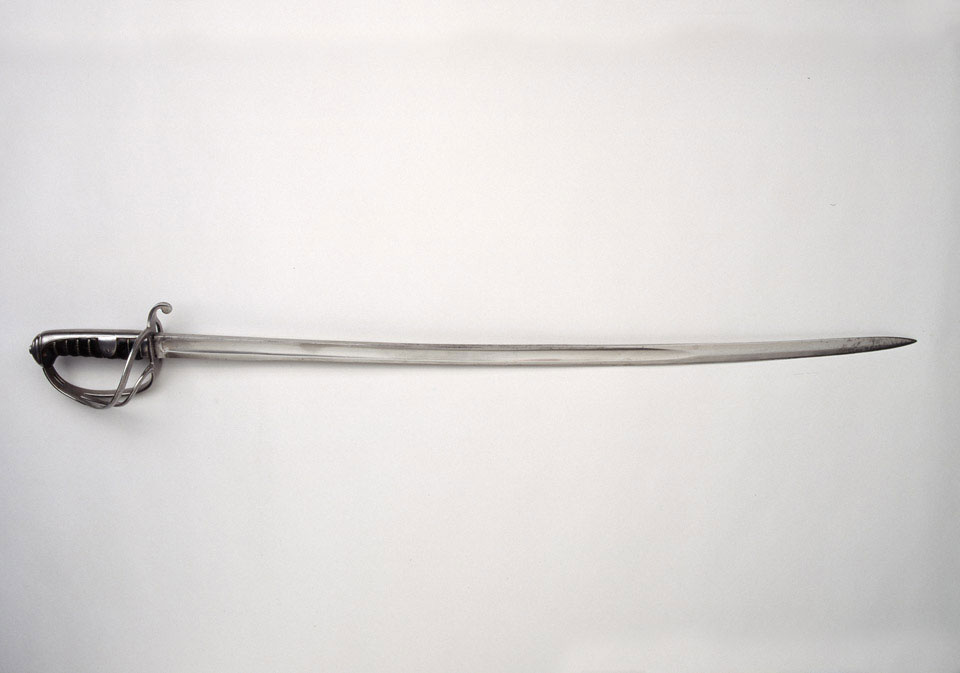
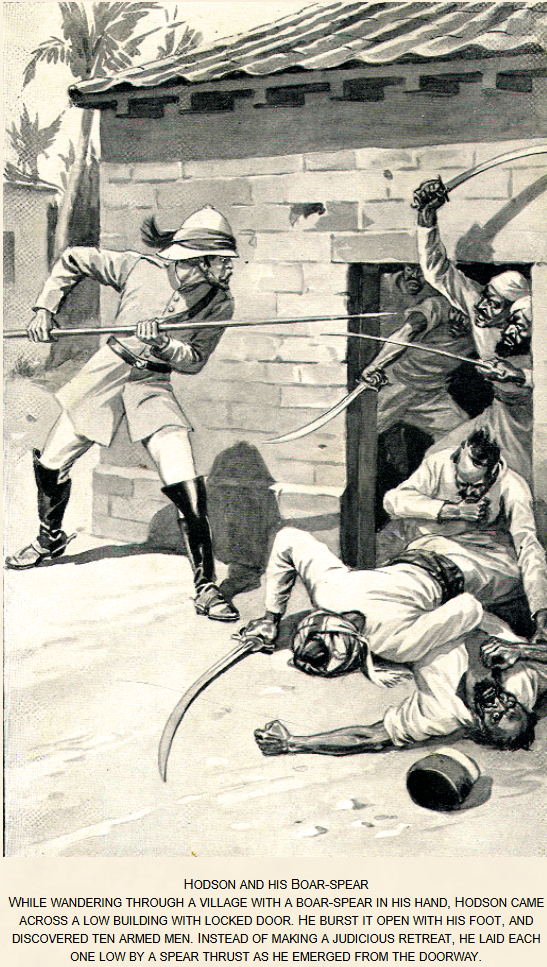
As such, it was Hodson who rode the 250 miles in the searing heat of May, and it would be Hodson who would organise spies for the Delhi Ridge. Whatever grudge the government bore him, he was still a man of duty, and when there was a battle to be fought, William Hodson was never far behind. An excellent swordsman and an intrepid cavalryman, although Hugh Gough thought he was something of an “ugly rider”, Hodson threw himself with such spirit into every battle he could, leaving some of the men thinking he was quite mad and leading Surgeon Edward Hare to remark that he “was only fit to lead Italian banditti.” Lieutenant Fairweather of the 44th remarked,
“It was beautiful to see him riding a little in front and the centre of his troops, and to see how quietly he controlled their eagerness to press on by motioning them back, first on the right, then on the left, by a mere wave of his hand, as he passed the hog-spear (the weapon he always used) from one hand to the other while he rolled up his sleeves…” then when it came time to charge, Hodson would shout, “Come along, lads, the fun’s begun!” Waving his spear in the air, he would then let loose a stream of abuse and mockery on his opponents in English and their own language. One officer later wrote,
“I fancy I see him now, laughing, parrying most fearful blows, as calmly as if he were brushing off flies, calling out all the time, ‘Why, try again now!’ and ‘What’s that? Do you call yourself a swordsman?”
Hodson was a superb linguist, a talent which served him well not just in the fearful provinces in the Punjab but now before Delhi – he could communicate with his spies in their own tongue, never having to fall back on an interpreter and, above all, endearing him to his men.
“I am to raise as many men as I please; 2000 if I can get them. The worst of it is, then, being in a part of the country I do not know and the necessity of finding men who can be trusted. Mr Montgomery (judicial commissioner for in the Punjab) is aiding me wonderfully. He called upon some of my old friends among the Sirdars to raise men for me. Shumshere Singh is raising one troop; Tej Singh ditto; Emaumoodeen ditto; Mr Montgomery himself one or two ditto. All these will be ready in about three weeks. I am to remain Assistant Quartermaster-General, attached to the Commander-in-Chief. This allows me free access to him at any time and to other people in authority, which gives me power for good. The Intelligence Department is mine exclusively, and I have for this line Sir Henry’s old friend, the one-eyed Moulvie, Rujub Alee, so I shall get the best news in the country.”
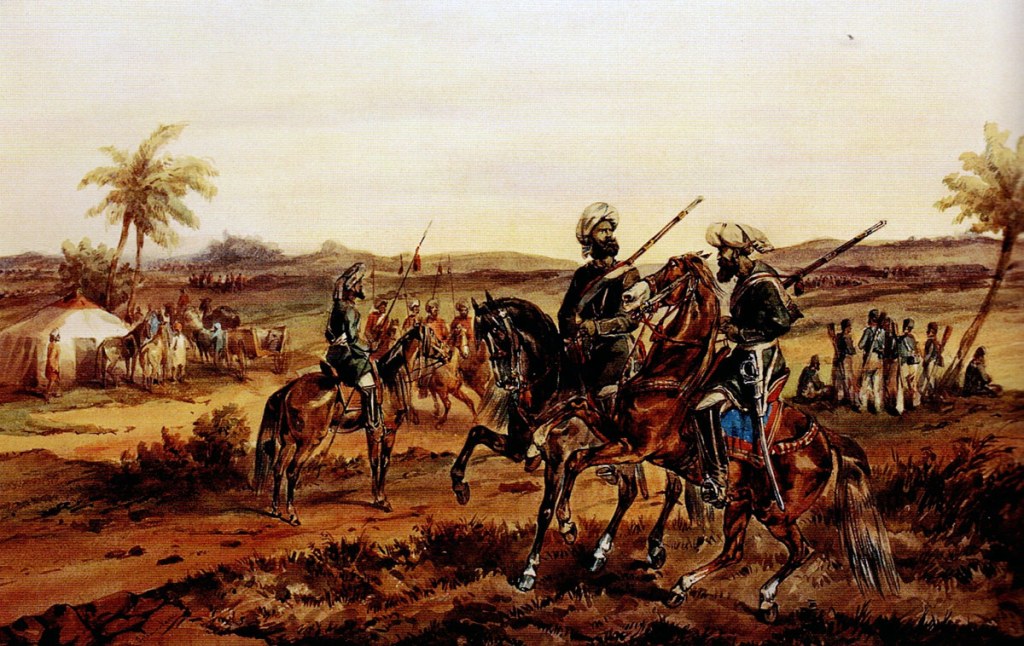
To Hodson’s peculiar merits as a leader of irregular horse Brigadier (afterwards Sir J.) Hope Grant,
G.C.B., himself a successful leader of cavalry, paid the following tribute in his diary of the siege:
” After Major Daly had been badly wounded Hodson was replaced in command. He was a dashing,
clear-headed, energetic officer; no man understood or could lead an irregular regiment better, and at
such a time, his services in the field could not be dispensed with.”
” He is scarcely out of the saddle day or night,” wrote another officer, “for not only has he to lead
his regiment and keep the country clear, but being Intelligence officer, he is always on the move to gain
news of the progress of affairs and acts and intentions of the enemy. Even when he might take rest, he will not, but will go and help work at the batteries, and expose himself constantly, in order to relieve some fainting gunner or wounded man.”
When the stress of work in camp fell so hard upon our wearied soldiers that the officers had to dispense
with the customary salute, ” it was remarked,” said another officer, ” that Hodson never passed down the
lines without every man rendering to him that mark of respect. The soldiers loved him as their own.’ There goes that ‘ere Hodson,’ said a drunken soldier, as he cantered down the lines; ‘ he’s sure to be in everything: he’ll get shot, I know he will, and I’d a deal rather be shot myself: we can’t do without him.‘
Hodson was a man coming into his own.
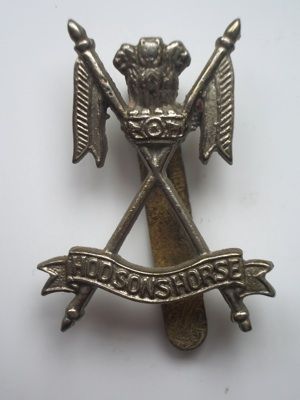
Command of the fledgling Hodson’s Horse had been given, albeit temporarily, to Lieutenant C.T.M. McDowell as Hodson was once again commanding the Guides who had lost both Henry Daly and Neville Chamberlain to injury. He hoped to lead the Guides in victory through the gates of Delhi — but before he could do so, there was the month of August to contend with. Nor would Hodson be freed of controversy.
Sources:
Twelve Years of a Soldier’s Life in India – The Rev. George H. Hodson (London: John W. Parker & Son 1859)
A Leader of Light Horse: Life of Hodson of Hodson’s Horse – Captain Lionel J. Trotter (London: William Blackwood & Sons, 1901)
Incidents of the Sepoy War, Compiled from the Private Journals of General Sir Hope Grant, Together with some Explanatory Chapters by Henry Knollys (London: William Blackwood & Sons, 1873)
 Mutiny Reflections