Able Seaman Edward Robinson – The Shannon Brigade – 13 March 1858
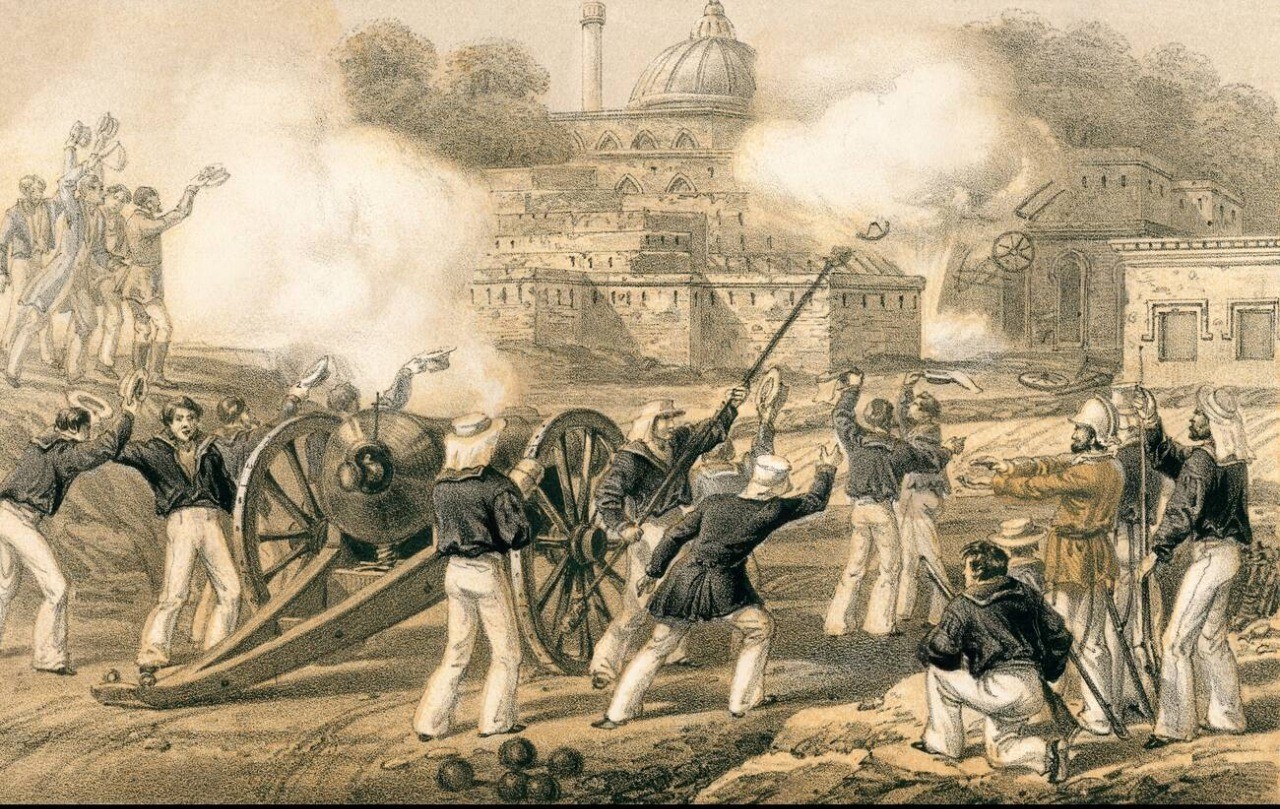
As at the Relief of Lucknow, Sir William Peel and the Naval Brigade of the Shannon were in good form. Peel had been keeping his men at their work regardless of where or what the circumstances happened to be. If they were not fighting, they were drilling, so when they were fighting, their dedication to the tasks at hand would be second to none. When Peel was wounded, command of the Naval Brigade fell to James William Vaughan, assisted ably by Thomas Young, Nowell Salmon and the other officers of the Shannon, all experienced men and determined not to disappoint their captain.
For the capture of Lucknow, Sir Colin Campbell required the Naval Brigade to provide a near constant barrage of fire on the city and the outlying positions; it was left up to Peel how to go about it. On the 9th of March, in what would be Peel’s last action, from a corner of the Martiniere, the guns opened fire on Banks’ House – as soon as it was taken, they were brought forward and positioned in a battery to the right of the house, while another battery was formed on the right of the road leading to the Begum Kothi. Then, a few hours before the actual storming of the palace on the 10th, the heaviest guns were brought up to 150 yards of the palace – at this range, the eight-inch shot smashed through all three walls of the palace, punching such substantial breaches in them that by late afternoon, the storming of the Begum Kothi could commence.
As soon as the Begum Kothi was taken, the Naval Brigade once again pushed forward, this time up to what had once been the insurgents’ own breastworks. Although the gunners were now relatively safe from any small-arms fire directed at them, they could not see far enough over the breastworks to lay their guns, but help was at hand from that stalwart volunteer, Oliver Jones ( who deserves a post all of his own and may receive one in the future), who rushed up, “planted himself on top”, in what can only be described in typical Jones style, and under the very real threat of being shot dead, directed their fire.
With the Begum Kothi now cleared, the Naval Brigade was once again on the move as the guns continued to push forward, this time in the direction of the Chota Imambara on the 13th. Not being on duty, Verney and Kerr decided to have a hand at reconnoitring a house in the vicinity, when suddenly,
“…we heard a yell and a cheer and the sepoy bugles from two different quarters sound successively, ‘the Alarm’, ‘ the Assembly’, the ‘Advance’ and the ‘Double.’ Kerr and I rushed back to our guns, the skirmishers evacuated their advanced posts and fell back upon the guns where we found all the troops drawn up under arms, the officers with swords drawn and pistols in hand; but the sepoys only set fire to a house and then withdrew.” (Verney)
The Naval guns opened fire instantly, but this time things did not go quite as planned – the sandbags at the front of the battery caught fire. The Strand Magazine (well after the fact, in October 1896) put their own flourish on the events of the 13th of March:
“At sunrise the English opened fire once more, the enemy being on their flank as well as in front. Thousands of mutineers swarmed on the other side of the Goomtee River. The fire was briskly returned, and our gallant fellows began to throw up batteries – of a sort.These defences consisted of branches of trees, dried grass, straw – anything that would make the dust and sand of the earthworks cohere on either side of the guns.
The weather was hot; water scarce and difficult to procure. Native carriers, who had manfully stuck by the British, were rapidly being shot down. Soon, the defensive works became as dry and inflammable as tarred rope. During the night, the water-bearers kept pouring the precious fluid on the heaps, but it simply ran through, only to be licked up later on by the fierce morning sun. Shell after shell from the sepoy lines came flying into batteries. Suddenly, the earthworks blazed up like a furnace, and the guns had to be abandoned.”
It was also not a matter of merely a pile of burning sandbags. The battery was full of shells, and these, had the flames reached them, would have spelt a swift and sudden end to the gun crew of the Shannon and everyone in the vicinity, insurgents included. Quick thinking Robinson picked up the water bags in the battery belonging to the bhistis and then, leaping over the low wall, he rapidly ascended the burning earthworks and proceeded to put out the flames. Two engineers were quickly on the scene, but they did not last too long – with musketry fire pouring on their heads, both men were wounded, but Robertson was undaunted. He rushed back for more water and repeated the procedure no less than five times; with most of the fire beaten down, he now picked up the remaining sandbags and threw them off the earthworks. Severely wounded in the shoulder, he was dragged back by his comrades. Curiously, in his book, “The Shannon’s Brigade in India”, Verney ascribes the deed not to Robinson but to William Hall; however, this was most likely a case of inattention on the part of Verney, as he further states that Hall was severely wounded, which was not the case. Unlike William Hall, who would pursue a successful naval career, the action cost Robinson his.
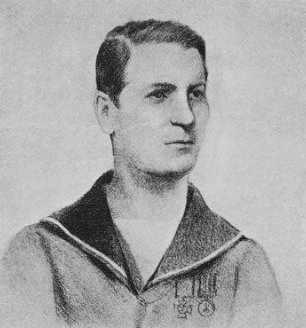
Born at Portsea on 17 June 1838, the Robinson family moved to Portsmouth, where, in 1852, Edward enlisted in the Royal Navy as Boy Second Class. His first ship was none other than the HMS Victory, Lord Nelson’s flagship, then being used as a training vessel. At 18, in 1856, he transferred to the HMS Dido and was promoted to Ordinary Seaman the same year. The lure of the newly built warship, the HMS Shannon, must have taken hold of Robinson, for he joined her crew in 1857 and with her, instead of the promised service they should have seen in China, the Shannon made her way to India instead.
In September 1858, the Shannon began her voyage back to England, taking Robinson with her. Admitted to a military hospital as soon as he arrived home, his wounds were found to be crippling after all. A shot had passed through his shoulder, another shattered his collarbone and damaged his neck, leaving him permanently disabled and unable to return to the Navy – he received his discharge the same year. With only six years of service behind him, his pension was a rather measly one, and Robinson found employment in the Coast Guard. Gazetted in December 1858, he received his VC from Queen Victoria on 4 January 1860.
Robinson married in 1863 to Annie Goldsack, with whom he would have eight children; with the burgeoning responsibilities after ten years with the Coast Guard, Robinson took a job with the Naval Reserve Office, where he remained until 1888. At this point, all trace might have been lost of Edward Robinson, but in 1893, through the kind offices of Queen Victoria, who had appointed her son, Prince Alfred, to keep an eye out on her heroes, Robinson was appointed the duty of gatekeeper at Albert Bridge, one of the old entrances of Windsor Castle. As the post came with accommodation, the Robinson family moved into Albert Bridge Lodge.
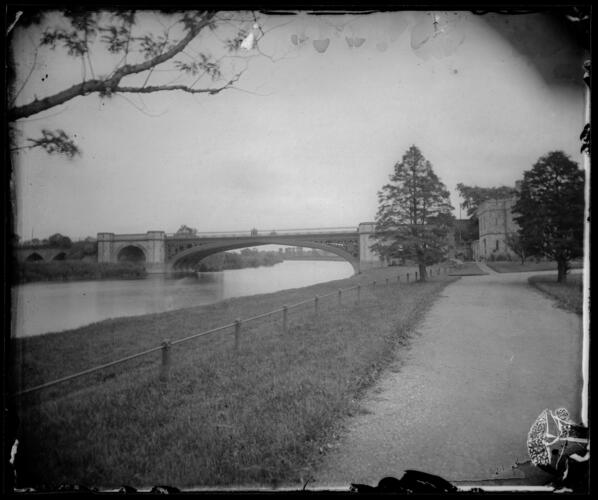
” Queen Victoria often rode round the Park in her carriage, preceded by two outriders, and frequently stopped in order to talk to tenants, particularly those wounded in battle whilst in her service. She often spoke to Robinson, who always wore his VC pinned to his uniform when on duty. Sadly, his final appointment did not last long.” (Derek Hunt, Windsor Local History)
Fate was, however, unkind to Edward Robinson as shortly after his appointment, it was found he had throat cancer. For three years, while he continued with his duties, he was slowly dying; on 2 October 1896, he succumbed to his illness at only 58 years old. What we may lack in knowledge of Robinson’s life, we do have a description of him as a person – when he joined the navy, he was 5’5″ tall (it is presumed he was considerably taller by the time he arrived in Lucknow), with blue eyes and brown hair, while his obituary noted he was of a “bright, plucky and cheerful disposition, which never left him, and he was greatly respected and admired by all who knew him.” Although no members of the Royal Family or the Royal Navy, for that matter, attended his funeral, the Vicar of Old Windsor conducted the service, and an entourage of Royal Gardeners carried his coffin to the grave, led by the Queen’s personal gardener, leaving many to assume in later years that Robinson must have been a gardener himself! For a man with a crippled arm, one soon sees that this would have been a physical impossibility. On 8 October 1896, Robinson was laid to rest in Old Windsor Cemetery. His Victoria Cross is in the hands of the National Maritime Museum, Greenwich, where it resides together with the cross awarded to William Peel.
In 2000, Robinson’s headstone, which had not weathered well, was completely refurbished and unveiled in a ceremony befitting a man who had, with the passage of time, nearly been forgotten.
“The front of the headstone was replaced with Welsh slate, and this was unveiled by HRH Prince Philip, The Duke of Edinburgh, on 15 May 2000. (This was very appropriate as it was a previous Duke of Edinburgh who had found Robinson employment in Windsor Castle.) On arrival, the Duke of Edinburgh proceeded to the Chapel to meet Edward Robinson’s relatives and sign the visitors’ book. He was then escorted to the grave and, after a few words, unveiled the reconditioned gravestone. It was then dedicated by the Vicar of Old Windsor. The ceremony was attended by many members of the Robinson family, including Mrs Daphne Read, the widow of one of his grandsons.” (Hunt)
 Mutiny Reflections