The 11th of March 1858 was a busy day before Lucknow. The Begum Kothi would be taken, and the men would push on, to the less-obvious delight of Sir Colin Campbell, towards the Kaiser Bagh, while on the other side of the river, Sir James Outram was proceeding with his plans to secure the right bank, and four men would find themselves recipients of the Victoria Cross.
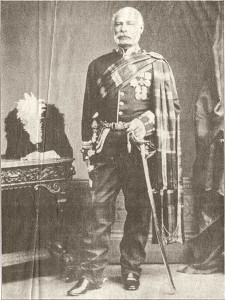
Lieutenant William McBean, 93rd Highlanders
Much can be said about the career of William McBean. Born in 1819 in Inverness, Scotland, the son of John McBean, a shoemaker and leather merchant, when William enlisted in the 93rd Regiment in 1835 at 16 and much against the wishes of his parents, he stated his own profession as a ploughman. He would now make his life with the Highlanders, rising through the ranks to receive a commission in 1854 with the rank of ensign – by December of the same year, he was a lieutenant. According to Forbes-Mitchell, promotion had been slow for McBean, not through any fault of his own, but because some officers took offence to his religion, having joined the Free Church of Scotland.
McBean then served in the Crimean War, where he was present at Sevastopol, the Sea of Azov expedition, the capture of Kertch and Yenikale. Then came India.
The 93rd were no strangers to Lucknow – they had, after all, been there already in November. By all accounts, it appears they were a hardy set of soldiers; if Munro’s flowery description is to be believed, for, in his estimation, they were “a perfect living picture of graceful human strength and power.”
“In the whole British Army, ay, in any other army in the world, there were not such eight hundred veterans as these. The light crisp hair, well-cut prominent features, and clear blue-grey eyes told their Celtic origin. The beards upon their faces, which were bronzed by exposure to well-nigh the colour of mahogany, were the evidence of manhood. The deep, full chest gave ample room for the throbbing heart; height considerably above average, great breadth of shoulder, sinewy arms, and limbs clothed with swelling muscles, which at the moment, knotted and tense as whipcord, were quivering under intense pent-up excitement, betokened great physical strength and activity.” (Munro)
As for McBean, his strength on the 11th of March was second to none, and he was one of the first men through the breach. Being a mounted officer, he was armed not with a claymore but a heavy cavalry sword, which McBean now wielded with some dexterity. Being a powerfully-built man (though Munro calls him, quite kindly, “as brave a man as ever lived and as simple as a child), he gave himself the task of dealing with any insurgent who was trying to get out of the Begum Kothi as quickly as the soldiers were pouring in. As the sepoys began to rush out of one of the smaller gates, an officer called out to McBean, “Now, McBean, let’s see how many you can cut down yourself!” With grim determination and using his sword and revolver with equal dexterity, McBean slayed eleven men.
“The havildar was the last, and by the time he got out through the narrow gate, several men came to
the assistance of MacBean, but he called to them not to interfere, and the havildar and he went at it with
their swords. At length, MacBean made a feint cut, but instead gave the point, and put his sword through the chest of his opponent.” (Forbes-Mitchell) Brigadier Sir Edward Lugard, who was watching the whole scene unfold from the ramparts, recommended McBean for the Victoria Cross.
McBean himself was rather surprised when he learned of the medal coming his way, and mentioned to Surgeon Munro that, “I was there to kill, d’ya see, man, and I did my best in that way.” Even later, at the regimental parade, as Sir R. Garrett pinned the cross the McBean’s chest, it was still quite clear that McBean did not consider himself extraordinary.
“This cross has been awarded to you for the conspicuous gallantry you displayed at the assault of the enemy’s position at Lucknow, on which occasion you killed eleven of the enemy by whom you were surrounded. And a good day’s work it was, sir,” said Sir Richard. ‘ Tutts, replied McBean, quite forgetting that he was on parade, and perhaps a little piqued at his performance being spoken of as a day’s work. Tutts, it didna tak me twenty minutes!”
Described as beloved by his men and respected by his fellow officers, whose curious rolling gait in his walk and the powerful strength that so came to his aid at Lucknow, William McBean was promoted to Major General of the 93rd Highlanders shortly before his death in 1878. At his side, nursing him through his last illness, was Surgeon Munro and an old soldier who had once been his servant.
“I believe that no man ever lived who tried more honestly to do his duty than William MacBean. Whatever were his little failings, all who knew him will acknowledge this.” (Munro) He had held every rank the regiment had to offer and died as their commander.
 Mutiny Reflections