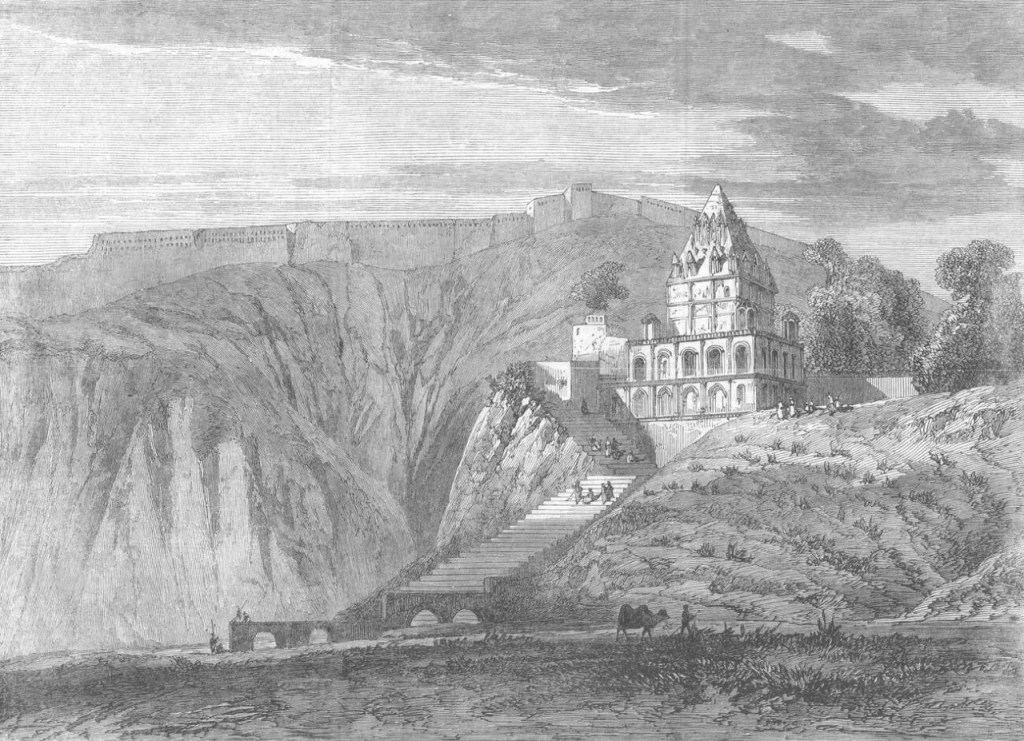
The position of Kalpi, with its labyrinth of ravines, was proving a formidable task. A direct attack from the southwest was extremely difficult and, owing to the lack of water in the area, a prolonged siege was inadvisable. Sir Hugh Rose saw that the most favourable line of attack would indeed be from the southeast, where the approaches to Kalpi were open, but he had other considerations.
The March Commences
At 2 am on 9 May, Sir Hugh marched with the First Brigade with every intention of following up the rebels who had fled from Kunch. He was waylaid at Hardoi, just one march from Kunch, where the fort was found abandoned and the chieftain willing to surrender. The fort was providentially well stocked, and the grain was quickly purloined for the use of Rose’s army. The fort itself would be reduced by a party of sappers to dust.
The Second Brigade now put his plans into some disarray. Coming up behind him, they were stopped at Kunch by a ferocious storm.
“…about 4 pm, the sky, usually so bright, became thick and mud-coloured, as though the air was filled by immense clouds of insects, and the heat was suffocating. This appearance rapidly increased for an hour, when it blew a regular hurricane. The wind was charged with sand, which, being driven with such velocity, well-nigh blinded us: even the horses crouched under it, and became quite frightened. The wind roared as it does at sea, and in a few moments, there was scarce a tent left of the vast town of canvas, which had stood on the plain but a moment before. Many of the tents were rent in pieces, and the consternation was great: one scarcely knew what was the next freak nature would play us. This state of things lasted for fifteen minutes, during which time breathing became difficult. After the wind had subsided a little in violence, much rain accompanied it (each drop was nectar to the thirsting souls on whom it fell ), and the temperature cooled down suddenly, and remained so until night, proving greatly refreshing to those who were suffering from the exposure during the action. Unfortunately, even this small fall of rain had made the tents so heavy that our march onward was postponed until the following day, the 10th, when we advanced to the village of Oorai.“

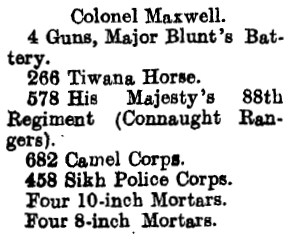
Delay was something Sir Hugh could ill-afford, for he had a date to keep. Learning of Rose’s problems with ammunition and his fatalities due to sunstroke, Sir Colin Campbell detached Lieutenant Colonel G.V. Maxwell from his force to form a Flying Column, to cooperate with Rose at Kalpi on the left bank of the Yamuna. Rose had written to Maxwell, stating he would be on the Yamuna by 14 May.
Accordingly, it was determined that the two forces would meet at Gulauli, a village four miles from Kalpi, where the ford across the river was passable. He entrusted the letter to a spy, who, after secreting the missive in the sole of his shoe, went on his way – unfortunately, he never reached Maxwell.
While the 1st Brigade would keep their appointment, there were now doubts about the 2nd. Having heard the rebels had constructed elaborate barricades to protect Kalpi from attack on the main road from Kunch he determined to put into action a ruse: by breaking off the high road, he would march to Gulauli and the 2nd Brigade was to head off towards the village of Bandha, where they were to take up their position – they were to march without further delay from Orai, on the very morning they arrived. It would effectively be a double march and with devastating consequences. Unfortunately, the 2nd lost their way and instead of making for Banda, they followed Rose to Sakhali, where Rose intended to turn the rebel defences on the high road.
“But this march was the one grand misfortune of the campaign. The faces of the men grew paler and paler, finally livid and anxious: they lost the bronzed colour they wore some ten days before, and first one, then two or three, then dozens and scores, fell out of the line of march, exhausted, dying, and dead, on the road side: there was no water to be had, no shade, and consequently no means of restoring them. The carriage for the sick was already crammed, and the wretched bearers themselves unable to carry the palanquins; the whole of the Staff was sick from the ardent heat; and to crown the whole the road was lost, and near mid- day we saw in the distant mirage the tents of the 1st Brigade, looking like huge woolpacks in a lake of water. In short, we had gone to Succalee instead of Banda.
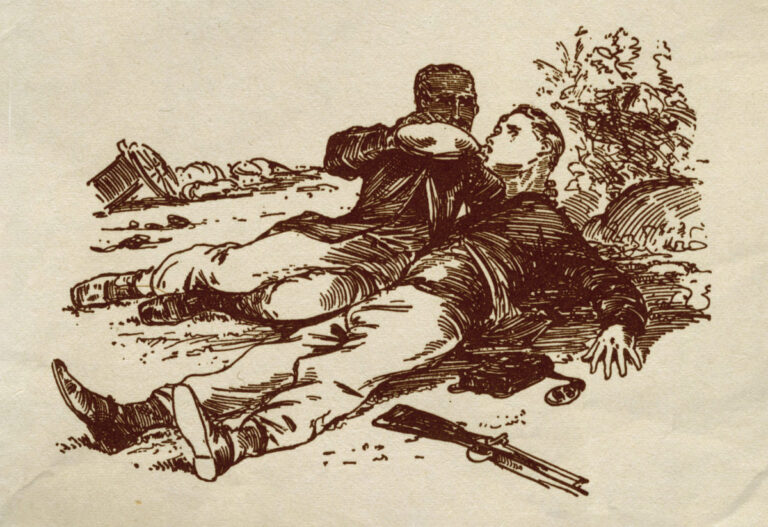
Once on that march, we came to a well, and near this the whole of the 71st Highlanders fell out, and came in as they were able during the evening. When the column had arrived within a mile of the encamping ground, it crossed a dried-up stream, where the men obtained a little dirty water by digging holes in the gravelly bed. At length, the Force gained the village, but not a drop of water was found in the well there; some few wretched villagers had stored up a supply in chatties, which was seized and drunk, and officers rode in every direction to discover more. This was at length found in a deep well, round which the Force encamped sentries were placed over it to preserve order. It was only a hardy few who had been accustomed to the sun who were not totally prostrated by that day’s work, and the sick list must have been an alarming one. We could scarcely get forage for our horses.”
By the time the 2nd Brigade reached Sakhali, Brigadier Steuart and his entire staff were on the sicklist and command was taken over by Lieutenant Colonel R.D. Campbell of the 71st. Although it was imperative for Rose to keep his appointment with Maxwell on the 14th, he had moved onwards to Ithara, but he was well aware the 2nd Brigade was in no condition for another march. He thus delayed the 1st Brigade at Itaura to give the 2nd Brigade a day to rest and detached all of his carriages to assist them while calling the attention of the rebels employing a diversion in a different direction, to prevent any attack on the transport.
Ravine Warfare
Matra – 16 May
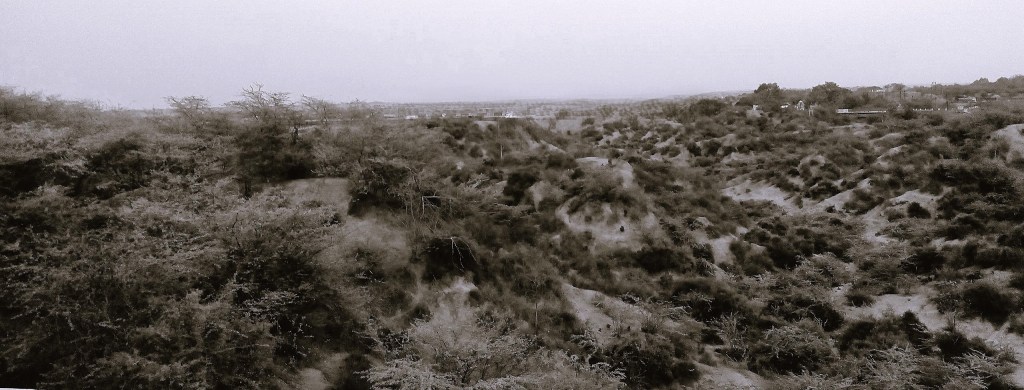
A few hours later, Rose marched the 1st Brigade and the Hyderabad Contingent Field Force to Gulauli, which they reached without any molestation except for a failed attack by rebel cavalry who dashed out from their concealment in the ravines to pounce on the baggage train. The 14th Dragoons, who were reinforcing the rear guard in anticipation of just such an ambush, quickly beat them off. Having now crossed the high road from Jalalpur to Kalpi, Major Orr was directed to drive a strong piquet on the road facing Kalpi. He was then to halt to cover the march of the rear-guard to Golauli and then draw out his camp at the village of Tehri near the road to keep not only an eye on the road but keep up communication with the 2nd Brigade who were making a night march to the village of Deopura, close to Tehri. As it turned out, it was a good plan.
The advance guard and the centre of the 2nd Brigade reached Deupora on the morning of the 15th, but their rear guard under Major J. Forbes (3rd Bombay Light Cavalry) had run into serious problems. They had barely left Ithara when confronted by a broad and deep ravine, passable only in single file over a narrow road. Suddenly, Major Forbes spotted the rebels approaching from Kalpi, on his left flank.
They were no less than 5000 in number, including 1000 horsemen and heavy guns dragged by elephants, and swiftly took up a position on his left and rear, occupying the Ithara in the process. Major Orr was quick to respond. He immediately reinforced Forbes with some of the Hyderabad Cavalry, who made such a strong front, they prevented them from moving forward, although the rebel cavalry boldly made several advances at a rapid pace. Captain Lowry of the Royal Artillery unlimbered on the far side and gave them a shower of grapeshot while the cavalry checked them long enough for the baggage to get out of danger. Once the road was clear and the baggage over the nullah, Major Forbes first withdrew the guns and artillery over the ravine, and then the cavalry followed at a walk and then at a gallop, making for concealed ground.
The insurgents quickly occupied the ground vacated by Forbes, forcing Lowry to halt and fire several times, while the 3rd Europeans checked them with their rifles. For the next three miles, however, the remainder of the rear guard was almost surrounded by the rebel cavalry, forcing the Europeans and the artillery to alternately halt and retire, until the baggage was safely in Deopura. Rose, hearing the cannons booming in the distance and realising Forbes was considerably hardpressed, wasted no time on leading reinforcements to his assitance. A 1/2 troop Bombay Horse Artillery, 1 troop 14th Dragoons, 1 Troop Hyderabad Contingent Cavalry, 3 Guns of No 4 Light Field Battery and the 38th and 25th Bombay NI sprang into action.
Sir Hugh Rose, fearing that a large portion of the force must have by now been struck down by the heat the sun, galloped on with his escort to find Forbes had reached Deopura but the rebels, who had been unable to cut off the rear-guard, had taken ground to the left and themselves reinforced by an additional four battalions from Kalpi, were swarming through the ravines. Under a heavy fire, they were making for the village of Matra, which Lieutenant Colonel Campbell with the advance guard of the 2nd Brigade, had judiciously occupied. While a large body of cavalry with their infantry support descended on Matra, Campbell gave orders to evacuate the village, realising he stood little chance of holding the village without support.
Rose quickly checked Campbell and ordered the troops to hold Matra at any price and ordered up at a trot the artillery and cavalry, with two companies of the Hyderabad Infantry and the 25th Bombay NI. Captain Lightfoot, with the skill Rose had come to expect from this intrepid artillery officer, placed his guns to the left of Matra and opened up with shrapnel and round shot, driving the rebel cavalry from their position in some confusion back towards their infantry, who still held the deep ravines in front of Matra. Captain Douglas of the Hyderabad Contingent Artillery, with admirable accuracy, posted his four six-pounders to the right of the village and tossed shrapnel over the heads of the rebel infantry in the ravines while the very accurate firing of the 71st Highlanders caused them so much suffering that the rebels quickly reassessed their choices. The main body fled back through the ravines to escape Douglas and the Highlanders, who had now pressed on to 700 yards of their position, while a few dashed across country back to Kalpi. Sir Hugh did not order a pursuit – a large part of the men had marched through the night, and exposing them any further to the gruelling sun would have been fatal. As it was, upwards of 200 out of 400 men of the 25th Bombay NI had fallen out during the march, sunstruck, and not a few were suffering from the effects of scurvy. With Matra secure, Rose returned with the detachments of the 1st Brigade to Golauli.
The day, however, was not over.
The rebels, seeing Sir Hugh had been forced to weaken his force at Golauli by withdrawing a portion of the 1st Brigade to support the 2nd, quickly reinforced their outposts in the ravines, “and supporting them with guns and masses at a distance, menaced and kept up a heavy fire on the position at Golauli from the Jumna to the village of Terhi, advancing against the latter place with a thick chain of skirmishers.” Their intention was twofold: to prevent any further support for the 2nd Brigade and, at the same time, defeat the 1st Brigade.
Brigadier Stuart at Gulauli and Captain Hare at Tehri were having none of it. Stuart opened up with a devastating fire of mortar and guns that the rebels quickly rushed back out of range while Captain Hare threw himself directly at the advancing rebels and, following them up to a grove of trees in the advance and chased them out of it. They then decided it would be better to take a high ridge opposite the right front of Hare, halfway between Gulauli and Kalpi and began fortifying it. Sir Hugh Rose had had just about enough of their antics for one day – he ordered a battery of two 8-inch mortars to be constructed in front of his right. They shelled the ridge and the ravines with such effect that the rebels quickly scattered.
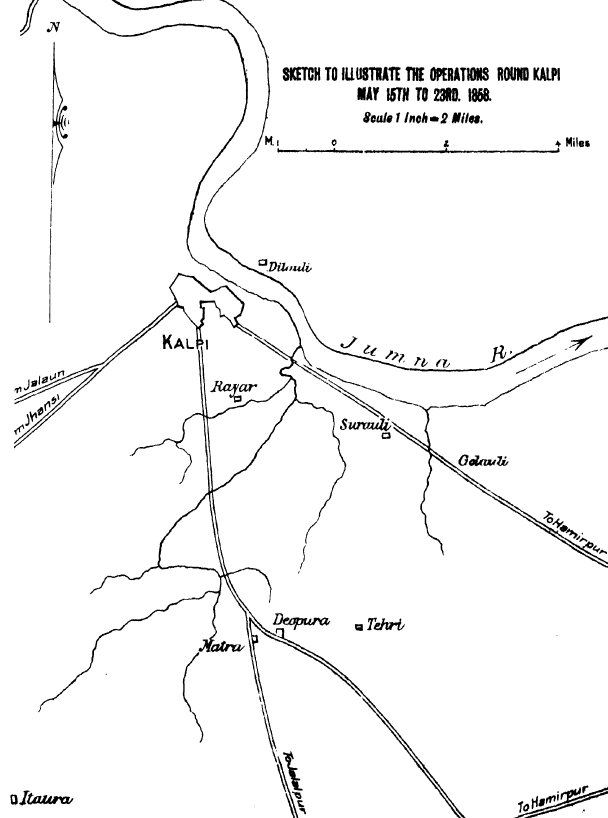
17 May
Of course, the rebels were not giving up. On the afternoon of the 17th, 200 of their cavalry with 3 guns suddenly moved up from the rear of a large village three miles on the left flank of the 2nd Brigade at Deopura, intending quite obviously to attack the camp. From Matra, Campbell reinforced the post with the whole of the 71st, two guns of No. 18 Battery and ordered the 14th Dragoons and two guns of the Royal Artillery to follow. Taking the lead, Campbell proceeded without delay to meet rebels, gathering up a half battery and the 3rd Bombay Cavalry who happened to be on their way to Matra. Campbell found the rebels “advancing rapidly in line, about a mile and a half off, and so widely extended as to threaten the left rear,” but he gave them little chance to reassemble. As heavy firing commenced from both sides, he brought his guns into play, and the rebels stopped their advance.
While thus occupied, another attack on Matra was imminent – here Majors Rich and Loftus of the 71st beat them off again; another column of infantry and guns was seen advancing from Kalpi, but Campbell treated them to a renewed onslaught of artillery and infantry, until the rebels decided, by sunset, to withdraw.
Colonel Maxwell Arrives
On his arrival at Golauli, Sir Hugh Rose sent a messenger to Colonel Maxwell, who, not having received Rose’s first message, had not advanced to Golauli. Rose requested him to move up now with all haste, and on 18 May, Maxwell reached the left bank of the Yamuna with his flying column. He quickly began the construction of batteries as instructed by Sir Hugh Rose, for the bombardment of Kalpi. The next day, his three 10-inch mortars were in place opposite the fort and by the 20th, the second battery was complete. That night, he sent Sir Hugh Rose reinforcements in the form of two companies of the 88th, the Camel Corps in their entirety, and 124 Sikh Infantry. The next morning, he sent two 8-inch mortars, two field guns and a company of the 88th to Rasulpur, a village three miles below Kalpi on the left bank of the Yamuna, just opposite the village of Rayar. Here, the rebels had constructed a battery which commanded the very road Sir Hugh Rose planned to use on his advance on Kalpi. To make things uncomfortable for them in Kalpi itself, Maxwell placed two 8-inch mortars in the village of Diauli, just opposite the kutcherry and Kalpi town.
While Maxwell was thus engaged, Sir Hugh Rose had other problems to face.
The Rebels Plan – 20 May
Until now, Sir Hugh Rose had, in effect, been playing a waiting game. He had successfully repulsed all the minor attacks on his position but, unwilling to expose his troops needlessly to the heat and the sun, had never followed up his advantages and with good reason. The temperature before Kalpi was 116° F in the shade (46°C), water was scarce and only obtainable from brackish wells as the nullahs and river streams were still dry; shade was a luxury as the rebels had followed a scorched earth policy, chopping down trees and groves in the immediate vicinity, giving the British troops little respite. They knew that Sir Hugh Rose was slowly moving his force into position for one swift attack against Kalpi, but the rebels were not going to give him the upper hand.
On 20 May, Sir Hugh Rose, who had just returned to camp from a reconnaissance on the left bank of the Yamuna, was startled by a sudden advance of the rebels through the ravines, covered again by thick line of skirmishers, all intending to attack his right flank. All the pickets were quickly reinforced by four companies of the 86th, two of the 25th and three 9-pounders. However, Sir Hugh Rose was not going to give the rebels the satisfaction of a fight – instructing the pickets to hold their ground, Major Stuart with the 86th Regiment steadily drove them back. The fight cost them 4 officers and 40 rank and file, but the rebels gained no ground.
Swearing on the waters of the Yamuna that they would rid themselves of Sir Hugh Rose or die trying, the rebels decided they had had enough. If Sir Hugh Rose would not withdraw willingly, they would show him the way to the river, and if the gods were willing, he and his blasted force would drown. He would not have the satisfaction of taking Kalpi because they would chase him out of Golauli first. Sir Hugh Rose, however, was wise to their plans. Although his own plans were not ripe as yet, the news of an impending sortie reached him on the 21st and he at once prepared for what would be his final confrontation with the rebels before Kalpi.
The story now continues in The Battle of Gulauli as Sir Hugh Rose’s campaign draws to a close.
Sources:
Behan, T. L. Bulletins and Other State Intelligence for the Year 1858. Vol. III. London: Harrison & Son, London Gazette Office, 1860.
Burne, Owen Tudor. Rulers of India: Clyde and Strathnairn. Oxford: Clarendon Press, 1892.
Forrest, George W. A History of the Indian Mutiny. Vol. III. London & Edinburgh: William Blackwood & Sons, 1902.
Forrest, George W. Selections of Letters and other State Papers. Calcutta: Superintendent of Government Printing, 1912.
Gimlette, G. H. D. A Postscript to the Records of the Indian Mutiny. London: H. F. Witherby, 1927.
Intelligence Branch, comp. The Revolt in Central India 1857-59. Simla: Government Monotype Press, 1908.
Jocelyn, Julian R. J. The History of the Royal and Indian Artillery in the Mutiny of 1857. London: John Murray, 1915.
Laurie, George Brenton. History of the Royal Irish Rifles. London: Gale & Polden, 1914.
Malleson, G. B. History of the Indian Mutiny, commencing from the close of the 2nd Volume of Sir John Kaye’s History of the Sepoy War. Vols. II & III. London: W.H. Allen & Co., 1888.
Smyth, John. The Rebellious Rani. London: Frederick Muller Ltd, 1966.
 Mutiny Reflections