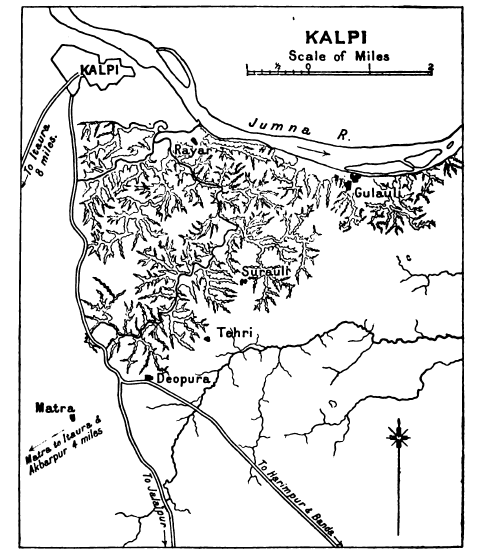
Sir Hugh Rose realised the rebels planned to attack him at Gulauli on 22 May. His own plans of battering Kalpi with artillery before storming it with infantry and cavalry were, for the moment, shelved, as he had run out of time. Instead, he would now be forced to meet the rebels on their terms. However, if they thought he was merely going to act on the defensive, they were sorely mistaken.
The line of the Deopura, Tehri and Gulauli separated the net of ravines surrounding Kalpi from an open plain, which, except for a narrow fringe of high but broken ground along the river, extended southwards from the Yamuna to the Kalpi-Banda road. On the morning of 22 May, Sir Hugh Rose split his force into two wings – Brigadier Stuart was to take the right on a line perpendicular to the river, facing the ravines, while he retained command of the left would be thrown back ” en potence” (meaning that a part of the troops were placed in reverse in relation to the general front of the front) across the plain, facing the open country south-east of Tehri.
Stuarts front extended from the river at Gulauli to nearly opposite Tehri and was comprised of three detached posts – Lieutenant-Colonel Lowth with a detachment of the 86th and Major G.H. Robertson with a wing of the 25th Bombay NI were placed on the right and left flanks, while the central body of the 86th and 3rd Europeans were positioned on the same hillock as the mortar battery. This hillock now formed not only the key of the right wing, but the entire position.
In reserve, Rose placed the 21st Company Royal Engineers under Lieutenant J.B. Edwards, the other wing of the 25th, two troops of the 14th Dragoons and the 3rd Bombay Cavalry, and 4/2 Bombay Artillery under Lieutenant C.H. Strutt.
On the right flank of the left wing were the 1st Troop Bombay Horse Artillery under Captain J.G. Lightfoot and a squadron of the 14th Dragoons. On their left, with a detachment of the 3rd Europeans on each flank, were Lieutenant T. Haggard’s five siege guns, followed again on their left, Major J. Ross and his Camel Corps, the Sikh Infantry and 2/Res Bombay Artillery under Lieutenant P.H. Harcourt. In support, Sir Hugh placed three troops of cavalry consisting of the 14th Dragoons and 3rd Bombay Cavalry, a wing of the 71st Highlanders, and 5/14 Royal Artillery under Captain T.S.P. Field.
Major Orr and the Hyderabad Contingent would watch Sir Hugh’s left flank, while two companies of the 88th Foot and a detachment of 25th Bombay NI remained to guard the camp. Captain F.M.M. Ommaney, Royal Artillery, commanded the artillery.
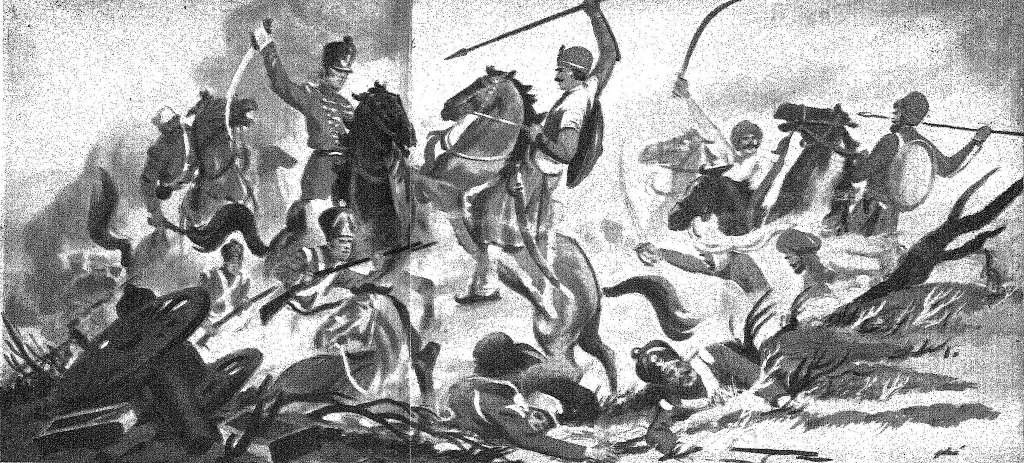
The rebels opened the proceedings.
“In order that the battle should be fought during the intense heat of an Indian May day, the rebels made
no sign till after 8 a.m., when their presence in the ravines was reported by Stuart’s pickets. Three guns of 4/2 Bom.A. (Sergeant-Major Graham) were then unlimbered on a small piece of level ground just
in front of the mortar battery. The three others were sent under Strutt to the left to support Robertson, and lest the hillock should be outflanked, the Brigadier advanced the wing of the 25th Bombay N.I., which was in reserve, to a position between that held by Robertson and the main body. Stuart then reported to Sir Hugh that he felt his position was secure .”
It now looked as if rebels were going to attack the left. Shortly after 8 am, a large force of all arms marched from Kalpi down the Banda Road, headed up by musicians and the entourage of the rebel leaders. When they reached Deopura, the troops extended across the plain as their cavalry looked as if they might attempt an outflanking manoeuvre. Sir Hugh, who had collected his cavalry in front of his left, ordered them now to retire as the rebels advanced, intending to lure them under his siege guns. The plan, though not bad, did not quite succeed. Haggard managed to cause some consternation in their ranks, and a number fell, but they refused to be drawn within striking distance of the cavalry. Sir Hugh was not particularly anxious about his left flank as he knew he could hold his own without moving a single man from his right, but he was very worried about the ravines.
While Sir Hugh was coordinating the cavalry demonstration, the rebels sent large reinforcements of infantry into the ravines behind the Tehri-Gulauli line, and there they remained hidden until Brigadier Stuart upset their plans by sending a company of the 3rd Europeans to reconnoitre. These stumbled quite by chance onto the hiding sepoys who now rose from their hiding places in thick lines of skirmishers, followed by a mass of columns and supports in the distance. In an instance, the entire battle changed and was now a general engagement along the whole line from the river to Tehri, and the ravines exploded in clouds of smoke and fire. All of Rose’s guns opened fire at once, and the support troops quickly closed up.
“Sir Hugh was watching the attack made on the centre of his position, when, noticing a slackening
of fire on his right, he sent to Brigadier Stuart to inquire if he desired the support of half the Camel
Corps. The Brigadier replied that he did; but even as he received the answer, Sir Hugh realised that the sound of the enemy’s fire was now coming from within the line our pickets had held, and that his right, the vital point, was in danger. He at once determined to bring the whole of the Camel Corps to the threatened quarter, and placing himself at their head, he made for the mortar battery hillock. On his way, he met an orderly riding at full speed with a message from Stuart saying there was not a moment to lose. The Camel Corps pressed on and presently dismounted at the foot of the hillock. They arrived just in time.”
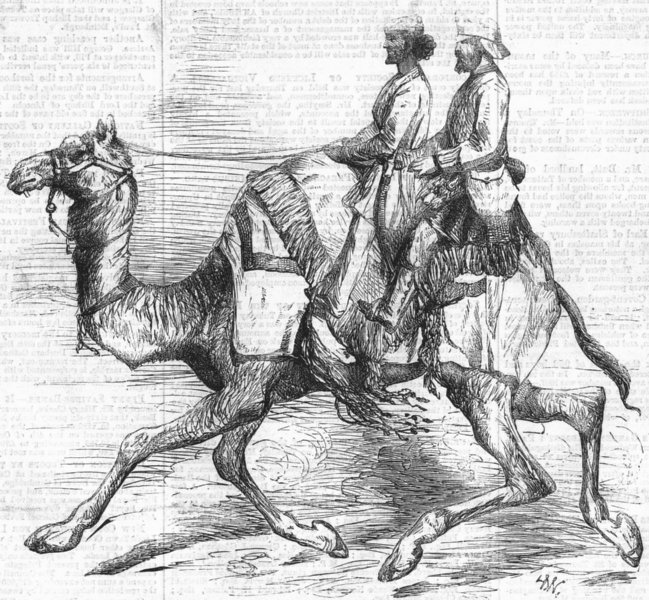
The moment was indeed critical. Volleys of musketry that had killed or wounded every horse but one of the General’s staff, were coming thick and fast over the crest of the rising ground from the rebel infantry, who were now rising in great numbers from the ravines and advancing rapidly across a small piece of level ground towards the mortar battery and the guns, with every intention of taking them – “with yells of triumph, their faces distorted by fury…Some were so bhanged or overcome by opium that they lay down like drunkards with their muskets in their hands, unable to move, but with eyes glaring and bright like owls, they lay cursing the Feringhees until death ended their rebel course.” The chain of skirmishers could not answer as their Enfields had become impossible to load, and the battery guns had fallen silent; The skirmishers, those who could still stand in the intense heat were rushing back in front of the oncoming rebels, while others unable to keep the pace, lay down on the ground, sunstruck. Brigadier Stuart, on foot at the guns, now turned to the gunners and bid them to draw their swords and defend the guns with their lives.
“Without halting on the crest, Sir Hugh Rose charged down it with the Camel Corps, into the dense lines of mutineers, who were ten times superior in number, the gallant soldiers of the Rifle Brigade and 80th Regiment (forming the Camel Corps) giving one of those cheers which all over the world have been the heralds of British success. The rebels wavered, turned and fled, pursued by the Camel Corps, with all their energy, through the ravines, where numbers were bayonetted or killed by musketry fire.“
When the general engagement began, the rebels off to the right had directed their main efforts against Lowth, who had been reinforced by another company of the 86th. These rebels, who had been pressing on Lowth, were now caught in a trap – their right flank had been opened by the retreat of the attackers on the hillock, and Lowth now seized his chance, drove them to the river and into it where many of the rebels were either shot or drowned.
While all of this was playing out, the 25th Bombay Native Infantry, which had been moved up from the reserve, was attacked by such overwhelming numbers they quickly fell back; Edwards rapidly brought up the 21st Company RE and by “a brilliant charge” not only defeated the assailants but chased them to the ravines. Robertson and the other wing of the 25th, though attacked, put up a determined resistance.
“The rebel sepoys pressed close up to the men, halted and flung reproaches at them, couched in the most revolting language, for their unshaken fidelity to the British. But the 25th answered the maledictions of the mutineers in a manner worthy of the reputation and English discipline, with a volley, a cheer and a charge with the bayonet.”
The whole British line was now advancing and driving the rebels from their positions with each step. The left centre under Lieutenant Colonel Robertson and the 25th followed up their spirited charge with a dash through the ravines in pursuit of the rebels. They came up with their rear near the village of Tehri, where they bayonetted many and then continued their charge well beyond the village until they fell down exhausted. “The whole of the infantry on the left covered by Captain Lightfoot’s troop of Horse Artillery, three guns of the Light Field Battery, and the whole of the cavalry, made a converging attack on the enemy’s right and the village of Tehri. They drove the rebels into it, through it, and over the plain towards the Calpee road. The enemy’s retreat had spread from right to left over the entire line of battle…On the left, the enemy’s retreat became more and more a flight. Their infantry, cavalry, and guns, all mingled together, rushed over the heights, up and down the ravines, and along the highroad to Calpee, closely followed by our cavalry and artillery. The pursuit lasted until horse and man could go no further and do no more. The majority of the rebels made their way towards Jaloun. Calpee afforded them no safe shelter, for Maxwell’s guns were pouring into it a stream of shot and shell.”
The rebels began evacuating Kalpi almost as quickly as Sir Hugh Rose could send his men forward in pursuit. When the last rays of the sun had fallen under the horizon, the battle of Gulauti was over, and Kalpi was his. During the night, the remainder of the rebel force fled, their leaders routed and disappointed – the once mighty Gwalior Contingent reduced to a mob, the 6 sepoys regiments and their irregular cavalry brethren, who had fought so valiantly, had once again been let down by the failings of the leaders.
23rd May – Kalpi Captured
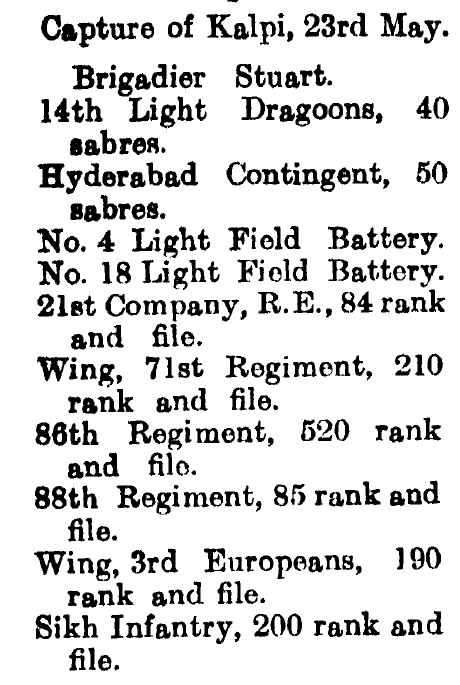
The complete defeat and serious losses incurred by the rebels, despite all the skill and tactics they had employed in the battle, convinced Sir Hugh Rose that an immediate advance on Kalpi would now undoubtedly be successful. He gave his men a brief rest and made them ready before dawn on the 23rd to take the fort. Again, he divided his force into two columns, the right under Brigadier Stuart through the ravines, with their right resting on the Yamuna, and the left, under his command, along the Jalapur-Kalpi Road.
Taking the road as the direction of his centre, Sir Hugh Rose covered his advance with the Camel Corps, supported by the Hyderabad Contingent Cavalry; when they reached the road, he dispatched a staff officer with a party of cavalry to communicate with Brigadier Stuart. While the majority of the rebels had fled during the night, a determined battery opened fire from the ravines, but their elevation was too high and they were too far to do any damage – a few rounds and these guns too fell silent. Stuart met with no opposition until he reached the village of Rayar – here too, a desperate band of rebels greeted him with a volley, but the 86th swiftly charged and drove them out. Both Kalpi town and the fort would be found deserted. Sir Hugh Rose had just missed capturing Rao Sahib and the Nawab of Banda, both of whom had delayed their departure until the morning – the Rani of Jhansi had vanished the night before.
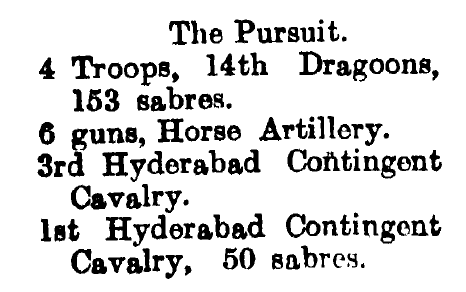
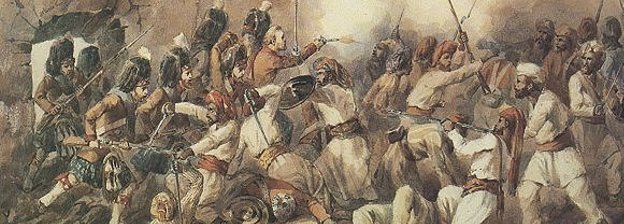
To make it absolutely certain that the victory was indeed his, Sir Hugh Rose now ordered the pursuit and force, under Major Gall, took off after a party of the rebels who had been observed moving off from Kalpi, to the northwest in large bodies, accompanied by elephants along the Kalpi-Jhansi high road. Half a mile up the road, he was informed that a large tomb was occupied by the rebels, but it was found to be deserted, and the rebels were seen retreating across the plain beyond it. Gall ordered the charge, and the retreating rebels were cut down in all directions – Lieutenant Dowker of the 1st Cavalry took two guns. In the centre, the Dragoons sabered the panic-stricken men who now fired wildly at their pursuers with no effect. Many simply threw away their arms and ran. On the left, Captain Abbott charged along the Jalaun road and captured another gun, a 9-pounder in good order. In all, five guns, artillery wagons, ammunition and bullock carts were captured, along with six caparisoned elephants and a score of camels and bullocks.
The fort itself held the substantial arsenal of the rebels. In all, 58 guns were taken, including one 18-pounder of English make. The subterranean rooms held no less than 60’000 pounds of English powder, boxes of both old and new English muskets, vast quantities of English shot and shell, of which piles were also found outside the fort. Engineering tools of every description, boxes of brass shells and a miscellaneous assortment of “warlike stores”made up the rest. Bales of cloth for uniforms, along with caps, boots and jackets were neatly laid out; surveying instruments, government books and official documents were found heaped in piles; in another corner lay medical stores looted from Cawnpore. The fort and town boasted of three cannon and mortar foundries in perfect working order, and much to the surprise of the Highlanders, when they advanced through the ravines, a panther rushed across their path. The riches of the fort were negligible – no great stores of money or precious items were found, but the Gwalior Contingent had left behind 27 of the silk standards, and the Kotah Contingent, too, had been deprived of theirs. The Rani of Jhansi, too, had left in such a hurry that she had not taken along her box of correspondence, from which it would later be deduced how involved in the rebellion she had truly become.
From the buttons found on the dead sepoys, it was clear that not less than eleven Gwalior and Bengal Infantry regiments had been present at Kalpi – it astonished the men to no end that these had died wearing the very uniforms they no longer served.
Outside the town in the shady parkland surrounding the tombs, the British pitched their camp. Early on the morrow, the troops paraded, and a royal salute was fired, for it was the 24th of May—our Queen’s
birthday—and the troops rejoiced in the prospect of going into quarters and the sick and wounded of
going home. On the 24th of May, Lord Canning telegraphed to Sir Hugh Rose: “Your capture of Calpee has crowned a series of brilliant and uninterrupted successes. I thank you and your brave soldiers with all my heart.”
Dr. Lowe was singularly disappointed by Kalpi. He declared he had never seen a place more filthy or more miserable. Many of the houses had been ransacked in the year the rebels had had the place, and in many piles of plunder of English origin was found, belonging to the officers murdered by their men. In others, masses of sugar, corn and oil were found, and in still another, pieces of tents. His concern now, however, was not securing trophies – most of the officers and men were sick, and he now needed to secure places for those who desperately needed to go home. Among them were Lieutenants Harry Prendergast and Fox, both of whom had managed to sneak their way, by invitation of the 86th Regiment, from Jhansi all the way to Kalpi. Although neither of them took part in the battle owing to their wounds, they could at least say they were there.
Final Actions
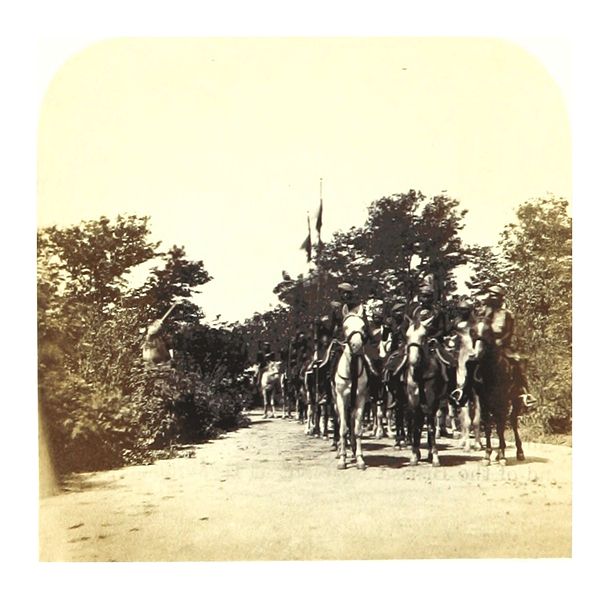
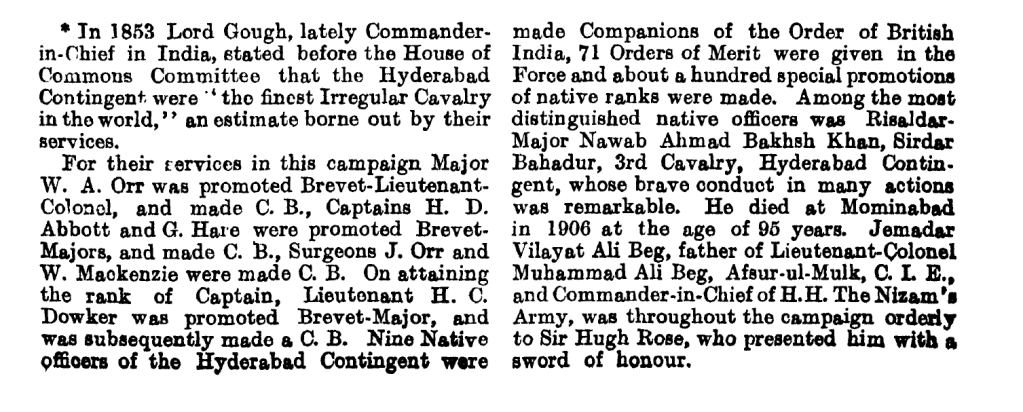
As it was clear that the main body of rebels had retreated down the Jalaun Road, Sir Robert Hamilton believed they would make for Sher Ghat to the north and cross the Yamuna; if this was impracticable, they would take the ford higher up the river. Colonel W. Riddell with the 3rd Bengal Europeans, some Sikh horse and two guns of the Royal Artillery had been sent up from Fatehgarh to guard Sher Ghat and it was determined to catch the fleeing rebels between Riddell and the main force under Major Robertson, “to meet him if he turned or to ascertain his line of flight.” While Robertson’s men were well and truly exhausted, they determined to follow the rebels down the Jalaun road on 25 May. Major Orr with his men of the Hyderabad Contingent, all three arms, was sent down the Jhansi road to clear it of a band of insurgents who waved the banner of the Bilyan chief, Barjur Singh. They were trying with all their might to reorganise the fleeing army and at the same time, cut off all communication with Jhansi. Major Orr marched to Orai and on the evening of 30 May at 10 pm marched to Bilyan with his entire force. At daybreak, he surrounded the place with his cavalry while waiting for his guns and infantry. The fort, now aroused, greeted him with a volley of musketry – but it was ineffectual. Meanwhile, 250 sepoys appeared in the town, who formed up under the cover of a garden and moved forward as a compact body, in regular formation, to take on Orr. Collecting some of his pickets and leaving others to watch the fort, Orr advanced with 81 sabres towards the sepoys. The guns of his light battery, now within range, opened with shrapnel and shell; then the cavalry charged. The rebels decided this really wasn’t something they were up for, and after losing a number to the blades of the cavalry, they rushed down the deep ravines running towards the Betwa. As an attack by cavalry was difficult in this terrain, the infantry took on the work. Here, the remaining sepoys fought desperately, but they stood little chance; 130 were killed and 35 were taken prisoner.
As for Barjur Singh – he had taken part in the affair, proudly on horseback, but he was unhorsed, his steed and banner captured, and he was forced to run on foot through the ravines, stripping himself of most of his clothes to make flight easier. Major Orr let him go.
The Hyderabad Contingent, in this, their last fight, lost seven of the 3rd Infantry killed with Lieutenant Westmacott, a subadar and six men wounded.
Sir Hugh Rose wrote:
“So much of the success of the operations is due to the portion of the Hyderabad Contingent that formed part of my force, that I ought not to fail to express my best thanks to Colonel Davidson, Resident at Hyderabad, for the proof of confidence which he placed in me by putting at my disposal troops who organisation in the three arms, light equipment, knowledge of the Indian language, and country, combined with their high military qualities enabled them to act as the wings of my operations.”
The End of the Central India Field Force
The capture of Kalpi completed the plan the Government had drawn up for the Central India Field Force. Instructions were conveyed to Sir Hugh Rose that as soon as Kalpi was secure, the force was to be broken up – a part would be sent to Gwalior and the rest to garrison Jhansi. The Hyderabad Contingent Field Force was ordered back to the Deccan, and Sir Hugh Rose was ordered home on sick leave. He wrote his final farewell order on 1 June to the troops and thus took his leave from the men who had fought so well under his command.
“The Central India Field Force being about to be dissolved, the Major-General cannot allow the troops to leave the immediate command without expressing to them the gratification he has invariably experienced at their good conduct and discipline, and he requests that the following general order may be read at the head of every corps and detachment of the force:
“Soldiers! You have marched more than a thousand miles and taken more than a hundred guns. You have forced your way through mountain passes, and intricate jungles, and over rivers. You have captured the strongest forts and beat the enemy, no matter what the odds, wherever you met him. You have restored extensive districts to the Government, and peace and order now where, before for a twelvemonth, were tyranny and rebellion. You have done all this, and you have never had a check. I thank you with all my sincerity for your bravery, your devotion and your discipline.
When you first marched, I told you that you, as British soldiers, had more than enough of courage for the work that was before you, but that courage without discipline was of no avail, and I expected you to let discipline to be your watchword. You have attended my orders. In hardships, in temptation and danger, you have never left your ranks. You have fought against the strong, and you have protected the rights of the weak and defenceless, of foes as well as of friends. I have seen you in the ardour of the combat preserve and place children out of harm’s way. This is the discipline of Christian soldiers, and this it is which has brought you triumphant from the shores of Western India to the waters of the Jumna, and establishes, without doubt, that you will find no place to equal the glory of our arms.”
Sources:
Behan, T. L. Bulletins and Other State Intelligence for the Year 1858. Vol. III. London: Harrison & Son, London Gazette Office, 1860.
Burne, Owen Tudor. Rulers of India: Clyde and Strathnairn. Oxford: Clarendon Press, 1892.
Forrest, George W. A History of the Indian Mutiny. Vol. III. London & Edinburgh: William Blackwood & Sons, 1902.
Forrest, George W. Selections of Letters and other State Papers. Calcutta: Superintendent of Government Printing, 1912.
Gimlette, G. H. D. A Postscript to the Records of the Indian Mutiny. London: H. F. Witherby, 1927.
Intelligence Branch, comp. The Revolt in Central India 1857-59. Simla: Government Monotype Press, 1908.
Jocelyn, Julian R. J. The History of the Royal and Indian Artillery in the Mutiny of 1857. London: John Murray, 1915.
Laurie, George Brenton. History of the Royal Irish Rifles. London: Gale & Polden, 1914.
Malleson, G. B. History of the Indian Mutiny, commencing from the close of the 2nd Volume of Sir John Kaye’s History of the Sepoy War. Vols. II & III. London: W.H. Allen & Co., 1888.
Smyth, John. The Rebellious Rani. London: Frederick Muller Ltd, 1966.
 Mutiny Reflections