“On the 22nd we commenced to cross the Ganges in order to relieve Lucknow; the river was running strong, boats were few and we were in the middle of the rains…” (Captain Maude)
General Sir Henry Havelock had one goal in mind – the relief of Lucknow. Having failed, through no fault of his own, to save Cawnpore, he now placed all his energy on the one task ahead of him. It would however entail much disappointment for the 62-year-old general. Experienced a campaigner as he undoubtedly was, neither his reading of military strategy nor his extensive knowledge of India had prepared him for what was to come.
The first detachment of Highlanders and three guns arrived on the Oudh side of the river during the early morning of the 21st of July; the second detachment would take the rest of the day to cross over, not arriving until the evening. Without enough men to furnish a baggage guard, the men were left without tents – their only shelter from the incessant rain was a few abandoned fishermen’s huts and under the ridges of low, sandy hills. On the 22nd, an additional three guns and the 84th joined the comrades in what was rapidly becoming a swamp – among them, Captain Maude of the Royal Artillery.
The last detachment to cross over were the Madras Fusiliers – armed with their Enfield rifles – they would be employed once again as skirmishers.
“We crossed the river last night in a pelting shower of rain and marched up to the General’s position, which we reached at dark. As a special favour, we were allowed to remain on the road ! ! ! Our proper position in the line was knee-deep in water, and great was the difficulty Stephenson had in keeping us out of it.” (Groom) Groom had been “hurried up” by Havelock who feared there might be an unpleasant detachment of rebels lurking on the river bank but the report proved to be false. As for Groom, he would spend the remainder of the night with his colleagues, Dangerfield and Bailey, under a tree, sharing a chicken leg which he had been given to him by a man of the 60th Rifles, hard biscuits and rum- “a famous dinner.”
As for General Havelock, he remained in Cawnpore until the 25th, keeping a sharp overview of the operation and an eye on the entrenchment that he would soon leave in the hands of Neill and the 250 men who were remaining behind. When he left, work was still ongoing – the commissariat was nearly full with stores which the town and surrounding country had supplied and the guns which had been dug out of the ruins of the magazine had been brought in. Confident Neill could withstand an attack, Havelock stepped into a boat and turned his sights on Oudh.
The next morning, on the 26th of July, Havelock marched his men three miles in the advance, to what he hoped would be healthier ground. Much to his horror, cholera had already taken hold of some of his men. Groom took a little time to write in his journal:
“We are waiting here for our food, and 1 70 of our men who are not across the river, Hamilton, Gosling and Arthur will be with us to-night, I expect. The General says he will march to-morrow, whether the men and stores are up or not. The place are now in is a little better than our last bivouac. It rained, though, last night in torrents. Our cavalry has just gone ahead reconnoitring. The enemy, they say, are in position about ten miles to our front. Lots of reports flying about. I am sorry to say that cholera has made its appearance in the Force, and we have lost a great many men, chiefly 64th and Artillery. We had a case or two last night, none yet fatal. We certainly cannot afford to lose a man at this juncture.”
The man hurrying operations along the right bank was Lieutenant-Colonel James Fraser-Tytler, Assistant Quartermaster General to Sir Henry. He had been given charge of orchestrating and then superintending the entire movement across the river of 1500 men, all the stores and material needed for the campaign and this with only 20 boats. It took the indefatigable man exactly one week to accomplish the feat. On the 28th of July, he joined Havelock at Mangelwar.
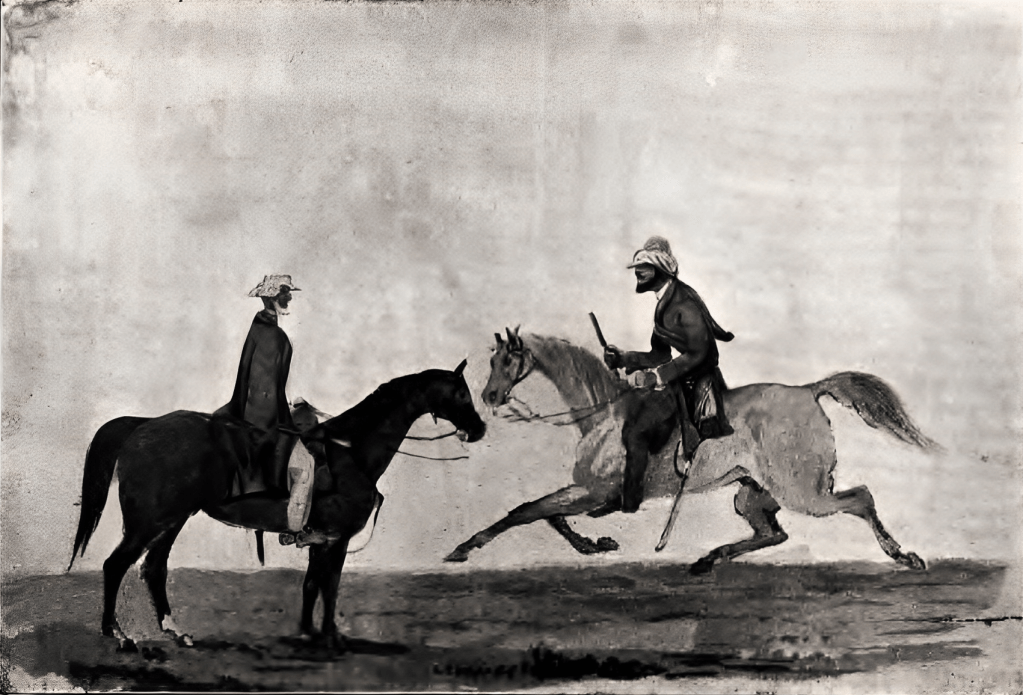
The whole force was now assembled at Mangalwar, a village 6 miles from the river on a ridge elevated some 200 feet above the surrounding country. It was a commendable position – extending some five miles it provided Havelock with an unbroken view of the surrounding countryside, its height provided an ungainly obstacle to would-be attackers, and he might, if he needed, to have “defied all the armies of Oudh.” But Havelock was not going to stay in Mangalwar. In a telegram to Lord Canning, Havelock was only too aware of the problems he would soon be facing.
“… I beg to state that I should consider it certain that I must incur the risk of serious loss in an attempt to recross the Ganges to Cawnpore, even supposing that I had been reinforced by the remnant of the garrison of Lucknow. The chances of relieving that place are at the same time hourly multiplying against us. I will not now enter into all the details, but specify only that Nana Sahib has succeeded in collecting 3000 men and several guns, and is on our left flank at Futtehpore Chourassee, with the avowed intention of cutting in upon our rear, when we advance towards Lucknow.
The difficulties of an advance to that capital are excessive. The enemy has entrenched and covered with guns the bridge across the Sye at Bunnee and has made preparations for destroying it if the bridge is forced. I have no means of crossing the canal near Lucknow, even if successful at Bunnee. A direct attack at Bunnee might cost me a third of my force. I might turn it by Mohan unless the bridge there also were destroyed. I have this morning received a plan of Lucknow from Major Anderson, engineer in that garrison, and much valuable information in two memoranda, which escaped the enemy’s outpost troops and were partly written in Greek character. These communications, and much information orally derived from spies, convince me of the extreme delicacy and difficulty of any operation to relieve Colonel Inglis, now commanding in Lucknow. It shall be attempted, however, at every risk, and the result faithfully reported. Our losses from cholera are becoming serious, and extend to General Neill’s force, as well as my own. I earnestly hope that the 5th and the 90th can be pushed on to me entire, and with all despatch, and every disposable detachment of the regiments now under my command be sent on. My whole force only amounts to 1500 men, of whom 1200 are British, and ten guns imperfectly equipped and manned.”
 Mutiny Reflections