The Returns of Havelock’s Campaign
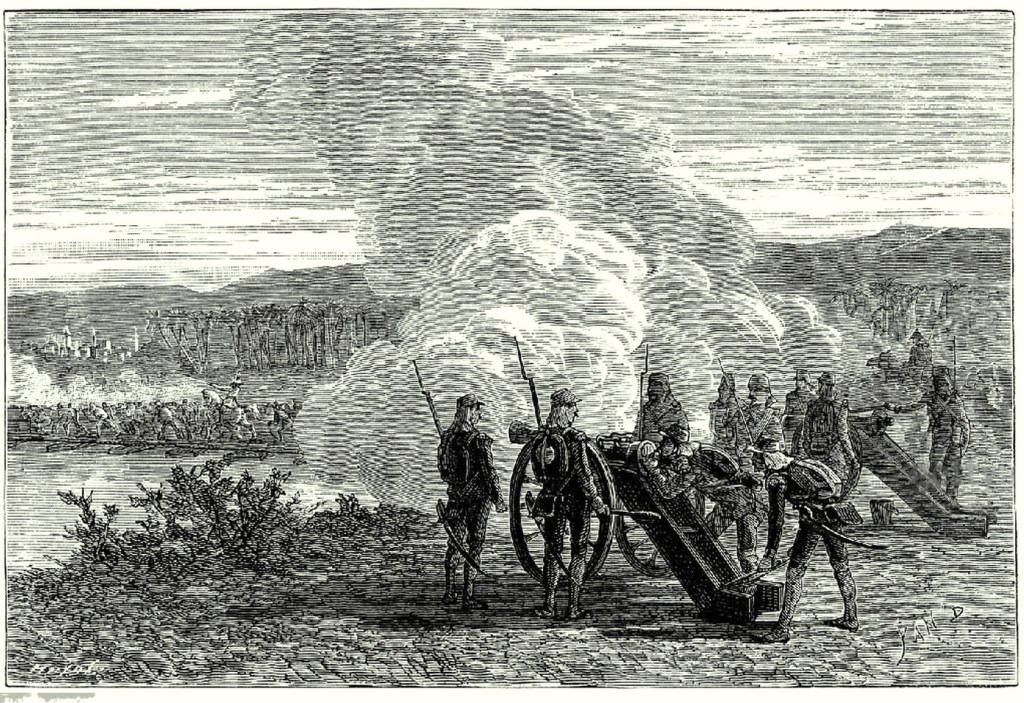
Colonel James Neill upon arriving in Allahabad, set to work to organise a moveable column. It was placed under the command of Major George Renaud and sent out towards Cawnpore. The Allahabad Moveable Column consisted of 200 officers and men of the 84th Regiment, 300 of the 1st Madras Fusiliers, 300 Sikhs of the Ferozepore Regiment, 65 Indian Irregular Cavalry and 2 bullock drawn 9-pounders, manned by old soldiers (invalids) of the Bengal Artillery.
Subsequently, the force commanded by Sir Henry Havelock, The Oudh Field Force, set out in Renaud’s wake and consisted of the following:
Cavalry
Allahabad Volunteer Cavalry, under Captain Lousada Barrow of the 5th Madras Cavalry – 20 men
Detachments of the 3rd Oudh Irregular and the 13th Bengal Irregular Cavalry, under Lieutenant C.H. Palliser, 95 men, disarmed on the 14th of July, following the Battle of Fatehgarh
Infantry
435 men of the HM 64th Regiment, under Major Thomas Stirling
190 men of the HM 84th Regiment, 2, centre companies, initially under Lieutenant H.A.W. Ayton, then Captain Eugene Currie
284 men of the HM 78th Highlanders, under Colonel Walter Hamilton
“Neill’s Bluecaps” otherwise known as the 1st Madras Fusiliers, 376 men in total, under Major Renaud who would be succeeded by Major John Stephenson
Ferozepore Regiment or Brayser’s Sikhs, 448 men under Captain Jeremiah Brayser
Artillery
Maude’s Battery, No. 3 Company, 8th Battalion of the Royal Artillery – 79 Europeans, 18 Golandauz. The Indian civilian drivers that accompanied them were not counted. Attached to the battery were 31 men of the HM 64th
One division of Bengal Artillery an “ad hoc” unit under Lieutenant T.N.Heward consisted of 22 European Invalids of the Bengal Artillery. Although they initially accompanied Renaud’s force, they would subsequently be attached to Maude’s Battery.
There was further support for the force in the form of a river steamer, the Bhramapootra, with Captain Dickson in command. Onboard were 100 men of the 1st Madras Fusiliers under Captain John Spurgin and 12 Invalids of the Bengal Artillery, manning 2 6-pounder guns. The artillerymen would be taken over the Ganges into Oudh, but it was not necessarily to their liking.
“We were obliged to take most of the Invalid (or “ Veteran”) Bengal Artillerymen with us into Oudh. After Cawnpore, Havelock ordered a medical report to be made as to their individual fitness. Probably few medical inspectors have been more sanguine than ours were as to the hopes of recovery on the part of their patients; nor were ailments and disabilities often treated more lightly. Havelock and myself especially coveted the twenty gunners of the SpurginDickson force, and 1 am afraid we had much of the “ press-gang ” spirit in our minds when we went on board the Uurrampootra and picked out the best of them, sorely against their will, poor fellows! One whom we impressed protested that, if I would “ come down in the cabin he would show me a rupture as big as my head.” But necessity over-rode compassion, and, as soon as the men had been selected, Havelock ordered them to parade, and proceeded, with the necessary pomp and circumstance, to deliver to them a Napoleonic oration. “ My men,” said he, “ I have come to thank you for so nobly volunteering to assist your country in the hour of her great peril.” The poor fellows did not appear to realise the situation, and looked rather puzzled as to the precise meaning of the language addressed to them, when one of them stepped forward, and, saluting in a slouching sort of manner, interrupted the General by saying: “ Beg pardon, Sir, we ain’t no volunteers at all; we only come ’cos we was forced to come!” Quick-witted as the General was, this interruption took him so completely a-back that he utterly collapsed, and brought the parade suddenly to an end.” (F.C.Maude)
A vast number of drivers, camp followers, doolie bearers and servants were not counted in the general numbers of the force but would nevertheless be an indispensable part of the campaign.
The Battles
In his attempt to relieve Lucknow, Sir Henry Havelock fought 9 battles between July and August 1857.
12th of July – Battle of Fatehpur
15th of July – Battle of Aong and the Battle of Pandu Naddi
16th of July – Battle of Cawnpore
29th of July – Battle of Unnao and the first Battle of Bashiratganj
4th of August – Second Battle of Bashiratganj
12th of August – Third Battle of Bashiratganj
15th of August – Battle of Bithur
 Mutiny Reflections