“The conviction, then, that naturally arises in reflective minds is, that there was a purpose – a special purpose – in all that took place at Cawnpore during the forty days that Satan was permitted to employ the agency of wicked men to commit the deeds, which no man, unaided by the devil, could have done. “ J.W. Shepherd
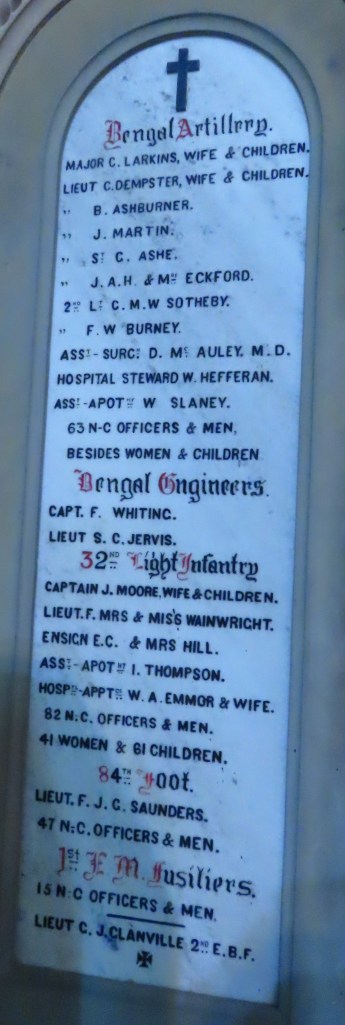
Detachment of H.M. 32nd Regiment of Foot
Captain John Moore – Moore joined the 32nd as an ensign in 1842, was raised to the rank of Lieutenant in 1842 and promoted to captain by purchase in 1851. He was present at the Siege of Multan, the surrender of Cheniote and the Battle of Gujarat. He had been assigned to Cawnpore as the commander of the 32nd’s invalids. He was described by his friend, S.H. Jones-Parry with whom he had served in the Crimea, as remembered the winter after the fall of Sebastopol, when they would go skating around a large lake – “Moore was a marvellous skater, and used to lead the hounds a terrible game over obstacles…”
Mowbray Thomson wrote,
“Captain Moore, who was the life and soul of our defence, was a tall, fair man, with light blue eyes, and, I believe, an Irishman by birth. He was in command of the invalid depot of the 32nd Regiment when the mutiny broke out. Throughout all the harassing duties that devolved upon him, he never lost
determination or energy. Though the little band of men at his direction were daily lessened by death, he was cheerful and animated to the last, and inspired all around him with a share of his wonderful endurance and vivacity. He visited every one of the pickets daily, sometimes two or three times a day, speaking words of encouragement to every one of us.
His never-say-die disposition nerved many a sinking heart to the conflict, and his affable, tender sympathy imparted fresh patience to the suffering women. Mrs Moore sometimes came across with him to our barrack, and we fitted up a little hut for her, made of bamboo, and covered over with canvas; there she would sit for hours, bravely bearing the absence of her husband, while he was gone upon some perilous enterprise. She, poor creature, was amongst the unhappy number who outlived the siege and were afterwards murdered in the house of horrors.”
He had been wounded by a fall from a horse shortly before the siege, breaking his collarbone, but he was, “…sure to be the foremost, with his arm in a sling and a revolver in his belt, directing and leading the men.”
Captain Moore was “quite disgusted with the prolonged siege “ and it would be Moore, along with Captain Whiting and Mr Roche, who would be left in charge of negotiating the terms of surrender. Moore would be killed, trying to push one of the boats away from Satichaura Ghat, when a musket ball pierced his heart. His wife Edith (the younger daughter of Captain Daniell of the 17th Dragoons) and their three children were killed at the Bibighar.
Lieutenant Frederick Wainwright. His wife died of fever in the entrenchment, or possibly of smallpox. The child did not survive the siege. We have an account from Jonah Shepherd of what Mrs Wainwright would have endured, with the others:
“Suddenly something struck the tiles with a tremendous crash, and an immense iron ball, an 18-pounder, darted down, killing a handsome-looking youngster, who was held by the hand of his mother, and wounding one or two others besides. Oh! the anguish of the moment! For a while, a fearful silence prevailed, then the heartrending shrieks of the mother ( an officer’s wife) burst upon us…The following were in the barracks…Mrs Wainwright, ditto infant.”
Miss Wainwright – the sister of Lieutenant Wainwright. Died of fever in the entrenchment.
Ensign Evelyn Charles Hill and wife. Son of George Hill, late of Calcutta. His wife, Mary, was killed in the Bibighar.
Colour Sergeant John Johnson, 4th Company, acting Sergt-Major Grenadier Company
Assistant Apothecary I. Thompson – killed during the siege.
Hospital Apprentice W.A. Emmor and wife – killed during the siege.
Sergeants
Brownley, Mordecai
Lonergan, Michael
Magwood, William
Maher, Patrick
Patterson, Thomas
Stacey, Thomas
Coporals
Coyle, George
Doyle, Richard
Goldsmith, William
Moberly, Henry
Price
Pue, George
Drummer Richard Wood
Privates
Adcock, William
Ashton, John
Bannister, John – ‘Please tell my brother to take care of young John Bannister and never let him enlist for a soldier. If he does he will only repent once, and that will be all the days of his life.’– In the last letter of Private John Barrister, he made a vain attempt to prevent his nephew from joining the army.
Born in Sledgley near Wolverhampton in 1822, Bannister enlisted in 1841, listing his profession as Coker. He arrived in India in time to be embroiled in the Afghan War, and he was hardly impressed with his choice of career – it was grim start, and his experiences led him to write “he had a belly full of soldiering.” Matters did not improve; he took part in the Sutlej Campaign, including Mudki and Ferozeshur, where he was wounded. He transferred out of the 44th to the 32nd.
In March 1848, Bannister sent home a rather grisly letter: ‘The least crime which you may commit is punishable with a severity that is the way a poor soldier gets for fighting for his country.’ Narrating the story of a young artilleryman who was shot by firing squad for hitting an Assistant Surgeon, Bannister wrote that on the day of the execution the man was too ill to walk and the firing party did not manage to shoot him: it was left to the Provost to end the matter by blowing his brains out with a pistol shot.
If Bannister was a reluctant soldier at heart, he was nevertheless an adept one. He was once again in battle, this time during the Punjab Campaign, where he was not only employed in the Siege of Multan but the Battle of Guzerat. His last letter home was from Kasauli in 1854, from where he tried to prevent his nephew from following his footsteps. We do not know how Barrister died, but “an official communication, dated in March 1860, stating that he had no effects and the matter of any prize money due should be taken up with the authorities at the Royal Chelsea Hospital.”
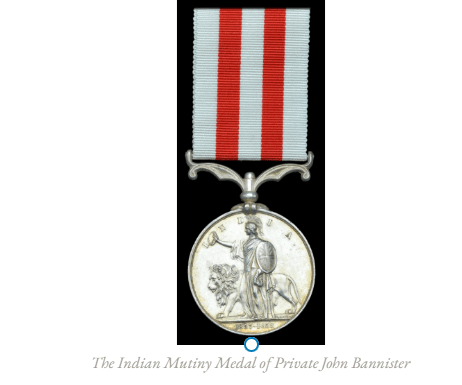
There are very few examples Mutiny Medal that were awarded to men who died at Cawnpore. As they remained mostly unclaimed, they were eventually returned to be melted down. Only twelve such medals exist for the 32nd Regiment.
Barnes, Robert
Barrister
Brogan, John
Brown, Joseph
Butler, James
Cagby or Cogley, George
Carrigan, Patrick
Carroll, Charles
Casey, Thomas
Clarke, Peter
Collins, William
Connell, John
Dobson, John
Dowling, Thomas
Doyle, Richard
Farroll, Jeremiah
Fillison, George
Furrall, James
Galway, Alexander
Gomm, Henry
Green, James
Hagerty, Jeremiah
Harper, Frederick
Hawkins, Alfred
Hindes, Henry
Holland, Henry
Hopkins, George
Johnson, George W.
Johnson, Henry
Keane, John
Kelly, Richard
Lees, James
Leiland, Henry
Lonsdale, Mark
Lovell, James
Lyons, Thomas
McGarry, Daniel
McGoverin, Michael
Mager, Thomas
Morgan, Thomas
Mulrae, Daniel
Murdough, John
Murphy, Thomas
Nevin, Martin
Noble, John
Overmass, John
Payne, Valentine/Vincent
Payne, Philip/ Patrick
Pestel, George
Pinder, William
Potter, John
Pout, John
Reddington, Malachi
Revin, Martin
Reynolds, John
Shanny, William
Sharpe
Skiffington, Patrick
Sommers, Arthur
Stokes, Charles
Stoney, Denis
Thorpe, James
Tillison, George
Toms, George
Toole, Michael
Turner, Charles
Turrell, James
Tutton, Charles
Wagstaff, Samuel
Wellington, William
White, George
Whitington, William
Widdowson, Thomas
Woolley, Joseph
Names of the Women of Her Majesty’s 32nd Regiment
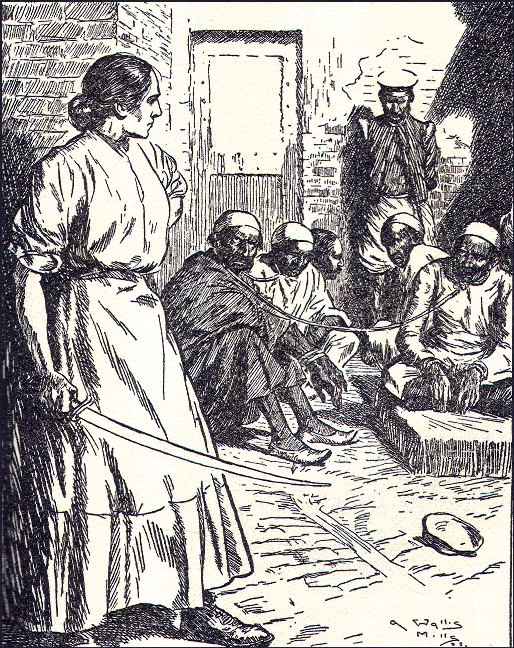
Francis Bromley, 2 children
Mary Butler, 1 child
Mary Burne, 1 child
Bridget Brown, 1 child
Mary Carroll,1 child
Maria Casey, 2 children
Ellen Cagby or Cogley
Mary Carroll, 1 child
Margaret Collins
Ellen Connell, 1 child
Mary Corrigan, 1 child
Sarah Coyle, 1 child
Elizabeth Doyle, 1 child
Dorcas Fulton
Jane Furrall
Bridget Gomm, 2 children
Susanna Holloway
Agnes Johnson, 1 child
Margaret Jool
Mary Keane, 2 children
Mary Kelly, 1 child
Catherine Less, 1 child
Catherine Lonsdale
Anne Lovell, 1 child
Martha Maggan, 2 children
Eliza Magood, 3 children
Rosa Mahser, 3 children
Margaret Mulrae, 1 child
Mary Noble, 1 child – married to John Noble of the 32nd, relatives of George Kelly, killed at Cawnpore.
Emma Payne, 2 children
Maria Payne, 1 child
Harriet Patterson
Louisa Pestel, 2 children
Sarah Pender, 1 child
Diana Potter, 1 child
Susanna Pratchell
Elizabeth Pue, 1 child
Catherine Reddington, 2 children
Margaret Stacey, 3 children
Honor Stoney
Bridget Widdowsdon, 1 child
Mary White, 2 children
“Mrs. White, a private’s wife was walking with her husband undercover, as they thought, of a wall, her twin children were one in each arm, when a single bullet passed through her husband; killing him, it passed also through both her arms, breaking them, and close beside the breathless husband and father fell the widow and her babes; one of the latter being severely wounded.” (Thomson)
Seventeen other children and orphans whose fathers were at Lucknow.
Detachment of Her Majesty’s 84th Regiment
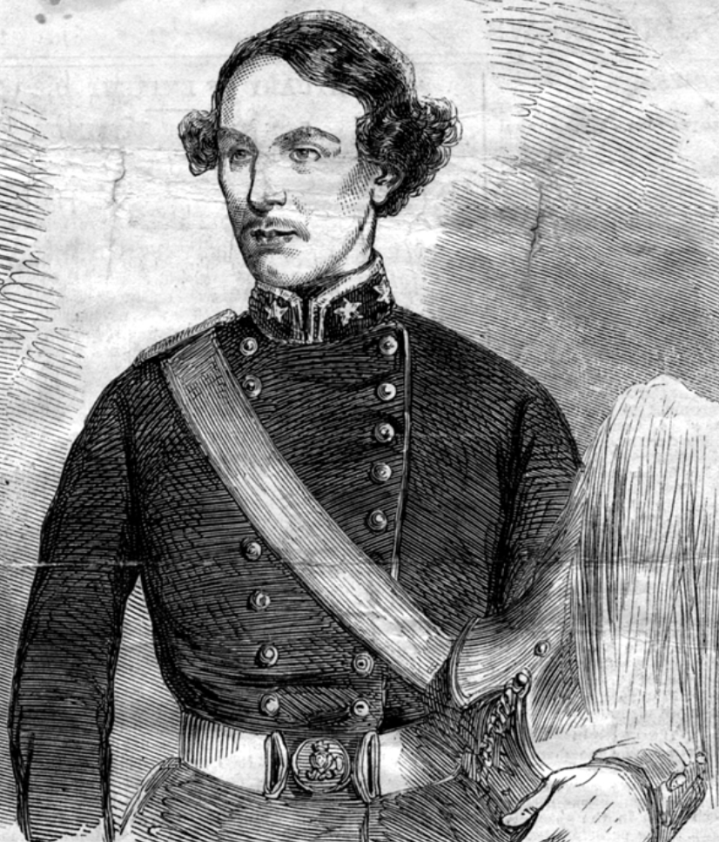
Lieutenant Frederick John Gothleipe Saunders -Aged 31. Fifth son of Lt-Col. R. Saunders, 60th Rifles. Born in 1826 in Glanmire, Co. Cork, he commissioned as an ensign by purchase into HM’s 56th Rifles on the 29th of December 1846, but three months later, he exchanged into HM’s 84th. In April 1847, barely a month later, he married Sarah Herbert in London. He joined his regiment in India the same year and was promoted to Lieutenant without purchase in 1850. In 1854, he left India to join the Turkish Contingent under Sir H. Vivian during the Crimean War and only returned ot India in December 1856. His offer to serve in the Persia Expedition “in any capacity” was rejected, so Saunders made his way to Rangoon to rejoin his regiment.
At the outbreak of the mutiny, the 84th were at Dum Dum, just north of Calcutta, waiting for the arrival of further European troops and then join the moveable column. However, due to the pressing nature of events and requests from the North Western Provinces, it was decided to move the “E” and “G” Companies immediately up country. Lieutenants Saunders and O’Brien, Ensign Magrath, 5 sergeants, five corporals, 2 drummers and 88 privates duly left Dum Dum in parties of up to 20 men over the next 5 days, commencing on the 19th of May. It is anyone’s guess why Saunders was allowed to take his wife and 9-year-old son, Frederick Herbert, with him. On the 3rd of June, the detachment from “E” and “G” Companies arrived in Cawnpore.
Saunders was wounded by grapeshot in the left breast during the siege but continued, despite his wound, to take an active part in the defences. He was one of the men who objected to the surrender of the garrison and “raised his voice against putting any trust in the word of the rebels, and was for continuing the struggle to the last.” Moore and the other officers pointed out that at soon as it started raining, the mud walls of the entrenchment would vanish, the rifle pits would fill with water and the powder, what was left of it, would be too damp to use. In Moore’s estimation, as soon as the monsoon started, there would be nothing left to fight with.
The nature of Saunders’ death is rather incredible, but as the tale is often told in connection with Cawnpore, it can be mentioned here. Saunders managed to get into one of the boats at Satichaura Ghat but quickly changed his mind when the boat started to burn. He jumped overboard mid-stream and managed to reach the shore. He was quickly seized by a group of sepoys who took away his sword, but they did not see the revolver Saunders had concealed about his person. Unlike the other men who escaped the blazing boats, Saunders and a few soldiers of the 84th who “determined to share the fate of their commander” were not killed but brought, at Saunders’ request, to the Nana Sahib. Now what happened next appeared initially in a newspaper.
‘Upon getting near the Nana’, it was reported, ‘he dashed forward through the guards by whom he was surrounded, shooting down five of them with his revolver, and firing the sixth round at the Nana, but unfortunately without effect. A few moments later, he was stretched and crucified; his nose, ears, hands and feet were cut off.’ He was then left mutilated, bleeding and roasting in the sun until the next day when further and more horrible cruelties were perpetrated, until death relieved him from his unutterable agony. A body of cavalry … charged over him, each man of which cut at him as he passed, until he was literally hewed into pieces.‘
As there are many incredulous stories in connection with Cawnpore, it would appear at first reading this is yet another one; however on the advent of Havelock arriving in the city, an NCO of the 84th who had come up with the column, wrote in a letter home, which was eventually published in the London Times, the following:
‘At Cawnpore, a cookboy who was with ‘G’ Company by some means escaped; being a Bengalee, of course, he could mix with the remainder of his class without detection. He is but a lad; he told us that Mr. Saunders was nailed down, hands, feet, and knees; and that these barbarians the first day cut off his feet and ears and nose, and so left him until the next day when some other pieces were cut off him, and he died. He had killed six men and would have shot Nena [sic] Sahib also, that terrible ruffian, but his revolver did not go off.’
Whatever the final fate was of Lieutenant Saunders can only be conjectured; however, his wife and son were killed at the Bibighar.
Sergeants
Gildea, William
Grady, John -shot in the head at Satichaura Ghat
Mulvehill, John
Corporals
Henigan, John
O’Keefe, Arthur
Privates
Ahern, Thomas
Bentley, Robert
Brooks, Thomas
Butler, Robert
Cole, John
Condry, Edward
Dowd, Andrew
Duggan, Michael
Dunne, Thomas
Eaton, Charles
Fisk, Roger
Flynn, John
Fuller, David
Gannon, Peter
Gould, Charles
Higgins, Ambrose
Hollas, William
Horrigan, Jeremiah
Hunt, John
Jackson, Joseph
Leahy, Timothy
Leonard, Elias
Loveday, Edward
Lynch, Daniel
Lyons, Francis
McCulla, John
McNamee, Peter
McNeice, A.
MacIntyre, James
Mace, Richard
Mahon, Peter
Mallison, Thomas
Martin, Philip
Murphy, Dennis – escaped with Delafosse, Thomson and Sullivan
Neeves, William
Norris, George
Pratt, William
Purdee
Reddington
Rielly, Lawrence
Ryan, George
Scott, Richard
Taylor, James
Timmins, John
Wadsworth, John
Sources:
The Story of Cawnpore – Capt. Mowbray Thomson (1859)
A Personal Narrative of the Oubreak and Massacre at Cawnpore – Jonah Shepherd (1894)
Cawnpore – Sir George Trevellyan (1899)
Casualty Roll for the Indian Mutiny – I.T. Tavender (1983)
Our Bones are Scattered – Andrew Ward (1996)
The Tablets in the Memorial Church, Cawnpore, 1857 – a Key Describing all that is known concerning names recorded on the Tablets (Calcutta, Thacker, Spink & Co., 1894)
The Massacred and the more than Illustrious the 32nd (Cornwall) Regiment of Foot at Cawnpore and Lucknow: Part I, Cawnpore – Clive Cohen Journal of the Society for Army Historical Research, Vol. 95, No. 382 (Summer 2017), pp. 97-118
https://www.jstor.org/stable/44872015
 Mutiny Reflections