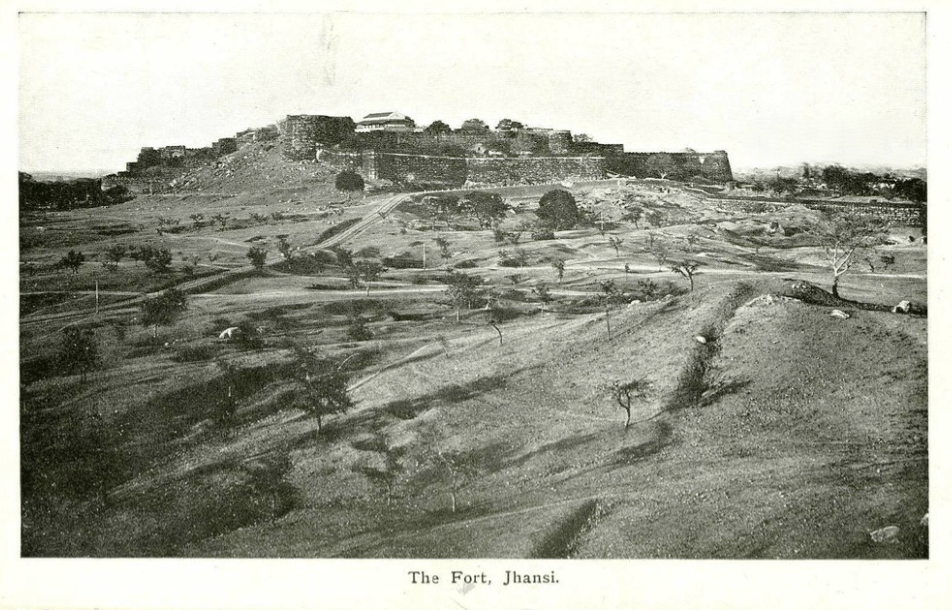
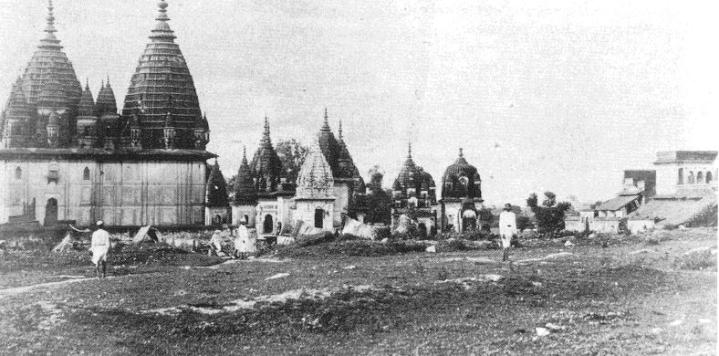
Following the Battle of Betwa, Sir Hugh Rose returned to Jhansi, leading his weary men who had not rested for over 36 hours. They returned now to their camps to wait for his next orders.
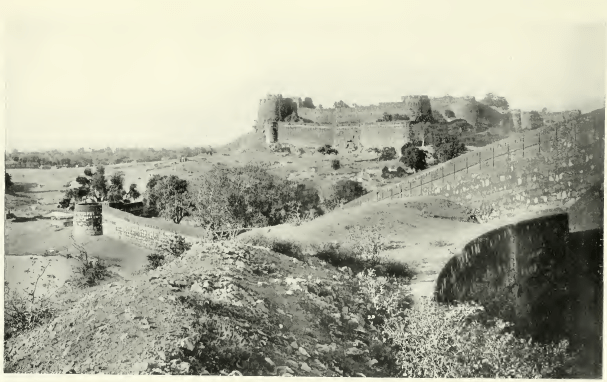
The bombardment of the fort had, on Sir Hugh’s orders, continued with unceasing vigour; while the walls were showing signs of crumbling and fires were seen burning in the city, the towers on the south face of the fort were now useless, and the works on the walls had been blown to bits. The breach itself, however, was deemed to be “just practicable,” but it was enough for Sir Hugh
Rose’s plans and Jhansi would be taken by escalade.
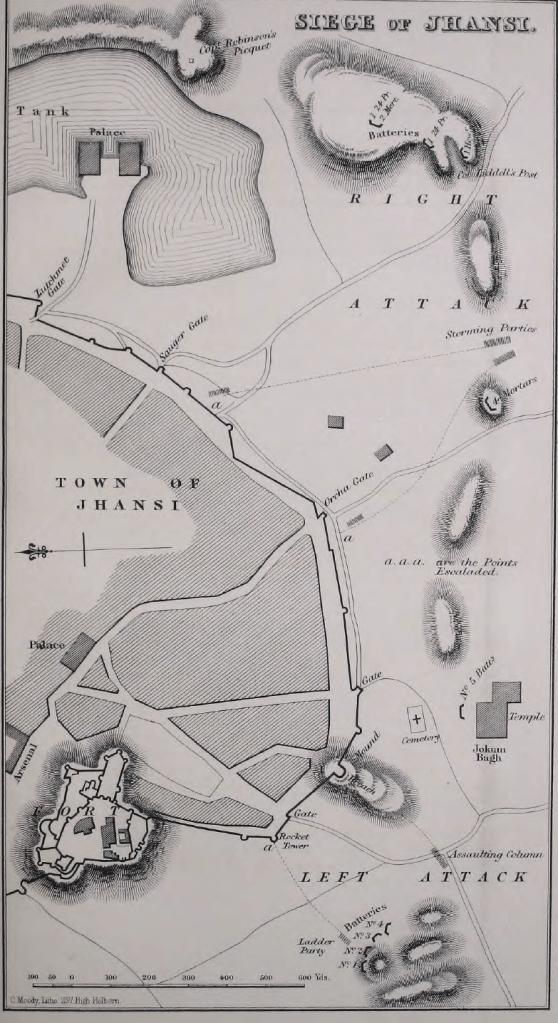
While his men rested, the General completed his preparations. On 2 April following a report from Major Boileau, Chief Engineer, that everything was ready for the escalade, Rose rode out to one of the batteries on the right attack to inspect the ladders which had been prepared, and now were laid in rows, covered by the hill; a 24-pounder howitzer was placed in front of the Jokan Bagh to enfilade and clear, during the coming night, the wall from the mound to the fort and cover the Rocket Tower. Sir Hugh then inspected the left attack before returning to his tent to write up the orders for the next day. Only the commanding officers were informed of the plans, and the order for the attack was issued shortly before midnight.
The plan, if he could pull it off, was not complicated. The assaulting force was to be divided into two parts, utilising the already established fronts of the left and right attack, each subdivided into two columns and a reserve. A detachment under Major Gall was to make a feint attack against the western wall; with this accomplished, a signal fired from three of Captain Ommanney’s guns in quick succession would indicate the commencement of the actual attack. Sir Hugh Rose issued the following orders:
The Left Attack: The left column, commanded by Lieutenant-Colonel Lowth, 86th Regiment, was to storm the breach; the right column, led by Major Stuart, 86th Regiment, was to escalade the Rocket-Tower and the low curtain immediately to the right of it. The reserve was commanded by Brigadier C. S. Stuart.
The Right Attack: Madras and Bombay Sappers, 3rd Bombay Europeans, and infantry of the Hyderabad Contingent, was divided into two columns and a reserve:—
The left column under Captain Robinson, 3rd Europeans; the reserve under Brigadier C. Steuart, C.B., 14th Light Dragoons; the right column under Lieutenant-Colonel Liddle, 3rd Europeans. This attack was to attempt to gain the town by escalade.
Meanwhile, the cavalry pickets were to remain in place and cut off any fugitives who might escape from the city.
Lieutenant Joseph Bonus certainly knew something was up, for he wrote in his diary, “On the night of the 2nd April orders came round very late, but neither Dick nor I was detailed for any duty. We both, however, decided that we would be in the game somehow.”
Both men would get their chance; Lieutenant Dick returned to his tent to hurriedly write, in pencil, his last will and a letter to his mother. He wrote he felt quite sure he would be killed in the assault, and he hoped Sir Hugh Rose would do his best to obtain a suitable position for his younger brother. In his will, he left his rifles to Lieutenant Strutt, forty rupees to a gunner for the kindness he had shown the wounded Lieutenant Christie at Dhar and his remaining property to an older brother who was an officer in the Royal Navy. In the letter to his mother, Dick enclosed a lock of his hair. Above all, he wrote, he hoped he would not die in disgrace.
At two o’clock in the morning, the men of the assault parties were roused from their beds with the words, “Assault immediately.” Surprised, but undaunted, an hour later, they were marched off in silence from their tents to the two attacks.
“The moon was very bright; too light, indeed, for the coming work. We waited for some time in terrible suspense for the signal, as morning was fast approaching. At length the word to advance was given in a voice a little above a whisper, the ladders were hoisted on the shoulders of the sappers, preceded by the 3rd Europeans and Hyderabad Infantry as a covering party, and away we marched from our cover in three bodies — swords and bayonets glistening in the pale light.”
And so began the assault on Jhansi.
The Left Attack
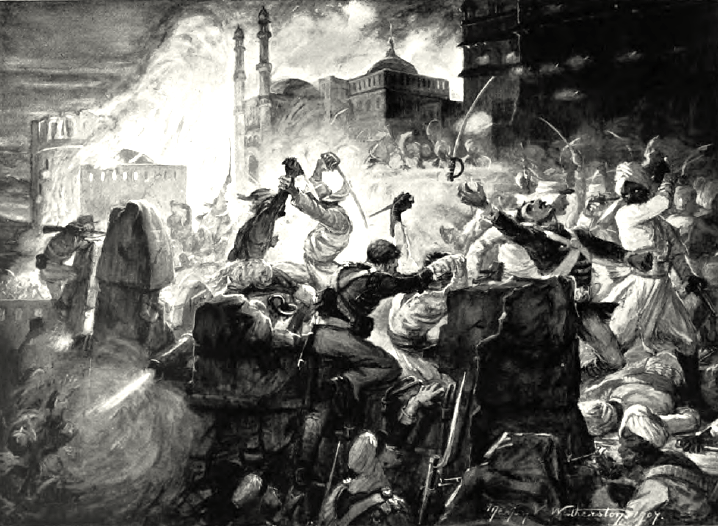
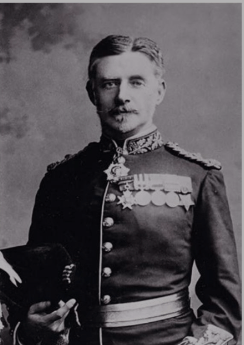
Major Stuart took the men forward – with the sound of the rebels’ bugles ringing in their ears, Stuart ordered the 350 men of the 86th to lead the way, followed by 100 men of the 25th Bombay NI and then the two reserves of 75 men of both corps. Ensign Fowler, with a few skirmishers, was in the advance – they came within 350 yards of the wall, which was 23 feet high, just as dawn was breaking. As soon as they heard Ommaney’s signal, the rest of the column moved forward rapidly until they were within 150 yards from the Rocket Tower, and the low curtain immediately to the right, Major Stuart who was leading the ladder party, called out, “Now lads, for an Irish yell!” and “Such a yell as given as might have frightened the devil.” Within minutes a dreadful fire was opened up on them – the closer the came to the wall, the worse it became, with stinkpots, rockets and red-hot balls raining down on their heads but the ladders were swiftly planted and up rushed Lieutenant Dartnell, followed by the two ensigns, Fowler and Sewell, Lieutenant Webber of the Royal Engineers and Major Stuart, with “all his men at his heels.”
Dartnell was the first over and jumped down straight into a circle of rebels. Unfortunately, behind him, the ladder broke under the weight of the men, and Dartnell suddenly found himself alone. “With no means of defence but a regulation sword, he tried to get his back to the wall, but his foot slipped, and he had to defend his head with his arm, which was cruelly hacked; one man fired a musket at him at the distance of about a foot, but the plate on his sword belt turned the bullet, and he was only slightly bruised.” Lieutenant Webber of the Royal Engineers, who came up another ladder, managed to extricate Dartnell while Ensign Fowler shot a few of his assailants and saved his life. Sergeant Byrne jumped into the fray, but as he came down off the wall, he fell over onto his knees. Unable to gain his feet, he swung his rifle around him, which he was holding by the muzzle, managing thus to smack anyone who came close enough in the shins and legs until his comrades could come to his help.
“After a great death-wrestle, the mamelon was gained, and the soldiers, running down the incline to the street leading to the palace, were joined by the stormers of the breach, who, led by Captain Darby, in the most gallant manner had carried it with little loss.”
Sir Hugh Rose, who had entered the breach with the troops, now determined to take the palace. The street ran under the fort walls and a large open space, exposed to the flanking musketry fire from an outwork of the fort and from the houses and palace in the front, still had to be crossed. Initially staggered by the double fire on their front and flank, the 86th, with Rose at their head, and mad with battle, rushed the houses in their front “in a most business-like manner…. Suddenly, this party came under a severe fire from the fort, under which they were obliged to retire, as they were unable to get into it, and lost in a very short space three officers killed-Captain Darby, Ensign Sewell, and Lieutenant Halroyd (an attached officer)— and many men severely wounded. Ensign Sewell was very badly hit, but Lieutenant Jerome and Sergeant Byrne carried him off at the risk of their lives.” The party quickly took shelter in the houses nearest them while their officers decided what to do next. Surgeon Stack, who had accompanied the regiment, was looking after the wounded – just as he was dressing a wounded man, Major Stuart called out, “For God’s sake, take care, the fire is terrific!” Surgeon Stack merely replied, “Never fear!” when a well-directed gunshot hit him in the heart, and the surgeon fell over, stone dead. Meanwhile, Rose directed loopholes for the riflemen to be made through the houses, which brought a fire to bear on the fort’s outworks. He then ordered a large house close to the palace to be occupied. “During the whole of this time, General Rose was walking about among the men as cool and unconcerned as if nothing was taking place.”
Amid the chaos and carnage, a little boy, no more than 3 years old, suddenly tottered out of an adjoining house. A gunshot from the fort tore through his shoulder, and the screaming, bewildered child fell. Private Kavanagh, seeing his plight, rushed out into the street with a shout and picked up the boy, carrying him to safety. A surgeon quickly bound up his wound, and Kavanagh, now convinced he had a higher purpose in life, took charge of the child and would nurse him back to health himself. All efforts to find his parents in Jhansi proved in vain – the child could give no account of himself, and none of the town’s people recognised him. Kavanagh refused to be parted from the boy – for the duration of the campaign, the boy remained with the regiment under the personal care of Private Kavanagh – at the end of the mutiny, when the regiment was due to return home, Kavanagh was unable to gain permission to take the boy back England, he was forced to hand him over to the Roman Catholic Asylum in Bombay.
We will now return to the attack.
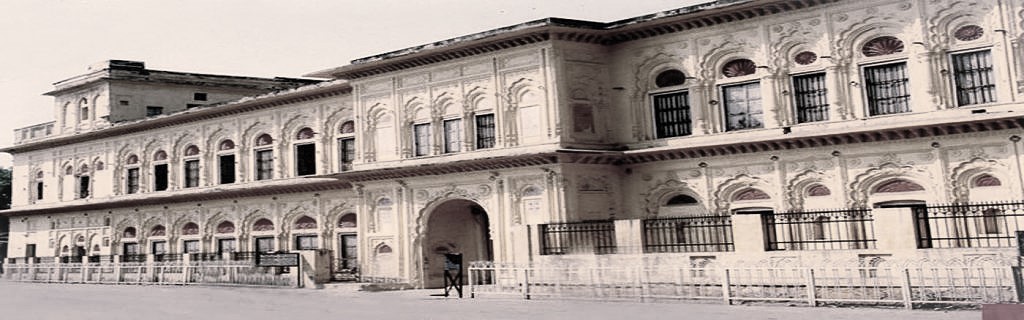
From the house ordered to be occupied by Sir Hugh, the skirmishers of the 86th were able to gain the palace, but it was not an easy fight. The Rani’s mounted guard put up a desperate defence at the palace stables, which were being enfiladed by the fire from the fort. They fired from behind the doors, through windows and loopholes with matchlocks and pistols, and as the British approached, dashed out with their tulwars, while others ran into the nearby houses and made their last stand in the dark rooms. “One body remained in a room off the stables, which were on fire, and then rushed out with their clothes in flames and hacked at their assailants with their swords whilst they guarded their heads with their shields.” To the shock of some of the men of the 86th, one man tried to blow himself and his wife up; when he failed, he cut her throat and then killed himself; another threw his wife into a well and then jumped in after her.
Inside the palace, things were even worse. Every room was defended in an almost desperate fury as the 86th advanced, taking each one at the point of the bayonet, giving no quarter. As the defenders fell back, they set fire to trains of gunpowder and “perished with their assailants in the explosion.” But in the end, their gallant defence was in vain – the palace was be taken.
Meanwhile, neither Sir Hugh Rose nor his staff had heard anything from the Right Attack, where things were not going as well as expected.
The Right Attack
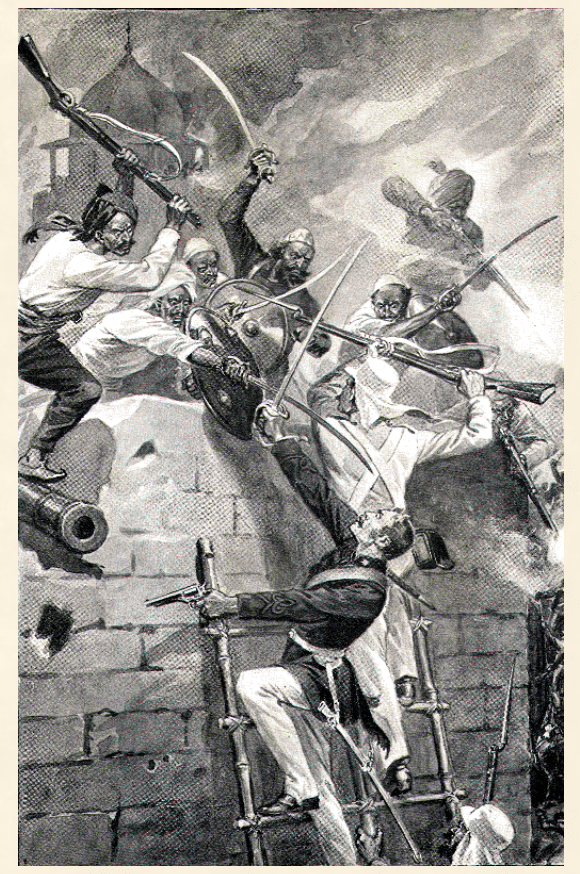
No sooner had the attackers of the left column turned onto the road leading to the gate that the rebels sounded their bugles from the fort walls and let loose a fearful fire of missles down on the men’s heads from all along the long line of the wall and the fort towers. “For a time it appeared like a sheet of fire out of which burst a storm of bullets, roundshot and rockets, destined for our annihilation.” Through this deluge, the men had to march 200 yards before they reached the walls. The Sappers quickly planted the ladders in three places, and the stormers began their ascent. The rebels were having none of it. Within seconds, they bombarded the climbers with anything that came to hand, besides the musketry fire and rockets, they tossed down logs of wood, powder-filled clay pots, bricks and stones. Of the first stormers, many fell, and those still on the ground were forced to shelter behind stones. The Sappers, however, refused to release their grip on the ladders; while many fell, others took their place and held on. Major Boileau, seeing that things were not going very well, sent word to Major Steuart to send him a few of the 3rd Europeans for covering fire; Steuart sent forward 100 men from the reserve, and the stormers again rushed the ladders.
“It seemed as though Pluto and the Furies had been loosed upon us; and inside bugles were sounding and tom-toms beat madly, while the cannon and muskets were booming and rattling, and carrying death among us fast. “
Lieutenant Dick of the Bombay Engineers made it to the foot of one of the ladders, and calling on the 3rd Europeans to follow him, rushed up – no sooner had he gained the top, than a bayonet pierced his body and he was shot in the head; Lieutenant Miekeljohn and one man of the 3rd Europeans made it to the top of their ladder but owing to the weight of the men coming up behind them, the ladder snapped, leaving the two men alone on the walls. Both were dragged over and hacked to pieces. Lieutenant Bonus, mounted another ladder, but no sooner was he at the top, when after some hacking, thrusting and parrying of blows, a rebel whacked him over the head with the butt of his musket, sending Bonus tumbling to the ground – although he had his pistol in his left hand, he had been so busy warding off the blows, he had forgotten to use it. Coming up right behind him was Lieutenant Fox of the Madras Sappers, but his sojourn on the wall was brief: shot through the neck, he too fell. Corporal Hard, Privates Rogers and Archibal of the Grenadiers, along with Privates Drummond and Duran of the 3rd Europeans, tried to find a way through the fracas, but to their consternation, the ladder gave way and they too were sent back down towards earth.
Lieutenant-Colonel Liddell, finding the ladders were truly useless, ordered Lieutenant Goodfellow of the Bombay Engineers to try and blow in a postern gate. With a few Sappers for support, Goodfellow rushed through a hail of bullets to fix the powder bag to the gate and fire it. The door flew open in the blast, and a rush was made to get through the entrance, but to their consternation, it was filled in with a mountain of stones and blocks of masonry. There was nothing for it but to gather up the dead and the wounded and move back towards the rifle pits. “Meanwhile, Captain Robinson, 3rd Bombay European Regiment, having been informed that some of the 86th Regiment had entered by the breach to his left, doubled some of his party round to that point, at which he effected an entrance and cleared the
ramparts so as to enable the remainder to mount the ladders unopposed.” It was only through the success of the Left Attack that Captain Brockman, with some men of the 86th, was able to attack the rebels in the flank and the rear, enabling the right to renew their attempt and enter the city but a change of tactic, however, was needed – by spreading the attack out over eight ladders instead of three, the stormers were finally able to gain the wall, clear it and join the left attack.
The enemy smote them with a deadly fire from the houses. The assailants burst open the doors: the contest was furious, but it was short. Shouts and groans were heard in every quarter, and the street was wet with dark blood. Every inch of ground was contested until the palace was reached.”
Sir Hugh had gained possession of a large portion of the city by advancing the 3rd European to the north-east, leaving the 86th to hold the palace. The two regiments then picketed the houses commanding the front. However, the bloody work of the day was far from over. While occupied at the palace, he received a report that a body of rebels, some 400 in number, had attempted to force a picket and had taken up a position on a high and rocky hill to the west of the fort. He immediately ordered out from the camps two brigades of all arms to recapture the hill and drive out the rebels.
Led by Major Gall, the force consisted of Woolcombe’s battery, some companies of the 24th Bombay NI and the Hyderabad Contingent Infantry, with a few 14th Dragoons in support. As the hill was no more than an isolated rock with a few paths running up it, Gall ordered it surrounded while a barrage of shot and shell was sent up into its heights. The infantry was then sent up on the attack, but by the time they reached, 20 of the rebels who had ensconced themselves on an outcropping had forged a different plan – they set fire to a train of gun powder and blew themselves up. The remainder, except a few who were taken prisoner, were slain. Of the prisoners, one was of particular importance, as it turned out to be the Rani’s father. Unable to flee due to a bullet wound in his leg, he was taken prisoner and a few days later, hanged.
A British flag which had been given by Lord Bentinick to the grandfather of the dead Raja of Jhansi was found in the palace by a soldier of the 86th – with Sir Hugh Rose’s permission, it now waved from the palace roof. Sir Hugh, seeing he now had most of the city, intended to take the rest of it, but Brigadier Stuart dissuaded him – the men were exhausted and it was nearly dark. As for the Rani, she had taken the hint and was now safely within the fort. Tomorrow, the fighting in Jhansi would continue, but not with her.
Sources:
The Revolt in Central India 1857-59, Compiled in the Intelligence Branch (Simla: Government Monotype Press, 1908)
Rulers of India – Clyde and Strathnairn – Maj.Gen. Sir Owen Tudor Burne KCSI (Oxford: Clarendon Press, 1892)
A History of the Indian Mutiny, Vol III – G.W. Forrest (London: William Blackwood and Sons, 1912)
Selections of Letters, Despatches and other State Papers Preserved in the Military Department of the Government of India 1857-58, Vol IV – edited by George W. Forrest (Calcutta: Superintendent Government Printing India, 1912)
Historical Record of the 14th (King’s) Hussars from 1715 to 1900 – Col. Henry Blackburne Hamilton (London: Longmans, Green & Co., 1901)
A History of the Indian Mutiny – T. Rice Holmes (London: Macmillan & Co., 1904)
Central India during the Rebellion of 1857-1858 – Thomas Lowe (London: Longman, Green, Longman & Roberts, 1860)
History of the Royal Irish Rifles – Lt. Col. George Brenton Laurie (London: Gale & Polden, 1914)
History of the Indian Mutiny, commencing from the close of the 2nd Volume of Sir John Kaye’s History of the Sepoy War, Vol. III – Col. G.B. Malleson (London: W.H. Allen & Co., 1888)
Recollections of the Campaign in Malwa and Central India under Major General Sir Hugh Rose – Asst. Surgeon John Henry Sylvester (Bombay: Smith, Taylor & Co., 1860)
The Life of General Sir H.N.D. Prendergast, R.E., V.C., G.C.B. (The Happy Warrior) – Col. Henry M. Vibart (London: Eveleigh Nash, 1914)
Links:
https://www.reubique.com/Bonus.htm
 Mutiny Reflections