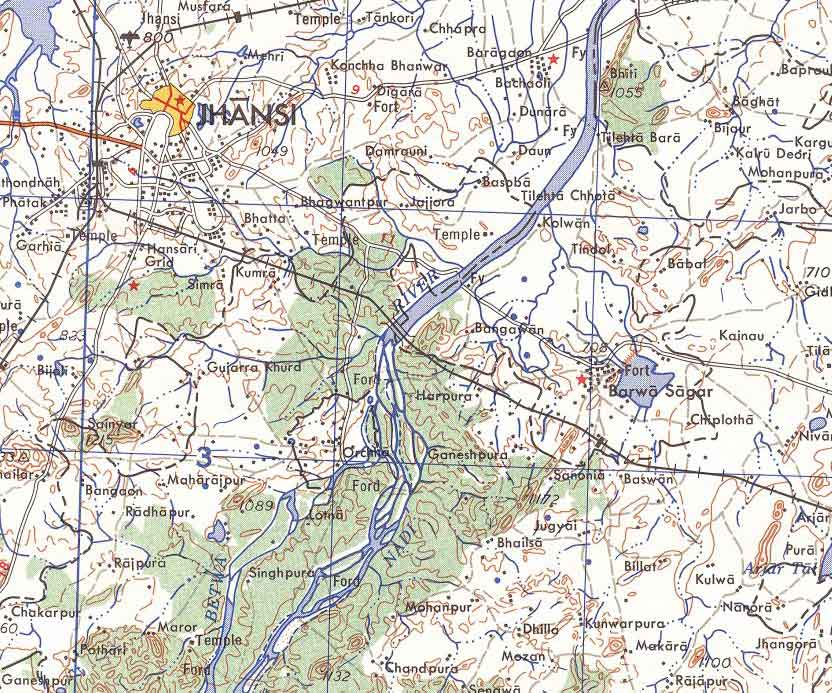
Sir Hugh Rose received the news of Tantia Tope’s arrival with some consternation. The bombardment of Jhansi was still underway, which by no means could be halted — if Rose withdrew, he knew the Jhansi garrison would see this as a victory and most likely sally forth to join forces with Tope. Nor could he risk Tope breaking through and reinforcing Jhansi. Therefore, there really was only one choice open to him — take Tope head on, without relaxing either the siege, nor withdrawing any of the pickets.
At sunset on March 31st, the enemy lit an immense bonfire on a rising ground on the Jhansi side of the river Betwa, as a signal to the town of their arrival. It was answered by salvos from all the batteries of the fort and city, and by shouts of joy from the defenders. There was now no doubt that Tantia Topi sought
battle with the besieging force. The reason of his self-confidence presently appeared from statements
made by prisoners. Tantia Topi, they said, had been informed by his spies that nearly all the English
force was scattered in the siege and investment, and that he could easily destroy the few who guarded the
camp.
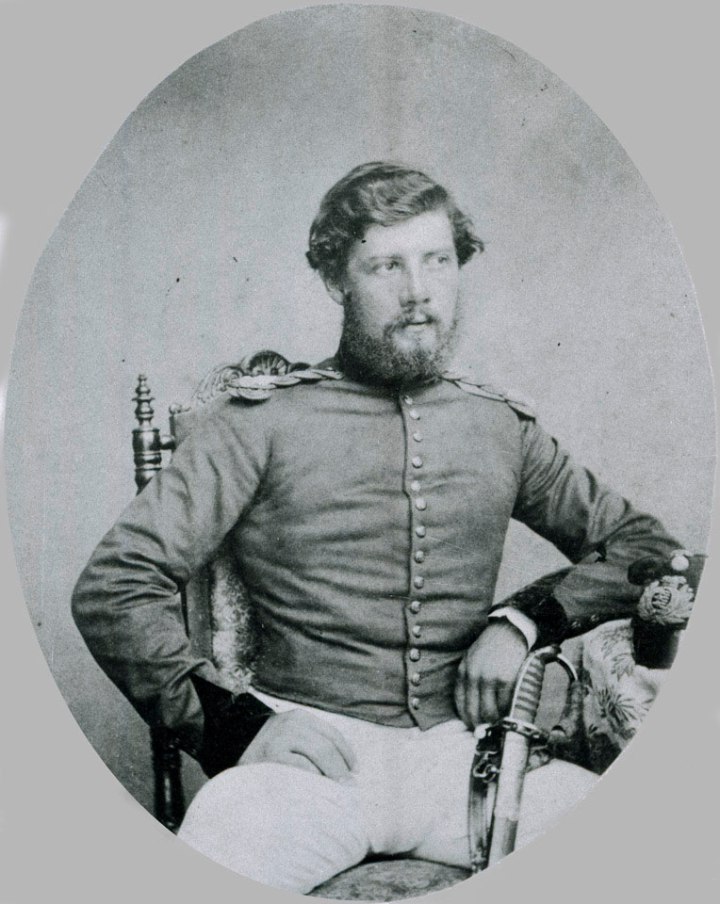
The first Lieutenant Prendergast heard of Tope’s army was from Lieutenant Bonus, late the same evening at mess. “You all seem comfortable,” said Bonus to the laughter of the other officers, “Do you know there are 20,000 of the enemy nearby?” He had seen them, he added, from the observatory and had ridden out with Sir Hugh Rose to have a look at them. Seeing as the next day was, after all, April Fool’s Day, the officers were disinclined to believe Bonus, but Prendergast wasn’t so sure it was a joke. In case there really were 20,000 men lurking nearby, he ordered his charger to be ready at a moment’s notice before he turned in for the night. Like every night, he slept with his boots and spurs on, with his sword and pistols at hand. If it really was a joke, he thought, then the entire Jhansi garrison behind their fort walls were in on it, for “they were firing gaily and beating drums, and sending up rockets as if it were a time of rejoicing.”
The Defeat of the Army of the Peshwa
14th Light Dragoons – 243 rank and file
Hyderabad Contingent Cavalry – 207 men
86th Regiment of Foot – 208 men
3rd Europeans – 226 men
24th Regiment Bombay NI – 298 men
3 Siege guns and Lightfoot’s light field guns
According to his spies, Tope intended to attack Rose the following morning. As soon as he received the news, Rose rode out to the village of Bapoba, where he received reports from the two outposts that were watching the fords of Rajpur and Kolwa, that Tope had not yet moved. Rose surmised quite correctly that Tope would not cross until the British were close to it, and as such, Tope did send out a party to reconnoitre: what they reported back to him was that the whole British force was scattered and engaged in the siege of Jhansi – he could cross the river at his leisure and take them without expecting too much of a fight.
Rose made his plans. Firstly, he withdrew all the men of the 1st Brigade who were not needed for duty to a position along the Kalpi Road, shortly after sunset. They marched along the right flank of the rebels and then halted with the orders to remain under arms for the remainder of the night. “By and by, elephants came silently up to the battery and took off two 24-pounders, which were placed upon the Orcha road near the hill, so as to check the enemy making for the city this way.” Then at 9 pm, he marched the 2nd Brigade to Bapoba, only six miles off.
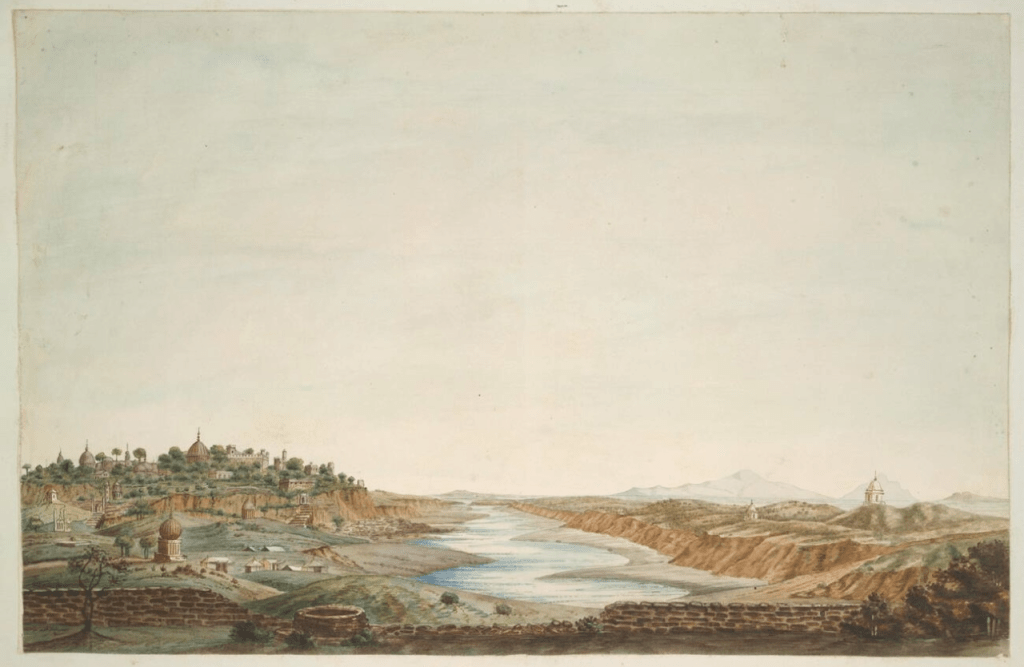
Acting on the information from his spies, Tope crossed the Betwa at the upper ford of Rajpur and took up a position in the rear of the 2nd Brigade’s camp, believing, quite incorrectly, that this was the entire force he would be engaging. The 2nd Brigade remained under arms in their camp while Rose reinforced all the pickets along the entire British line, to be ready for action. As planned, Rose would engage Tope with the river in his rear.
Rose had sent Major Orr off with a detachment of the Hyderabad Contingent Cavalry to keep an eye on Tope along the Betwa road. He had drawn up his forces across the road from the river, half a mile from the camp. On the right flank of his first line, was the 2nd Brigade, the Hyderabad Contingent Cavalry under Lieutenant Clarke, a troop of the 14th Dragoons and four Horse Artillery guns in the centre, with detachments of the 24th Bombay NI and the 3rd Europeans, 3 heavy guns and a detachment of the Hyderabad Contingent Infantry, while on his left flank stood on the ready Captain Lightfoot’s Battery and two troops of the 14th Light Dragoons. The second line was in “contiguous columns at quarter distance,” with weak troop of the Dragoons on the right, the Hyderabad Cavalry on the left flank; in the centre the 86th Regiment, Captain Woolcombe’s battery of 6-pounders, and Captain Ommanney’s battery of 9-pounders with a detachment of the 25th Bombay’s. He had also thrown out strong pickets and lines of vedettes of the 14th Light Dragoons and the Hyderabad Contingent Cavalry to the front and the flanks.
“They accordingly marched in masses and took up a position close in front of our camp, lighted great fires, killed their cattle and ate! The enemy in the fort could see all this, and they shouted, and fired a salute, while the tom-toming and bugling went on at a Bedlam pace all night, and the matchlock men along the wall wasted a proportionate amount of ammunition. The campfires of both forces burnt all night, and our sentries were often taunted by the enemy’s, who told them that they would all be ‘sent to Jahannam (hell) on the morrow. What was the handful before them to the Peshwa’s thousands! wah!’”
During the night, while the two armies watched each other, a cavalry horse became loose and rushed the rebel camp – a brisk discharge of muskets ensued, and one Dragoon was wounded. With the excitement over, both parties returned to uneasy sleeplessness.
The First Brigade
14th Light Dragoons – 40 men
Hyderabad Contingent Cavalry – 107 men
2 guns of Ommanney’s battery
86th Regiment 208 men
25th Bombay NI
A little after midnight, a sowar arrived from the Kolwa Ford to inform Sir Hugh that the rebels were crossing the river, but Rose had expected it. Tope was planning to turn his left flank and force his way along the Bangaon Road, through Major Scudmore’s flying camp and then march into Jhansi. Rose at once detached Brigadier Stuart with the 1st Brigade along the Bangaon Road, 8 miles from Jhansi and not far from the river, to oppose and outflank the rebels who had crossed the ford. This left Rose now without a second line, so he now formed it up from the detachments of the 24th Bombay NI. “Knowing well that the best way of making up for numerical inferiority is by a determined attack on the enemy’s weakest point, Rose had intended to commence the attack at daylight, advance in line, pour fire with all his guns, and then turn and double up on the hostile left.”
However, Tope opened up the fight at 4 in the morning. He advanced, covered by a “cloud” of skirmishers. “On they came, their long line spreading far beyond the British flanks, waving innumerable
banners of all colours and devices, beating drums, and their bayonets gleaming.”
The pickets and vedettes retired steadily, closing to each flank to unmask Tope’s guns. Before Rose uncovered his, the rebels took ground to his right. Rose “conformed” to prevent his left from being outflanked, but with much caution, to prevent the rebels from forcing him to draw too much to the left before they fell on his right flank. As such, this was what Tope had intended to begin with, for a body of cavalry was now seen to the right. Rose halted and fronted, and Tope did the same. Then Tope let loose his artillery, his infantry and matchlock men all along Rose’s front. Likewise, Rose replied and then “commenced the terrific roaring of the heavy guns and field artillery…vollies of musketry rattled from both sides for some time, then the first line of our infantry was ordered to lie down while the horse artillery poured awful destruction upon the left flank of the enemy’s infantry.”
Tope had taken up an excellent position, a little rear of a rise in the ground, making it difficult for Rose’s artillery to bring any effective fire on him. With the first line lying down, Rose ordered a troop of the Horse Artillery (the Eagle Troop) to take the ground diagonally to the right, and thus enfilade Tope’s left flank. Unfortunately, round shot shattered a wheel of one of the guns, causing the rebels to let out a cheer. Captain Lightfoot, however, answered their mirth by advancing on their left front and opened up his battery.
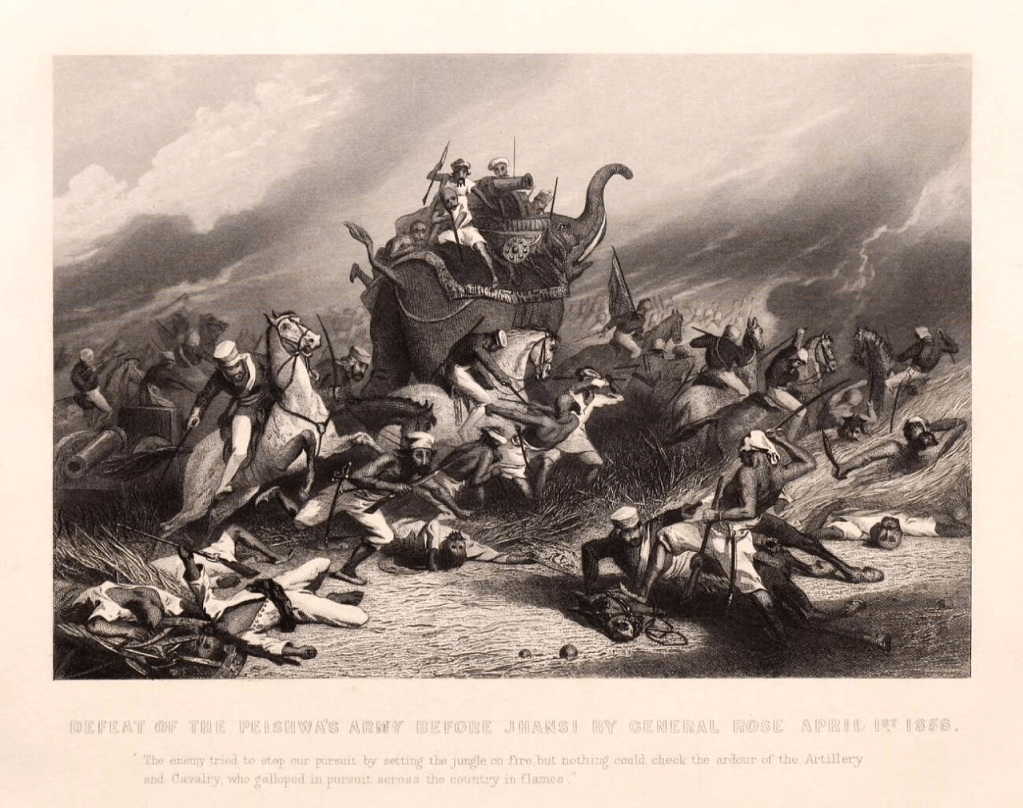
While Tope’s men suffered under the fire of the Horse Artillery and Lightfoot, Rose ordered Captain Prettijohn of the 14th Dragoons to charge the rebel right, supported by Captain McMahon of the same regiment. “Sir Hugh Rose directed Lieutenant Clarke, who commanded the Hyderabad Cavalry, to charge the enemy’s battery, which was done, but ineffectually. Showers of grape and volleys from the Velliattee matchlock men drove them back. Thrice the gallant Clarke charged, but with like effect. In fact, the enemy followed them up, and killed and wounded many men and horses, and wounded their leader severely.” Seeing the Hyderabad Cavalry hard pressed, Rose himself led a charge against their left with Captain Need of the 14th Dragoons, “while Prettyjohn and MacMahon led their troops into the enemy’s right, and doubled them up. This was a magnificent sight, and in a moment the enemy’s ranks were a mass of confusion: they were shaken and disorganised, and commenced a disastrous retreat. They were hurled back on the Betwa by the irresistible attack of the Dragoons.”
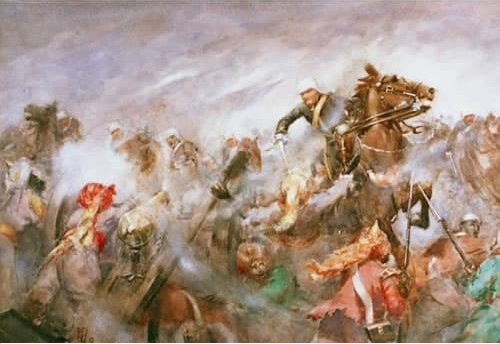
Rose, on his charge, was facing Tope’s best troops, sepoys and Walayatis, who now threw themselves back on the right and rested the flanks of their new line four or five deep on two rock knolls and received Rose with heavy musketry. “Breaking through this dense line, which flung itself among the rocks and bringing their right shoulders forward, the cavalry took the first line in reverse and routed it.” The British infantry, seeing the confusion, sprang up and poured on them one volley and then rushed forward with their bayonets.
The cavalry and artillery moved forward in pursuit, with the Horse Artillery following the Betwa Road, from which it had enfiladed the rebel position, and the Field Battery rushed on across country. A few of the rebels bravely rallied and fought in groups to the last, taking every advantage of the ground. “One body wedged themselves so dexterously into the banks of a nullah that neither musketry nor artillery fire could destroy them. Lieutenant Armstrong (3rd Europeans), coming up with a few skirmishers, dashed at them and bayonetted them all.” The further the rebels were chased, the fewer they became, until only small groups and retreating fugitives dotted the plain; they left behind six guns and their wagons. The pursuit had now destroyed Tope’s first line. A cloud of dust to the right pointed out the line of retreat of another larger body, which formed his second line, and was led by Tope himself, some three miles to the rear of the first line. Rose ordered the whole force to pursue. They came up with the skirmishers on broken, rocky ground, which covered the retreat of the second line.
“Driven in, they closed to the right and uncovered the main body, which commanded the troops in pursuit with an 18-pounder, an 8-inch mortar and other guns. Captain Turnbull answered with a few rounds. Captain Lightfoot, who had come up, thinking that he could bring his guns to ground from which he could enfilade the enemy’s left, was directed to join the cavalry which had been sent to turn the enemy’s left and take their guns. But the insurgents did not await this attack, and retired precipitately by the high road to the Rajpur Fort, firing the jungle to try and check their pursuers. But the mounted troops galloped through the burning forest. Once on the road, guns and cavalry galloped without check until they came within gunshot of the village of Rajpur, where the enemy made their last stand.”
The Horse Artillery and the Field Battery, placed advantageously on higher ground, now crossed their fire on the rebels who, keeping a heavy firing of musketry, retreated while a 12-pounder on the opposite bank tried to cover them. The gun was swiftly disabled by round shot and two troops of the 14th Dragoons and the Hyderabad Contingent Cavalry now crossed the river, which was crowded with not only the rebels’ artillery but their ordnance park and much of their stores, the 18-pounder and an 8-inch mortar drawn by two elephants, their ammunition wagons and all the ammuntion remaining that belonged to the Gwalior Contingent, all trying to make an ineffectual escape. Although the rebels continued to keep up a heavy fire on the cavalry as it crossed the ford, they were unable to stop them from ascending the steep bank on the other side. They then rushed the remaining rebel infantry and sabred them to a man, but not before Captain Need, surrounded by a determined party received nine sword cuts on his horse and trappings, but with the help of Lieutenant Leith, 14th Dragoons, managed to get out of his perilous position without a scratch to himself.
“I saw one sergeant of the Horse Artillery hewn in pieces in one of those nullahs, while numbers of our troops were close at hand. He had cut down two of the enemy and was then attacked by others from behind; he fell in the ditch and was there sadly cut up, while numbers of the enemy were being slain beside him. The man who had cut him down then ran amongst us and figured away like a mad dog, first stepping one way, then another, brandishing his bloody tulwar, until he fell shot by a 3rd European.”
Brigadier Stuart and the 1st Brigade had not been idle. With no rebels to contend with at Bangaon, he quickly marched his men back towards the sound of the battle, the cavalry sent on ahead. After an hour’s march, some fugitives were seen making their way on the left front – the 14th Dragoons rushed up and cut them down. As they approached the village of Kushabir, Stuart observed a large body of rebels, of all arms and no less than 2000 in number, were ready to give him a fight, with their guns in position not just on the road but in the village.
Stuart, however, advanced his infantry in skirmishing order with his cavalry on either flank, with his guns on the road until he was within 600 yards of the rebels. Then, as his guns opened fire, he prepared his infantry for the attack – as soon as the guns fell silent, the 86th and the 25th rushed forward and carried the village at the point of the bayonet, captured all six guns and their ammunition. They continued to advance, always driving the rebels before them, through the broken ground in the rear of the village until they reached the next village, where the rebels now turned, and tried to make a stand. The 86th again charged, but the rebels, still in a “compact body” with a strong rear guard, retired.
“The enemy now began to retire, fighting, and though Lieutenant Giles exhibited the most dauntless gallantry, with the thirty men, now reduced by six, and ten horses and seconded, as he was, too, by some Hyderabad Horse-he could do literally nothing against the dense masses of matchlockmen save cut up outsiders. The ground, too, was impracticable for Artillery, and our tired-out Infantry could not long keep up with the fugitives, and the pursuit was at length abandoned.”
All the Tantia Tope now saw was his men fleeing – the day, he now realised, was lost. Sir Hugh Rose had broken his lines – rallying his routed army was impossible. So flight was his only option, and he quickly took the only road open to him – towards Kalpi.
“The attack by cavalry, of infantry and guns in a strong natural position was unconventional; Rose’s favourite brigadier and many of his best infantry were absent, and the position might have been strongly held against an ordinary attack; the charge of the cavalry acted as a surprise; the mutineers swore that not men but 300 devils on horseback attacked them; some threw down their arms and fled, and before the terror inspired by the cavalry had subside, the infantry advancing seized the guns and the position, and the enemy’s like was forced back till, by the flank attack of Stuart’s brigade, the the retreat was changed into a rout.”
It was a disastrous defeat for Tantia Tope – he lost all 28 of his guns, his ammunition wagons, his supplies, elephants and camels. According to him, only 200 sepoys followed him to Kalpi. It also spelt another defeat for the once mighty and feared Gwalior Contingent, who could not recover from this brutal licking. In all, Tope left 1500 men dead on the field; Rose had 66 wounded, among them Lieutenant Prendergast, and 15 killed in action.
In Jhansi
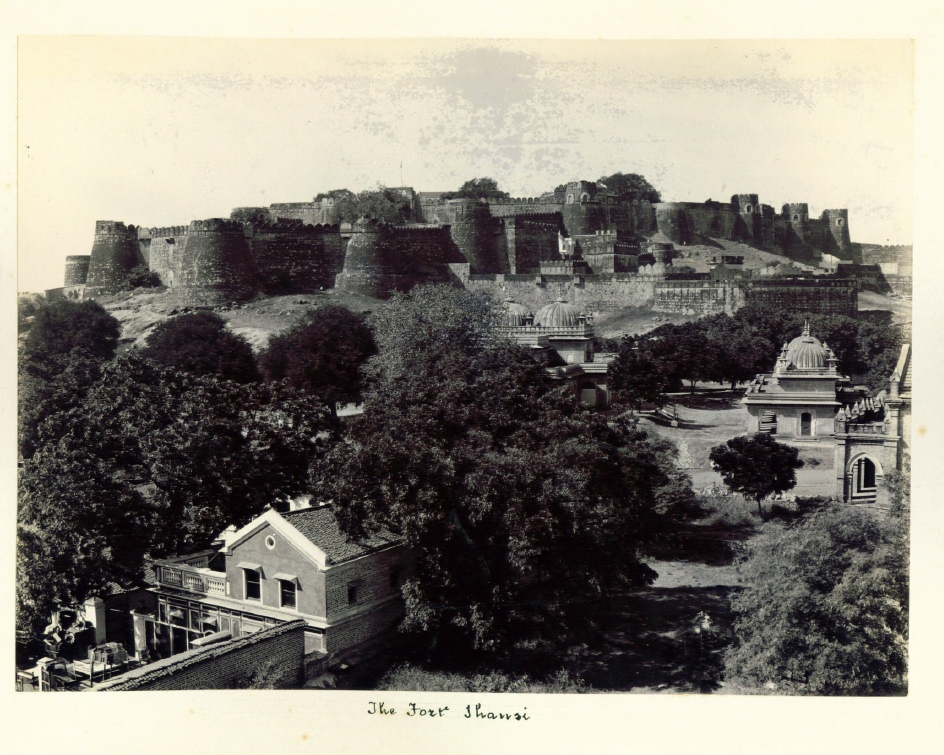
One of the risks Sir Hugh had taken was to leave a relatively small force in Jhansi, who were carrying on the work of battering down the walls. He was well aware that a determined sortie by the Jhansi garrison could have not only destroyed his batteries but put every single one of his men to the sword. Instead, the Jhansi rebels spent the day on the bastions of the fort and on the walls of the city, shouting and yelling, and pouring down volleys of musketry on the batteries, but not a single man ventured out of the citadel. While the battle raged, they redoubled their efforts to make life in the batteries a veritable hell; but as soon as they saw Tope and his host fleeing across the plain, their ardour likewise diminished – there would be no relief for Jhansi afterall. What was left now, as their walls crumbled away, was that they too would soon face this irritating general and his small army. What they did not know, Sir Hugh Rose would not take a rest; without losing a step, and breach or no breach, he would take Jhansi the very next day.
Sources:
The Revolt in Central India 1857-59, Compiled in the Intelligence Branch (Simla: Government Monotype Press, 1908)
Rulers of India – Clyde and Strathnairn – Maj.Gen. Sir Owen Tudor Burne KCSI (Oxford: Clarendon Press, 1892)
Selections of Letters, Despatches and other State Papers Preserved in the Military Department of the Government of India 1857-58, Vol IV – edited by George W. Forrest (Calcutta: Superintendent Government Printing India, 1912)
Central India during the Rebellion of 1857-1858 – Thomas Lowe (London: Longman, Green, Longman & Roberts, 1860)
History of the Indian Mutiny, commencing from the close of the 2nd Volume of Sir John Kaye’s History of the Sepoy War, Vol. III – Col. G.B. Malleson (London: W.H. Allen & Co., 1888)
History of the Thirtieth Lancers, Gordon’s Horse, formerly 4th Nizam’s Cavalry, 4th Cavalry, Hyderabad Contingent, 4th Lancers, Hyderabad Contingent – Major E.A.W. Stotherd (Aldershot: Gale & Polden, Ltd., 1911)
Recollections of the Campaign in Malwa and Central India under Major General Sir Hugh Rose – Asst. Surgeon John Henry Sylvester (Bombay: Smith, Taylor & Co., 1860)
The Life of General Sir H.N.D. Prendergast, R.E., V.C., G.C.B. (The Happy Warrior) – Col. Henry M. Vibart (London: Eveleigh Nash, 1914)
 Mutiny Reflections