“By this time, the heat was becoming intense… The roads were dusty, the wells almost dry, the grass bleached and withered away, the dry yellow leaves rustled beneath the jungle trees, and the branches above were naked and bleached, and the cattle crept in vain beneath these for shade. The winds began to blow as though they had just escaped from the hitherto-closed door of Pandemonium, and they swept over us, scorching up every pore of the body, and making the eyes feel as though they had been blistered. The thermometer stood in the shade of our tents at 110°, in the open at 130°! Nothing was cool, the chairs we sat on felt as though they had just been baked, the tables and tent poles were too hot to touch without necessity; cold water was a luxury, and the necessity of having one’s beer cooled for the evening became one of the great and momentous objects of our existence. Each bottle was carefully enveloped in wet cloth and assiduously punkahed by a servant until required, or when a breeze blew, was hung up and constant evaporation encouraged. The heat was indeed so great, that even the hair of the head became a burden, and many officers placed themselves in the hands of the barber, and came out cropped to the scalp — as sort of stubble field pate, deliciously cool, and favourable to the constant immersion we were now obliged to practise… This gave a very comical air to the personnel, but then brushing and combing were dispensed with…while it became a very easy thing to water the pate and allow evaporation to go on steadily… When night came on, our beds were always brought outside; this was the only cool time, but this was never enjoyed long, as we were roused at all hours for the march.”
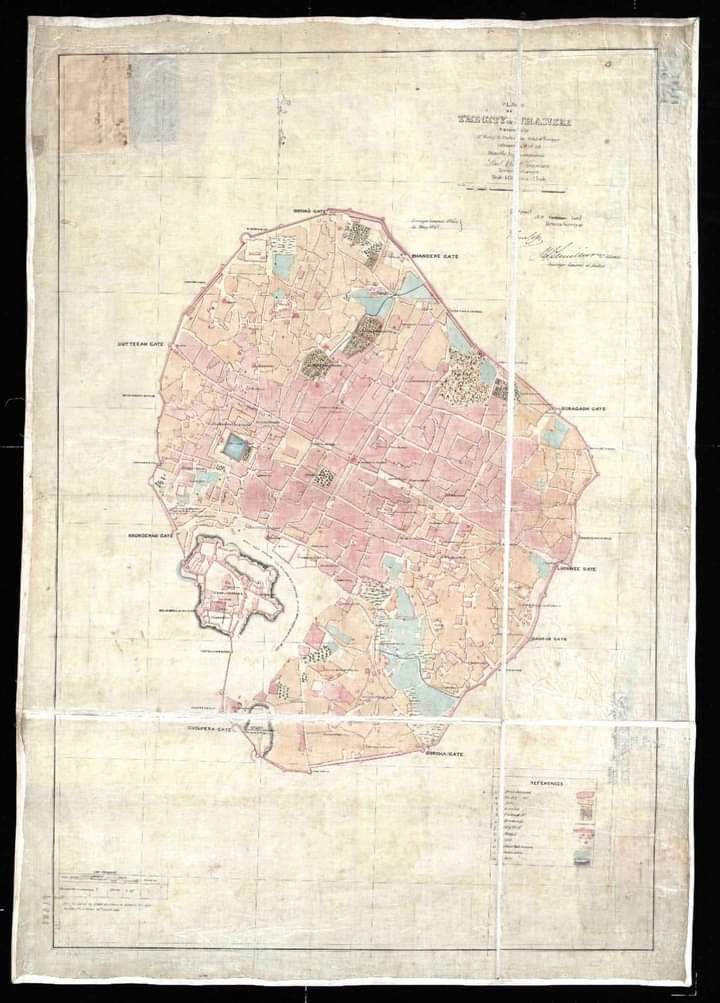
Before Sir Hugh Rose, on this sweltering plain, stood Jhansi, this small Mahratta principality in the heart of Bundelkhand. The city fort contained the royal palace — it was built on a steep-sided rock, which, due to its height, commanded an unbroken view of the surrounding countryside. The masonry was massive, and its walls were up to 20 feet thick. At its feet, on three sides, lay the city of Jhansi, except to the west and a part of the north face. The city itself was not a mean one, four and a half miles in circumference and surrounded by a fortified wall, some 12 feet thick and, in some places, 30 feet high, with several flanking bastions. Between Rose’s forces and the fort was the ruined cantonment and the smaller Star Fort, where Skene and the others had attempted to hold out back in June 1857. On its right, stretching north and east of it, stood a long belt of hills through which ran the Orcha and Kalpi roads. The rebels had taken every precaution to cut down trees that could be used to shelter an attacking party, and walls had been thrown down wherever it was believed they could be of use to “derange” their plans. On the old bastions of the fort, they had mounted large guns, thrown up batteries outside the fort’s walls in advantageous positions, while on the town wall itself, guns too had been erected to command every possible approach.
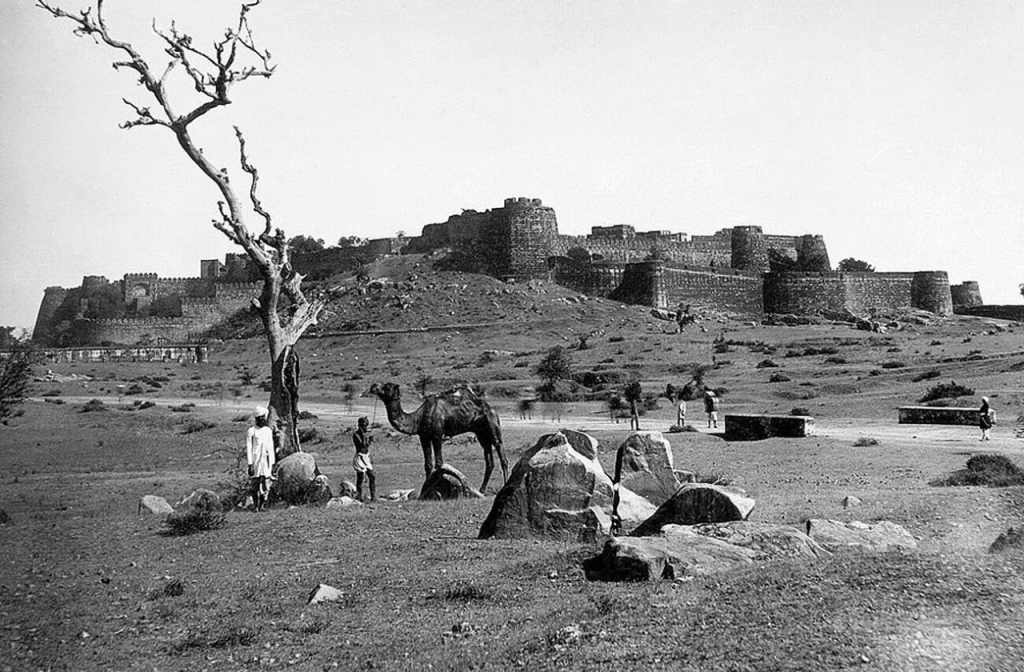
Four strong bastions stood on the south face of the fort – the one looking east had a white top upon which flew the standard of the Rani. All along the east face were more towers overlooking the lines and the city.
The rebels were evidently preparing for an attack, and on the day of Sir Hugh’s arrival, they could be seen putting the last touches on a three-gun battery on the wall a little to the east of the fort’s south face. From this battery, they could then command any approach to this angle; further east along the wall, was another battery to command the Sagar Road, from another bastion, the guns pointed towards the Orcha Road. To the west of the fort, in what had once been a garden, they had planted a two-gun battery to command any approach to the city gate. Every tower had its guns pointing to three points of the compass — east, south and west. To make things just that more complicated, the east was further covered by a large tank and a maze of gardens and temples; the west boasted of another tank with its accompanying gardens and temples, while the north had more gardens and wide open space, or maidan.
How many rebels were in Jhansi was anyone’s guess — estimates, however, fluctuate wildly according to every writers’ best guess, so it is best to err on the side of reason: the Bundelas local levies numbered no more than 10,000, Walayatis and mutinied sepoys made up another 1500 men of whom 400 were cavalry. They were certainly heavy in artillery and boasted of roughly 40 guns. They did have the advantage of numbers, besides a well-stocked fort, and an enterprising leader in the Rani of Jhansi.
At this time, Tantia Tope was not in Jhansi. He was off causing mischief in another quarter, namely, pestering the Raja of Charkhari, still staunchly loyal to the British. While Sir Colin Campbell and Lord Canning were anxious to see Jhansi fall, they were well aware that Sir Hugh Rose and his small force were no match for it — as such, Rose was given the honourable option: bypass Jhansi, and continue to Kalpi while assisting Charkhari on the way.
“ Much as Sir Colin Campbell might desire to be relieved of ‘the stiff neck’ caused by having so constantly to look over his shoulder at Jhansi, he began to doubt Sir Hugh Rose’s ability to take the place with a comparatively small force; while he foresaw that a check before so strong a fortress would be little short of disastrous. The Commander-in-Chief had accordingly authorised Sir Hugh Rose to pass by Jhansi if, after weighing all the circumstances of the case, he considered that the siege could not prudently be undertaken; and to march instead, in two divisions, one on Kalpi through Charkhari, and the other on Banda. Lord Canning wrote on the same day to Sir Robert Hamilton, expressing a wish that, as Sir Hugh Rose was too weak in European infantry to run any risks, he should not consider himself under any obligation to attempt the reduction of Jhansi against the possibility of success.”
However, Sir Hugh Rose did not quite see things the same way. For him, leaving Jhansi in his rear, garrisoned by some 11,000 desperate men, was hardly a wise option either. He did have a difficult decision before him — obey the orders of the Commander-in-Chief and risk Bundelkhand to be once again overrun by rebels, or disobey the Commander-in-Chief and take Jhansi. It was not a decision he would have to take alone, for Sir Robert Hamilton was quick at hand.
‘To relieve Charkhari,’ said Sir Robert Hamilton (March 13th, 1858), ‘by this force would involve refusing Jhansi, and the suspension of the plans of operations towards Kalpi; both of which operations form the groundwork of Sir Hugh Rose’s instructions. However anxious, therefore, the desire to aid the Raja of Charkhari, Sir Hugh Rose, is compelled to consider the movement of his force, or of any part of it, in the direction of Charkhari at present impossible. The advance of this force on Jhansi, in the opinion of Sir Hugh Rose, is calculated to draw the rebels to assist in its defence; whilst the fall of this fortress and its possession by us will break up the confederacy, take away its rallying point, and destroy the power and influence of the Rani, whose name is prominently used to incite rebellion.’
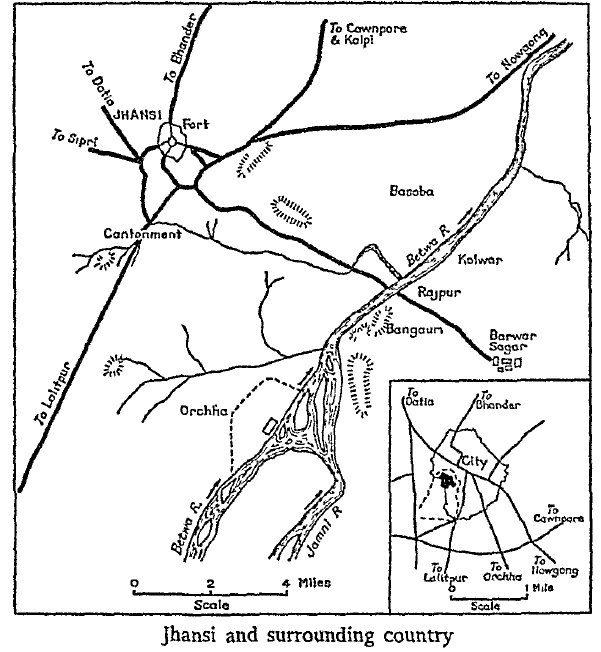
Hamilton followed this up with a letter to the government on 19 March, stating they would comply with the new instructions at “a fitting time,” when Jhansi was taken. Had Brigadier Whitlock been of sense at the time, he should have marched to Charkhari; in the same breath, he should also have proceeded to Jhansi as ordered; he did neither. Instead, he took Banda and remained there. As such, Tope took Charkhari with a small force of 900 sepoys and 4 guns. He plundered the treasury, burnt half the town to the ground and marched off with 24 guns. Along the way, he would pick up six regiments of the Gwalior Contingent and a further 28 guns. He would reach Barwa Sagar, 3 miles from the Betwa and four miles south-east of Jhansi, on 30 March, brimming with confidence, he would grind Sir Hugh Rose to dust. However, before we turn our attention to that particular difficulty, we must first return to Sir Hugh Rose and his problem at Jhansi.
Sir Hugh Rose Invests Jhansi
25th-30th March
On 17 March, Sir Hugh Rose and the 2nd Brigade encamped on the left bank of the Betwa and on the 19th reached Chachanpur, and the next day he was at Simra, 14 miles from Jhansi, The same day, he sent a force of horse artillery and cavalry, including 476 sabres of three regiments of the Hyderabad Contingent, to reconnoitre Jhansi and give the rebels the first idea of what as coming for on their road, they met and cut up 100 Bundelas who were on their way to join the Rani. With the remainder of the 2nd Brigade, Sir Hugh Rose arrived before Jhansi on 21 March and halted his troops a mile and a half from the fort. Unfortunately, while he knew, according to intelligence received by Hamilton, who was in the fort, Rose had no current plan of either the fort or the city; all he had was an old and erroneous map of the surrounding countryside. Reconnaissance was the order of the day — accompanied by his staff, Sir Hugh Rose would once again take the task on himself. His first move was to send the cavalry into the ruined cantonments – through the temples and the notorious Jokan Bagh where the Europeans had been put to death – to clear the way. The rebels had settled down in ‘great numbers’ but after exchanging a few initial pleasentries which included interchanging a few shots and presenting a show of cavalry, the rebels retreated into the gardens near their defences and Sir Hugh Rose proceeded to reconnoitre under the fire of their batteries. The men remained in the saddle until 6 in the evening; it was the first of many such rides he would take. Following the first reconnaissance, his first decision was not to assault the fort, which he could see for himself was, at this juncture, difficult and well-nigh impossible, but to take the city instead.
Meanwhile, the Mhow Brigade, or the 1st Brigade, was hurrying towards Jhansi. Sir Hugh Rose had cleared the way for them in the past days: on the 19th, the 14th Dragoons left to join the 2nd Brigade, and Brigadier Stuart now pushed his men onwards in their wake. The country they marched through was desolate of all life — the villages were deserted, “and the fields were teeming with corn ripe for the sickle; but it seemed as though a plague had swept over the land, and carried off its occupants.” The 14th Dragoons arrived in Rose’s camp on the night of the 22nd – Stuart and the rest of the force would march in three days later; Whitlock, as we know, would never turn up.
The arrival of Dragoons certainly was a great boon to Rose’s plans. He had wasted no time in drawing them up, and it consisted of establishing seven flying camps as an investing force throughout the city. The principle camp was placed under Major Scudmore with half a troop of Horse Artillery, another, on the most distant side of the city was under Major Gall with two nine-pounders, another opposite the lake palace to the east was commanded by Camtpain Thompson and the 14th Dragoons; Captain Forbes and the 3rd Bombay Cavalry took another, while Captains Abbott, Murray and Clerk with the Hyderabad Contingent looked ot the rest. The last three held the western side and watched against any rebels approaching from Gwalior; similarly, the other four camps guarded the approaches from Cawnpore, Kalpi and the Betwa. “These camps detached to the front outposts and vedettes, which watched and prevented all issue from the city day and night; each camp on any attempt being made to force its base was to call on the other to help.” Sir Hugh further gave instructions that the road from the city should be obstructed with trenches and abattis.
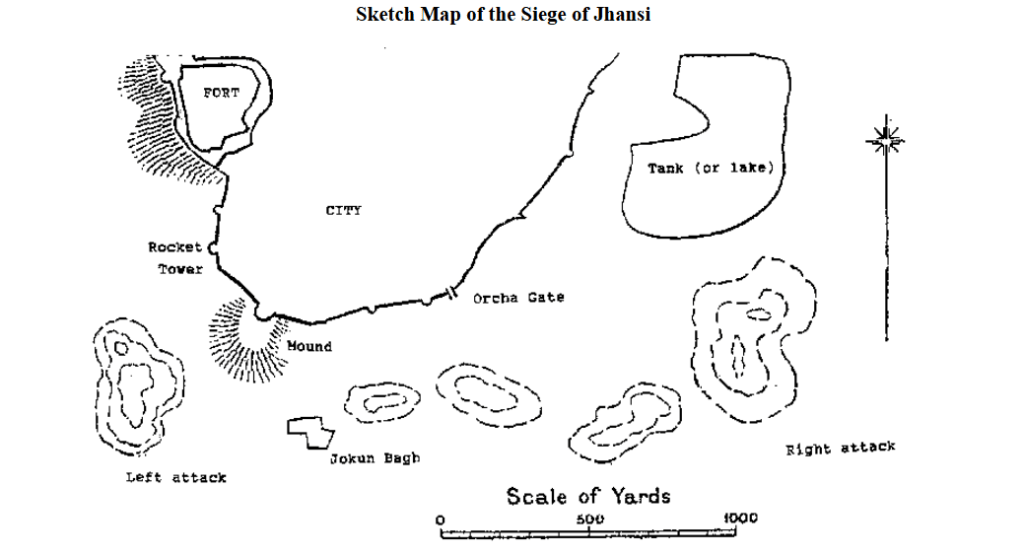
The city would have to be taken before taking the fort, and a fortified mound was the key to it- it covered not only the south side of the fort but enfiladed two walls of the city, besides commanding the entire south quarter that included the palace. As Rose could not breach the fort except from the south, the city wall and the mound would need to be taken first. He determined, therefore, to concentrate a heavy fire not only on the hillock but on the south of the city, breach the wall close to the mound and then dismantle the defences which protected it. During his reconnaissance, Sir Hugh Rose had found a rocky knoll, opposite the Orcha Gate and the south east wall of the city, which would take in reverse, the mound and the two walls running from it. On the left, a rocky ridge, though excellent for a breaching battery, was too far off at 640 yards and the firing from it would have been oblique. This would subsequently be known as the Left Attack and the Right Attack.
On the night of the 22nd, the Madras and Bombay Sappers moved quietly from the camp with two 18-pounders, howitzers and mortars with a company of the 24th Bombay NI to erect a battery near the Orcha Road on the east side of the city wall. They had been preceded by some horse artillery and Dragoons, who skirted the hills, making for the north-east side of the Jhansi. As the guns reached their destination, the darkness before them was suddenly broken by a flash of light – the men halted and made ready to resist an attack. Several officers now pushed their horses forward – to their relief, it was found the light came not from the rebels but from a party of 3rd Europeans who had taken possession of the position where the battery was to be erected.
Working through the night, a mortar battery was thrown up on a small temple, and the heavy guns on a rocky knoll, some 300 hundred yards from the city wall. By morning, the rebels caught sight of the opponents and opened fire with their guns from the fort and their batteries on the city walls.
“At first, the shots passed over us, but by and by they got our range exactly, and then their shots struck the sandbags and the temple almost every time. There was generally time to bob one’s head beneath the bags when they fired before the shot reached, but one of their guns, which we named “Whistling Dick” never gave us time for precaution, for the puff of smoke was scarcely seen before the shot whizzed over your head, or came with a heavy thud on the battery.”
By the 23rd, all seven camps were in position. For one young man of the Dragoons, it would undoubtedly lead to a most exciting time.
“We were expected to cover a certain portion of the city, to see that none escaped, or to turn out at any moment, and on any emergency. Consequently, we were never out of harness, sleeping in front of our horses,, which were always ready saddled and bridled – never having the bits out of their mouths, night or day, except a few at a time for feeding purposes, or to give them a drink in comfort, so that it came harder on the horses than it it did on us. As for ourselves, I don’t think we were able to change our clothes or have a wash for about a fortnight; yet somehow, in spite of this and dreadful heat, none of us fell sick, and all seemed to enjoy the life we led. The system of investment by “flying camps” of cavalry was most admirably conducted; it was said a cat could not pass their lines. Day after day, the same routine was rigidly enforced. No quarter was given: those attempting to escape from the city were cut off by our vedettes and sentries or attacked by our ambush parties posted at night. There was not a night passed but large numbers of prisoners were taken by our cavalry picquets, and many of these were summarily disposed of.”
On 24 March, four batteries were ready on the Right Attack and commenced firing on the 25th, the same day the siege train of the 1st Brigade arrived. The next morning, the Madras Sappers marched out with a working party of the Royal Engineers to erect batteries of the Left Attack of the rocky ridge. Beneath it was a small defile, and from it, the ground sloped upwards to a small plateau. The plateau would be taken under a very “galling cross fire from the guns of the fort, the bastions and the city walls.” Captain Ommanney of the Royal Artillery soon had his ten-inch howitzer in place, while the Hyderabad Contingent Artillery brought up their two 5 1/2 mortars and swiftly played on the mound and adjacent houses. However, the rebel gunners were still throwing their shots with unprecedented precision – with one round shot, they killed a subadar and a havildar. A sepoys of the Contingent was heard to remark, “There is luck for somebody….”
Between the 26th and the 29th of March, the Right Attack came into form. The two 18-pounders commenced to dismantle the defences of the fort, two 10-inch mortars were to destroy the fort itself, two 8-inch mortars and one 8-inch howitzer would act not only on the mound but the adjacent wall and the city. One 18-pounder would breach the wall near the bastion of the mound, which was unrelentingly exposed to fire on its right face and left rear. The fire from the two 18-pounders proved so effective that within days, the parapets of not only the white tower but two others, which faced the attack, were nearly destroyed. The two 10-inch mortars managed to hit the powder magazine in the fort and blow it up.
The knoll of the Right Attack was also high enough to erect a telegraph and an observatory, which would be worked using signal flags, and in case needed, could indicate to the flying outposts a series of messages, such as “enemy escaping” and “enemy advancing.” Rather like a weather vane, the direction by which the rebels might be coming or going could be indicated, signalling for the officers commanding the outposts to “let loose the dogs of war.” In charge of the telegraph and observatory was an officer and two non-commissioned officers who, with the aid of a telescope, could see right into the city itself.
At night, the battery was by no means silent – every few minutes, it threw a shell into the city. Some shells set fire to stacks of hay and forage, and the resulting fires lit up the night sky. What the British soon found was that they were not facing a rabble of undisciplined soldiery. At the head of the rebel artillery was a first-rate gunner, who with his two companies of golandazes, gave as good as he got. Undaunted, he organised his men, saw to it that damaged defences were swiftly repaired and reopened almost as quickly as they were silenced. From some batteries, the gunners matched the British, shot for shot.
On the Left, two of the rebel defences continued being a nuisance. One was a tower on the south and a garden battery on a rock in the rear of the west wall of the city. To counteract these problems, a new battery was constructed, called the East Battery, on a ridge east of the existing ridge, with two 5 1/2 inch mortars – these proved wanting, so they were substituted for two 8-inch mortars and one 9-pounder. Then, to drive the point home, a 24-pounder was dragged up to enfilade the wall running eastwards from the mound. The garden battery was shelled unrelentingly by two 8-inch mortars and occaisionally by two 10-inch ones: what the British did not know at the time, many sepoys had taken their quarters here on account of the five wells and their good water. On hot days like these, water was undoubtedly something precious enough to fight over, but once it was all over, some sepoys taken prisoner admitted the British shelling had cost them, at its most severe, 60 men a day killed.
Since battering the city and the fort was by far not enough, Sir Hugh Rose ordered the infantry to keep a galling fire against the rebels lining the walls. “All this time, there was a constant rattle of musketry firing from the enemy, and from our infantry who occupied various advanced positions behind boulders of granite, cottage walls and temples. We already had several wounded, and lost a Bombay sapper whose arm was torn off by round shot…There was the excitement of the enemy before us and the work of destruction to go on with, so by constant applications of cold wate to the head upon a towel and frequent large draughts of cold water from the musuk, we managed to endure for long consecutive hours what one would imagine would kill one in half the time. ”
By the 30th, the defences of the fort and the city were either dismantled or their guns disabled. The rebels had, on the white tower, made a superb parapet of big sandbags which they admirably always kept wet, but by now their best guns had been disabled, and many of the best artillerymen were dead. The rebels certainly were proving more obstinant that Sir Hugh Rose had anticipated – all this cannonading, breaching and firing was causing his force to eat through its ammunition supply at an alarming rate – so much so there was no longer enough to continue breaching the city walls or to establish even a main breach on the south double-wall of the fort. However, there had been some fruit of all these labours – a small breach had been effected near the mound, and it was now determined to widen it, but the rebels were having none of Sir Hugh Rose’s ideas. As soon as the British let off firing their guns, they swiftly closed it off.
Sir Hugh Rose was now eight days into the investment of Jhansi, and he was still no closer to taking the fort. He did however, decide, in light of his growing concerns regarding the ammunition, he would have to take the fort by escalade – and he was standing in the battery on the right hillock discussing his plans with his ADC, when the telegraph suddenly signalled, “enemy approaching in great force from the north.”
Tantia Tope had arrived and Sir Hugh Rose’s problems were about to get much worse.
Sources:
The Revolt in Central India 1857-59, Compiled in the Intelligence Branch (Simla: Government Monotype Press, 1908)
Rulers of India – Clyde and Strathnairn – Maj.Gen. Sir Owen Tudor Burne KCSI (Oxford: Clarendon Press, 1892)
Selections of Letters, Despatches and other State Papers Preserved in the Military Department of the Government of India 1857-58, Vol IV – edited by George W. Forrest (Calcutta: Superintendent Government Printing India, 1912)
Central India during the Rebellion of 1857-1858 – Thomas Lowe (London: Longman, Green, Longman & Roberts, 1860)
Memorials of an Ancient House – a History of the Family of Lister or Lyster – Rev. H.Lyttelton Lyster Denny (Edinburgh: Ballantyne Hanson & Co, 1913)
The Rebellious Rani – Brigadier Sir John Smyth (London: Frederick Muller Ltd., 1966)
History of the Thirtieth Lancers, Gordon’s Horse, formerly 4th Nizam’s Cavalry, 4th Cavalry, Hyderabad Contingent, 4th Lancers, Hyderabad Contingent – Major E.A.W. Stotherd (Aldershot: Gale & Polden, Ltd., 1911)
Recollections of the Campaign in Malwa and Central India under Major General Sir Hugh Rose – Asst. Surgeon John Henry Sylvester (Bombay: Smith, Taylor & Co., 1860)
The Life of General Sir H.N.D. Prendergast, R.E., V.C., G.C.B. (The Happy Warrior) – Col. Henry M. Vibart (London: Eveleigh Nash, 1914)
 Mutiny Reflections