Rani Lakshmibhai and the Mutiny
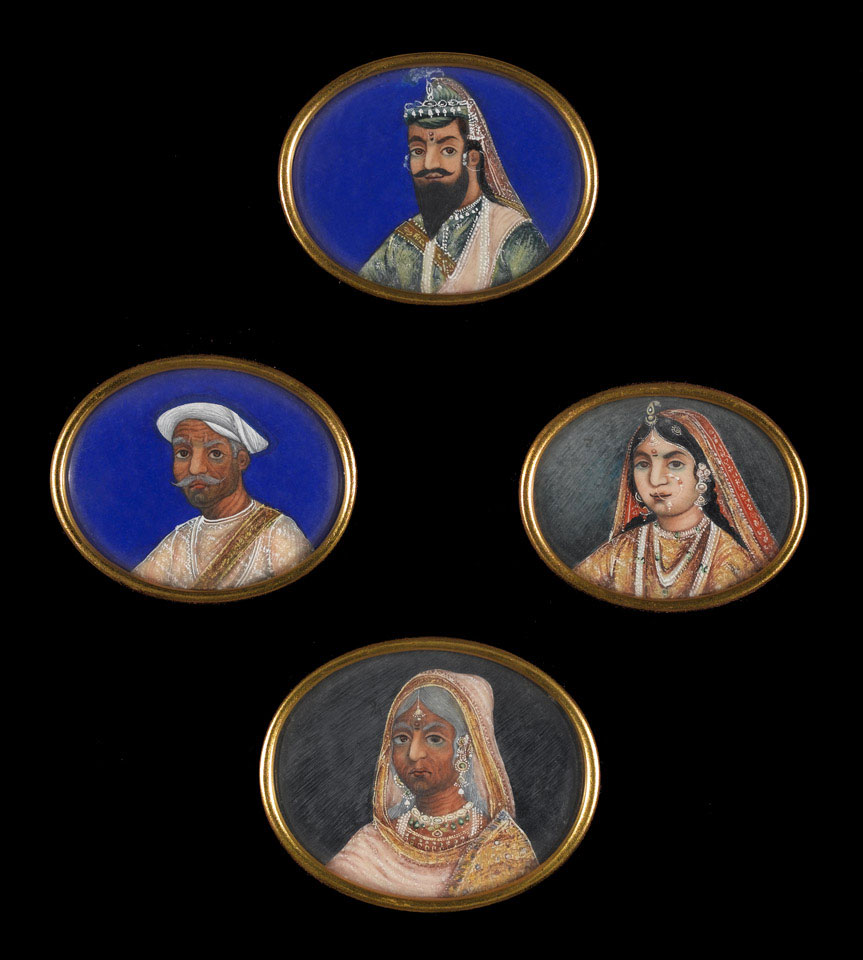
Watercolour on ivory, by an unknown Indian artist.
Found during the capture of the Nawab of Farrukhabad’s palace in 1858.
The Mutiny at Jhansi undoubtedly did not speak in Rani Lakshmibhai’s favour, and there would remain two camps among the British regarding her complicity — the ones who believed she was little short of a demon and others who thought she had been coerced. The more modern opinion is that she was a marvellous ringleader who had planned the entire mutiny from start to finish. At the same time, it makes for an interesting rewriting of history, but it is rather distanced from the truth.
There are a few salient points to remember: in June 1857, the troops in Jhansi consisted of the left wing of the 12th Regiment, Bengal Native Infantry (the right wing being at Nowgong), and the right wing of the 14th Irregular Cavalry and an artillery detachment. None of them were at home in Jhansi, and the men who served in these regiments owed the Rani no loyalty. While the 12th remained in Jhansi and threw in their lot with the rebellion in Central India, the 14th Irregulars marched off to Delhi; some of them joined the Nana at Cawnpore, while others were defeated by Hodson at Rohtak. The atrocities at Jhansi can be ascribed to the cavalry, who had induced the officers and men to leave the Star Fort under false pretences and then promptly murdered them along with all the women and children. However, it must also be pointed out that the assurance for their safety of the besieger had been signed by the Rani – unfortunately, a similar assurance was given by the Nana Sahib to General Wheeler at Cawnpore, barely 20 days later.
It must be further remembered, the Rani of Jhansi, despite her name, was not the natural ruler of Jhansi. Her husband, the actual ruler of Jhansi, Gangadhar Rao, died in 1853 with no natural heir; his son, Danodar Rao, was adopted in 1851 and denied, through the Doctrine of Lapse, his right of succession in contradiction of the treaty of 1817.
According to the treaty, which was signed with the then Raja of Jhansi, Ramachandra Rao, he and his heirs and successors should be given the right of hereditary rule of Jhansi. In 1835, when Rao died without issue, his widow adopted Krishna Rao, the son of her sister. However, since the boy’s family had no blood ties with the deceased raja, his adoption was contested by other family members, which eventually led to the EICo replacing him with Ragunath Rao, Ramachandra’s uncle. As he proved to be a worse than useless ruler who also died without an heir, the government was once again involved in a familial dispute and ended up giving the right of rule to Gangadhar Rao, the last surviving brother of the raja. However, he was not invested with ruling power until 1843. Once again, there was a problem with an heir.
Gangadhar Rao happened to be a good leader and a thoughtful ruler, but he was blighted by childlessness. His first wife died, leaving him with no children, and so grieved was he by her loss, he determined never to marry again. However, in 1842, he did remarry, a young girl, of no more than 14, from a good Mahratta family, named Manakarnika. On her marriage, she took on the name Lakshmibhai. The marriage itself had been suggested by Baji Rao, the ex-Peshwa now exiled in Bithur: the girl, following the death of her father, who had once been a retainer of Baji Rao’s brother, was taken to live in the court at Bithur. It is without question that she would have been known to not only the Nana Sahib but Tantya Tope, though both were older than her.
While she did bear Ganghdar Rao a son, the baby died in infancy, and for the remainder of their 9-year marriage, there were no other children. Rao was, of course, much concerned by this state of affairs, and given Jhansi’s previous experiences with the EICo regarding heirs, he had every right to be worried. Nevertheless, in 1853, one day before his death, he adopted a 5-year-old boy from a branch of his family, and in the presence of the Political Agent to Jhansi, Major Ellis and other state officials, the boy was adopted with all ceremony. Rao then commended his wife and child to the care of the EICo and pleaded that the government would treat them with kindness and the administration of the state should fall to his wife until his son came of age. While Ellis agreed, the Governor-General’s agent, Major Malcolm, had to throw a spanner into the works and bleat that this was “against policy.” The policy of Lord Dalhousie, that is, and his rigorous use of the Doctrine of Lapse.
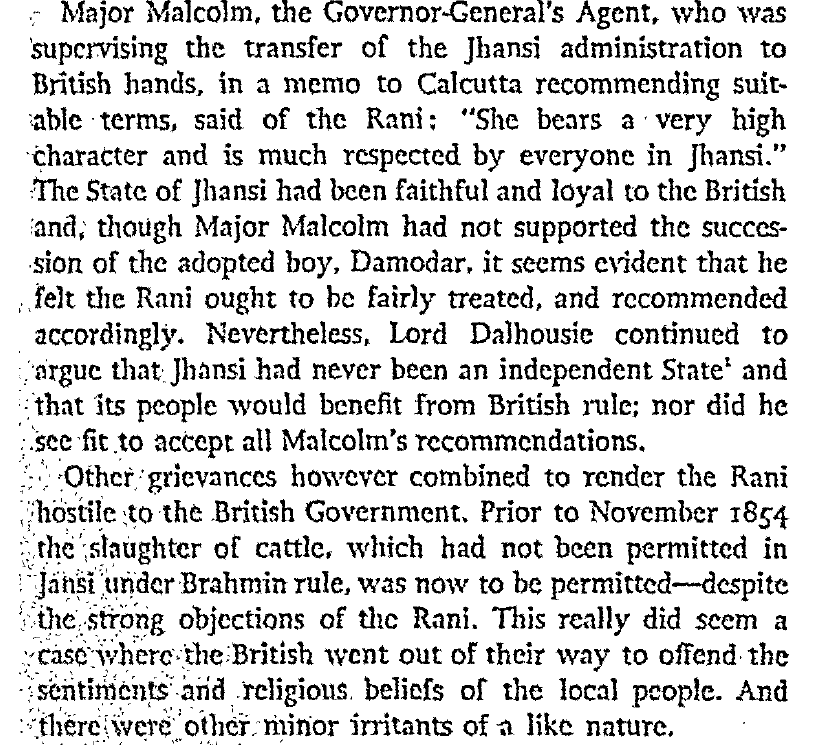
Dalhousie’s actions regarding Jhansi were, in effect, illegal due to the stipulations of the treaty. We must also consider the absolute greed of the EICo, who, despite the annexation being declared unjust, did not have to answer to any court of law and promptly went ahead with the annexation regardless.
When the annexation of Jhansi came into force in 1854, Rani Lakshmibhai sent at least three appeals to the EICo, but with no effect. She was finally accorded a pension, permitted to live in the palace, while being placed outside the jurisdiction of EICo courts and police. The troops at Jhansi were dismissed, and sepoys of the left wing of the 12th BNI were deployed to garrison the fort with a detachment of artillery. She did have her own personal bodyguards. Captain Alexander Skene was appointed Political Officer in charge of the State and Captain Dunlop commanded the garrison – neither of them were men of wide experience and Jhansi, with its precarious position as neither a Princely State, nor an independent one, with a Rani who was not recognised by the EICo as the leader, but merely as the pensioned widow of a dead raja, with an adopted son of no rightful standing, the EICo should have sent a civilian with more vision than Skene.
As the mutiny in Jhansi has already been detailed in another post, we shall not dwell on it here; however, it must be said that after it occurred, the Rani’s position was precarious, to say the least. She no longer had the support of the EICo or the advice of the Political Agent, who was murdered under her watch, and while she made overtures to the government pleading her innocence in the murders that were mostly believed, her situation was becoming untenable. Major Erskine advised the Rani to take control of Jhansi and rule to the best of her abilities until order could be restored. No one suggested at this point she had been complicit in the murders themselves, and it was pointed out that the situation as it stood had been out of her control. Had she attempted to prevent the murders, most likely her head would have ended up on a stake; however, since that did not happen, she ended up an unwilling participant in a war that was much larger than herself.
Translation of Khureeta of the Ranee of Jhansee to the address of the Commr. and Agent Lieutenant Governor, Saugor Division, dated (supposed) 12th June 1857.
After compliments. States that the Govt. forces, stationed at Jhansie, thro’ their faithlessness, cruelty and violence, killed all the European Civil and Military Officers, the clerks and all their families and the Ranee not being able to assist them for want of Guns, and soldiers as she had only 100 or 50 people engaged in guarding her house she could render them no aid, which she very much regrets. That they the mutineers afterwards behaved with much violence against herself and servants, and extorted a great deal of money from her, and said that as the Ranee was entitled to succeed to the Reasut, she should undertake the management since the Sepoys were proceeding to Delhi to the King.
That her dependence was entirely on the British authorities who met with such a misfortune the Sepoys knowing her to be quite helpless sent her messages thro’ the Tehseeldar of Jhansie, the Revenue and Judicial Seristadars of the Deputy Commissioner’s and Superintendent’s Courts to the effect that if she, at all hesitated to comply with their requests, they would blow up her palace with guns. Taking into consideration her position she was obliged to consent to all the requests made and put up with a great deal of annoyance, and had to pay large sums in property, as well as in cash to save her life and honour.
Knowing that no British Officers had been spared in the whole District, she was, in consideration of the welfare and protection of the people, and the District, induced to address Perwannahs to all the Govt. subordinate Agency in the shape of Police &c. to remain at their posts and perform their duties as usual, she is in continual dread of her own life and that of the inhabitants.
It was proper that the report of all this should have been made immediately, but the disaffected allowed her no opportunity for so doing. As they have this day proceeded towards Delhi, she loses no time in writing.” (British translation from the original Persian)
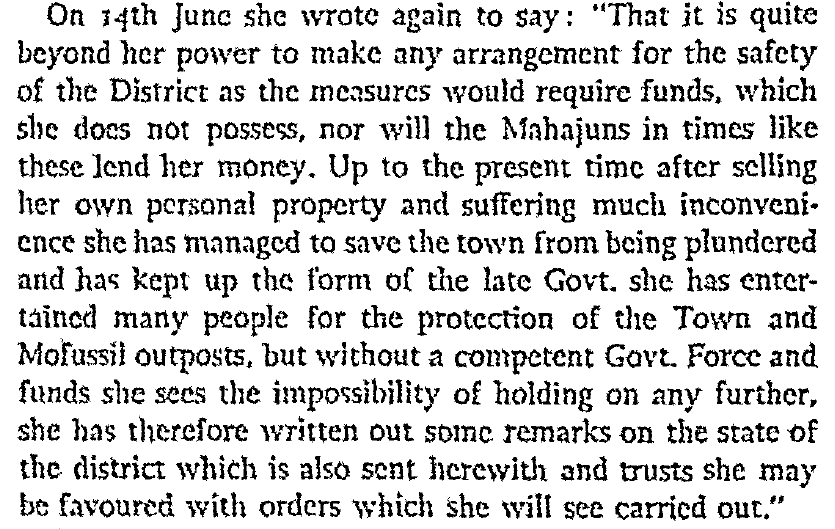
While neither letter proves her innocence or her guilt, it must have been clear to her, that as soon as the Jhansi mutineers left, she would need to find a way to put herself back in the good graces of the EICo, who took a dim view of massacres, especially where Europeans were the victims. Her position was further complicated by the fact that she had no contingent, no army, and besides the obvious strength of Jhansi Fort, no actual defences. Her court itself was mutinous, and more than one courtier was eyeing her throne.
Major Erskine, who thoroughly believed she had been “more sinned against than sinning” advised her to “collect the Revenue, to raise Police and to do everything in her power to restore order, and that accounts will be settled with her when Officers reach Jhansi, when she will be liberally dealt with…” He further sent her a proclamation to be issued calling on all inhabitants of the district to obey her rule “agreeable to the custom of the British Government, who will for a time make proper arrangements.” The government itself was only partially pleased with Erskine’s actions and issued a rather stern warning.
“In respect of the Rani…his Lordship in Council does not blame you for accepting the circumstances in which you placed her account of the own proceedings and sentiments, and entrusting her the management of Jhansi territory on behalf of the British Government, yet this circumstance will not protect her if her account should turn out to be false.” In other words, if she remained on her best behaviour, there was some hope of redemption; as long as the government did not have the time to deal with Jhansi, she would remain on approval until resources were available to deal with her. It must also be considered that rulers with fewer resources than the Rani put their necks on the line for the EICo if only as a means to save their principalities from destruction, so it does beg to question where her motives essentially lay.
That she was not complicit in the murders could only be taken on her word; the British did find witnesses not only to the siege of the Europeans in the Star Fort but to the massacre at Jokhan Bagh, which certainly did not cast a favourable light on her case. Mrs Mutlow, in particular, was adamant that the Rani knew perfectly well what was happening, and she did nothing to prevent the killings, especially since among the murderers were her own bodyguard. That the corpses lay unburied for three days, stripped of all their clothes, does not speak much in her favour: one can argue that in her situation, surrounded by evildoers in her court and mutinous sepoys, she could not have shown even the smallest amount of respect without forfeiting her head. However, when her palace was seized on 3 April and the next day, the fort, among the many things found within those edifices was the plundered property and the possessions of the dead Europeans, everything from their furniture and books to their letters and personal trinkets. For whom exactly she was keeping these things is anyone’s guess, and essentially it might have been wiser to destroy every last scrap. It certainly did not speak in her favour.
The problem, however, was, the government must have realised by their actions they were effectively setting the Rani on the road to rebellion. By withdrawing their support, be it temporarily or permanently, the Rani was now open to attack from enemies much closer than the Calcutta government. A relative of her late husband was quite assiduously eyeing the Jhansi throne; with the removal of British authority and the aid of the rebel sepoys, Sadasheo Rao managed to capture Karera Fort, not 30 miles from Jhansi and declare himself the Maharaja of Jhansi. The Rani, however, was not taking his proclamation lying down – instead, she attacked him twice and took him prisoner. It was his destiny to languish under her very watchful eye in Jhansi Fort. He was the least of her problems.
The Bundelas, who had been causing mischief since the mutiny began, harboured a natural animosity towards Marathas, whom they saw as interlopers and quite resented the very idea of the principality of Jhansi being run by them. As such, the Dewan of Orcha opened hostilities by offering the Rani the same pension as she had received from the British if she would just surrender Jhansi and go away. To prove his point, he sent a formidable force right up to her walls – the Rani, on the other hand, realising she could not match Orcha in military might, had used her influence with the people of Jhansi and summoned her friends among the petty chieftains to come to her aid. These answered her call by raising their own levies, and Jhansi became effectively a military camp. The Dewan of Orcha’s general must have been a little surprised on his arrival, when the Rani rode out of the city at the head of her troops, dressed in every manner of warlike attire and even more so, when he realised a little too late that his force had settled itself uncomfortably close to the Rani’s artillery that lined the walls of the fort. Without much formality, the artillery opened fire, and the Orcha force turned and fled. This settled matters with Orcha for a time and checked the Bundelas, who now decided that Jhansi would have to wait.
Although a relative peace descended on Jhansi following the embarrassment of the Orcha troops, the Rani was under no illusion that this would last. As such, she began enlisting troops, casting cannon and manufacturing ammunition, in fact, anything and everything essential to wage war. Due to the rather isolated nature of Jhansi, she also looked for new friends – among these were the rebel rajas of Banpur and Shahgarh. Gaining their allegiance was also one way of ensuring they did not persist in plundering her estates or looting the district of all its wealth as they had done in Banda and any portion of Bundelkhand and Central India within their reach. With them on her side, she was able to effectively bring about a decent administration and see to the wants of her people, but the downside, of course, having friends like these was going to bring her to the less favourable attention of the EICo. Until now, she had done nothing to incur their ire. Jhansi was peaceful, she had a functioning government, and she had proved she was able to withstand threats from without. The British, for their part, had quite efficiently let her down. Her letters had been to no avail, but she would, as late as January 1858, continue to elicit their support.
Letter by the Rani to Sir Robert Hamilton, the Agent Governor General to Central India, dated the 1st January 1858. Hamilton did not reply. Quoted from Sen (Foreign Political Consultations, No 266, 30th Dec 1859 (Supp).
Translation of a Khureeta from the Ranee of Jhansee to the Agent Governor General for Central India dated 14th Jamdeeoolawul A.H. 1274, corresponding to 1st January 1858.
After compliments.
To narrate all the strange and unexpected occurrences that took place during your absence from India is a painful task. I cannot describe the troubles and hardships I have suffered during this period. Your return to India has given me new life. I take this opportunity to give you a brief statement of my history. At the time when the British forces mutinied at this place, and when the Chiefs of Dutya and Oorchha commenced their career of coercion and rapine, I lost no time in writing to the British Officers as per margin [see below], and gave them detailed information as to the state of the country some of the bearers of these letters are missing, others being plundered before reaching their destination came back to Jhansee, those that were sent to Agra returning, stated that they succeeded in sending the letters within the Fort of Agra through a Bhiestee [water carrier], that their life being not safe they did not wait for a reply. Major Ellis informed me that my letters were referred to the Officer that was acting for Captain Skene. I got a letter from the Commissioner through the Chief of Goorsaray dated 23rd June stating that I should take charge of the District. Another communication from the same Officer dated 10th July in reply to my three letters was also received, it referred me to his former communications in which a proclamation putting me in charge of the District was said to have been enclosed. On the 29th July, I wrote back in reply stating that I had not received the proclamation.
2. Taking advantage of the disturbed state of the Country, the Cihiefs of Dutya and Oorcha first took possession of the district of Jhansee Illaka that lay on the borders of their respective states, both to the East and West.
3. On the 3rd September (both these Chiefs acting in concert) the Forces of Oorcha composed of the Thakoors and relations of the State, and amounting to 40,000 men with 28 Guns, invaded Jhansee itself and made other Chiefs support them. Altho’ the two letters received by then from the Commissioner were sent to Nuthey Khan [leader of the forces of Orchha] for his perusal, yet he took no notice of them. On this, I again wrote to the Commissioner who told me in reply (by letter dated 19th October) that British forces were assembling at Jubbulpore–That he will come to Jhansee and examine the conduct of all either high or low and deal with them accordingly. In the meantime I tried my best by selling my property, taking money on Interest–collected a party of men and took steps to protect the City, and to meet the invading force. The enemy by firing guns, matchlocks and rockets (Ban) did much mischief, and killed thousands of precious Souls, my resources failing, I wrote on the 20th September and 19th October for reinforcements. After 2 months the besieging force retired to a village Koma situated about 3 miles from Oorcha, all the districts that were formerly occupied by the Chief of Oorcha are still in his possession. In the same manner the Ranee of Dutya still holds all the districts that fell into her hands. The authorities at Oorcha and Dutya do not give up these places, the troops sent to reoccupy them meet with opposition.
4. As was the case in former days the Pawars and Mawasas are excited to ruin by rapine and plunder the remaining districts.
5. Under these circumstances I can never expect to get rid of these enemies and to clear myself of the heavy debts without the Assistance of the British Government.
6. The Commisioner seems not prepared to move for my help as he states in his letter dated 9th November, that the services of the British troops for the present are required at his quarter. As these short sighted individuals seem unmindful of the British supremacy and do their best to ruin myself and the whole country, I beg you will give me your support in the best way you can, and thus save myself and the people who are reduced to the last extremity and are not able to cope with the enemy.
While Hamilton did not seem to find it necessary to answer the Rani, he most certainly kept himself informed, and on 8 January the following intelligence report appeared:
It is reported that Bukhshish Alli, the Duroga of the Jhansee Jail, asking the Ranee whether she would fight, or not, with the English Forces, was informed by the Ranee that she would not; but will return all the districts under her to the British officers when they come to Jhansee. On getting this information, the Duroga did not take service with the Ranee.
Major Erskine, who would soon be harassed by Brigadier Whitlock, was keeping an eye on Jhansi too, as can be seen from this extract of a letter by Gopal Rao, record keeper of Jhansi, to Major Erskine dated 16 Jan 1858.
The most important news is that Nana Saheb has a vakil in Jhansi and the Queen of Jhansi has one in Kalpi as well. The Queen has complete arrangements for the reception of Nana Saheb’s family members in Jhansi. Both the King of Banpur and Nana Saheb have decided Jhansi is their final refuge.
Lala Dulkara, the army commander to the King of Banpur, was feeling solitary and insecure in Sagar. So, the King of Banpur arranged for a portion of the Gwalior Contingent to be sent there. He had already sent over some soldiers to Sagar under the leadership of Sadar Ali and Muhammad Ali. The rest of the Banpur troops, three to four thousand gun-bearing soldiers and two cannons were placed in Jhansi. Only 1300 of them are fully armed.
The Queen of Jhansi is paying the Banpur King 500 rupees a month while he fills up his own treasury by looting the rich moneylenders and shopkeepers. These shopkeepers are eagerly awaiting the arrival of the British. The Queen is always incredulous about British advances – whoever has said the British won at Kanpur has been punished by the Queen.
The prison warden, Bakhshish Ali (who was one of the chief perpetrators of the British massacre in Jhansi in June 1857), has written to the Queen that he was with the brother-in-law of the Emperor of Delhi in Aligarh and was now approaching Jhansi with an enormous army. He wanted a gift of 5000 rupees from the Queen, who has sent 3000 rupees. Military preparations are being made in Jhansi around the clock.
The problem is that no one was interested in talking to the Rani herself. With her letters unanswered and no one ready to support her claims of innocence regarding the massacre in June except Erskine, who essentially had no say in the politics of Jhansi and was thus hardly more than a well-wisher, she had now to prepare for the worst. Sir Hugh Rose and his force were coming, and as luck would have it, her erstwhile friends were being beaten by him at every turn. This, of course, could, at any moment, give Orcha the idea of attacking Jhansi again. Her military preparations were for the benefit of the British as much as for her aggressive neighbours – needless to say, she had been left with little choice in the matter. She would have to fight because, ultimately, there was nothing else she could do. She had most likely received instruction in the martial arts in the court of the Baji Rao – it was not uncommon for Maratha women to be trained thus, even the widows in the court of Gwalior could wield a sword, shoot an arrow and ride a horse. She even recruited women into her ranks, and these could plainly be seen serving on the walls of the fort during the siege. Although she lacked some military foresight, such as not attacking Sir Hugh Rose’s force in the rear when he was busy at Betwa. Overt reliance on the abilities of Tantia Tope, too, may have clouded her judgment, but her policies as a whole were sound.
The Rani was certainly skilled in diplomacy. On one hand, she had influence over her people and, to some extent, over the sepoys who not only remained in Jhansi after the mutiny but also all those who flocked to her banner. Had she been an indecisive ruler with no definite message, she would not have been able to hold sway with them. The emissaries from the Nana had been skulking about for months; Scindia had had on two occasions at least, sent them packing; however, it would seem the Rani may not have been so inclined. The old court of her childhood and the ghost of a glorious Maratha kingdom were very likely not far from her thoughts. While it might be claimed she feared falling into British hands and being hanged as a rebel, it must also be pointed out that the Nawab of Banda, who similarly had followed in the steps of the mutiny, was ultimately sent into exile, as was Bahadur Shah Zafar, the last Mughal ruler in Delhi. The Rani of Jhansi could not foretell her own fate; however, she was certainly very good at hurrying it along. There is more than enough to say, while she might have started out in the role of a reluctant rebel, she certainly warmed to the title as the months wore on. By the time Sir Hugh Rose began the siege, the Rani of Jhansi was leading an army as a most capable leader. Had the British been a little less concentrated on the fact that she was a woman and seen her as a genuine adversary, they might have considered marching on Jhansi sooner. However, they were too quick to disregard her position and certainly less prepared for the stance she ultimately took.
Sources:
The Rebellious Rani – Brigadier Sir John Smyth (London: Frederick Muller Ltd, 1966)
Selections from the Letters, Despatches and Other State Papers preserved in the Military Department of the Government of India 1857-1858 Volume IV Jhansi, Calpee, Gwalior – G.W. Forrest
The Indian Mutiny of 1857 – G.B. Malleson (London 1891)
1857 – S.N. Sen S. N. (Ministry of Information, Government of India, New Delhi, 1957)
 Mutiny Reflections