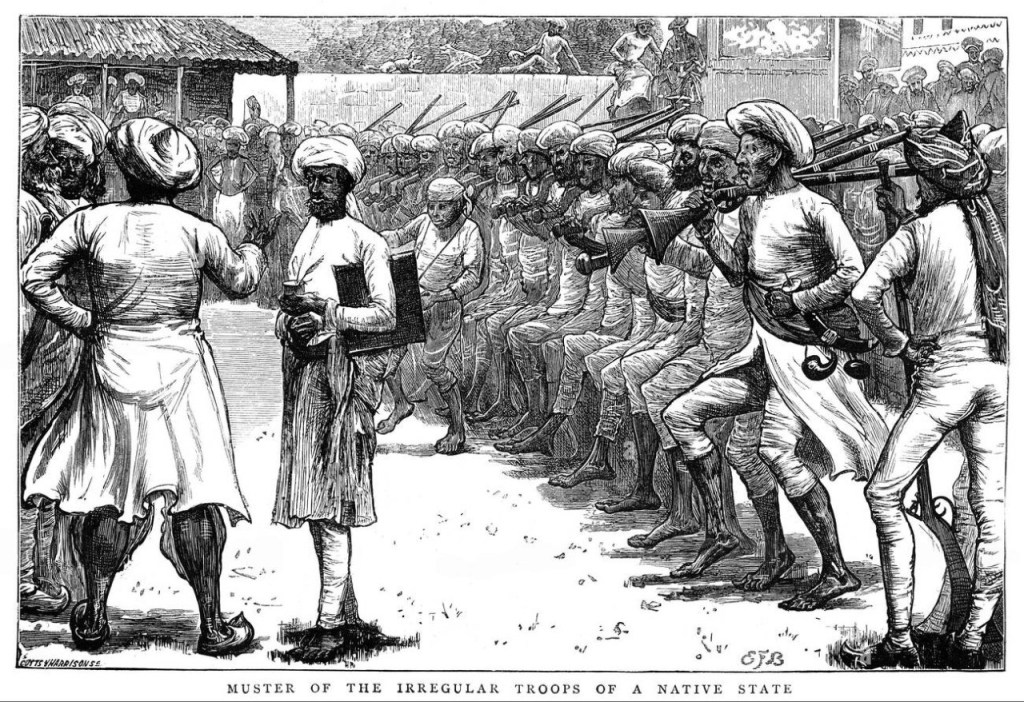
As it was quite impossible for the British to have large, standing forces throughout the areas they had recaptured, numerous smaller irregular units were formed to keep the peace in the countryside. Rapidly formed and just as quickly disbanded, they patrolled larger towns and the countryside surrounding them.
The levies raised in 1857 and 1858 were numerous and were disbanded almost as quickly as they were raised. Many irregular units existed, and while some would be integrated into the army as a whole, some simply disappeared with the end of the mutiny.
The Cawnpore Levy
The Moradabad Levy
The Sealkote Infantry Levy
The Goojramwallah Levy
The Kemaoon Levy
The Mhair Regiment – raised in 1857 and converted to a police force in 1861
The Kamroop Regiment
Disbanded, 1882, 1890, 1902 and 1922
The Bareilly Levy – Raised in Bareilly in 1858, they would become the 36th Bengal Native Infantry in 1861, the 36th (Bareilly) Regiment Bengal Native Infantry in 1864 and disbanded in 1882.
The 1st Gwalior Regiment – raised in 1858. They were designated as the 45th Bengal Native Infantry in 1861, the 41st (Gwalior) Regiment of Bengal Native Infantry in 1864 and disbanded in 1882.
The Fatehgarh Levy – Raised in 1858, in 1861, they became the 38th Bengal Native Infantry but quickly redesignated, the same year, as the 34th. 1864 saw them as the 34th (Fatehgarh) Regiment Bengal Native Infantry, and they would be disbanded in 1882
The Mynpoorie Levy – Raised in 1858 and became the 39th Bengal Native Infantry in 1861, the 35th (Mynpoorie) Regiment Bengal Native Infantry in 1864 and disbanded in 1882.
The Meerut Levy – Raised as the Meerut Levy in 1858, they were designated as the 41st Bengal Native Infantry in 1861, to become, in the same year, the 37th and in 1864, the 37th (Meerut) Regiment Bengal Native Infantry. They were disbanded in 1882.
The Aligarh Levy – Raised at Aligarh in 1858. Became the 43rd Bengal Native Infantry in 1861, shortly after, in the same year, the 39th. They would be disbanded in 1890.
The Loyal Purbeah Regiment – Formed in 1858 from the faithful 3rd, 36th and 61st Bengal Native Infantry, they were “styled the Loyal Purbeah Regiment”. In 1861, the moniker was discarded from the more practical 21st Bengal Native Infantry and in the same year, to continue their tradition, they were designated the 17th (Loyal Purbeah) Regiment Bengal Native Infantry. By 1898, the name changed again, and they were now the 17th (Loyal) Regiment, in 1902 the 17th Musalman Rajput Infantry (Loyal Regiment) and finally in 1903, The Loyal Regiment. They were disbanded in 1902 but had fought with glory, gaining the Battle Honours, Afghanistan 1879-1880, Suakin 1885 and Tofrek.
The Deoli Irregular Regiment (later the 42nd Deoli Regiment) was raised in 1857 as the Meena Battalion. Based in Deoli, Rajputana, it functioned as both a military police and a local corps, conducting patrols to suppress tribal unrest and banditry. The regiment was disbanded in 1921.
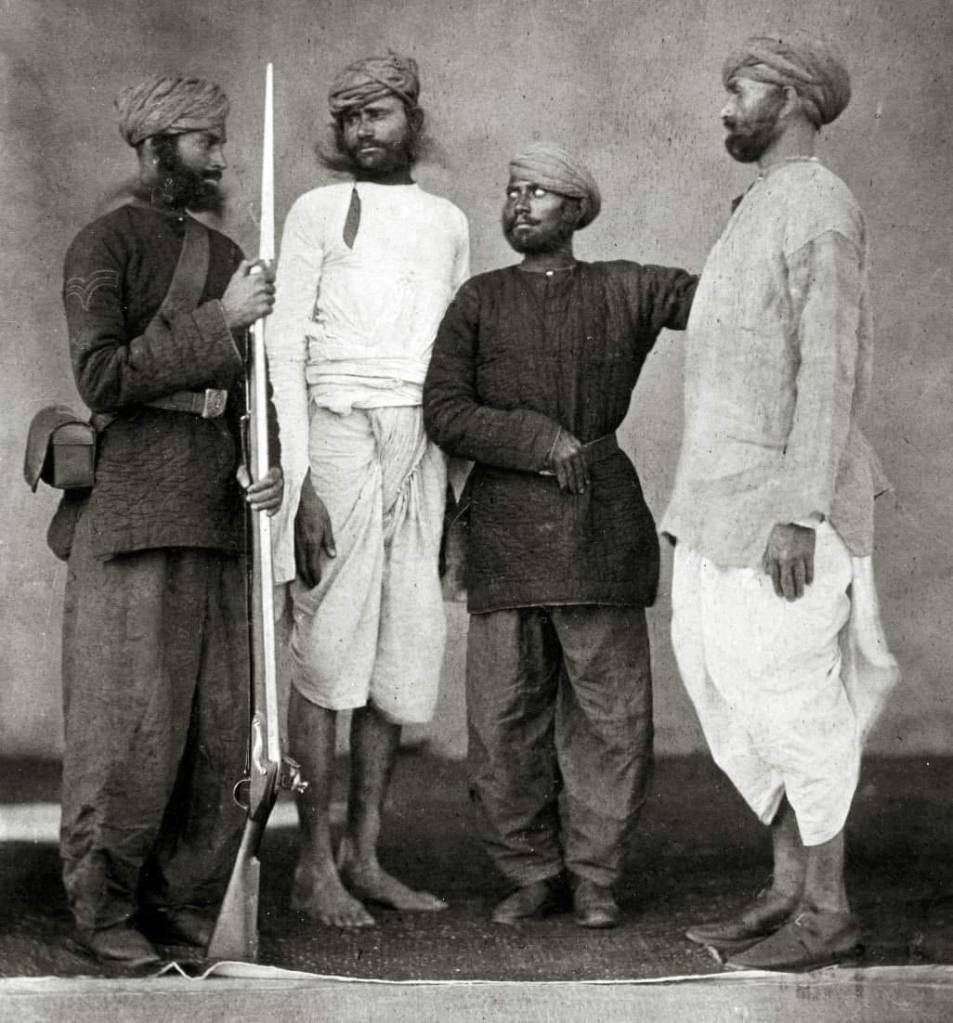
There were some notable exceptions:
Regiments Still Serving Today
The Allahabad Levy – raised in 1857. They would be absorbed into the regular army in 1861 and renamed the 33rd Bengal Light Infantry. By 1890, they were known as the 33rd (Punjabi Mohamedan) Regiment Bengal Native Infantry, shortened to the 33rd Punjab Infantry in 1901, the 33rd Punjabis in 1903 and finally, the 3rd Battalion, 15th Punjab Regiment in 1922.
The regiment fought in the Third Burma War, gaining the Battle Honour, Burma 1885-1887. They served with distinction in WWI; In WWII, they served in the Malayan Campaign. Captured by the Japanese following the surrender of Singapore in February 1942, they were re-raised in 1946. Following Indian Independence in 1947, it was one of the regiments allocated to the Pakistani Army and would be amalgamated in 1956 into a single Punjab regiment. They continue to serve today.
The Agra Levy – raised in 1858 as the Agra Levy, they survived the military changes that followed the mutiny to become the 42nd Bengal Native Infantry in 1861, redesignated the same year as the 38th. They remained the 38th (Agra) Regiment Bengal Native Infantry from 1864 to 1890, when they were redesignated the 38th (Dogra) Regiment of Bengal Infantry, to become the 38th Dogras in 1903 and the 2nd Battalion 17th Dogra Regiment in 1922. The regiment fought in Malaya and Burma in WWII and after partition in 1947 became part of the new Indian Army, and were renamed the Dogra Regiment. They continue to serve today.
The Shahjahanpur Levy – Raised in 1858, the levy was taken into the army in 1861 as the 40th Bengal Native Infantry. In 1864, they were redesignated the 40th (Shahjahanpur) Regiment Bengal Native Infantry; in 1890, as the 40th (Baluch) Regiment Bengal Infantry, and in 1892, the 40th (Pathan) Regiment Bengal Native Infantry. By 1901, they were simply the 40th Punjab Infantry, and in 1903, the 40th Pathans. In 1922, another renaming saw them now as the 5th Battalion, 14th Punjab Regiment. They served with honour in both World Wars and were allocated to the Pakistan Army in 1947, where they continue today as part of the Punjab Regiment.
The Bhopal Levy – raised just after the mutiny in 1859 from the remnants of the Malwa, Bhopal and Gwalior Contingents, they would become the Bhopal Battalion in 1865, the 9th Bhopal Infantry in 1903 and the 4th Battalion (Bhopal) 16th Punjab Regiment in 1922. Following their honourable services in both world wars, the regiment was allocated to the Pakistan Army in 1947 and continues on today as the 17th Battalion (Bhopal) of the Punjab Regiment.
The Regiment of Lucknow – Raised in 1857 from the remnants of the 13th, 48th and 71st Bengal Native Infantry who had fought during the defence of Lucknow, they were designated the Lucknow Regiment in 1857. In 1861, they became the 20th Bengal Native Infantry and were redesignated the same year as the 16th. “Lucknow ” remained a part of the many namings over the years, and in 1922, they were still called the 10th Battalion (The Lucknow Regiment) 7th Rajput Regiment. Following the Partition in 1947, the unit became the Indian Army’s Rajput Regiment. The 10th Battalion of the Rajput Regiment, often referred to as the 10th Rajput (Lucknow), carries forward the battle honours and esprit de corps of its predecessor, serving as the primary custodian of the 16th Rajputs’ lineage within the modern Indian Army.
Movable Columns too, were a mainstay of the mutiny, and their purpose was exactly as stated in their title – a force capable of being raised at short notice and move, with as little hindrance as possible for a single objective – the greatest of these was the Punjab Movable Column that had scoured the Punjab through 1857 before turning their attention to Delhi; Greathed’s Movable Column was formed after the fall of Delhi for the purpose of clearing out pockets of rebels on the road to Cawnpore; Showers’ Movable Column, like Greathed’s, was sent out to clear the territory of Jhajjar of rebel forces. Seaton’s Movable Column escorted supplies for Sir Colin Campbell’s army while fighting several battles, and others, like the Kamptee Movable Column, would be active exclusively in the Saugor Narbada Territories. Varying in strength and size, these columns were generally broken up and reintegrated into other forces once their objective had been achieved.
The military police units formed during the mutiny provided the foundation of subsequent colonial policing strategies in India. It was largely due to their success as localised law enforcement that led to the establishment of the modern Indian policing and paramilitary systems. Two would rise to prominence during the mutiny — the Allahabad Military Police and the Bengal Military Police, who were better known as Rattray’s Sikhs. As their doings are vast, another post will explore the work of those formidable Sikhs.
 Mutiny Reflections