“The westering sun flashed and glimmered along the mass of polished bayonets, and brightened up the varied colours of their tartan kilts; this and the slight waving motion of the dark plumes of the feather bonnets stirred by the evening breeze…And there they stood – under the most perfect discipline, silent and steady, willing and ready to dare, to accomplish anything, forming…a perfect living picture of graceful human strength and power. It was a noble sight.” (Munro)
Two Hard Days and Outram and the 11th of March detail the operations in which the men listed below fought and, in many cases, died.
10 March
1st Battalion 20th Regiment of Foot
Private Alexander Egan – slightly wounded
Drummer Frederick Wray – wounded
1st Battalion, 23rd Fusiliers
Private George Bowle -killed in action
Downey, Joseph – slightly wounded
42nd Highlanders
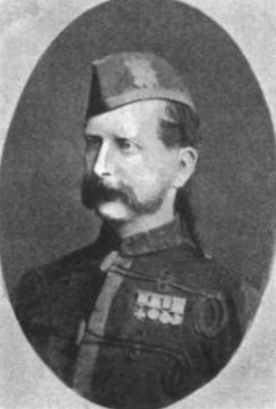
Lieutenant F.E. Farquaharson – severely wounded. While leading his company forward, the lieutenant was shot in the elbow. Unfortunately, the regimental surgeon, Furlong, and Surgeon Munro of the 93rd were unable to find the bullet, and it was never removed. As a result, the elbow joint was permanently stiff.
Privates
Burgess, H. – slightly wounded
M. Brown – severely wounded
Burke, P. – slightly wounded
Burnes, J. – slightly wounded
Eldridge, A. – slightly wounded
Hill, T. – severely wounded
Howie, A. – slightly wounded
Sinclair, H. – slightly wounded
White, J. – severely wounded
McCrea, R. – slightly wounded
McDonald, A. – dangerously wounded
McKay, D. – slightly wounded
McLaren, A. – severely wounded
Monteith, J. – dangerously wounded
Moodie, J. – killed
Murphy, E. – slightly wounded
Paul, G. – severely wounded
Watson, A. – severely wounded
79th Highlanders
Sergeant William Daire- killed in action
Private James Miller – died of wounds
2nd Battalion Rifle Brigade
Sergeant William Richard
Private Charles Dignan
Naval Brigade
Captain of the Maintop William Hopkins – slightly wounded
Leading Seaman John Richardson – slightly wounded
Able Seamen
Nicols, John – slightly wounded
Downer, George – severely wounded
Royal Artillery (6/11)
Lieutenant H.A. Tracey – slightly wounded
Gunner and Driver – John Williams – slightly wounded
Siege Artillery
Gunner & Driver Alexander McNeil – slightly wounded
5th Punjab Cavalry
Major Charles Ayshford Sandford (formerly of the 3rd Bengal Light Cavalry) – killed in action.
“He was killed while gallantly scaling the wall of a house when scouting through a village, by a shot from an unseen enemy. Only a few days before, he had come to see me and reproached me for my foolhardiness, and yet fell a victim to his own recklessness. A curious incident was told me after his death: on the receipt of the news that he had been gazetted to a brevet majority for his services at Delhi when commanding the Guides cavalry, his brother officers drank his health at mess. In his speech in reply, he said he had a presentiment he should not live to enjoy his newly won honours,— that he was convinced he would be shot, but not in a cavalry charge or fair fight. Poor fellow! the next day realised his sad forebodings.”
Aged 28. Son of Edward Ayshford & Henrietta Sanford, Nynehead Court, Somerset, born in 1828. Joined the Bengal Army in 1850. Like William Hodson of Hodson’s Horse and Lt.Col Ingram (who would be killed at the Kaiser Bagh) of the 97th, Sandford had, for a time, attended Rugby School. In all, 18 Rugbeians died during the Indian Mutiny, nine of whom fell at Lucknow between May 1857 and March 1858, and one, Lieutenant Salmond, in Cawnpore. In his short life during the mutiny, while it was Hodson who received the accolades of riding from Karnal to Meerut, it was Sandford he met on the road, who happened to be riding from Meerut to Karnal with despatches, an event as momentous as Hodson’s but only memorialised with a footnote in the histories of the day.
He commanded for a time the Guides Cavalry at Delhi and was mentioned twice in despatches. Upon the death of Younghusband before Fatehgarh in 1858, Sandford took his place in command of a detachment of the 5th Punjab Cavalry.
According to A.R.D. Mackenzie, on the Lucknow-Fyzabad Road, some 100 yards beyond the bridge where the road crossed the Gokral nullah, Sandford was buried. Over his grave, a memorial was raised, in the shape of an obelisk, within a small, walled enclosure. On a white marble tablet, his comrades had dedicated the following:
“Beneath this monument rest the mortal remains of Charles Sanford, late of the 3rd Bengal Light Cavalry, who, when gallantly leading a body of dismounted Punjab Cavalry in an assault on a fortified place near Lucknow, on the 10th of March, 1858, met a soldier’s death. Stranger: Respect the lonely resting place of the brave!”
It was consecrated in 1878 by the Right Reverend Ralph, Bishop of Calcutta, on the 17th of January. Thirty-three years after A.R.D. Mackenzie had buried his friend he found the grave was still there, “a solitary tree marks the spot on the bare brown plain…” but when this author attempted to find it in 2023, it had disappeared.
4th Punjab Rifles
Lieutenant O.L. Smith – severely wounded
5th Punjab Cavalry – 1 rank & file wounded
Bengal Sappers and Miners
Lieutenant G.R. Forbes – slightly wounded
Punjab Pioneers – Sergeant John Copeland – severely wounded
3 rank & file wounded
Infantry Division, Gurkha Force – 7 rank & file wounded
11 March
Staff
Captain William Robert Moorsom, Her Majesty’s 52nd Light Infantry, Deputy Assistant Quartermaster-General to Sir James Outram- killed close to the Iron Bridge.
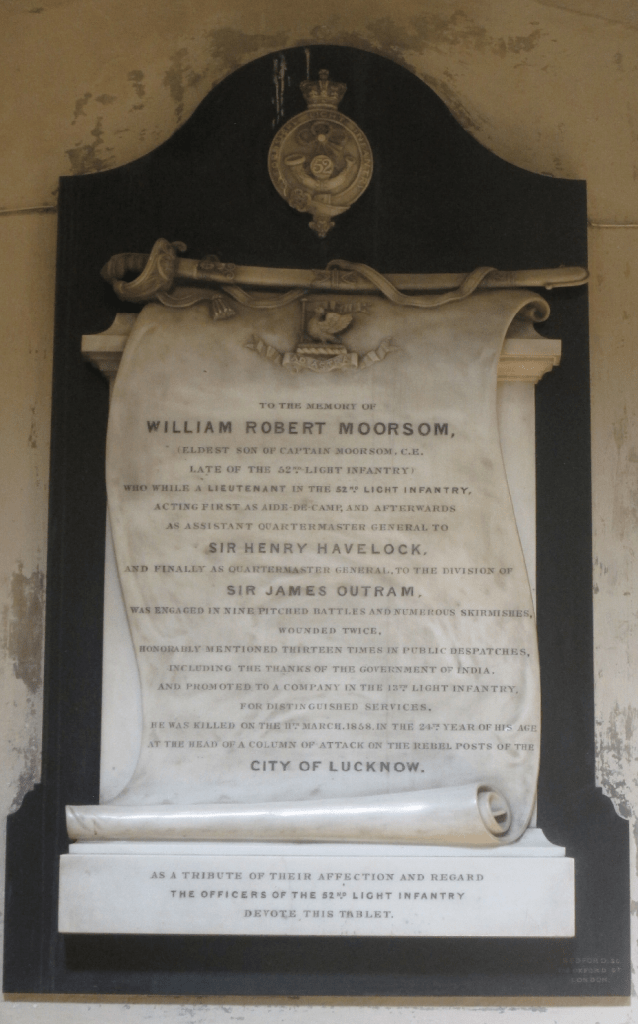
A Remarkable Life
Born in 1834, William Robert was the eldest son of Captain William Scarth Moorsom (52nd Regiment), who made his name as an engineer, best known for designing railway lines in England, Belgium, Germany and Ceylon. Educated at Harrow, Moorsom joined the 52nd Light Infantry in 1852 – a competent and capable officer, who spent four years studying at every free opportunity his duties allowed, he would gain a reputation during the mutiny as a brilliant surveyor, an excellent engineer and a fine soldier. Moorsom had also been in Lucknow before, in January 1856, when his regiment formed the first army of Oudh during the annexation, although they only remained until November, when they took up quarters in the Punjab. In that short time, Moorsom had been tasked with carrying out a detailed survey of the city, something which came in very useful during Havelock’s advance in 1857.
As it was, the 52nd marched to Delhi under Brigadier General John Nicholson and took their part in the taking of Delhi, but without William Moorsom.
As luck would have it, in May 1857, he happened to be on a leave of absence from the regiment and was in Ceylon employed on a government survey. An express received from Calcutta that stated the Punjab was in flames saw Moorsom immediately resign his appointment to return with all haste back to India, only to find on his arrival in Calcutta, due to the disturbed state of the roads, it was impossible for him to rejoin his regiment. Not one to kick up his heels, Moorsom placed his services at the disposal of the government, who, with some delight, gave him a commission, repairing the telegraph lines between Benares and Allahabad. The Moveable Column had already left Allahabad when Moorsom joined up, meeting it along the road on their first march to Fatehpur. He was just in the process of attaching himself to the 78th Highlanders when an order came from Havelock, brought to him personally by Captain Beatson, that he had been placed on Havelock’s staff, as an extra A.D.C. So Moorsom fought at Fatehpur with neither a uniform on his back or weapons of any kind – he was in civilian dress and armed with a stick. A private of the 64th gifted him a cavalry sabre – a spoil of war – after the battle.
He would act as ADC for the first four battles of the campaign and was with the advanced guard during the capture of Cawnpore. Moorsom was quickly appointed to Deputy-Assistant Quartermaster General and carried out the first reconnaissance of Bithur before Havelock finally took it. Moorsom initially remained behind when Havelock crossed the Ganges back into Oudh to attempt to take Lucknow, tasked with completing the bridge of boats that would be so instrumental later in the campaign. However, he was more than a little disappointed.
“I am just ordered to go back and take charge of the establishment of a better communication across the Ganges. I have expostulated and represented that I am the only man in the force who knows Lucknow intimately, but the order is peremptory and must be obeyed. I could have cried as I turned my horse’s head with a heavy heart, and, to add to my mortification, I now hear the guns booming in front, showing that our people are engaged while I am going to the rear. For the first time during this campaign, I feel tired and ill. However, this is no time for illness, and the duty must be done.”
Lieutenant Colonel North, in his “Journal of an English Officer in India, had nothing but praise for Moorsom, writing, “This bridge was covered by our 24-pounders and by a téte-de-pont planned by young Moorsom of her Majesty’s 52nd, an officer of extraordinary promise. His capabilities on a campaign seem inexhaustible and emanate from a military genius of no common order.“
However, things changed in September. Havelock, having found he could not take Lucknow after all, retreated back over the river to wait for reinforcements and the arrival of Sir James Outram. Outram understood Moorsom’s genius and employed him as a guide to lead the way into Lucknow. When the force reached an impasse after crossing the Char Bagh Bridge, it was Moorsom with his intimate knowledge of the byroads and streets of Lucknow who pointed the force in the direction they should take to relieve the Lucknow Residency. As it was, the advance proved chaotic at best, and no one really listened to Moorsom’s advice to actually bypass the city itself, but as it was, Moorsom arrived outside the Residency with the company he was leading without losing a man or a single gun by taking a route parallel to Havelock and Outram. However, his talents were well-recognised.
“Captain Moorsom of her Majesty’s 52nd Regiment, having surveyed the city and environs of Lucknow previous to the outbreak of hostilities, has constantly been able to render most important service, and is a very bold and intelligent officer …. Captain Moorsom was here, as everywhere, a sagacious and daring guide. On the 28th of September, the Palace buildings extending in the direction of the Khas Bazaar were explored by Captain Moorsom, who, with a party of fifty men of the 90th and 5th Fusiliers, gallantly drove the enemy out at the point of the bayonet, killing a considerable number, with the loss of one man of the 90th. Captain Moorsom then placed a picket in a house commanding the Cheena and Khas Bazaars…The daring and intelligent Captain Moorsom… has given very valuable assistance.” (London Gazette 13th of October, 1857; and on 17th of February, 1858).
The plans sent to Sir Colin Campbell for the relief and withdrawal of the Lucknow Residency were drawn up by Moorsom under the directions of Sir James Outram and were instrumental in Sir Colin’s success in November. It was, however, deemed prudent to leave Moorsom behind at the Alambagh after the withdrawal, and here he remained, with Sir James Outram, holding the fort while Sir Colin Campbell decided what to do next. When he finally returned in 1858, he was pleased to find Moorsom was still alive.
On 5 March, Moorsom accompanied Sir James Outram as Quartermaster General to the corps, and although still recovering from a wound he had received in a cavalry action outside the Alambagh some days previously, he was as energetic as expected, pointing out the rebel positions, from the other side of the Gumti, which would be possible to take in the reverse. As special thanks for his services, just five days before his death, Lieutenant Moorsom was promoted to captain in the 13th Light Infantry by Sir Colin Campbell. What he could have achieved, had he lived, will never be written.
On 11 March, while on reconnaissance with Sir James Outram towards the Iron Bridge, a bullet found its way to William Robert Moorsom, killing him instantly. It was a chilling reminder that 13 mentions in despatches and a glowing career could be instantly wiped away by one swift shot. He was just 24 years old.
An officer writing from the camp, in a letter to the Bombay Standard, dated 22 March, stated,
“Our loss was not great as regards numbers, but we sustained an irreparable loss in Captain Moorsom, of her Majesty’s 52nd Regiment, Assistant-Quartermaster-General: one of the very ablest men in the service, as brave as he was able, as cool as he was brave; honoured and beloved by all. Captain Moorsom was buried this morning by the Rev. G. Cowie. Sir J. Outram, whose anguish at the loss of his beloved staff officer was visibly depicted on his countenance, acted as chief mourner. All his staff were present, for Captain Moorsom was known to all and beloved by all; and his minute knowledge of all the localities about Lucknow, which he surveyed on the annexation, renders his loss quite irreparable. But our loss is his gain: he lived the life of the righteous and has now entered into the mansions of the blessed.”
Captain William Robert Moorsom was buried in the Lucknow Residency Cemetery. Unfortunately, his gravestone, though still there, has not withstood the ravages of time and neglect. Three years before his death due to cancer, in 1863, his father compiled the “Historical Records of the 52nd Regiment” as a tribute to his son.
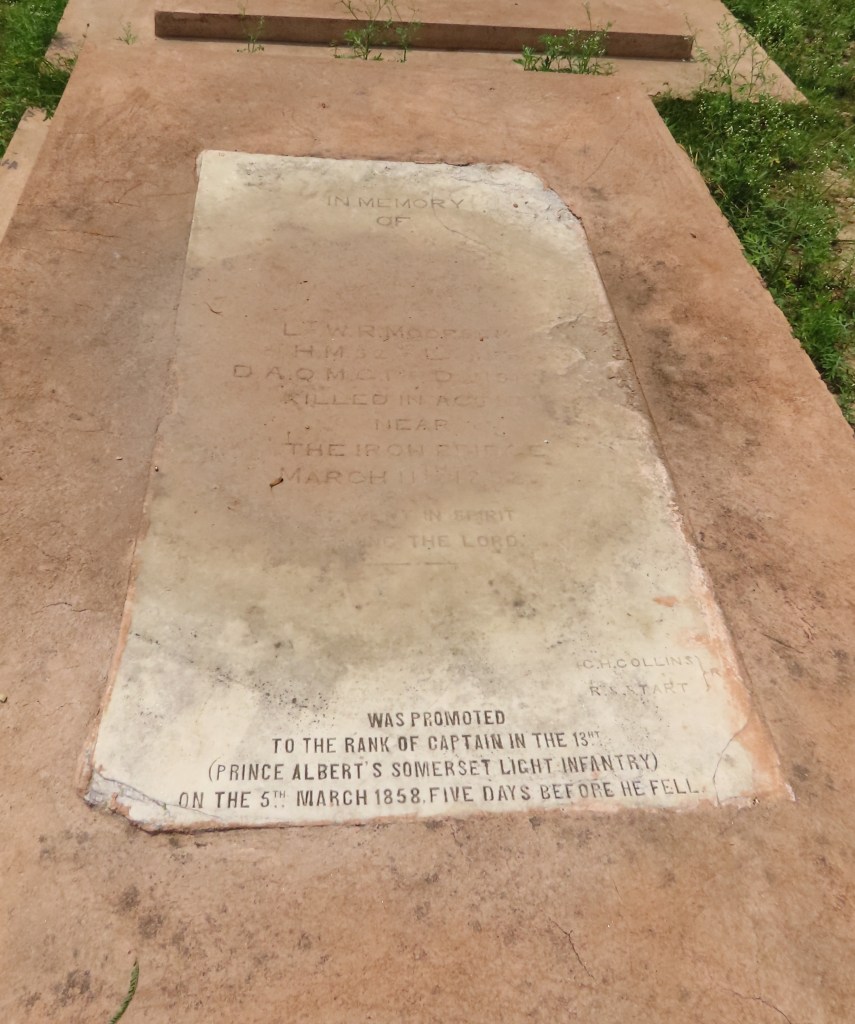
Inscription .’ In memory of Lieutenant W. R. Moorsom, Her Majesty’s 52nd,
Quarter-Master-General, 1st Division, killed in action near the Iron Bridge, March 11th, 1858.
Fervent in spirit, serving the Lord.
1st Battalion, 10th Regiment of Foot
Private David Sydney – dangerously wounded. Died of wounds
1st Battalion 20th Regiment of Foot
Sergeant Andrew Dempsey – slightly wounded
Privates
Bewsher, W, – slightly wounded
Buckley, C. – slightly wounded
Davy, Frederick – severely wounded
Buckley, Cornelius – slightly wounded
Mosely, Charles – severely wounded
Porter, W. – slightly wounded
Sturman, J. – slightly wounded
1st Battalion 23rd Fusiliers
Captain G.P. Provost – slightly wounded
Lieutenant G.W.H. Russell – severely wounded
Sergeant Charles Halland – slightly wounded
Privates
Bowle, George – killed in action
Downey, Joseph – slightly wounded
Francis, Frank – slightly wounded
Gawm, John – severely wounded
Herbert, Walter- severely wounded
Lett, Thomas – severely wounded
42nd Highlanders
Sergeants
Hiddle, John – slightly wounded
Mumford, Joseph – dangerously wounded. Aged 28
(He) received a wound from a musket-bullet (round), which entered about an inch and a half from the sternal articulation of the clavicle of right side, and was extracted from the left side of the neck behind, about the centre of the clavicle. The trachea was injured, and he spat blood for seven or eight days, and the air came out through the hole of entrance. The cervical plexus has been injured; the trachea, in the course of the wound, is tender, the opening of exit very much so, and all the fingers appear quite useless: they are fixed, apparently anchylosed in a straight position, but any attempt at bending them causes intense pain in the course of the median nerve. The hand is cold and affected with nervous tremor; all the fingers are numb, but the motions and sensation of the thumb are good. May, 1859. Duty. Results of wound probably not to a disqualifying extent. (Williamson)
Privates
Cronghan, James – slightly wounded
Brown, John – severely wounded
Black, Ronald – severely wounded
Doyle, Francis- killed in action
Fraser, Charles – slightly wounded
Holmes, Robert – killed in action
Stirling, William – slightly wounded
Minnis, William – slightly wounded
Morrison, Henry – slightly wounded
Watt, Thomas – slightly wounded
Yates, George- severely wounded
53rd Regiment of Foot
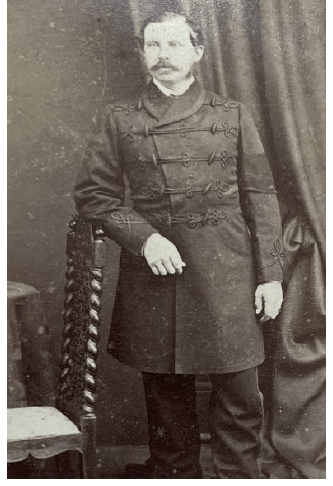
Lieutenants
Helsham, H. – severely wounded
Hopkins, G.R. – severely wounded
Flood, F.S.R. (Extra A.D.C. to Chief of Staff) – severely wounded
Private Joseph Gibson – killed in action
79th Highlanders
Captain George Miller – severely wounded
Sergeant James McLaren,- slightly wounded
Corporal James McDonald – severely wounded
Privates
Duff, Alexander – missing
Gregory, William – slightly wounded
Leckey, Peter – severely wounded
Lofferty, George – slightly wounded
McDonald, John – slightly wounded
McKay, Thomas – severely wounded
McKay, George – severely wounded
McKenzie, Samuel – severely wounded
McLeod, Robert – severely wounded
Munro, Duncan – slightly wounded
Patterson, Michael – dangerously wounded
Reid, John – slightly wounded
Reilly, James – dangerously wounded
Ritchie, Thomas – died of wounds
Shaw, Edward – severely wounded
Sheppard, James – severely wounded
Stewart, John – severely wounded
Thompson, Alexander – slightly wounded
Walker, William – severely wounded
White, John – slightly wounded
Wilson, Alexander – dangerously wounded
90th Regiment of Foot
Colour Sergeant G. Holsey -killed in action
Privates
Folney, William – severely wounded
Parr, William – slightly wounded
93rd Highlanders
“During the morning of that day, while a breach was being made in the strong defences which surrounded the enemy’s position, the regiment occupied an enclosure surrounded by high mud walls, which in former days had apparently been a well-kept garden. Even then, amid the surrounding ruin, the orange and the citron blossomed, and the rose, the myrtle, and the jasmine bloomed. From this enclosure, the regiment moved to take up its final position before the assault. As it passed out a brother officer (Charles William Macdonald), a captain, but still a lad, whose right arm had been severely bruised early in the day by a splinter of shell, but who, though thus far disabled, had refused to leave the field, plucked a rose, and, handing it to me, said, ‘ Good-bye, old friend- keep this for my sake,’ and then moved on. It was his last gift and last farewell, for within half an hour thereafter, he was killed, two bullets striking him in quick succession as he entered the breach at the head of his company. His faithful old servant brought the body out upon his back and laid it gently down upon the ground before the friend to whom he had spoken his last
‘goodbye ‘; and as they stood together side by side, and gazed down on the pale, boyish-looking face, the eyes closed as if in sleep, and a smile upon the lip just darkened by a fringe of down, the old soldier turned away, and, brushing his rough hand across his eyes, murmured, ‘ Oh, pity me, but it was a shame to kill him!’ (Munro)
Captain Charles William McDonald – killed in action – Just before the assault, McDonald had been wounded severely by a splinter of a shell which struck him on his sword arm, but he refused to relinquish his command and entered the breach with his men. As he attempted to enter one of the rooms in the courtyard, he was shot in the thigh. Before anyone could come to his assistance, a rebel stepped forward and shot him again, while another ran his bayonet through his body.
Lieutenant R.V.S. Grimstone – slightly wounded
“While Lieutenant Grimstone, with a party of the company, was pursuing some Sepoys amongst the passages and outbuildings, one of them concealed behind a pillar made a downward cut at Grimstone’s head, which he (Grimstone) warded off, and with a back sweep of his claymore cut deep into the enemy’s neck and killed him. The Sepoy’s sharp tulwar, however, cut clean through the basket hilt and leather lining of the claymore, into Grimstone’s hand.” (Munro)
Lieutenant C.W. Sergison – killed in action. Lieutenant Sergison was shot dead while trying to break open a door in the Begum Kothi. His rash behaviour nearly cost the lives of others, but his death was nevertheless regretted.
Sergeants
Dysert, John – severely wounded
“While we were standing in column…our enemies, concealed in the neighbouring houses, fired repeatedly at us, but on one shot took effect, Sergeant Drysart having been shot through both thighs. The man who fired that shot must have been very close to us, and considerably above us, for the bullet passed through both thighs obliquely.” (Munro)
McMillan, John – dangerously wounded
Gow, James – killed in action
Wedderspoon, John – dangerously wounded
Corporals
Hinde, William dangerously wounded
Steele, George – killed in action
Whyte, Solomon – slightly wounded
Ensign C.Hastie – slightly wounded by a sword cut
Privates
Bailey, Charles – dangerously wounded
Bryce, George – severely wounded
Buick, William – severely wounded
Caithness, Peter – severely wounded
Campbell, Arthur – severely wounded
Collie, William – severely wounded
Connor, John – severely wounded
Cosgrove, James – dangerously wounded
Cunnyngham, James – dangerously wounded
Cubbin, William – killed in action
Fraser, John – severely wounded
French, John – killed in action
Gibb, William – severely wounded
Gibson, William – slightly wounded
Graham, John – severely wounded
Houston, Andrew – severely wounded
Innes, George – killed in action
Kay, James – killed in action
Kinnear, James – killed in action
Leadbetter, William – killed in action
McEwan, John – killed in action
McGregor, John – killed in action
Martin, James – killed in action
Park, Daniel – killed in action
Readdie, Henry – killed in action
97th Regiment of Foot
Private J. McDonald – slightly wounded
2nd Battalion, Rifle Brigade
“On approaching the Iron bridge, Captain Wilmot, 2nd Battalion, found himself with only four men of his company at the end of a street opposed to a large force of the enemy. One of the men was shot through both legs and was quite helpless. Corporal Nash and Private David Hawkes took him up and carried him to the rear, and though Hawkes was himself severely wounded, he continued to carry him under fire from the enemy. Captain Wilmot, with his revolver keeping back the enemy and covering their retreat. Eventually, the Riflemen cleared the whole of the suburbs near the Old Cantonment road as far as the Iron Bridge.”
Captain W. Thynne – dangerously wounded. Died of wounds. Thynne was in a house drinking water when he was struck by a roundshot, which shattered his arm and leg. The arm was immediately amputated, but he died two hours later. He was buried the same evening in a tope of trees close to the Riflemen’s camp. His loss was much regretted by his brother officers, by whom he was much esteemed. ‘No one in the whole regiment,’ writes one of them, ‘ was more liked or could be more regretted. He was always a cheerful and agreeable companion, and a right good soldier besides.’
Corporal J. Longden – slightly wounded
Ensign Lovick Emelius Cooper – shot in the neck. Aged 20. Son of Revd. Lovick Cooper, vicar of Eppingham, Rutland. The ball passed through his shoulder and went into his lung. He died on 19 March and lies buried in Dilkusha Park. The last person to visit Cooper was Reverend Mackay. He found him, he had not “delayed preparations for a future state…Read and prayed, and came away with the impression that this young officer loves the Lord Jesus Christ in sincerity.” He died at five in the morning on the 19th. Mackay supervised the grave that was dug for the young man and presided over his funeral.
Privates
Hawkes, David – slightly wounded
Norris, John – dangerously wounded
Smith, George – mortally wounded
Turner, J. – slightly wounded
3rd Battalion, Rifle Brigade
Privates
Harding, Robert – severely wounded
Lynch, John – severely wounded
Royal Artillery (6/11)
Gunners and Drivers
Thomas McKeower – killed in action
Jones, John – killed in action
Barker, George – severely wounded
Royal Artillery (8/2)
Bombardier T. Perry – slightly wounded
Gunner and Driver T. Tood – slightly wounded
Naval Brigade
Mate Henry Garvey – killed in action
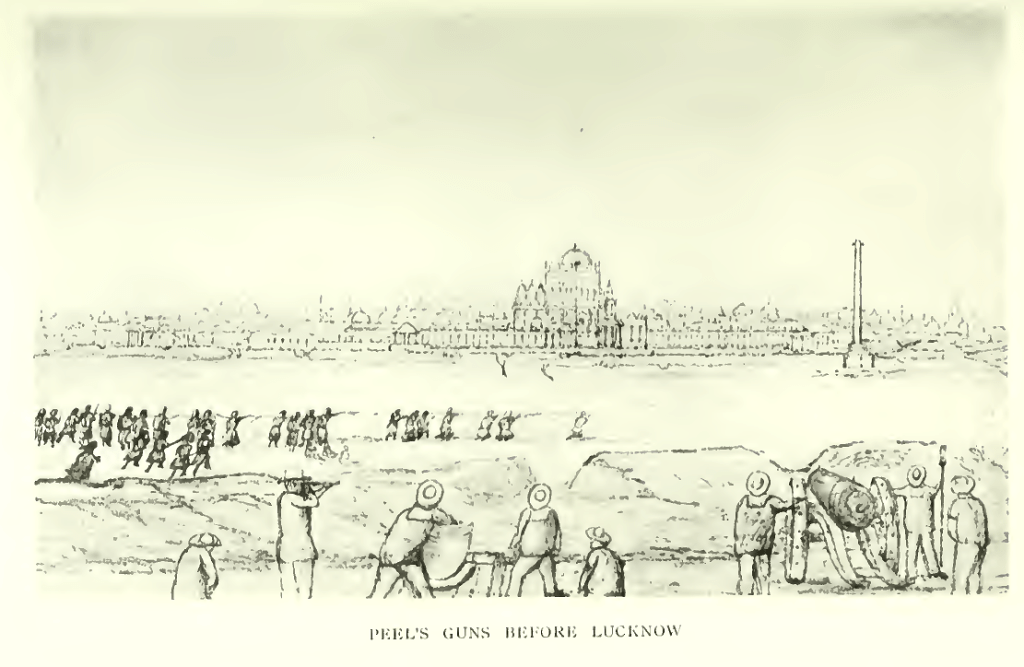
Garvey had been sent with a message regarding the placement of the guns and was riding at speed as he passed by the British mortars on the left flank.“The 5 1/2 inch mortars were primed with strands of quick match, which were lighted by means of a burning tow attached to linstocks. Garvey did not notice that the primings were lighted, and as he passed, the mortars went off, and a shell struck him in the head. His horse was unhurt.” (Jocelyn)
Yeoman of Stores Frederick E. White – severely wounded
Able Seaman George Downer – severely wounded
Nichols, John – slightly wounded
Pain, John – slightly wounded
2nd Punjab Infantry – 6 rank and file wounded
4th Punjab Infantry
Lieutenant A. McL. Stewart – slightly wounded
Hodson’s Horse
Captain William Hodson (Hodson’s Horse) – severely wounded at Shamshabad on 17 January; mortally wounded on 11 March. Died of wounds, 12 March
Punjab Pioneers
Corporal William Abel – slightly wounded
Gurkha Force, Infantry Division – 7 rank and file wounded
Bengal Engineers
Major Alexander Taylor – shot below the knee
One of the two celebrated engineers who orchestrated the taking of Delhi, Major Alex Taylor, was taken up by Robert Napier for the capture of Lucknow. While there was some controversy as to whether it was Richard Baird Smith or Taylor who should receive the accolades for Delhi, there was no question that Napier was the author of Lucknow. However, he needed a man of Taylor’s abilities to draw up the plans and, above all, take up much of the dangerous reconnaissance that just such an operation involved. He was present at the meetings between Sir Colin Campbell and Napier before the operations commenced; during the taking of Lucknow itself, Taylor’s experience in constructing batteries with considerable speed proved invaluable. It was unfortunate that the battery that was started on the night of the 9th of March and completed by dawn the next morning would be the very one that would cost Mate Garvey of the Shannon his head. Garvey, who was carrying messages at the time between the different batteries, might well not have been aware that Taylor’s latest project was already operational when he unfortunately crossed in front of it.
As for his own injury, which occurred shortly after the troops had stormed into the Kaiser Bagh, it occurred under rather injudicious circumstances:
“We had got in, and had made good headway, and I mounted on to one of the highest pinnacles of the Palace so see what was ahead of us, and what further could be done, when Pandy, from an adjoining house, took advantage of me.” The injury would have lasting consequences for the rest of his life, and there would be a noticeable drag on his left foot.
It must have been with some satisfaction when Taylor read the following in despatches, written by Robert Napier:
“Invaluable services and energy in preparation of the Engineer Park. Great energy in charge of the arrangement for attacking Banks’ house and Begum’s Palace; very valuable and cordial co-operation and assistance in all duties.“
After a long sojourn in England, he returned to India in 1861 and would serve in the Ambayla Campaign and in 1878 in Afghanistan. He retired in 1880 and died in 1911, as General Sir Alexander Taylor, G.C.B.
Sources:
Blunt, E. A. H. List of Inscriptions on Christian Tombs and Tablets of Historical Interest in United Provinces of Agra and Oudh. Allahabad: W.C. Abel, 1911.
Cope, William H. The History of the Rifle Brigade. London: Chatto & Windus, 1877.
Forbes-Mitchell, William. Reminiscences of the Great Mutiny. London: Macmillan & Co., 1894.
Forrest, G. W., ed. Selections of Letters & Despatches & Other State Papers. Vol. 3. New Delhi: Asian Educational Service, 2006.
Gordon-Alexander, W. Recollections of a Highland Subaltern. London: Edward Arnold, 1898.
Gough, Hugh. Old Memories. Edinburgh & London: William Blackwood & Sons, 1897.
Gray, Robert. Reminiscences of India and North Queensland, 1857-1912. London: Constable & Co., Ltd., 1913.
Jocelyn, Julian R. J. The History of the Royal and Indian Artillery in the Mutiny of 1857. London: John Murray, 1915.
Lieutenant-General Sir James Outram’s Campaign in India, Comprising General Orders and Despatches. London: Smith, Elder & Co., 1860.
Mackenzie, A. R. D. Mutiny Memoirs. Allahabad, 1892.
Majendie, Vivian Dering. Up Among the Pandies: A Year’s Service in India. London: Routledge, Warne & Routledge, 1859.
Moorsom, William Scarth, comp. and ed. Historical Record of the 52nd Regiment from the Year 1755 to the Year 1858. London: Richard Bentley, 1860.
Munro, Surgeon-General. Records of Service and Campaigning in Many Lands. Vol. 2. London: Hurst & Blackett Ltd., 1887.
Munro, Surgeon-General. Reminiscences of Service with the 93rd Highlanders. London: Hurst & Blackett Ltd., 1883.
Taylor, A. Cameron. General Sir Alex Taylor G.C.B., R.E.: His Times, His Friends and His Work. London: Williams & Norgate, 1913.
Links:
https://www.memorialsinportsmouth.co.uk/churches/royal_garrison/rugbeians2.htm
 Mutiny Reflections