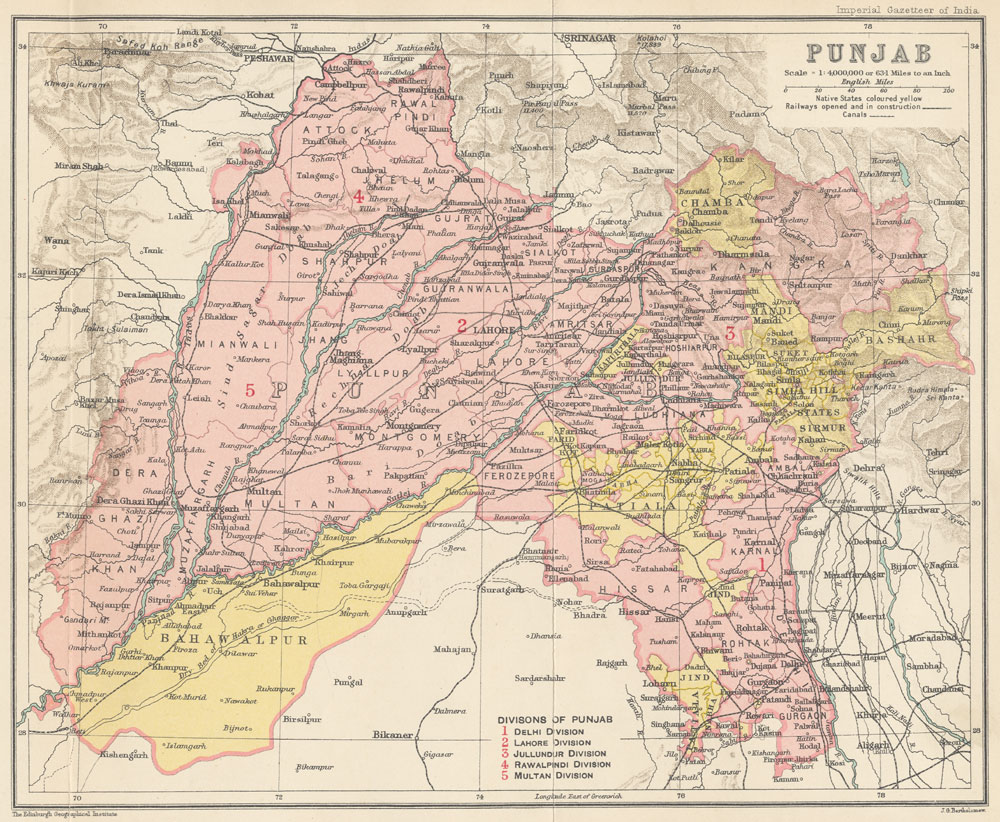
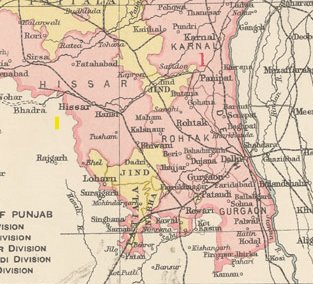
At Karnal, the collector, Mr Le Bas, was having problems. It was not with mutineers, and it was not with insurgents, but the landowners at the town of Bulleh were steadfastly refusing to pay their revenue. Fearing this might well lead to more landowners following their example if the situation was not contained with a show of force, Mr Le Bas requisitioned a detachment of the 1st Punjab Cavalry under Lieutenant Hughes to sort things out.
Hughes decided he would form his own little army for the expedition and accordingly set out with:
Artillery – 1 European officer, 1 Native Officer, 3 NCOs, 19 gunners and 20 bullocks; two six-pounder guns
Cavalry – 1s Punjab Cavalry, 3 European officers, 9 Native officers, 31 NCOs, 3 trumpeters, 198 sowars and 248 horses
Mounted Police – 1 native officer, 2 NCOs, 31 sowars, 34 horses
Infantry – 1 Native officer, 2 NCOs, 2 drummers, 45 sepoys.
Then, on 11 July, in compliance with Mr Le Bas’ instructions, Hughes left Karnal at 1 in the morning and marched to Bulleh, 29 miles distant, and he would find the people of Bulleh were expecting him for he found the town in a state of defence “…and the gateways barricaded on all sides. The town itself, substantially built of pukka bricks, stands on an eminence and is, or was, surrounded by suburbs, enclosed by a low wall and ditch. The entrance to each street leading into the town from the suburbs was also strongly barricaded, but of this circumstance I was not aware until I attempted an entrance.“
Hughes halted his men near the main entrance and rode forward to talk to the matchlock men who were eyeing him with some suspicion from behind their barricades. Without making much of pleas, Hughes simply demanded they pay up the revenue. This was met with yells from inside the town and volleys from the matchlocks, which wounded three of the cavalry horses and killed a trumpeter. Hughes wisely retreated to think about what to do next. A jemadar of the Military Police informed Hughes that he had noticed that one of the gateways, some two hundred yards to the left of the main one, was less heavily barricaded – it gave Hughes his eureka moment: he would rush that gateway and at the same time, send a troop to the opposite side of the town to force an entrance there.
The cavalry was ordered to dismount, and they proceeded to tear down the barricade; and with Hughes at the fore, swept through the suburbs with matchlock fire ringing around their heads. Their rush ground to a halt when, at one of the entrances to the town, they found another barricade. This time, it was a large piece of timber, too heavy to lift. There was nothing for it but to wheel around and cut their way back out again. Stumped, Hughes made note of his losses – one sowar and one horse killed, two native officers (Jemadar Azim Khan would die of his wounds) and nine sowars and twelve horses (Hughes’ included), wounded. In Bulleh, the townspeople would bury 20 men and tend to the wounds of a further 22.
So Hughes now pitched his camp in the “most open ground I could find”, close to the town but out of matchlock range and sent to Karnal for some more guns, requesting one from the Patiala Raja and another from the Karnal Nawab. He also asked Mr Le Bas to send some more infantry. Towards midnight, a merchant from Bulleh approached the camp. He was carrying a bag in which was Rs 1150 and promised to bring the remainder of the revenue by noon the next day. In the meantime, unbeknownst to Hughes, reinforcements from the neighbouring villages were pouring into Bulleh and by morning, they numbered 2000 matchlock men.
At 8 in the morning on 15 July, the villagers moved out to attack Hughes. They took possession of a tract of jungle, well intersected with deep ditches, that was in his front and lined the banks of a canal to his left. Hughes ordered his camp to break up and move slowly back, in the hope that the attackers would allow themselves to be drawn out into open ground. However, they were having none of it and stuck to the jungle and the canal, while Hughes moved out of range. Thus was the state of things until mid-morning, when the guns Hughes had called for arrived, commanded by Lieutenant Martineau (formerly 10th BNI) and accompanied by 50 of the Patiala Raja’s personal infantry. Hughes quickly pushed the guns to the front and opened fire on the main entrance of the town, and at the same time, ordered Lieutenant Millet to take the cavalry and cut off the retreat of the matchlock men who had extended themselves along the canal. The troops “dashed across the canal, near the town,” causing the matchlock men to take to the open country, with the cavalry in pursuit. Meanwhile, the cannonade had done its work – the infantry rushed the Bulleh, followed by a party of the 1st Punjab Cavalry: while they could set fire to the brick houses, they fired the forage stacks in the suburbs, causing an inferno. Hughes then ordered all the ghee and grain (of which there was plenty) found in the town to be confiscated in the name of the government and handed over to the Garonda Tehsildar. He also placed four of the town’s lumbardars under arrest, along with anyone who looked like he might be important.
These men, quite aware that without the ghee and grain Bulleh would starve, decided to make a deal with Hughes – if he returned the confiscated property, they would bring in the revenue; Hughes stipulated they were to pay Rs 1000 over and above the amount still due. In the meantime, not wishing to have a visit from Hughes, two adjacent villages handed in their revenue, unasked for; by afternoon, another had followed suit. Rumour had gotten around that Mr Le Bas intended to give all of them the Bulleh treatment.
Such actions, sadly, would be repeated throughout 1857, and no one would prove themselves more prolific at such tactics than the Meerut Volunteer Horse.
Sources:
Bulletins and State Intelligence for the Year 1858, Part I
 Mutiny Reflections