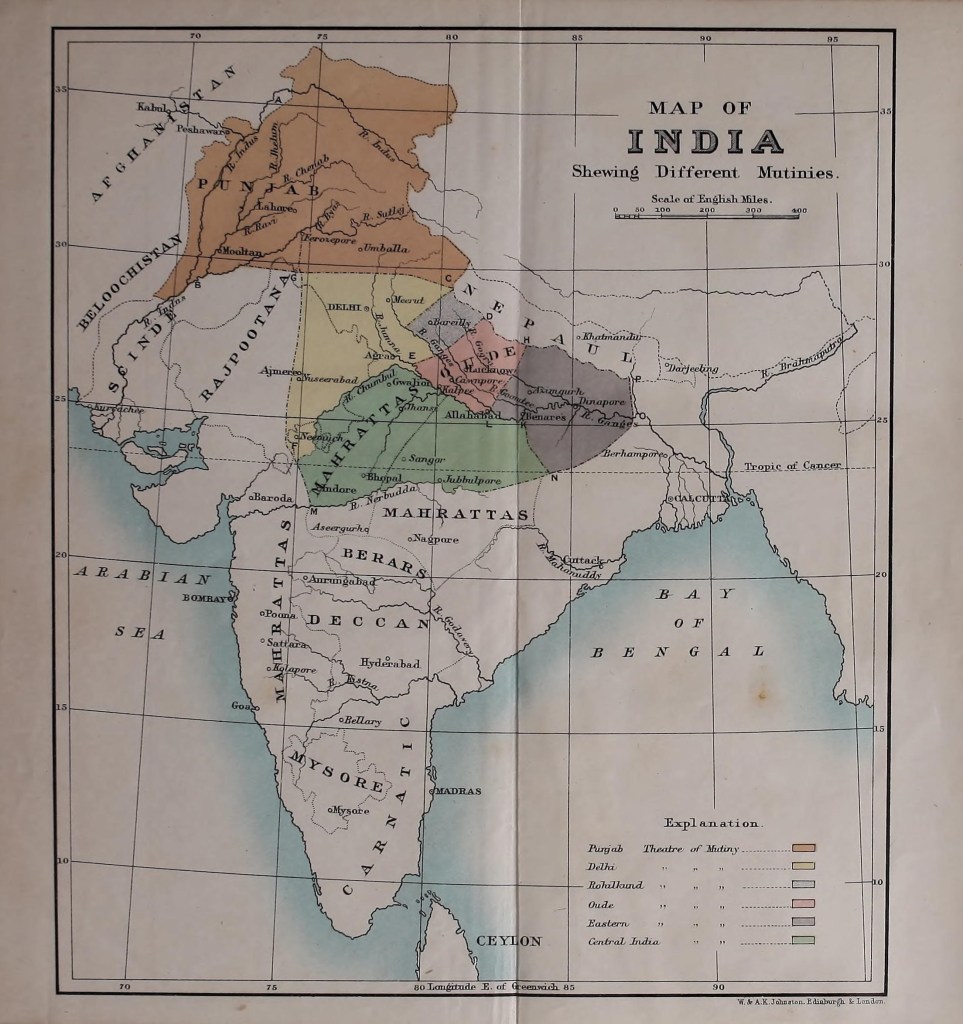
After the Fall of Lucknow in March 1858, the time of grand armies was over for a time in Oudh and the North-western Provinces. Sir Hugh Rose would lead the last great force in Central India all the way to the recapture of Gwalior in June, after which, much of the fighting, or as the British historians of the time called it, quite unfortunately, “mopping up,” would be done by smaller columns. By splitting up the larger armies, the British were able to cover more ground in less time and attack the remaining rebel forces from different directions. It was a tactic not unlike that used by the rebels themselves, who, after Lucknow, also split up their armies, making it more difficult for them to be caught, while retaining the ability to launch smaller attacks on various positions. It was a brutal game of cat-and-mouse, with both sides interchanging positions as the contest progressed.
For the rebels, it was a matter of survival, of prestige, of holding onto the essence of what the rebellion was supposed to be – a chance to drive out the foreign invaders from whichever territory they held dear. In Oudh, it was the dream of a province united under the now done and dusted Oudh Court that once reigned from Lucknow, but there was essentially no one left to lead them. The Maulvi of Fyzabad had pursued his own course, and Begum Hazrat Mahal was rapidly making her way towards the Nepal border, as was the Nana Sahib and his retinue. Tantya Tope, who had taken his army and waged war in Central India, was facing defeat after defeat at the hands of the relentless British forces, and Firoz Shah had, step by step, been pushed out of Marwar, into Central India, further onwards into Oudh and then into Rohilkhand. They left behind scores of zamindars, talukdars and petty rajas, each with their own interests in mind, to gain back the territory they had lost under Company rule.
For the British, this particular form of warfare was tiresome, costly and frustrating. Strategically, they had gained back most of their main stations – Delhi, Fatehpur, Cawnpore, Lucknow, Mhow, Indore, Gwalior, Fatehgarh, Azamgarh, Gorakhpur, Bareilly, Fyzabad and Sultanpore, to name a few, but there was still no end in sight to the fighting. The rebel forces kept them, in every sense of the phrase, on their toes. Sir Colin Campbell did have a plan, but it was a slow and laborious one. He never intended to defeat the rebels per se; instead, he would encircle them and push them out of India towards the Nepal frontier, where he intended either to crush them once and for all, or leave them to die of privation and disease in the Nepalese jungles. Until then, however, it is many months to go, and we shall now turn our attention to some of the smaller expeditions launched by the rebels that were solely intended to give the British headaches. We could fill a volume or two if we were to recount every single expedition, action or march of the British between April and the resumption of operations in September, and many of these barely receive a page in the dispatches of the day.
The Expeditions
One such expedition was to the village of Mohan, on 5 August, one march away from Nawabganj-Barabanki, where Colonel Frederick Evelegh (HM’s 20th) had been given to believe a rebel force of no less than 800 men had gathered. He was given permission by Sir James Hope Grant to take force out to drive the rebels off; Evelegh duly gathered up the 20th Regiment, placing them on the backs of elephants, a detachment of Sikh Cavalry and 4 guns of the Bengal Horse Artillery and went off to make war.
“On my arrival, I found that the enemy had not a single man in the place, and the houses were all shut up, though the occupants remained; it was ascertained, however, that the enemy had some 400 or 500 troops in the neighbourhood.”
His men had crossed one river and 11 miles of broken ground only to arrive at Mohan to find no one at all. Seeing the expedition was something of a bust, Evelegh recrossed the river and decided to give his men a rest. They had settled down to breakfast and a rest around 7 in the morning; three hours later, Evelegh’s videttes sent in a report that the rebels, both cavalry and infantry, had in the meantime circled round to his right flank and had settled themselves under some trees, while a detachment of cavalry was “approached slowly” on Evelegh’s front.
There was still time, however, to feed the artillery horses and ensure the troops had had their fill before Evelegh sent one company of HM’s 20th to extend in a grove of trees to the right, while Evelegh set off with two guns and 200 sowars to see for himself what the rebels were up to.
“The enemy’s sowars, on seeing the small force on the right, began to move quietly away, and as the ground was rough, I directed the guns to open, which they did at 1,000 yards, when the enemy’s sowars galloped off. I then followed up for about half a mile, and had three distant shots again at them, when both sowars and infantry retired as fast as possible. In the meantime, the company of Her Majesty’s 20th Regiment had driven the enemy from my right flank.
One man of the enemy was killed by a rifle shot at great range. One horse had both his legs broken by shrapnel, and myself saw two of their horses running away without riders. I did not see certainly more than about 150 sowars and 100 infantry of the enemy’s forces; but there were a number of thick topes, and it is difficult to say therefore what force there was.”
A heavy downpour put an end to the day’s proceedings; fearing he would be trapped by flooded roads, Evelegh broke camp and returned to Nawabganj-Barabanki. Such expeditions were tedious and achieved very little, for as soon as Evelegh had turned his back on Mohan, the rebels returned.
Back to Mohan
Evelegh’s troops were hardly back under canvas when a frantic letter from Mr Carnegy, Deputy Commissioner at Mohan, arrived. The rebels had regrouped in force, had attacked a police battalion and on 7 August, exactly one day since Evelegh had left the vicinity, crossed the bridge into the town, had driven off the police pickets and were now assuming a threatening manner, directed at Mr Carnegy himself, who believed they intended to attack him. Evelegh was back on the road to Mohan on 8 August at 6 am. He took with him 300 sowars of the 1st Sikh Cavalry, a detachment of Hodson’s Horse, 2 guns of the Bengal Horse Artillery, 25 gunners on horseback to support the guns and 12 rank and file of HM’s 20th, whom he placed on the limbers.
When within 3 miles of Mohan, Evelegh, recalling the rebels had a penchant for hiding in tree groves where they were difficult to see but could observe him without revealing their positions, he decided to give them the benefit of the doubt. He turned towards the village of Hussenganj on the direct road to Rusoolabad, convinced the rebels would most likely retire to the latter place as soon as they got wind of his approach. Evelegh was not disappointed.
“On crossing the open maidan towards Hussengunj, and when about a mile from it, I perceived the enemy’s sowars and infantry rapidly retreating from the village, apparently towards Rusoolabad. I immediately pursued at a gallop for about a mile and a half, but finding that the guns could not approach near enough to open fire, I halted them, and sent on two squadrons of the Irregular Cavalry, under Lieutenant Godby, who followed the enemy in pursuit for about five miles.”
The sowars left 45 men of the rebel force dead on the ground behind them while Evelegh took their only gun, a brass 3-pounder and relieved them of two camels and an elephant. He then called for a halt to rest the troops. In the meantime, Carnegy had assembled the Mohan police and rode out to meet Evelegh.
“The enemy’s forces did not appear to be more than about 150 sowars and 200 infantry, but I am inclined to think, from information afterwards received at Mohan, that numbers were lurking about in the neighbouring topes, which are thick and numerous. The brass gun I left at Mohan, and it was placed in an excellent position to command the bridge.”
The losses to Evelegh were slight: 1 artillery horse died of exhaustion, 2 Sikh sowars were killed and 5 wounded and 1 missing, 1 sowar of Hodson’s Horse was killed and another wounded. After a brief discussion with Carnegy, Evelegh made his way back to Nawabganj, another expedition that, besides marking British presence, had only driven the rebels off somewhere else.
Sources:
Behan, T. L. Bulletins and Other State Intelligence for the Year 1858. 4 parts/vols. London: Harrison & Sons, London Gazette Office, 1860.
Behan, T. L., ed. Bulletins and Other State Intelligence. Parts 1 & 2 [1857–1858]. London: Harrison and Sons, 1858–1859.
 Mutiny Reflections