Sir Charles Napier 1843-1847
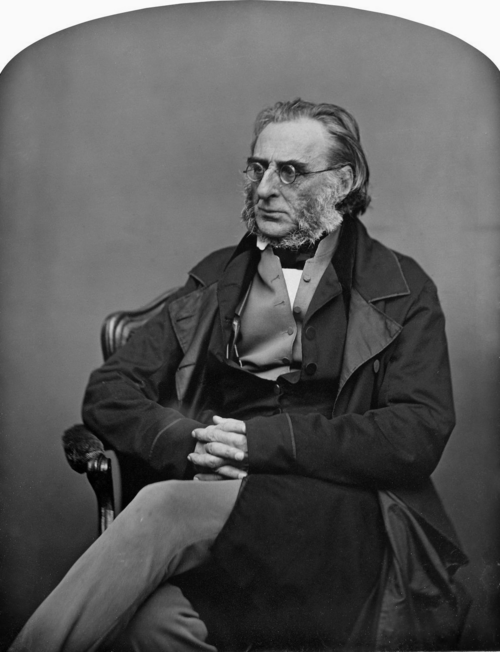
General Sir Charles Napier (1782–1853); Daguerreotype.
The story of Sir Charles Napier’s conquest of Sindh is often centred around a famous, albeit tall, tale, when he supposedly sent a telegram to Lord Ellenborough which contained only one word, “Peccavi.” This pun ( taking use of its Latin meaning “I have sinned” and the heterograph “I have Sindh.”) made the rounds; it was quoted throughout the years, right up to modern times, supposedly to highlight the masterful intellect of this particularly odious man. It appeared for the first time in print on 18 May 1844 in Punch magazine. However, Punch neglected to mention that the pun had been submitted by one Catherine Winkworth (who would later find fame as an English hymn writer and educator), aged 16. During a conversation about Napier’s exploits with her tutor, the Reverend William Gaskell (the husband of the novelist Elizabeth), Miss Winkworth mentioned that Napier’s despatch could have been shorter than Caesar’s, “Veni, vidi, vici,” and spontaneously came up with “Peccavi.” Gaskell, thinking this was quite the joke, encouraged her to submit it to Punch. Miss Winkworth sent it in, was duly paid for her moment of humour, and Punch published it under the title “Foreign Affairs,” as a factual report. The rest, as they say, is history.
The truth is, Napier had indeed sinned. And he would continue to do so until 1847.
With a handsome salary in place of Rs 7000 per annum (£700 in 1844 and equivalent to approximately £115,446.38 in today’s money), Napier took charge of Sindh as the province’s first governor in 1843. The Mirs were provided with a pension of 3000 lakhs (£30,000,000 or £4.65 billion today) to be divided between all of them, and those who had not been sent into exile were allowed to retain their lands in Jagir as long as the value did not exceed 1.5 lakhs. Napier also issued a proclamation intimating that all Jagirdars who proclaimed their loyalty to the British would be allowed to keep their estates. Nearly two thousand landowners stepped forward, and at least this time, Napier kept his word.
He then divided the province into collectorates, namely, Karachi, Hyderabad and Sukkur, which were further subdivided into districts and divisions, with a number of British officials appointed as Collectors and Deputy Collectors. These were not regular employees from the Indian Civil Service but “soldier civilians” chosen and appointed by Napier. The overall rule of law rested not with them, but with Napier himself. Unlike in other provinces, these early collectors had limited magisterial powers and serious offences were disposed of at military court martials instead of regular judicial courts. The commissioner, with no authoritative power, made the decisions in these cases was entirely in Napier’s hands, who did very much as he pleased.
He abolished the office of Sazawal-kar (revenue collector, bailiff, or district administrator) that had been put in place by the Mirs; these officers were now incumbents of the Kardars, who had once been the overseers of rural districts. The Kardars had once wielded heavy administrative power over the peasantry, often operating as tax and custom collectors, but now, with their pay reduced by half, they were little more than sub-servants of the new British collectors. In practice, the Kardars were now the only remaining link between the old rule and the new. Although their powers were severely limited, even Napier realised getting rid of them would rightly be perceived by the EICo as one bit of meddling too far. So the Kardars remained, in reduced circumstances, and their appointments were dependent on whether they could prove themselves well-behaved. To keep them in check, the villagers were now permitted to raise complaints against any Kardar they found objectionable. As the Kardars were salaried men, Napier hoped this would induce them to be honest and less inclined to bribery or visit extortion on the villagers.
As for the new collectors, these were charged with sending in reports to the commissioner, who, in turn, handed them over every month to Napier. Napier had not ordered either a land or population survey; all he wanted to know was whether a particular area was profitable or not, and the reports contained information such as:
a) the cost of food for five persons
b)the extent of newly irrigated lands, in square measure
c) the length of new roads
d) public buildings begun or completed
e) the height of the Indus River.
Furthermore, they had to explain their expenditures in detail and the current cost of labour.
Although land revenue decreased under Napier’s rule, the system under which it was collected remained nearly the same as it had been under the Mirs. Although the Jagdirs had been confirmed in their possessions following their pledge of loyalty, Napier preferred to discourage the claims of zamindars and deal directly with the occupants of the land, who in their turn, with little clear directive, continued to look to the jagdirs and zamindars. Napier insisted on the abolition of transit duties, but his decree was generally ignored.
Considering the province was newly annexed, Napier put much store into raising local police forces in each district under British commanders and augmented as needed by regular troops from the Bombay army. These were further supported by local levies of irregular cavalry who were distributed among and around the numerous collectorates. Napier’s plan was certainly novel.
“For as the city police stood between the rural police and the more degraded of the population, so the rural police stood between the city police and the irregulars, troops whose pride prevented familiarity with the people; and all three hedged round the regulars, who were never interrupted in their discipline by being detached on police duties, and never degraded in their own estimation by intercourse with criminals. Remaining in masses, they were isolated, mysterious objects of terror and respect for an uncivilised people who knew them only by their terrible deeds in war. Meanwhile, the police, being in constant contact with the population, were forced to exert all their energies, having, however, where overpowered, the irregular horsemen to look to for support, and finally the regular troops, of whose strength in battle the most exaggerated notions had been formed.” (Napier, William)
However, it was, in essence, a system worse than what even the most depraved Mir could have come up with. Napier openly rejoiced that he had set up a system in which the two departments would be constantly at odds with each other.
“While the police inform us of the cheating Kardars, Umbardars and Zamindars, these people complain of the usual faults of policemen, namely overbearing insolence. In this manner they keep each other in check, and both take the part of the poor, not out of humanity, but out of spite.”
Regarding the people of Sindh, Napier found them, on the whole, to be objectionable, as mentioned in his brother’s book, “General Sir Charles Napier’s Administration Of Scinde And Campaign In The Cutchee Hills” and he cannot help gloating:
“The money-seeking Hindoo goes about all eyes, and with fingers supple as his conscience, robbing everybody by subtlety as the Beloochee robs them by force. To him, the conquest must be as a feast and a blessing of grace.
The Scindee, strong and handsome, is indolent from the combined effect of heat and slavery; but he has fine natural qualities, and his bondage being of recent date, he may be reclaimed and fitted for independence — to him also the conquest is a blessing, and it shall be my business to make it a feast.
The Bcloochee, though fierce and habituated to acquire property by violence, is shrewd and has a strong though savage sense of dignity and honour according to the customs of his race. A combination of coercion, of respectful treatment, of generosity and temptation, may therefore bend. him to better habits, without breaking the chivalric spirit which is now his best quality. He fought desperately for the ameers, because to fight and plunder was his vocation; but neither he nor his particular chief, nor the ameers, fought from national feeling; education and habit have divested all three of patriotism in the European sense. The Beloochee warrior loves his race, his tribe, not the general community, which he regards as his prey and spoil.”
 Mutiny Reflections