The 25th of September
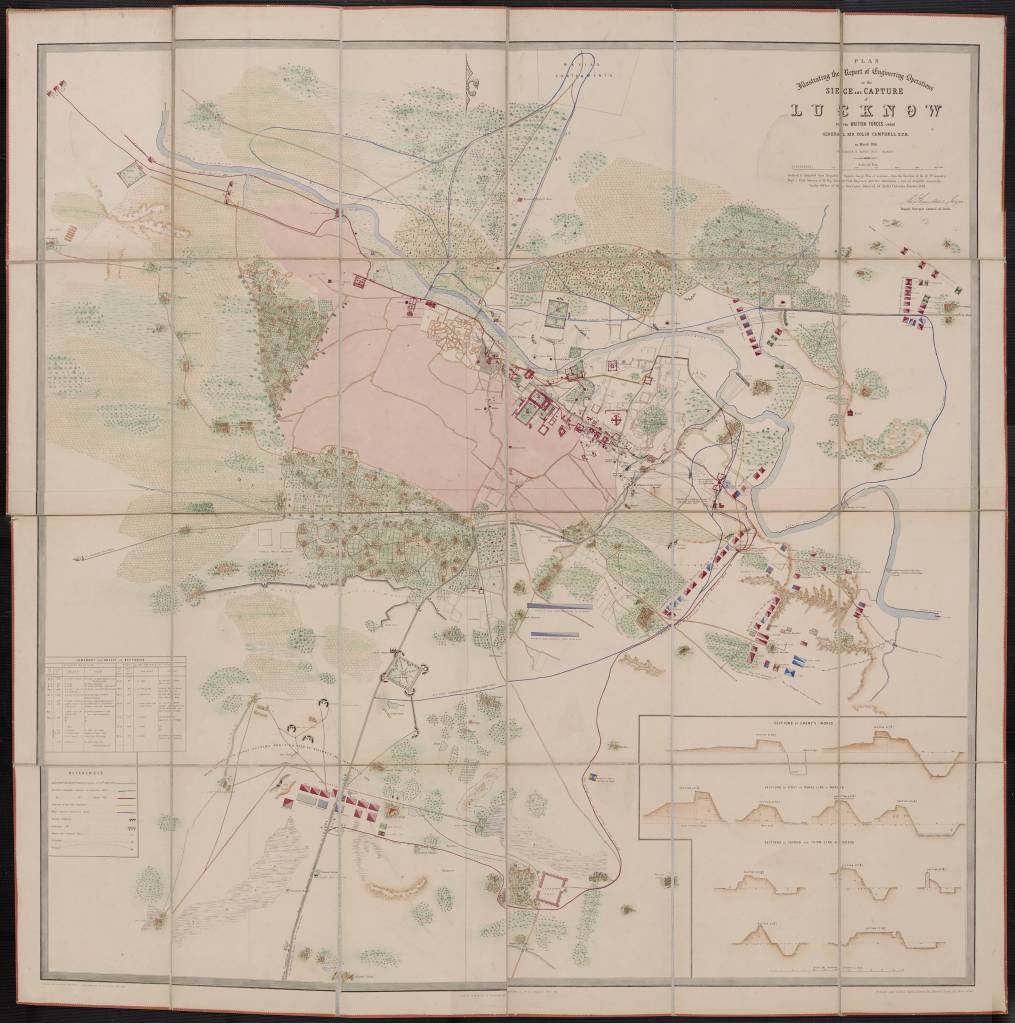
At 8 a.m. on the 25th of September, the relieving force was drawn up in front of the Alambagh under a gloomy sky, heavy with clouds. In the midst of the men, up galloped Outram, followed closely by his staff, and he informed Havelock that there would need to be yet another change in plans.
“A map of the city was spread out on a table, and as the two Generals were intently studying it, a round shot hit the ground a few yards in front of them and bounded over their heads. Then a loud thud was heard distinctly; a round shot had struck one of the gun bullocks fairly on the left ribs…in two or three seconds it quietly sank down and died…” Another was swiftly brought up to take its place.
After what seemed an age, the restless troops heard the welcome order, “Forward!” and they moved off, Neill’s brigade headed by two companies of the 5th Fusiliers and Maude’s battery, leading the way. Outram rode next to Maude with the leading gun, closely followed by Chamier and Sitwell of his staff.
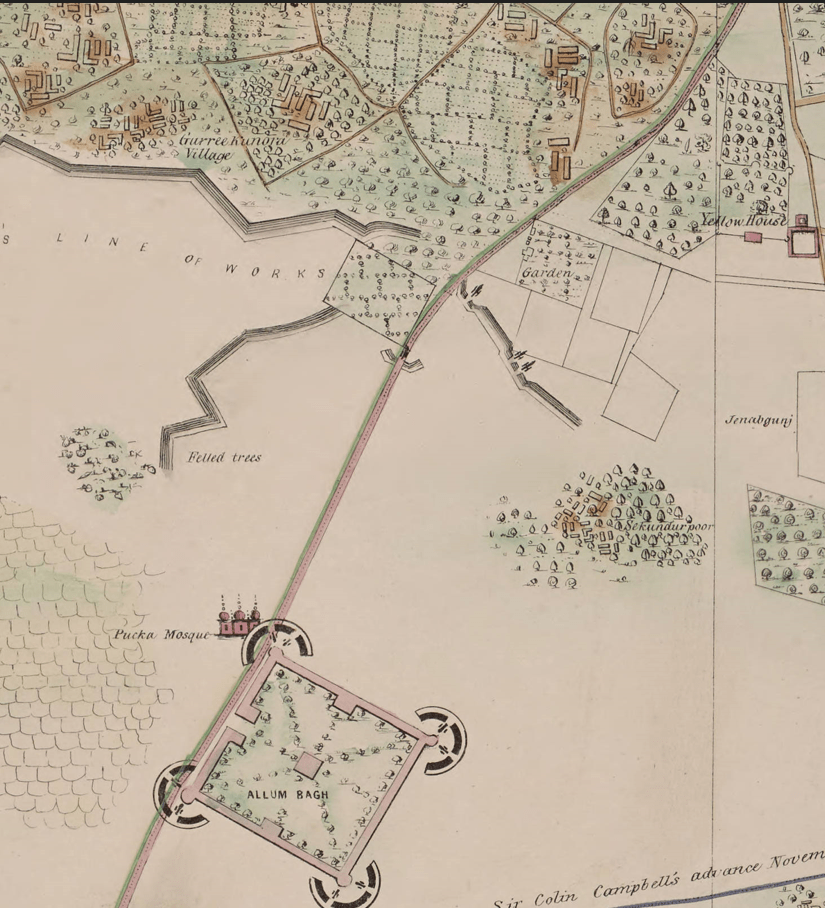
No sooner were they past their advanced picquets than the rebels opened up a murderous fire from a double-storied house, from the loopholed walls of the enclosure and “from a battery on each flank, and from two guns” which were loaded in the lane behind the Yellow House and then run out on the main road, carefully laid, and admirably served.
The Fusiliers were ordered to lie down in a ditch on each side of the road as Maude quickly went to work with his guns.
“Round shot, grape and bulllets went crashing through the trees which lined the road and struck many down. Shot followed shot, and bullet after bullet was poured into the advancing column. Outram’s arm was shot through by a musket ball; “but he only smiled, and asked one of us to tie his handkerchief tightly above the wound.”* Then his Aide. de-Camp, SitweIl, received a similar wound. Almost at the same moment, the Sergeant-Major of Maude’s battery had the whole of his stomach carried away by a round shot. ” He looked up to me for a moment with a piteous expression, but had only strength to utter two words’ Oh God’ when he sank on the road.” Just then another round shot took off the leg high up the thigh of the next senior Sergeant, John Kiernan, a splendid specimen of the Irish soldier. .. He was as true as steel” Fast as the men of the leading gun detachments fell, their places were taken by volunteers from’ other guns. But soon there would be no men to fill the gaps. In this desperate situation, Maude asked Outram “calm, cool and grave” if they might again advance.” (Forrest)
As the order to halt had come from Havelock, Outram did not want to alter it – fortunately for the party, up came Major Battine, Havelock’s galloper, giving the order to advance. Maude pushed his men forward, and the infantry now drove the enemy before them, through the gardens and out of the Yellow House. They proceeded forward until they came to a sharp bend in the road – two hundred yards in front was the canal and directly ahead the Char Bagh Bridge.
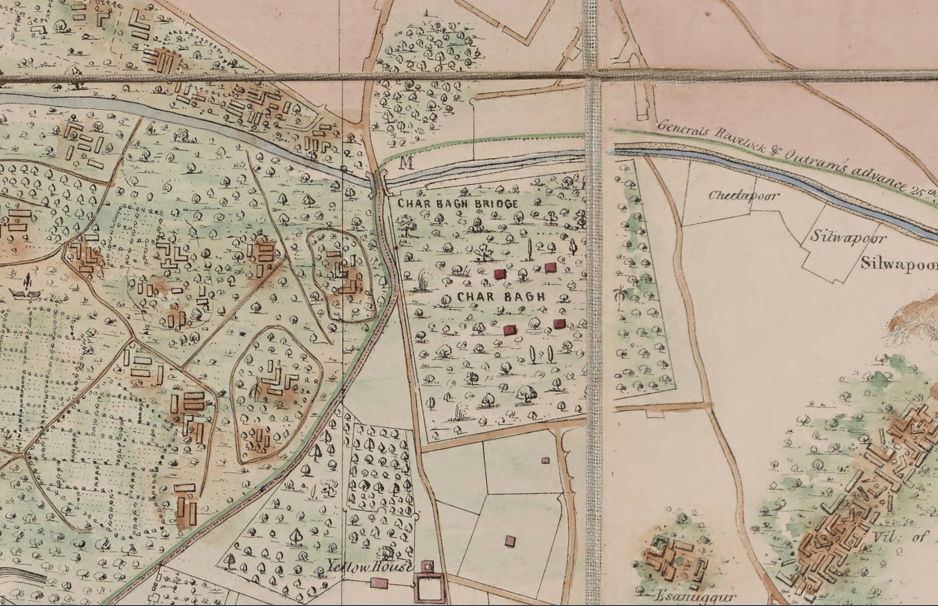
On the Lucknow side, the bridge was defended by a batter of no less than 6 guns, including one 24-pounder while off to the left and the right were tall houses, all loopholed and bristling with muskets. The skirmishers of the Madras Fusiliers were sent forward now to hold the left canal bank and check the fire from the houses while Outram and the 5th Fusiliers were sent to clear the walled gardens to the right and continue onwards until they reached the higher canal banks in order to bring down a flanking fire on the rebels. Maude in the meantime, unlimbered two of his guns, not having room for more, and replied to the fire from the rebels. The first discharge from the rebel guns disabled one of Maude’s and he watched as his men fell around him, killed or wounded. Volunteers were called for and the first to step up was Private Jack Holmes of the 84th – Outram was nowhere to be seen and the skirmishers were unable to make a dent in the defences of the rebels. For the next half hour, the rebels ploughed into the British force, felling the men at Maude’s guns almost as fast as he could replace them.
“So great was the pressure that Maude and his Lieutenant Maitland were doing the work themselves. At the end of half an hour, Maude recognised he was making no impression. Then he called out to young Havelock, to do something. Havelock rode at once to Neill and suggested he should charge to bridge.” Neill refused, defraying the responsibility to Outram, who was still nowhere to be seen.
In the fray, up rode Colonel Fraser-Tytler to reconnoitre the position – in his estimation, the only way to win the bridge now was by a bayonet charge and he too put his view to Neill who adamantly refused to listen.
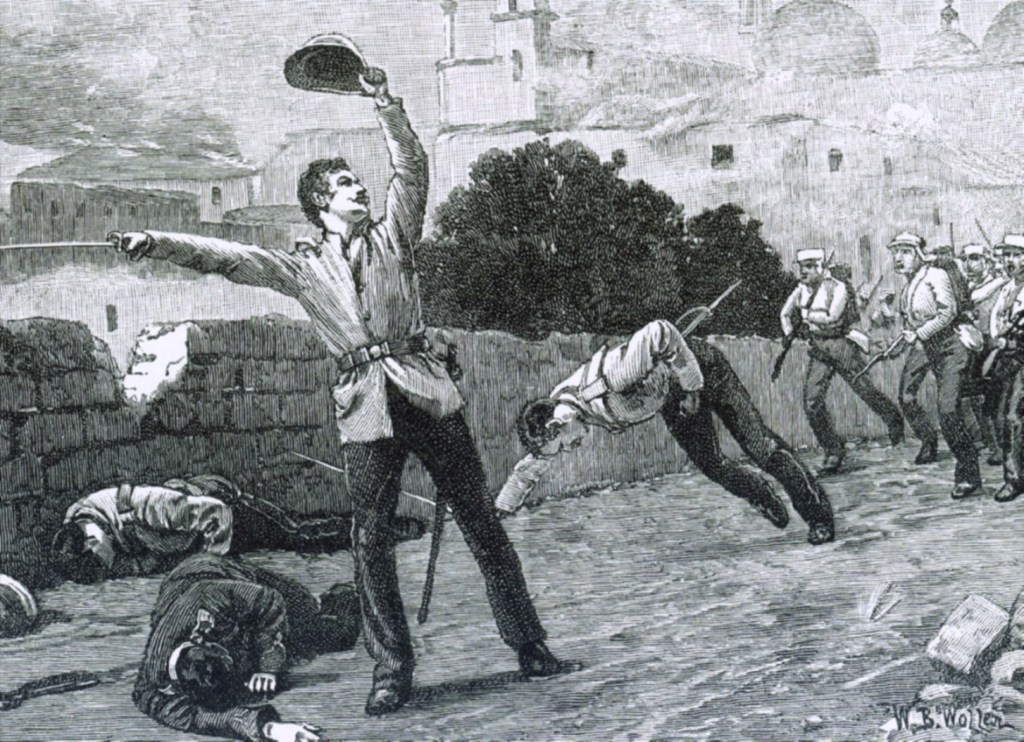
Seeing Maude would soon be overwhelmed, young Havelock took the responsibility on himself. He rode back a little way to the rear out of Neill’s sight and then suddenly turning his horse, charged back to Neill and saluting him smartly, said, as if the order had come from his father, “You are to charge the bridge, sir.” Neill immediately ordered young Havelock and Tytler to form up the men. At the word, Lieutenant Arnold followed by a mere handful of men, dashed forward towards the bridge, making straight for the barricade. A perfect storm of fire ensured. Arnold sank to the ground shot through both thighs, and Tytler’s horse was killed. Of the 28 men who made the fateful charge, only young Havelock and a private named Jakes remained unwounded.
“Unable to pass the barricade, Havelock, erect on his horse, waved on his sword and called on the main body to come on Jakes stood by his side, loading and firing as fast as he could…Then suddenly there was a rush and the Madras Fusiliers dashed forward, cleared the bridge, stormed the barricade and bayoneted the rebel gunners where they stood. “
As the bridge was carried, up came Outram, from the Charbagh garden.
The whole force now crossed the bridge and turned a sharp right to move along the canal. The 78th Highlanders alone did not accompany them – they had been detained to hold the end of the direct Cawnpore road, hold the bridge cover the advance of the heavy guns and then follow the column, acting as its rear guard.
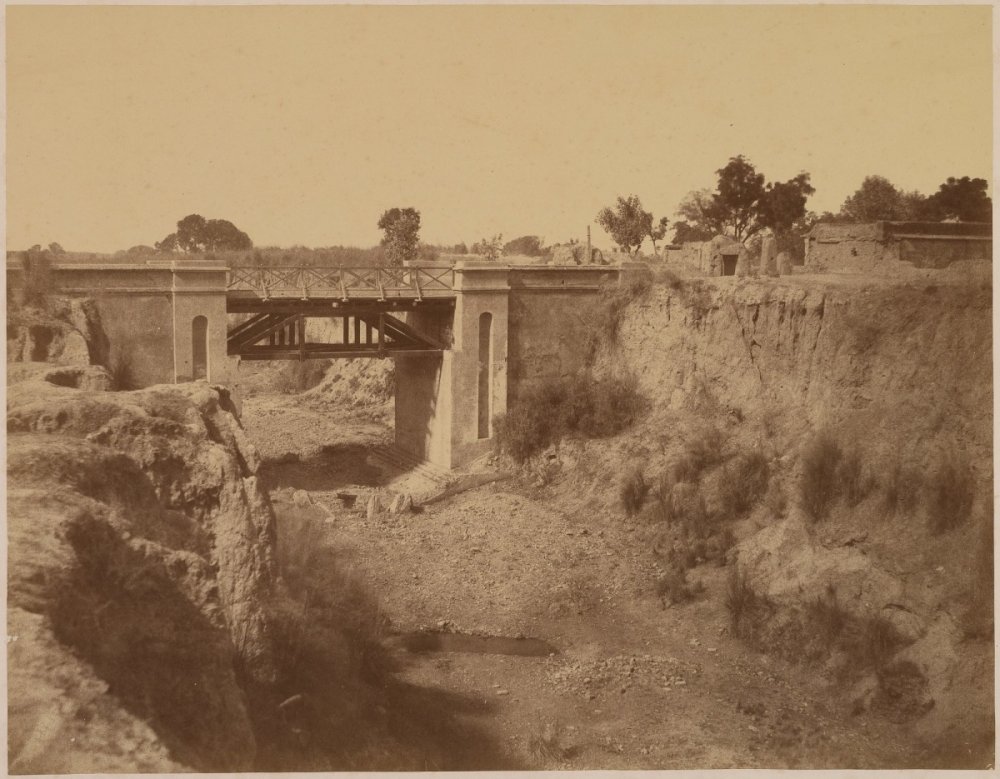
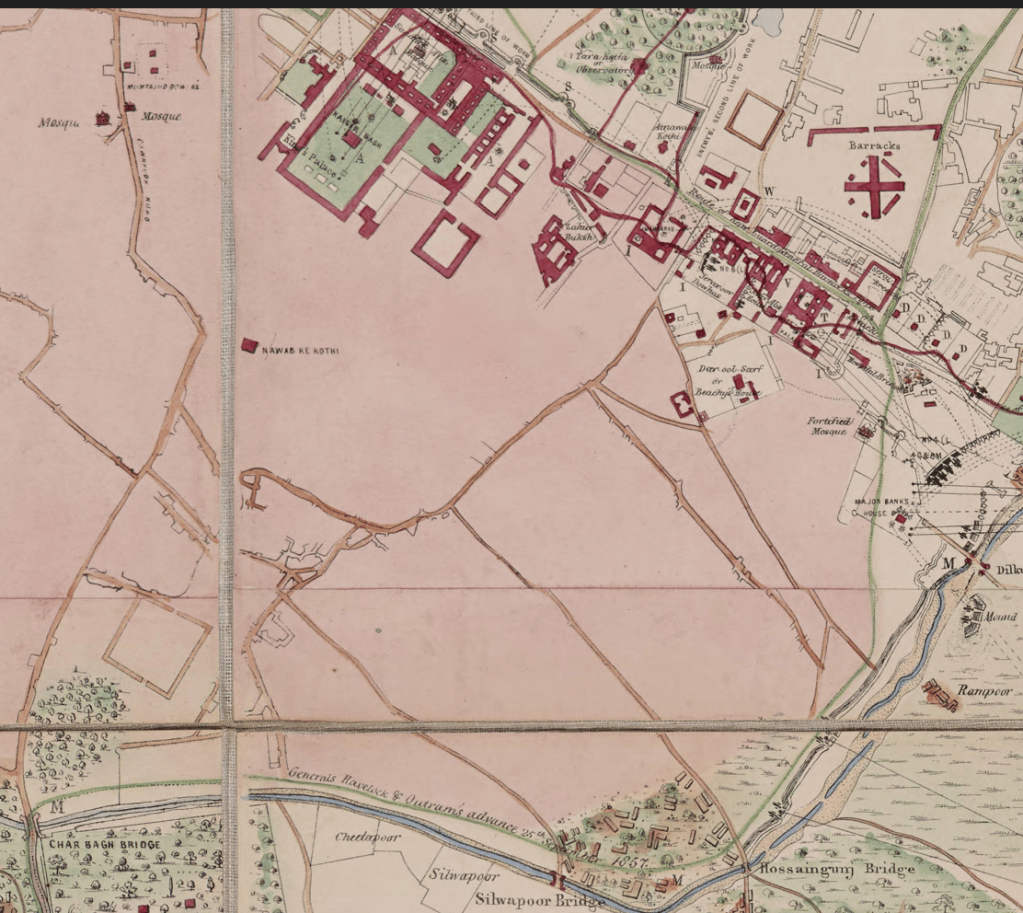
It was Tytler who was first aware that two of the enemy guns had opened up behind the Yellow House and were now threatening the right rear as they plied their fire directly at the bridge. No artillery was available to bear upon them and Tytler, finding General Havelock in the commotion was instructed to take the nearest available regiment and storm the guns. It happened to be the 90th who, led by the commander, Campbell, made a rush and took the two guns in the face of a shower of grape. Olpherts in the meantime carried off the guns on his spare limbers through a galling crossfire of musketry poured on him from the loopholes of the surrounding houses and walled gardens.
The Volunteer Cavalry in the meantime, had been kept behind in the rearguard and not in the advance. As the order came for them to “walk, march,” they went on slowly seeing with growing horror what was ahead of them, as doolies started to appear, carrying the wounded and dying back to the rear. At Charbagh Garden, their heads and shoulders, conspicuously showed above the wall, giving the marksmen easy targets. Barrow ordered his men to dismount and walk, but not before young Erskine who had volunteered in Calcutta was shot in the side. As they led their horses over the bridge, they came across “more and more of the dead and wounded.” The doolies were moving as fast as they could over the damaged road, and many of the ammunition carts had become stuck in the ruts, blocking their passage. The cavalry was ordered to advance and go past the carts. They halted by some brick kilns, where they found young Havelock and a few riflemen, standing on top of a high mound of bricks and debris. Barrow ordered his men to halt and dismount while the remaining wounded and the baggage had passed by. The rebels however were not dumb to the presence and the sight of so many men standing on the mound attracted so much attention, that they commenced firing on them. “At first we thought it must be our men firing on us by mistake as the whiz of the bullets sounded very like that of the Enfield, but we soon found out our mistake. The enemy were round us like a swarm of bees…”
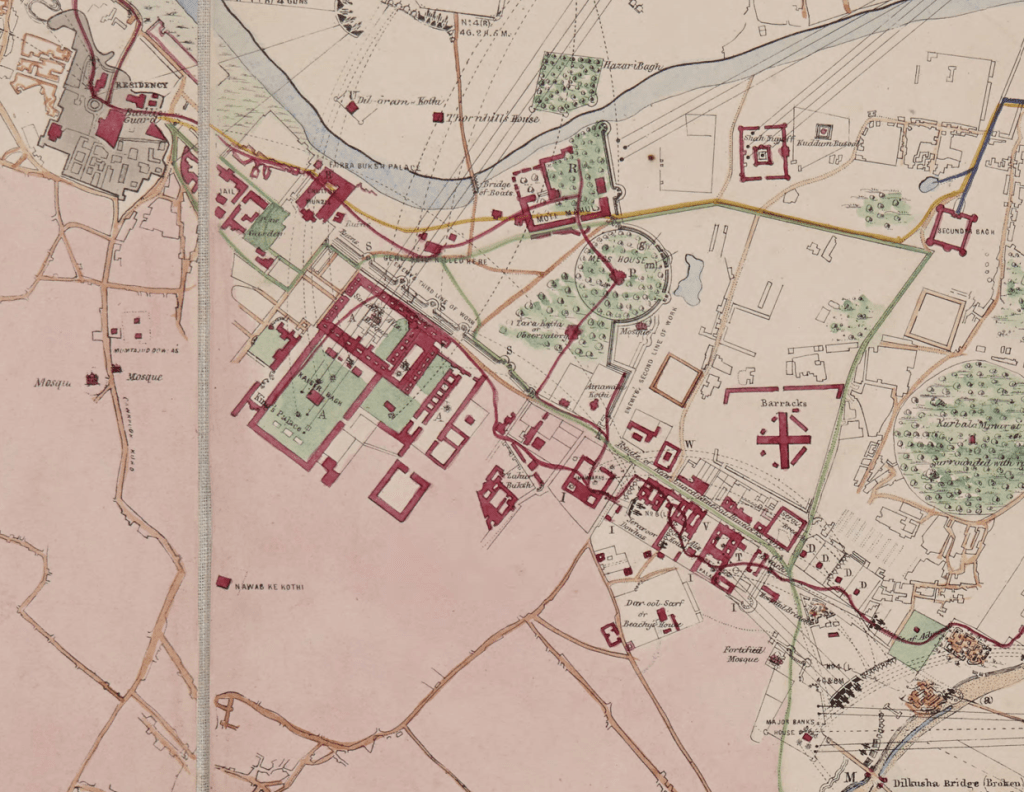
“The main column with Outram and Havelock at their head turned sharply to the right and advanced.
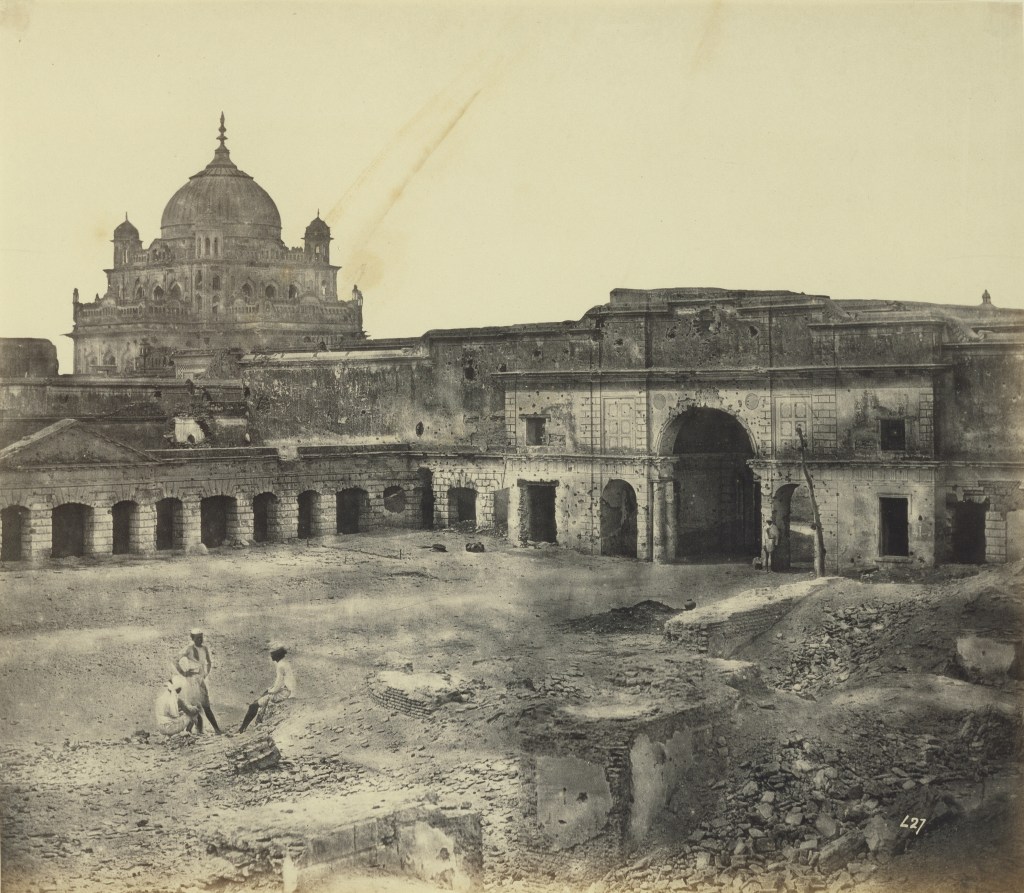
along the narrow lane skirting the canal. Ankle deep in slush they slowly proceeded and great was the difficulty in dragging the heavy guns over the soft ground. The wheels often sank deep in the ruts and Olpherts kept alive the spirits of the men as they did the tedious work of extricating them by telling them, ‘The sound of your guns is music·to the ladies at Lucknow.” The column followed the sandy lanes by the canal until it debouched on the Dilkoosha road near the 32nd hospital. Leaving the 32nd barracks on the left they followed the road across the open country to the Secundra Bagh and thence, still clinging to the road which there makes a sharp angle to the left, they entered a walled passage in front of the pile of buildings surrounded by a lofty wall known by the name of Moti Mahal.
The enemy had evidently been taken by surprise by the route adopted because from the Char Bagh no serious opposition- was made till the Moti Mahal was reached. Then the enemy plied them with grapeshot from four guns posted in. front of Kaiser Bagh the palace of the King of Oudh, and musketry from the Khoorsherd Munzil the Palace of the Sun, a strongly built house distant a few hundred yards
due north: two of the heavy guns under Major Eyre opened on the Kaiser Bagh battery and silenced it.”
The worst was yet to come.
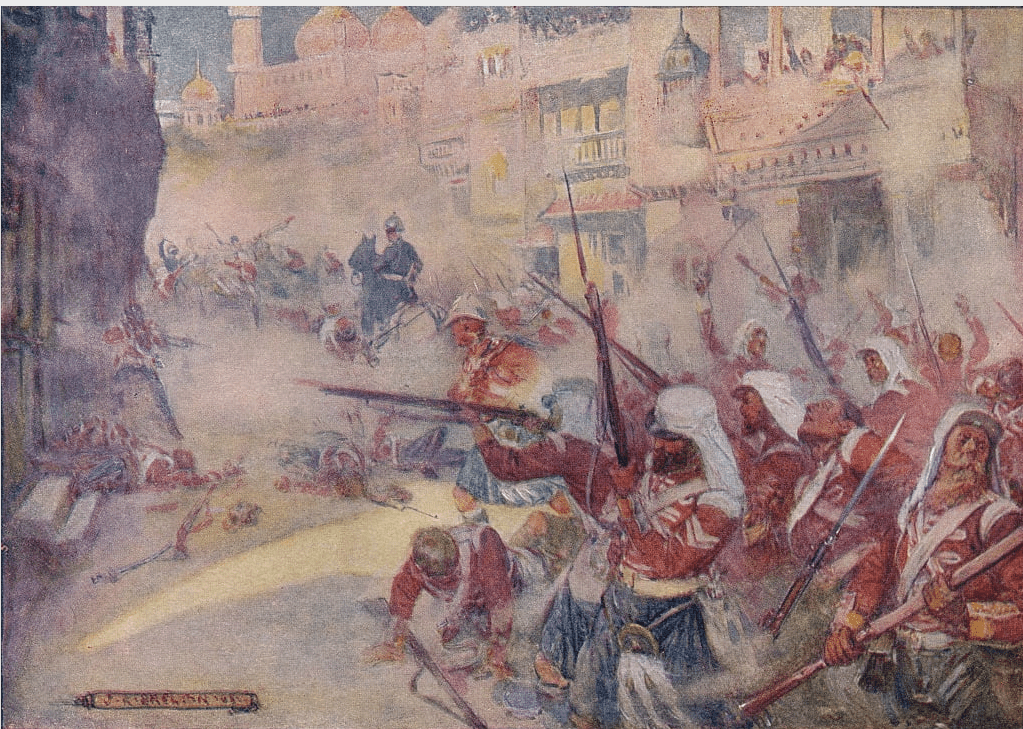
The rebels quickly overcame their surprise at Havelock’s movements and opened up a devasting fire on the advancing column. The fire of grape and musketry was so deadly, that even Havelock admitted, “Nothing could live under it. ” The force could not remain still – the advance had to continue.
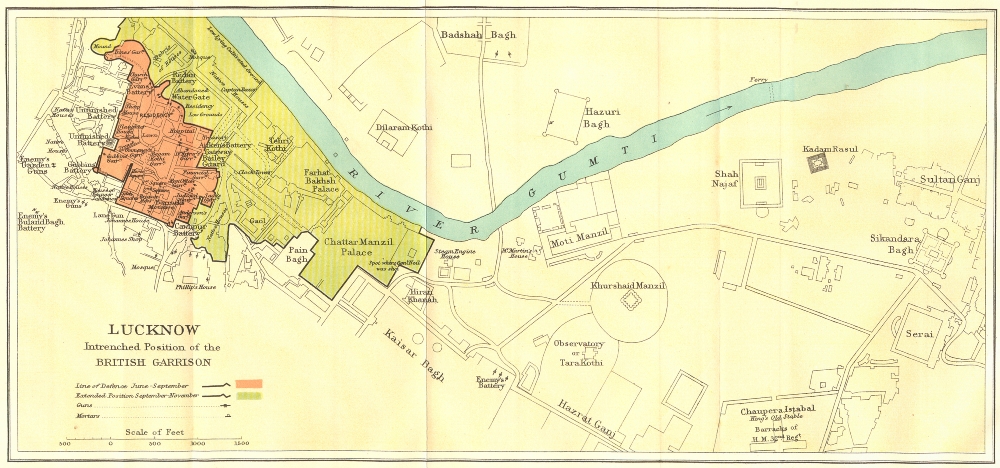
The men rushed forward, like “an impetuous torrent” rushing up the street, shells, shrapnel and bullets flying in a perfect storm over them as officers, men and horses fell. The column pushed onwards until they reached a narrow passage leading to the Chattar Manzil which brought them out of the “jaws of death.” Here they halted, and taking shelter behind the brick walls which lined the street, they waited for the 78th to catch up.
While the Volunteer Cavalry waited for the doolies and the carts to pass, the Highlanders took up the fight. They had to do their best to keep down the fire until all the baggage had passed.
As long the column was in sight, the 78th had been left unmolested, who had found work enough in throwing into the canal any guns they happened to capture. So busy were they, the 78th were caught off guard when the rebels suddenly charged them down the Cawnpore Road. For the next three hours, bitter, hand-to-hand combat ensued, while others of the rebel force poured musketry fire on the 78th from a small, fortified temple. Deciding this state of affairs could not continue, the 78th went on the defensive and attacked the shrine, carrying it by sheer force alone. Not to be outdone the rebels brought up their field pieces and and continued the fight.
The work of the 78th however ensured the remaining rear companies of the 90th could form its guard and cross the Char Bagh. The 78th now made haste to catch up with the rest of the column, eager to be in on the fray – but the last hour of fighting had brought them out of sight of the main column and when they came out of the narrow lane by the canal, they could not longer find them. Two roads presented themselves – instead of taking the one to the Secundra Bagh, the 78th turned sharp the left and found themselves on a narrow road – Hazratganj. All around them stood tall houses and from each of them “flame and a hail of bullets” fell on them. Ensign Kerby, carrying the Queen’s colours fell – they were grabbed by a bandsman, named Glen who, barely moving a few feet, was shot dead. The colours were immediately taken up by Sergeant Ried – but only a few paces on, the unfortunate sergeant met his death and the colours were seized by Assistant Surgeon Valentine M’Master who now rushed forward to spur the men on. Above the rattle of musketry, the men could hear the roar of the guns to the left and the right – the Highlanders pushed on up Hazratganj, towards the guns which were becoming louder with each step. In one rush, they burst into a wide open space and found, on their flank an entrenched battery in front of the great Kaiser Bagh Gateway and it was pouring a devasting fire on the main column as they came out of the narrow lane between the Moti Mahal and the ruined 32nd Regiment’s Mess House. The Highlanders, realising they had the advantage, stormed the battery and captured it. They spiked the largest gun and then pushed on until they had rejoined Outram and Havelock.
The cavalry in the meantime had been ordered back and lost two men, shot dead in their saddles and one severely wounded.
“…back we went…I was standing looking down the road by one of the kilns when bang went a musket out of a house my right and whiz came a bullet right across my throat and killed a man standing on my left….All having passed, we were now ordered to move on. We had no sooner turned our backs on the enemy that they swarmed round us like ants; every house and hedge belched forth its deadly fire. On, on we went, passing dead bodies of horses and me, and the guns which been taken, spiked and left behind. “
They soon found themselves in a wide road, leading to the Tera Kothi, unaware they were taking the wrong road.
“…we were everywhere met on all sides by such fire as I hope I many never see again. Howm any men were knocked over I cannot say…on, on we went, the Infantry officers gallantly leading their men, rushing first at one house and then at another, and oh! how many a poor fellow was killed – hit in the back.”
They finally arrived at a corner of the Tera Kothi grounds, just opposite a large gateway leading to the Kaiserbagh. They had to pass so close to houses that the rebels, seeing musketry was useless, resorted to flinging stones and spitting on the men as they passed by. As they arrived in the corner, they saw some of Neill’s Blue Caps who had rushed out to try and keep down the fire of the enemy in the houses, while to the right, the Sikhs made their advance. It transpired they had, instead of following the main body, had turned up the road to the left past the Tera Kothi instead of proceeding to pass it on the right towards the river. When the cavalry arrived where the men had gathered, they found “Infantry, Cavalry doolies and camels – all huddled together” in a small space just outside the walls of the Fareed Baksh Palace, close to the river. Here they remained for nearly 2 hours, the rebels occasionally firing round shot at them from a gun they had managed to remove the spike from and another from across the river. It was only luck the rebels fired to high, “and so the balls went over our heads and probably in among their own people.”
When the advance was called, the 78th led while the cavalry took up the rear.
Darkness was now coming on and though now barely 500 yards from the Bailey Guard Gateway, Outram, one of the few men who was familiar with the ground they still had to cross, proposed calling a halt of a few hours, to allow the rear-guard, with the baggage, heavy guns and the wounded to come up. His reasoning was sound -the Chattar Manzil, he said would now be in their possession and from that post, a light battery could be called to keep down the fire from Kaiser Bagh and the force could then work their way through the intervening palaces incurring fewer losses than what a forward advance would cost.
At the same time, he offered to guide Havelock through the street, should Havelock “prefer it.” Prefer it he did and with the Outram’s sanction, he ordered the the main body of the 78th Highlanders and the Sikhs to advance, by having the entered the passage last now found themselves at the head of the column.
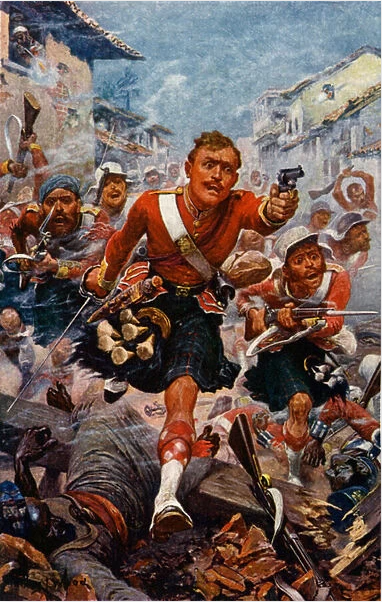
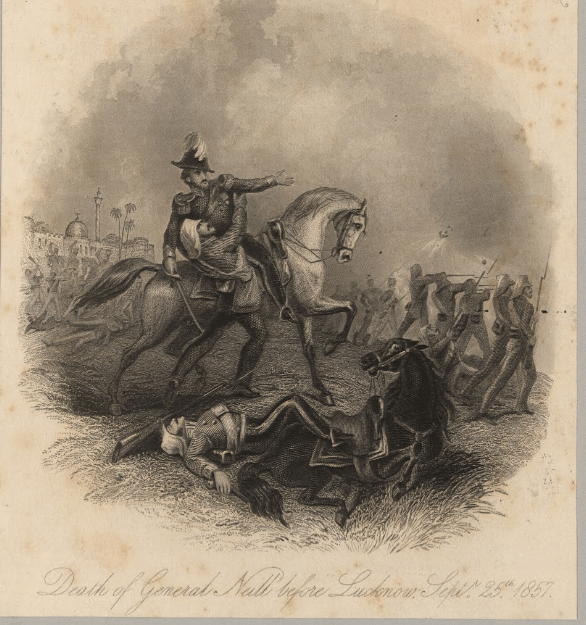
The lane which the men had to traverse led into a courtyard, surrounded on all sides by flat-roofed houses with an archway in the centre of the further end. As they entered the courtyard, they were greeted by such heavy musketry fire, that a number of the men were mowed down – return fire was useless as the rebels were well protected by a parapet that ran along the complete front of the houses. The houses themselves had doors on the opposite side, making them impossible to enter. General Neill, from the back of his horse, continued to coolly give orders, to prevent the men from rushing the archway. One of the guns, which he was waiting for was long in making its appearance and Neill sent an officer back to find out the reason for the delay. As he turned his head to watch for it, a mutineer took aim from a loophole in the archway and fired. The bullet struck Neill on the head, just a little behind and above the left ear. He fell wordlessly from his horse which took fright and galloped off, riderless, towards the lane.
“On going through the archway Olpherts posted his gun, and the Highlanders and Sikhs led by Outram and Havelock pushed on towards the Residency. The guns of the enemy at the Kaiser Bagh smote them from the rear. Olpherts boldly answered, but his guns could not keep down the fire.”
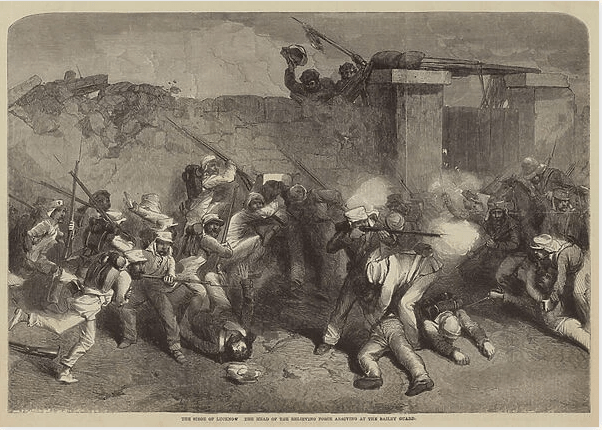
The force advanced on the Khas Bazaar under a deadly fire, but the Highlanders rushed forward, and in their enthusiasm, ran beyond the turning that led to the Residency. Outram quickly ordered the leading companies to halt and fall back. Then, riding up to the front of the centre companies, he led them, the rear companies and Brayser’s Sikhs pushed forward, “slaying and being slain as they went,” right up to the Bailey Guard Gate. From within the Residency, Lieutenant Aitken of the 13th BNI and his men heard the shouts of the advancing force and “sallied forth to meet them.” In the maddening rush of battle, some of the soldiers mistook Aitken’s sepoys for rebels and three were bayonetted before he could stop them. One, as he lay on the ground, a bayonet in his gut, looked up at the soldier, saying in his last breath, “It is all for the cause…” Aitken dashed between the men, holding up his hands, imploring the Highlanders to stop preventing any more useless slaughter of his brave sepoys.
The remainder of the column with the guns, who had been prevented from advancing due to the deep trenches that cut across the street, was being led by Lieutenant Moorsom. He was a man of some talent and better memory, having in 1856 drawn a map of much of the area surrounding the Residency, including the palaces the force had traversed – it was from this survey that all the plans had been drawn up. Moorsom had joined Havelock in Calcutta when he was forming up his staff – and the lieutenant would prove to be a valuable asset for his knowledge of the city. As such Moorsom chose a route parallel to Outram’s thus avoiding much of the fire, taking the men past the lower garden and the palaces until they reached the rebel battery at the Clock Tower. The rebels, realising they were about to be taken from the reverse, quickly turned their guns around.
“At that moment, from the right-hand corner, I saw the unmistakeable light of a port fire and the semicircle it described as it was lowered to the vent of a gun; so I was not surprised when a shower of case shot came whistling in our faces, and I tried my best to get a dozen men to charge the gun before they could reload it. But the man who fired it, and I believe he was alone, disappeared in the darkness.”
The battery silenced, and they advanced past the now abandoned Clock Tower straight up to the Bailey Guard Gate. Under its shelter, the men threw themselves on the ground, exhausted, and waited while a portion of the barricade was removed to allow their entrance.
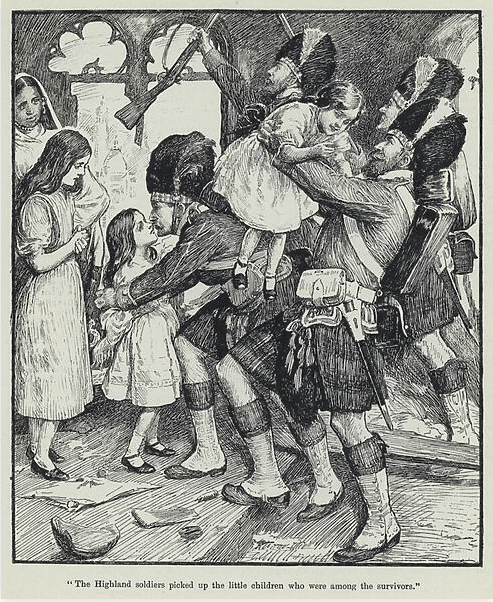
The weary besieged ran down to the Bailey Guard Gateway to greet their saviours. As Havelock and Outram came through a side entrance into the Residency, cheers rang out, the Highlanders rushed up the road towards Dr. Fayrer’s House, picking up children in their arms, weeping, they had saved them, the wee ‘uns were safe in the burly arms of the wild men of the north.
Outside the Residency, however, matters were far from resolved. Men were still struggling through the streets and now in the darkness, many had become lost in the tangle of roads – the wounded were abandoned as the doolie bearers dropped their loads and ran for cover, the heavy guns and a large number of the ammunition wagons were still at the Moti Manzil Palace with Colonel Campbell and his 100 men of the 90th. Invested by the rebels, Campbell could not move forward and sent a desperate message to the Residency, calling for relief. At the Paeen Bagh, much of the force and some of the guns remained until the morning, likewise unable to move. Along the streets of Lucknow lay one-third of Havelock’s force, dead and wounded, including his own son.
Sources:
Forrest, G. W., ed. Selections from the Letters, Despatches and Other State Papers Preserved in the Military Department of the Government of India, 1857-58. Vol. 2, Lucknow, Cawnpore. Calcutta: Military Department Press, 1902.
Goldsmid, F. J. James Outram: A Biography. 2 vols. London: Smith, Elder, & Co., 1880.
Headley, J. T. The Life of General H. Havelock. New York: Charles Scribner, 1861.
Malleson, G. B., ed. Kaye’s and Malleson’s History of the Indian Mutiny of 1857–8. Vol. 3. London: Longmans, Green, and Co., 1892.
My Journal, or What I Did and Saw Between the 9th June and 25th November, 1857: With an Account of General Havelock’s March from Allahabad to Lucknow. By a Volunteer. Calcutta: Baptist Mission Press, 1858.
North, Charles Napier. Journal of an English Officer in India. London: Hurst and Blackett, 1858.
 Mutiny Reflections