Colour-Sergeant William Gardner – 42nd Highlanders, “The Black Watch”
“For his conspicuous and gallant conduct on the morning of the 5th of May last, in having saved the life of Lieutenant-Colonel Cameron, his Commanding Officer, who during the action at Bareilly on that day, had been knocked from his horse, when three Fanatics rushed upon him. Colour-Sergeant Gardner ran out, and in a moment bayoneted two of them, and was in the act of attacking the third, when he was shot down by another soldier of the Regiment.” — Letter from Captain Macpherson, 42nd Regiment, to Lieutenant-Colonel Cameron, Commanding that Regiment. (The London Gazette, 24 August 1858, No. 22176, page 3903)
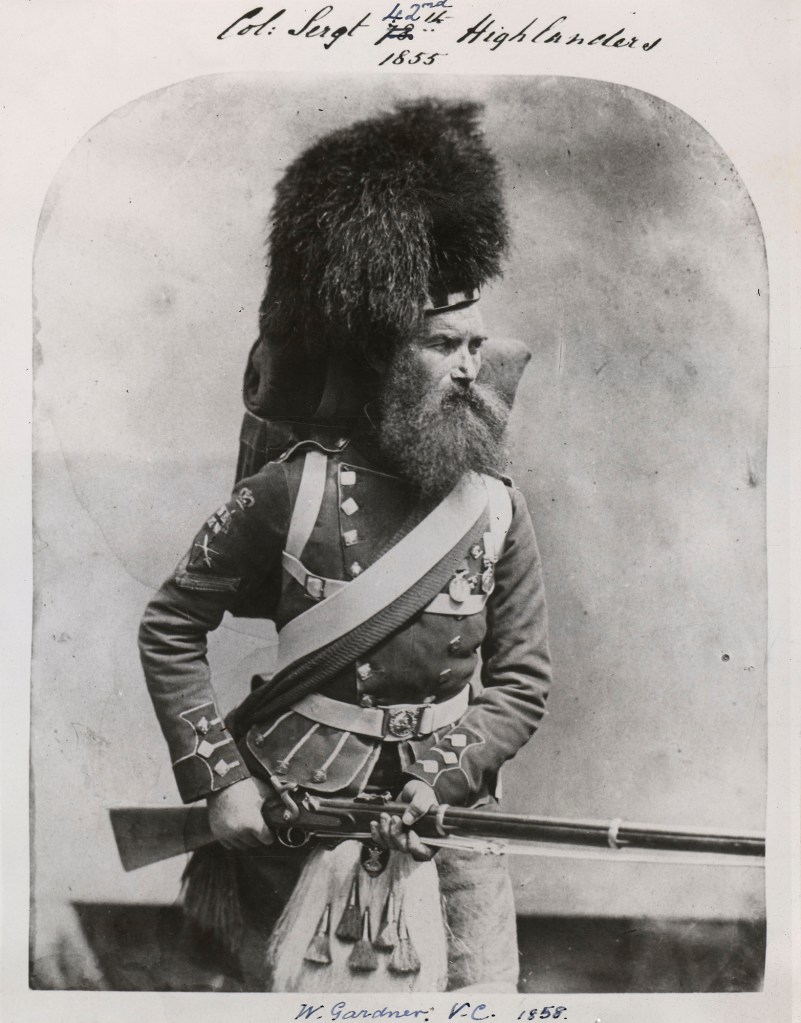
Following the regiment’s return from Crimea, Queen Victoria, who took an active interest in the welfare of her troops, met a number of veterans at Buckingham Palace, Chatham Military Hospital and Aldershot. She commissioned a series of photographs to be taken by Joseph Cudall & Robert Howlett – one of the men they photographed was William Gardner.
Long before William Gardner met Queen Victoria or indeed became the subject of the celebrated photograph, his life had been an ordinary one. Born on 3 March 1821 in Nemphlar, Lanarkshire, Scotland, to Daniel Gardner, a general labourer and his wife Ann. Nemphlar was not a remarkable place but a straggling settlement of stone cottages and small farms, perched high above the River Clyde. The area was famed for its fruit orchards, and while there was living to be made, William apparently felt his life as a gardener was indeed a limited one. On 9 February 1841, he joined the 42nd Highlanders. Army life seemed to agree with him – he made corporal on 1 March 1842 and swiftly rose to sergeant on 15 May. While the regiment would serve i abroad between 1847 and 1851, in 1854 the 42nd would find themselves in Crimea. For the next two years, they would freeze, starve, fight and die in that dreadful war; and while there was glory to be had, it did come at a horrible price.
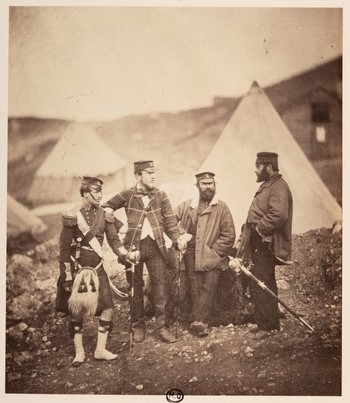
A man who would have seen the terrible conditions Crimea presented to the ordinary soldiers was Lieutenant-Colonel Alexander Cameron. Although he would not have known his father, who died while Alexander was still an infant, he likely grew up with the stories of John Cameron (of Achnasaul), who had served as a lieutenant-colonel during the American War of Independence and had once held the position of Governor of Fort William, where on 12 February 1816, he died. His sister Jessie would set sail for New Zealand aboard the Blenheim in 1840 with her husband Moses Campbell and five children, and his brother Ewan, once a captain in the 79th Highlanders, joined her there a year later. As it was, Alexander Cameron appears to have had no ambitions of settling in a far-off land; he seems to have found his place in the army. With his regiment, he would fight through the Crimea and in 1857, he would land in India. Cameron was well-liked by his men, although a mild eccentricity seems to have prevailed when he insisted his men keep to their tartans, for morale; they chaffed him a little behind his back, but no one had anything terrible to say about Lieutenant-Colonel Cameron. It was rather lucky for him, as on 5 May 1858, during the Battle of Bareilly, it would take a very determined man to save his life. That man was Colour-Sergeant William Gardner.
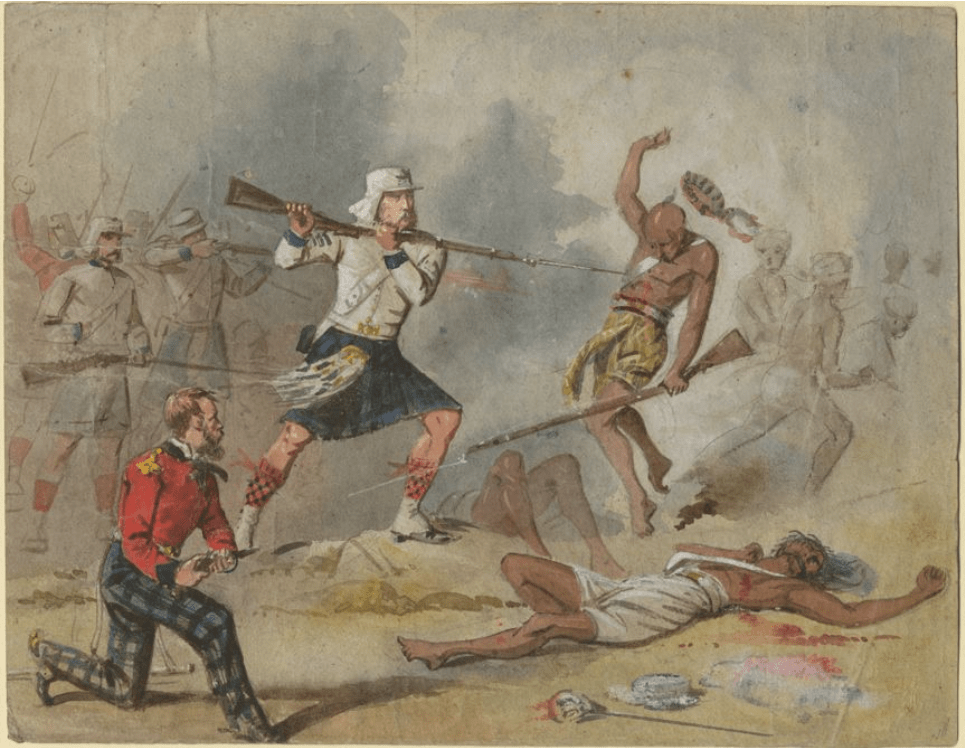
“The Sikhs and our light company advanced in skirmishing order, when some seven to eight hundred matchlock-men opened fire on them, and all at once a most furious charge was made by a body of about three hundred and sixty Rohilla Ghazis, who rushed out, shouting
”Bismillah! Allah! Allah! Deen! Deen!”
Sir Colin was close by and called out, “Ghazis, Ghazis! Close up the ranks! Bayonet them as they come on.”
However, they inclined to our left, and only a few came on to the Ninety-Third, and these were mostly bayoneted by the light company, which was extended in front of the line. The main body rushed on the centre of the Forty-Second, but as soon as he saw them change their direction, Sir Colin galloped on, shouting out,
“Close up, Forty-Second! Bayonet them as they come on !”
But that was not so easily done; the Ghazis charged in blind fury, with their round shields on their left arms, their bodies bent low, waving their tulwars over their heads, throwing themselves under the bayonets, and cutting at the men’s legs.
Colonel Cameron, of the Forty-Second, was pulled from his horse by a Ghazi, who leaped up and seized him by the collar while he was engaged with another on the opposite side; but his life was saved by Colour-Sergeant Gardener, who seized one of the enemy’s tulwars, and rushing to the colonel’s assistance, cut off the Ghazi’s head...” (Forbes-Mitchell)
It certainly is more hair-raising than Gardner’s VC citation, for the story only improves with the telling:
“There were about 150 of them screaming, “Bismillah, Allah, Deen, Deen”. They had swords called tulwars and kept their heads low behind shields as they chased Sikh skirmishers who had broken the ranks of the 42nd as they ran back through the Regiment. Sir Colin Campbell ordered ranks to be closed and bayonets used as the Ghazis came. Three dashed at Col. Alexander Cameron and pulled him off his horse. He would have been hacked to death had Sgt Gardner not killed two of them and Private Gavin the third.” At the time, Cameron was only armed with a pistol, and he had even tried to fight with his bare hands.
Admirably, Cameron remained calm and most collected, although a Ghazi had quite deliberately tried to separate his head from his shoulders; with a cut on his wrist, he brushed himself off, tied a kerchief around his wound and resumed command as if nothing had happened. Gardner would receive the thanks of Sir Colin Campbell. Unfortunately, Lieutenant-Colonel Cameron would not be there to see Gardner receive his VC; two months later, on 9 August 1858, he died of fever in Bareilly. His sons would grow up without their father, but both would follow in his footsteps. Captain Ewen Hay Cameron would die in 1885 in Quetta; the other would have a longer life and see out his days as Sir Maurice Alexander Cameron, K. C. M. G.
Colour-Sergeant Gardner’s wounded hand soon recovered, and he would see out the rest of the mutiny with his regiment. On 2 December 1859, he was raised to Quartermaster Sergeant, and after 21 years of service with the 42nd, he was discharged on 4 March 1862 at Stirling Castle. His impressive set of medals included, besides the Victoria Cross, the Crimea Medal 1854-56 with clasp Sebastopol; the Turkish Crimea Medal 1854-55the Indian Mutiny Medal 1857-58 with clasp Lucknow; a Long Service and Good Conduct Medal (LS&GC), and Meritorious Service Medal (MSM). Following his discharge, Gardner married, and he served as a drill instructor at Lanarkshire RV, retiring in 1885 with the final rank of Sergeant Major. He died at home on 24 October 1897 and was buried at Bothwell Park Cemetery with full military honours.
In 2008, his great-grandson, Dr David Gardner, sold the VC and the five other medals for a princely sum of £135,000; the money from the sale was donated and distributed amongst different charities. The medals now form part of Lord Ashcroft’s collection.
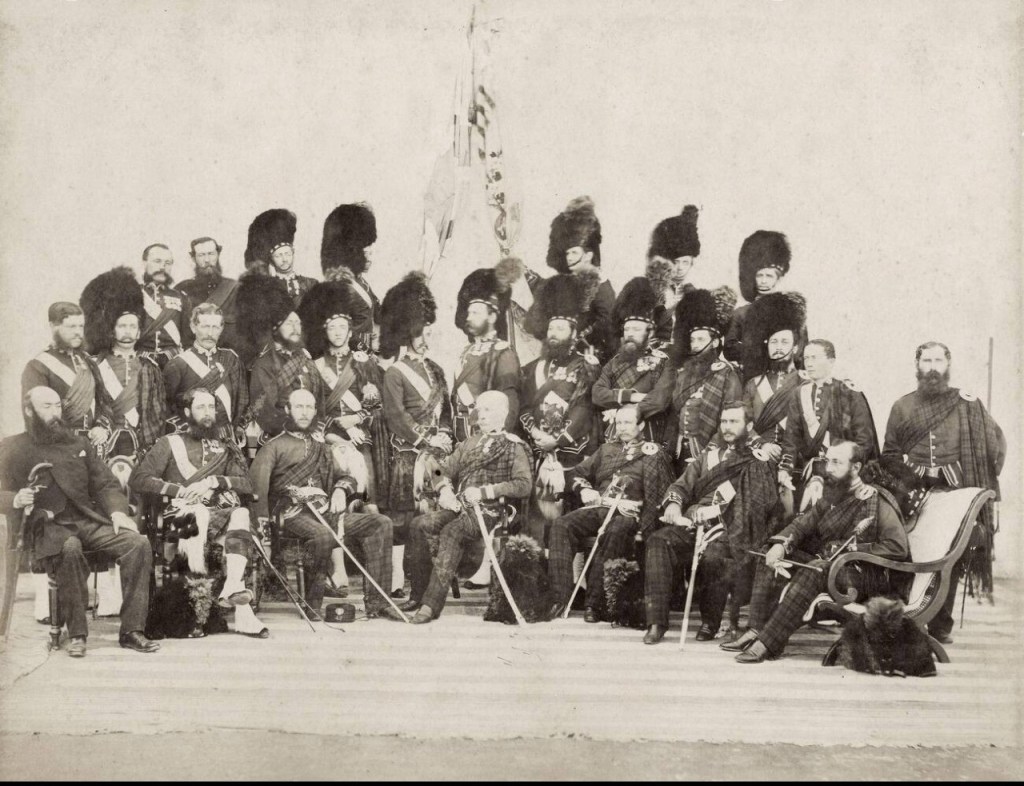
Another man would win a Victoria Cross for Bareilly, but as we shall see, his life would take a very different turn. That man was Private Valentine Bambrick of the 60th Rifles.
Sources:
Forbes, Archibald. The “Black Watch” – the Record of an Historic Regiment. New York: Charles Scribner’s Sons, 1896.
Forbes-Mitchell, William. Reminiscences of the Great Mutiny. London: Macmillan & Co., 1894.
Groves, Percy. History of the 42nd Royal Highlanders: “The Black Watch”. Edinburgh: W. & A. K. Johnston, 1893.
Online Sources:
https://www.victoriacross.org.uk/bbgardnw.htm
https://victoriacrossonline.co.uk/william-gardner-vc-dcm/
https://www.ancestryresearchservice.com/genealogy/getperson.php?personID=I2323&tree=cameron1
https://www.heraldscotland.com/default_content/12455754.sale-150-year-old-vc-helps-raise-pound-135-000-service-charities
https://search.fibis.org/bin/aps_detail.php?id=2724577 (death of Lt. Col. Cameron)
 Mutiny Reflections