Suicide
The Brisbane Courier (12 March 1864), in an article entitled “Flogging in the Army,” would applaud Bambrick as ” the kind of men with whom the army authorities have to deal, and to remind the public, at the same time, how much rough and rude nobility is still to be found in the ranks.” Upon the sentence being passed, the Courier saw this as further proof of Bambrick’s valorous nature:
“…when Bambrick, seizing the girl’s hand in his strong grasp, held it aloft, and cried out, with a wild chivalry that must have appealed to the human sympathy of every one in that court, “Look at this small hand, my lord! What could she have done against a strong man? She was merely in the room.” His last words before he was led away to gaol were these, “There won’t be a bigger robber in England than I shall be when I come out!” It was a reckless and desperate speech, but such a man as this is not to be despaired of. For once, the prison chaplain will, we venture to assert, meet with a nature that can be won to better things. This soldier—one of our proudest “Legion of Honour”—never did anything finer or braver than when, faithful to the last to his unhappy companion, he made that touching appeal on her behalf. The roughest fellows in the ranks have in them some elements of good. Humanity, kindness, and consideration for their failings would soon develop these to their full extent. Such men as Bambrick are not uncommon, but their virtues are stunted, their vices confirmed, by a system which gives them scarcely any opportunities for self-improvement, whilst it punishes their faults and errors by the lash. The cat-o’-nine-tails never yet made a bad soldier into a good one; but it has made many a good one bad.”
The Courier is presuming Bambrick was a soldier beaten by the army, who had erred in his ways due to a violent environment. Unfortunately, no one would fight in Bambrick’s corner. According to the Royal Warrant, his VC and pension were forfeited; if he had hoped for a new life in Australia with his brothers, we shall never know, for on the evening of 1 April 1864, Valentine Bambrick, aged 26, hanged himself in Pentonville Prison by tying his pocket handkerchief to the handle of a ventilator behind the cell door. By the time he was discovered, all life was extinguished. Sadly, both the governors of Winchester Prison (where Bambrick was first held) and Pentonville believed he was innocent. The Pentonville governor had gone so far as to lodge an appeal on Bambrick’s behalf to commute his sentence, but no one had told Valentine, and he killed himself, believing to the end that his life was no longer worth living.
On a slate, found in his room after his death, Valentine Bambrick had written:
“My dear, dear Friends and Family, – Becoming quite tired of my truly miserable existence, I am about to rush into the presence of my Maker uncalled unasked. To you, I appeal for forgiveness and pardon for all the unhappiness I have ever caused you. I dare not ask for mercy of God. I am doing that which admits of no pardon, but if He will hear my prayer. I pray to Him to grant you consolation in your hour of affliction, for I know that, notwithstanding all my faults, that love which you always manifested towards me is not withheld yet, and therefore the news of my unfortunate fate will make time sorrowful. Pray for your unfortunate son.
“VAL BAMBRICK.”
P.S.-Before I die, I protest solemnly my entire innocence of the charge for which I was punished, all but the assault, and that was done under the circumstances before mentioned to you in my letter. God bless you all. Love to all my relations. Pity even while you condemn. Poor Val.
A verdict of “Suicide while labouring under an unsound mind” was returned at the inquest that followed.
According to John Potter, a prisoner who knew Bambrick by his designation, “G21”, stated that he had spoken to him twice before his death. On the first occasion, Bambrick had told him he had been allowed to send a special letter (the one referred to subsequently on the slate), that he expected to be discharged. The second time, Bambrick had protested his innocence to Potter.
The foreman of the jury wanted to know if the letter had indeed been sent; the governor of the prison, Captain Craig, was sent for. He, …informed the jury that on the 26th of February the prisoner applied to him for permission to write a special letter, and as he was a well-behaved man, he granted the application. Prisoners were only allowed to write a letter on their entry, and then one every three months. The deceased was not entitled to write until this month. That special letter was forwarded to his family directly. A petition followed, and there was no doubt that, if a certain woman had been found, the deceased would have obtained his release. The deceased came from Winchester Gaol; the governor there, feeling highly interested in the prisoner, endeavoured to get a commutation of sentence. He considered he was perfectly innocent, as did also he (Captain Craig).
A week before his death, according to the medical officer of the prison, Bambrick was fretful, saying he was being unjustly punished; he was also suffering from delirium tremens.
After Bambrick was unceremoniously buried in an unmarked grave in St. Pancras and Islington Cemetery, an article appeared in the United Service Gazette, calling his trial a “melancholy miscarriage of justice.” Quite correctly, the writer wanted to know if the evidence presented had been verified and whether the very facts had been looked into with any patience or deliberation on the part of the court. As a case of petty theft, Bambrick’s sentence was unduly harsh and unlike the Brisbane Courier that blamed a flogging army for the man that was Valentine Bambrick, the Gazette points out:
“If Bambrick had been a sentenced member of a gentlemanly position, whole counties would have risen on his behalf, and the Secretary of State would have been bullied into the timid remission of a more just sentence. As it is, he was only a poor private soldier known in his regiment better by his number than his name; and when he was wrongfully convicted of theft, he had no friend or protector to seek a remission of his sentence.”
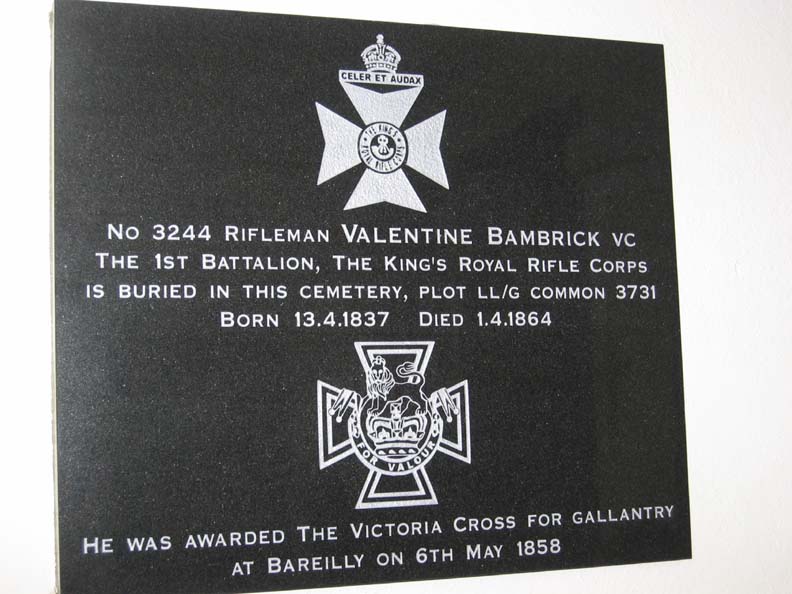
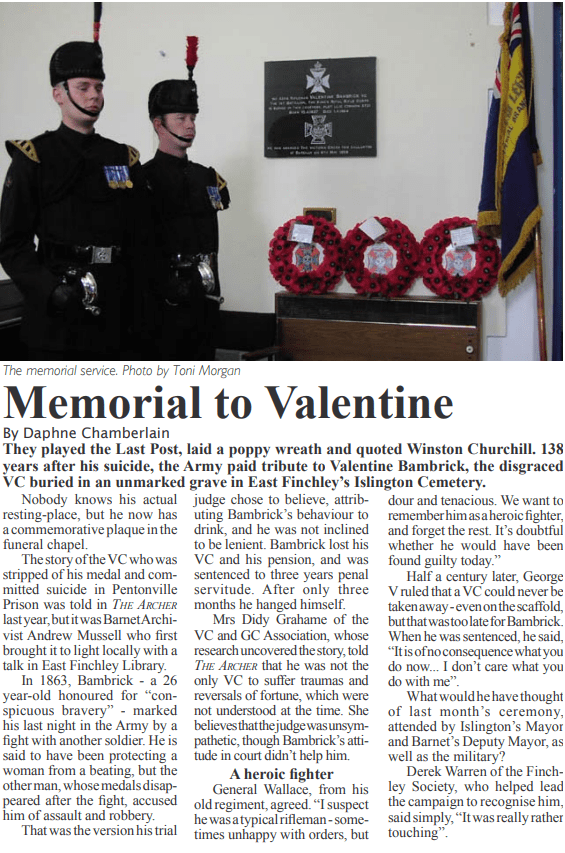
Restitution for Valentine Bambrick and the other seven men whose VCs had been forfeited came from King George V in 1920. In a letter to his private secretary, he wrote, “The King feels so strongly that, no matter the crime committed by anyone on whom the VC has been conferred, the decoration should not be forfeited. Even were a VC to be sentenced to be hanged for murder, he should be allowed to wear the VC on the scaffold.” Eventually, the eight names were added to the Register of Victoria Cross recipients, but it is unclear if Bambrick’s family were presented with his medal. To date, its whereabouts are unknown. In 2002, a plaque was unveiled in the cemetery chapel by the King’s Rifle Corps in honour of Valentine Bambrick.
Sources:
Izzard, Brian. Glory and Dishonour: Victoria Cross Heroes Whose Lives Ended in Tragedy or Disgrace. Stroud: Amberley Publishing, 2018.
Charge of the Light Brigade
https://wiki.secretgeek.net/valentine-bambrick-b1837
https://wiki.secretgeek.net/Category/mad-bastard-bambricks
Melancholy Suicide in Pentonville Prison
https://www.victoriacross.org.uk/bbbambri.htm
https://www.findagrave.com/memorial/6380565/valentine-bambrick
https://vcgca.org/our-people/profile/1143/Valentine-BAMBRICK
VC Citation
Memorial to Valentine – The Archer, 20 October, 2002
 Mutiny Reflections