Private Valentine Bambrick, 60th Rifles
Valentine Bambrick was born on 13 April 1837 in Cawnpore to a family that had found its place in the cavalry. His father was Troop Sergeant Major John Thomas Bambrick of the 11th Light Dragoons, whose career spanned 35 years. He included in his fights not just Waterloo, the capture of Paris, but also Bhurtpore, where there were two Bambricks – John, and his younger brother, Robert. Possibly a much younger brother, named Valentine, was also present.
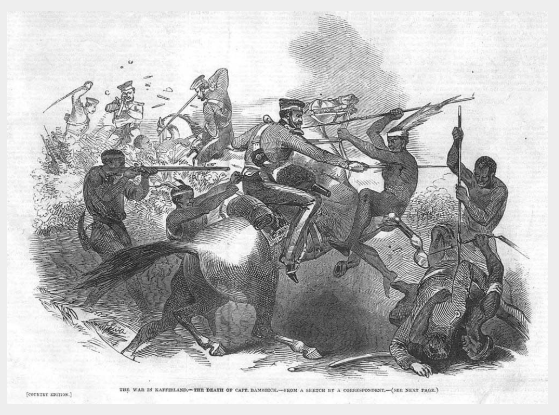
Unfortunately, Robert would be killed in action during the Xhosa Wars on 16 April 1846. Now a captain, Robert was leading a troop of 7th Dragoons when he was ambushed:
The first day’s action at Burn’s Hill was disastrously marked by the death of Captain Bambrick, 7th Dragoon Guards, a fine old Waterloo soldier, who had also served for many years in India, in the 11th Hussars. He unhappily went too far into a dense bush and was shot. One or two circumstances connected with his death are worthy of notice.
Captain Bambrick’s troop formed part of a division under Major Gibsone, 7th Dragoon Guards, who had been left in charge of the baggage. During the day, some Kaffirs came down upon the herds and oxen belonging to the waggons, and in fighting for the cattle, mortally wounded a young boy named McCormick. His brother ran to his assistance, and the dying child, seeing the other herds retreating, raised himself, and shouting, in his death-agony,
“Don’t run! Don’t run! We’ll beat them yet!” sank back exhausted, and spoke no more.
Captain Bambrick was sent in pursuit of the Kaffirs who had killed this poor young settler, and the old dragoon officer, reckless of the foe, seen or unseen, and accustomed to charge wherever that foe might be, dashed into the bush at the head of his troop, went too far, and fell in consequence by the hand of a concealed savage. Shocking to relate, his body was cut in pieces by the enemy, and either burned or hung about the bush...Ere Captain Bambrick fell, he called to his men to retire, having found out, too late, that “that was no place for cavalry.”
He must have received many wounds. His charger galloped past the troop without its rider; its trappings and saddle were covered with blood, while the savages bore off the mangled body of their victim, brandishing his sword on the top of the hill as they retreated. Captain Bambrick was forty-seven years of age and had served his country for more than thirty years...Captain Bambrick received distinct orders from Major Gibsone, “by no means to proceed to any distance.” The old soldier could not, or would not, understand a warfare which demanded such caution, dashed onwards, full of chivalry, utterly wasted on such a foe, and fell, as might be expected. It may be added that, had he not fallen when he did, the whole troop would have become the victims of his noble but ill-timed daring.
John and his wife Harriet had named their sons — the eldest Robert (1827), the second John Thomas (1832) and the youngest Valentine. In 1838, the Dragoons returned home – John was discharged as medically unfit. The family was a sizeable one of six children; next to the three sons, there were three daughters, Harriett (1825), Maria (1829) and Adeline (1834). For their father, the army life had been a good one:
“The churchwardens of Windsor have received a letter from the War-office, stating that troop serjeant-major, John Bambrick, a native of this town, who was discharged from the 11th Hussars, on the 12th of September 1838, after long and faithful services, has been awarded the gratuity which is granted by her Majesty to discharged soldiers who have conducted themselves meritoriously while in the army; and the authorities of the War-office notify that fact to the churchwardens with the object of making it generally known in the parish to which he belongs.”
—Selected Reports from The Windsor and Eton Express, 25th June 1842
Along with his older brother, John, Valentine would be educated at the Royal School. Robert, on the other hand, did not seem to fancy a military life: on 24 July 1848, he married a young lady named Harriet Howard; one year later, they set sail for Australia and arrived in Adelaide on 10 October 1849. He had given his profession as carpenter, doubtlessly a noble trade, but Robert would not only work as a publican but later in life, with his second wife, Jane, he would become a small-holdings farmer, living in a dug out hut along the Bambrick Creek near Orooroo, selling produce to any stage coaches that happened to pass by. Robert and Jane eventually faced bankruptcy; at the age of 70, Robert was still working but as a caretaker of the Tarella Government tank.
Both John and Valentine would follow their father’s footsteps, but unlike the brothers of the past generation, only John enlisted in his father’s old regiment, now titled the 11th Hussars. Valentine would make his own way into the 60th Rifles. Corporal John Thomas Bambrick would be one of the survivors of the Charge of the Light Brigade in Crimea; he would also be present at the battles of Alma, Inkerman, and Sevastopol. In later years, John would move to Australia and retell the events of that mad charge of the Light Brigade to a local newspaper, the Narracoorte Herald. It seems John was a peculiar man, for he features once again in the news:
Cracked Chesnuts
Some years ago one of the Six Hundred named Bambrick occupied the position of ostler at the Narracoorte Hotel. He had just come off a bad tear, and by way of weaning himself, decided to invest in some locally made cider. Narracoorte was never captivating. Bambrick sampled the stuff and was about to ruin the cider-maker’s constitution forever when a happy idea struck him, and he carted off two gallons of the cider. Having deposited it safely in his small but neat room (he had all the good order of a soldier), he went out and invited to his room all the people he didn’t like and placed the cider before them. None of them died, but they got near enough to doing so to fully satisfy Bambrick, and he was hard to please in a little matter of that sort. (Quiz and the Lantern (Adelaide, SA: 1890 – 1900) — Fri 8 Jul 1892 Page 7 )
We have established that Valentine Bambrick came from a good family, educated for the day, and resplendent with men of honour and duty. Perhaps he should have followed their footsteps and never joined the infantry. For as his career will show, life for Valentine Bambrick would be short and very cruel.
 Mutiny Reflections