The Action at Sahejani, September 27 1858
Keeping the Grand Trunk Road had been on an ongoing fight since the beginning of the mutiny. In the early days of the outbreak, portions of it had fallen into the hands of the rebels, and it would be a hard fight to gain it back. Victories by Sir Henry Havelock, not only at Fatehpur but also those around Cawnpore, had established a corridor along the road towards Allahabad; however, the portion of the road running through Bihar continued to be a source of grave annoyance.
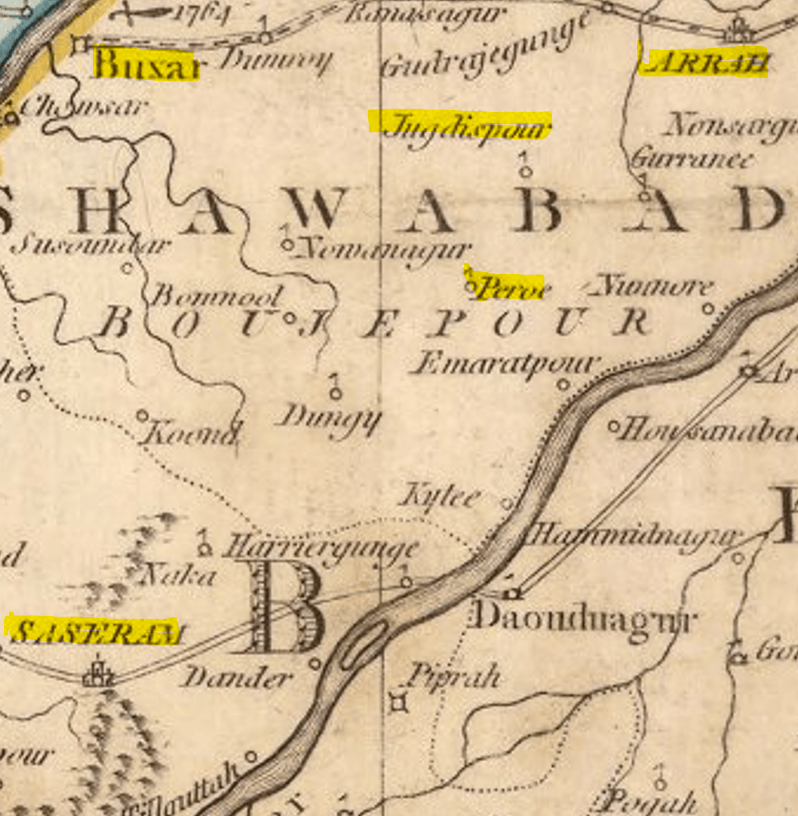
Reinforced not only by the mutineers from across the Ganges but also by discontents in Bihar itself, Singh dug in his heels and launched a bold and determined campaign against the British. Marauding bands scoured the country. Saseram was attacked by a force of 2000 insurgents and pillaged; they then moved to Rohtas and settled in. The extensive jungles around Jagdispur provided the rebels a safe haven, not only for mutineer sepoys but any amount of “bad characters” from the surrounding districts. Although Amar Singh had established a provisional government with a rule of law, the mutineers were not all under his control. To supply themselves, they resorted to “a system of uncompromising severity and barbarity,” operating in small parties to loot and pillage their way through Bihar. Amid this mayhem was Lieutenant-Colonel William West Turner, and he was tasked with holding the Grand Trunk Road. Saseram, despite being practically destroyed, was in British hands, and to facilitate their operations along the Grand Trunk Road, it was established as a military post to keep an eye on the road. From here, Turner could move at a moment’s notice at any intimation of trouble and not only on the road, but in the areas surrounding Saseram, as far as the outer edges of the Jagdispur jungles. Unfortunately, for the local population, caught between the British sword and the insurgent tulwar, this was a war of no pity. Their villages were razed to the ground and their livelihoods destroyed, with little thought from either side. Many labourers left their homes for the precarious lives of indentured workers in the sugar cane fields of Mauritius, accounting for nearly half of the workers who left the Bengal Presidency between 1858 and 1859.
Lieutenant-Colonel Turner had turned Sasaram into this base of operations, and the work was busy, with the constant depredations of the rebels keeping him in the saddle, chasing plunderers, skirmishing with errant bands of rebels and preventing them from using the area as a rallying point. It would not be until September 1858, however, that it was finally decided that something more definitive had to be done. Located just south of Jagdispur, Piro was the ancestral stronghold of Babu Veer Singh and his brother Amar Singh. It was separated from Sasaram (a major station on the Grand Trunk Road) by a 30-mile stretch of dirt roads and dense jungle, and Amar Singh’s rebels were prone to using the cover of those very jungles for raids on British supplies. Chopping pathways through the jungles had only been marginally successful, and nowhere near enough road had been laid to consider this plan useful. For Lieutenant-Colonel Turner there was only one option left, and that was to attack the zamindars.
On 27 September, reliable information reached Turner that the rebels had encamped themselves at Sahejani, a village not far from Piro – considering his own position, which at the time was over halfway between Saseram and Piro itself, Turner turned his attentions to launching an attack. Consulting his maps, Turner found that Kharauna, where he stopped his men for breakfast, happened to be on one of the roads to Piro; he decided the most prudent line of attack would be to take the rebels on the left flank and their rear. While this was an admirable idea, it swiftly turned into a terrible one. The road turned out to be little more than a mud track, interspersed with narrow, rice-field ridges and the mud was so deep neither horse nor man could proceed.
“Parading the cavalry, I called the officers around me and impressed upon them my great anxiety to strike a severe blow upon rebels, who, trusting in their rice-fields, and the generally impracticable state of the country, have hitherto escaped with but slight chastisement; and well and gallantly have these gentlemen, and the men they commanded, answered my appeal.”
The force at his disposal consisted of:
Cavalry
2 officers and 54 sabres, 3rd Sikh Irregular Cavalry;
3 officers and 68 sabres, Bengal Police Sikh Battalion.
Infantry
3 officers and the men of H.M.’s 37th Regiment;
5 officers and 117 Camel Corps;
Natives and Europeans: 3 officers and 164 Bengal Police Battalion;
1 officer and 50 men, Sebundy Levy.
He also had the benefit of two enthusiastic gentlemen volunteers, George C. Blake (attached to the 3rd Sikh Irregular Cavalry) and George Bell Chicken (Bengal Police Battalion).
“At one p.m. therefore, I order the cavalry to march by Koosembey, Etumba (Itumba Ganesh), &c., and get into their rear with all possible despatch, and in case the enemy gave them a favourable chance to charge well-home, and cut up as many as they could. With the view also that there should be no want of European gentlemen to lead them, I placed at the disposal of Lieutenant Broughton, 3rd Seikh Cavalry, the commanding officer, the services of Lieutenant Nolan, Sasseram Sebundy Levy, Mr. Chicken, Master, Indian Naval Brigade, and George Blake, Esquire, who had volunteered, and were anxious to serve with him.”
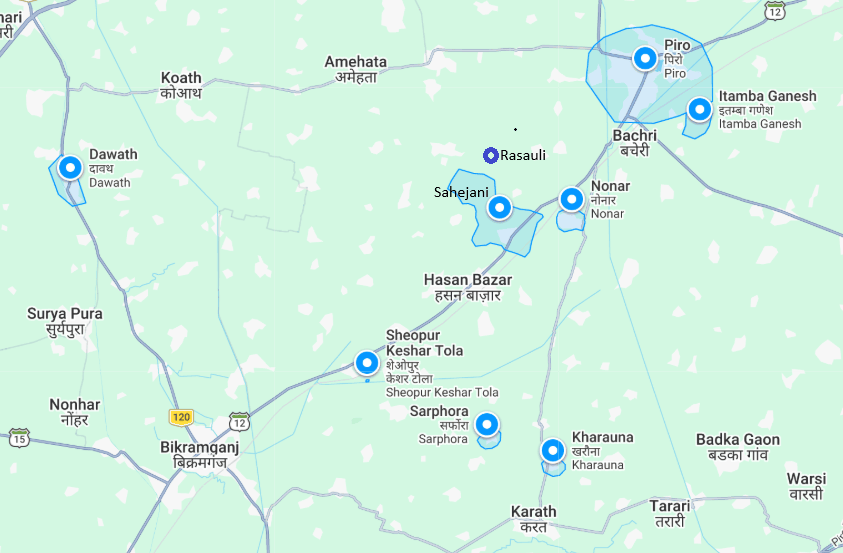
Turner now split his force – as the cavalry wheeled from behind the village, he marched with the infantry via Sarphora and Sheopur, where he knew the road was not only dry but firm and sandy, and proceeded directly on Sahejani. However, when within half a mile of the place, it was clear that the village had been deserted. Turner ordered a halt and bivouacked his troops at the nearby village of Meghwan (today a hamlet within Piro), “in its immediate front” and waited to hear from the cavalry.
As for the cavalry, on nearing Sahejani, they were well ahead of Turner and found the village still occupied by the rebels. They were also well encamped in the neighbouring villages and in “topes of trees and sugar cane khets &c…” and wasted no time in opening a heavy fire on the approaching cavalry. As if to drive the point home, they further opened an “irregular fire” from the adjacent village of Nonar. Lieutenant Broughton, who had been given command of the cavalry, suddenly had a change of heart. “Declining the responsibility” he handed over command to Lieutenant Charles George Baker of the Military Police. Baker, non-plussed by this change in his fortunes, ordered Broughton, with the 3rd Sikhs, to take up a position just north-west of Sahejani, well clear of the rebels fire, “which was no very hot” while he halted his troops to send a note to Lieutenant-Colonel Turner. Considering the position they found themselves in, it is little surprise that Broughton did not feel this venture was anything more than a death trap. With a concentrated fire over their heads, the ground before them was unsuitable for cavalry. It was nothing but a “succession of muddy rice khets, intersected by water-courses.”
The rebels, realising that the British were not moving, and seeing neither infantry nor guns coming up in support, acted on the offensive. They threw out skirmishers and emerged from their cover, drawn up in line, with their right on Sahejani and their left on the village of Rasauli. It was an impressive sight for they number no less than 900 infantry and some 50 cavalry. They advanced and Baker “retired slowly” without firing a shot. The rebels followed for some 100 yards until both forces were clear of not only the village but the jungles and then Baker, without warning, made his move.
“…suddenly wheeling about my divisions into line with a hearty cheer, we charged into and through the centre of the enemy’s line, Lieutenant Broughton with his detachment immediately following up the movement, with excellent effect from his position upon the enemy’s left. The rebel right wing, of about 300 men, broke at once, but the centre and left, observing the great labour of the horses in crossing the heavy ground, stood, and, receiving the charge with repeated volleys, were cut down or broke only a few yards ahead of the cavalry. “
Amid the charging cavalry was a most enthusiastic gentleman volunteer, one George Bell Chicken, who was somewhat carried away by his own zeal. Plunging with his horse through a water course, he then charged into the jungle and singlehandedly attacked a body of 20 sepoys, who were preparing to fire. What Chicken did not realise at the moment, was he had left everyone else behind. Here, in the jungle, surrounded on all sides by equally determined sepoys, Chicken managed to cut down five of his attackers before he was knocked off his horse. Now on foot and wounded, he found himself in a very bad situation, fending off blows from musket butts and slices from tulwars. There would have been very little left of Mr Chicken had Lance Duffadar Kala Khan, Duffadar Akbar Khan, and Trooper Shahbaz Khan with Trooper Dal Singh, (3rd Sikh Irregular Cavalry) not dashed into the crowd to his veritable rescue. Killing several of the attackers, the men extricated Chicken, but not before each of them and their horses had been wounded.
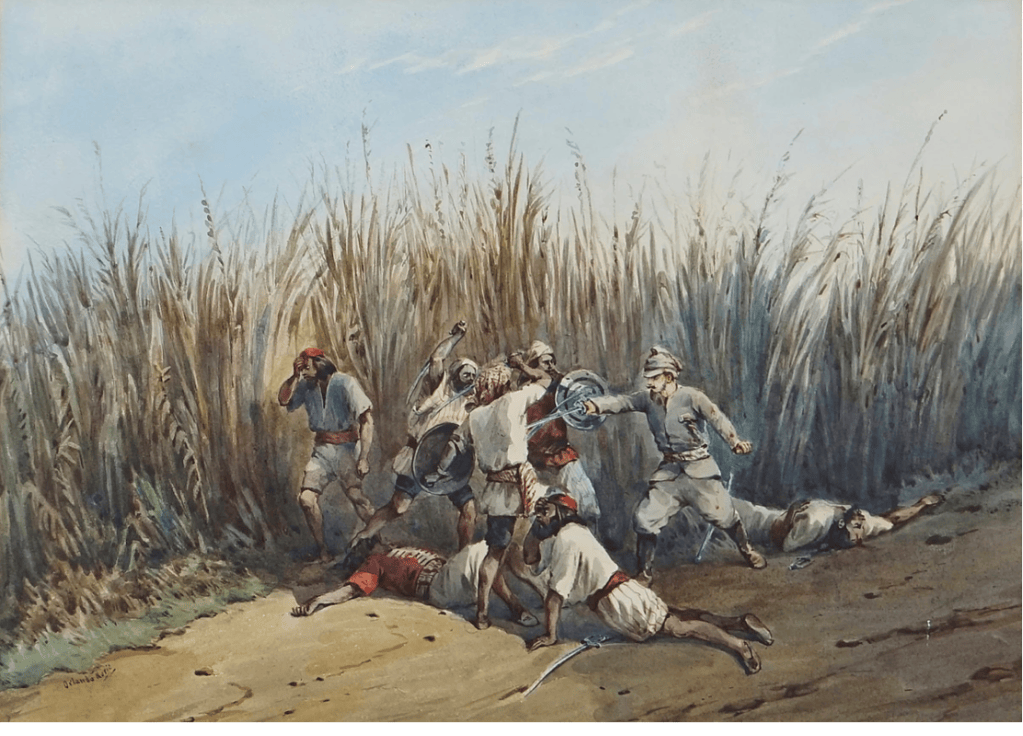
“From this moment the pursuit was limited to the strongest and best horses of the force, numbering some 60 of all ranks, who, dashing into and swimming a deep and wide nullah, followed the flying enemy through the village of Russowlee and its sugarcane khets, over two miles of swamp, and five hundred yards into the thick jungles near Peroo, when, both men and horses being completely exhausted, I sounded the halt and assembly, and, collecting my wounded returned to Camp at Munjhaen about 6 P.M.”
As the camp at Munjhaen was effectively in the fields surrounding Piro, it no longer exists today. Before returning to camp, Baker ordered most of the arms and accoutrements captured from the rebels to be broken up and tossed into wells, as he lacked transport for it and with so many wounded, some of his men were obliged to dismount their horses and give them over to their injured colleagues. So ended the action on 27 September – the rebels were once again routed but not defeated, while the British had delivered yet another indecisive blow. It was not a victory per se, but for a moment, it succeeded in clearing the general area around Sahejani and Piro. It was, however, a costly battle for the British.
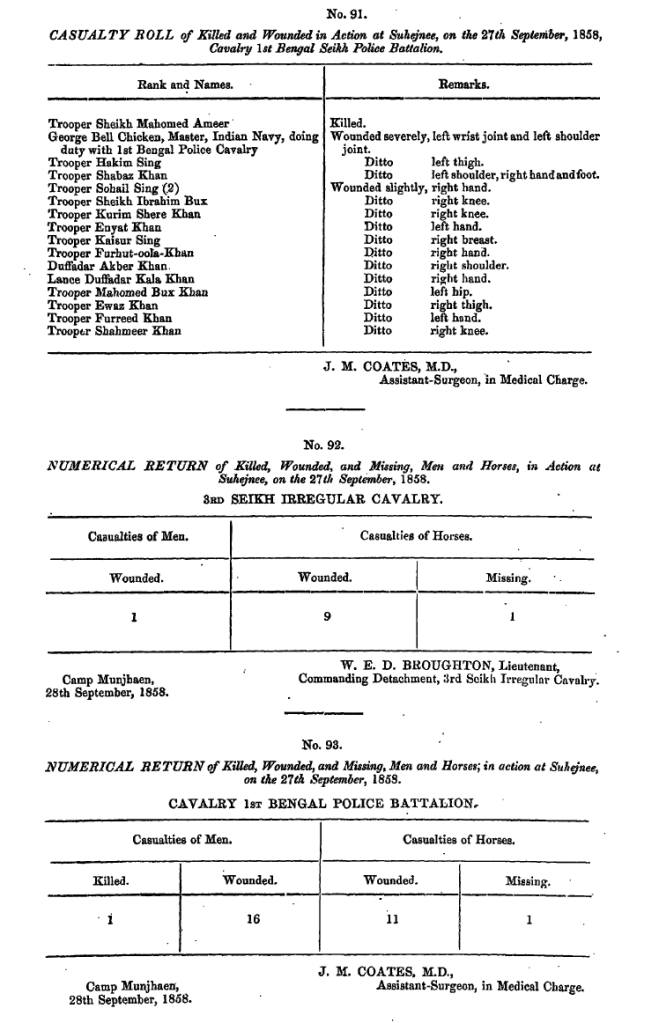
Writing from his camp at Dawath, Captain Rattray had nothing but praise for Lieutenant Baker and the men under his command.
“I beg permission to bring especially to the notice of the commanding officer, the gallant and excellent conduct displayed by Lieutenant Baker on this occasion, the command having devolved upon him. All the officers concerned are of opinion, that but for him, the charge would not have been effected, which ended in such a happy result. I have before had occasion to speak of Lieutenant Baker’s gallantry, and consider him well worthy of honourable mention.
It is also my pleasing duty to bring forward the name of George Bell Chicken, Master, Indian Navy. This officer volunteered for service with my corps when it started from Dehree, with a determination as he expressed it, to win his medal, and nobly has he earned it; he, as Lieutenant Baker writes, charged into the middle of a considerable number of the enemy, and he succeeded in killing five before he was cut down himself. I consider this officer as well worthy the consideration of Government.
I beg also permission to draw Lieutenant-Colonel Turner’s attention to the names of Ressaldar Mahomed Wuzeer Khan, 1st Bengal Police Battalion, and Fyzoollah Khan, 3rd Seikh Cavalry. The former native officer has been in action on many occasions during the last fifteen months, and has invariably distinguished himself. The Government have already promoted him to the 2nd Class Order of British India, and I should be much pleased, if Lieutenant-Colonel Turner could feel himself justified in recommending him for the 1st Class Order of British India, or 3rd Class Order of Merit.
It is also my duty to mention the names of Duffadar Akbeer Khan, who has been before mentioned in despatches by myself; Lance Duffadar Kala Khan, Trooper Shabaz Khan (who particularly distinguished himself), and Trooper Dhull Sing, 3rd Seikh Cavalry; but for the gallantry of these men, Mr. Chicken must have been killed. I beg to recommend all these men for 3rd Class Order of Merit, as also Troopers Nuttur-Sing and Hakim Sing, whose names are especially mentioned by Lieutenant Baker. I deem it of great importance that these men should meet with some reward, not only on account of their individual gallantry, but as an incentive to their comrades to come to the front on future occasions.”
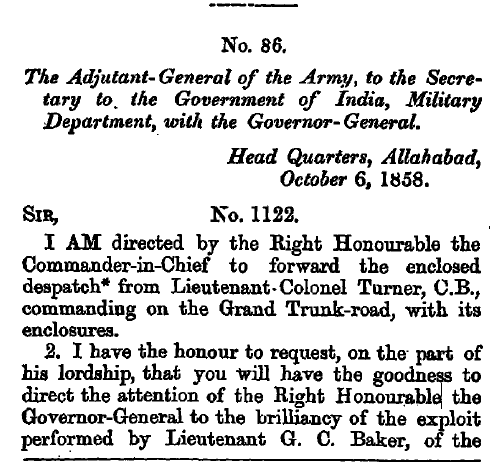
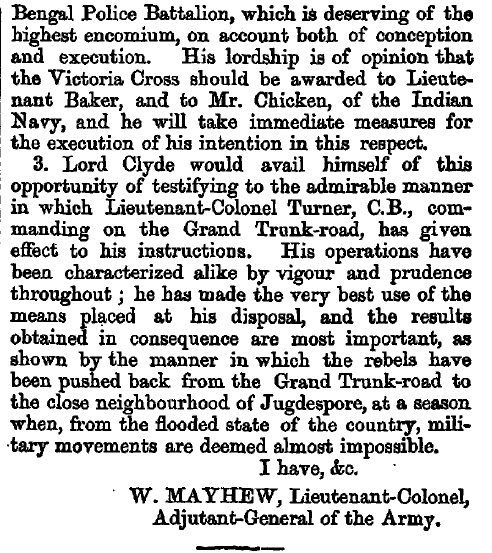
Lieutenant Broughton had requested Lieutenant Baker to mention Risaldar Fyzoolah Khan of the 3rd Sikhs, in his dispatch, which Baker, who was very keen to cite as many names as possible in his report, added the worthy risaldar “for his forward zeal.” It was rewards all around. However, what Rattray could not surmise when he was writing his commendation, was that the action would please Sir Colin Campbell so much, he would recommend not just Lieutenant Baker but Mr Chicken for the Victoria Cross.
The Order of Merit (3rd Class) was awarded for the action at Sahejani to:
Lance Duffadar Kala Khan (Bengal Military Police)
Duffadar Akbar Khan (Bengal Military Police)
Trooper Shabhaz Khan (Bengal Military Police)
Trooper Dal Singh (3rd Sikh Cavalry)
In all, the Bengal Military Police would receive 29 IOMs (Indian Order of Merit) for the mutiny, of which three were 1st Class, and two were 2nd Class. A 1st Class IOM was generally only awarded by promotion through the 3rd and 2nd Class of the order – in other words, it required three acts of outstanding bravery to receive it. Not surprisingly, the award was regarded as the Indian equivalent to the Victoria Cross.
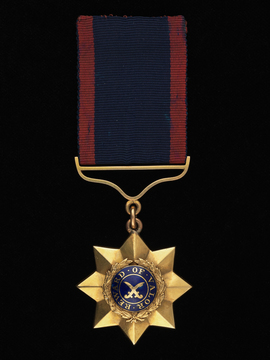
Accession Number: CM.1284-2009
PhThe Fitzwilliam Museum, Cambridge.
Creative Commons Attribution licence
The situation in Bihar, however, remained precarious – by October, Brigadier Douglas, very aware that Sir Colin Campbell was planning to open his winter campaign in Oudh in a matter of weeks, decided, of his own volition, to pre-empt the Commander-in-Chief. On 14 October 1858, Douglas, with four columns at the ready, began what he hoped would be the final operations in Bihar.
Sources:
Supplement to the London Gazette 22224, January 31 1859, p. 378-380
Journal of the Society for Arm Historical Research 77 (1999) 269-274, Cliff Parrett. Hon. Lieutenant Colonel Sheikh Hedayat Ali, Khan Bahadur, Sardar Bahadur, CIE, OBI, IOM
Behan, T. L., ed. Bulletins and Other State Intelligence for the Year 1859. Part I. London: Harrison & Sons, 1860.
Chaudhuri, Sashi Bhusan. Civil Rebellions on the Indian Mutinies (1857-1859). Calcutta: The World Press Private Ltd., 1957
Kaye, John William, and George Bruce Malleson. Kaye’s and Malleson’s History of the Indian Mutiny of 1857–8. Edited by G. B. Malleson. 6 vols. London: W.H. Allen & Co., 1888–1889.
O’Malley, L.S.S. Bengal District Gazetteers, Shahabad. Calcutta: The Bengal Secretariat Book Depot, 1906
Sen, Surendra Nath. Eighteen Fifty-Seven. Delhi: Publications Division, 1957.
Links:
https://data.fitzmuseum.cam.ac.uk/id/image/media-202535
 Mutiny Reflections