July 1858 – Debreheah
This continuous warfare was serving a purpose, although Lord Mark Kerr, attached to the Sarun Field Force with the left wing of the HM’s 13th Regiment, would not see it that way. He favoured a fast campaign, with hard hits and damn the losses; Rowcroft preferred to deliberate, plan and proceed with caution. These differences would eventually lead to some nasty scenes between Rowcroft and Kerr in the coming months. However, where the Sarun Field Force was concerned, Rowcroft would retain overall command until November 1858, when they would be swallowed up by a larger force, headed by Sir James Hope Grant. Until then, Rowcroft had his duty and his orders and he would pursue them both to the best of his abilities.
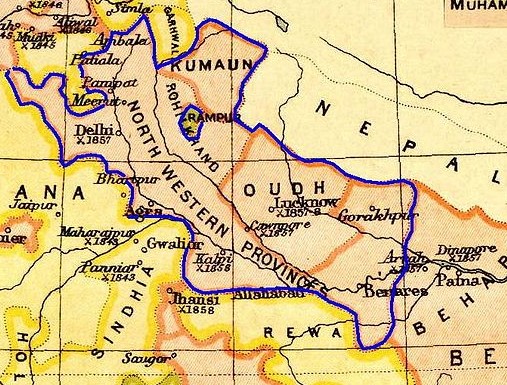
He had to get the most out of the men he had as reinforcements were far and few in between even if that meant allowing the rebels to retreat or allowing them to reoccupy previously held positions. Although his actions were many, his casualties remained small. What Kerr failed to understand, was that without the Sarun Field Force standing in their way, as many as 30,000 sepoys might have been available to meet Sir Colin Campbell at Lucknow in March. Further actions in Oudh, including Kerr’s own march on Azamgarh, were facilitated by Rowcroft’s intervention by ensuring the rebels continued to be busy in Gorakhpur District, unable to re-launch attacks on Oudh. It was harassing, almost painfully monotonous work but Rowcroft understood his duty. He was to keep the rebels in Gorakhpur, even if that meant letting them run free. He carefully held his outposts – Harriah, Amorha, Bansi and Captainganj – with Basti as his headquarters. With enough local intelligence, courtesy of Mr Wingfield and Mr Wilson, Rowcroft remained at least a step ahead of what ever the rebels had planned for him next. He also counted heavily on his outpost commanders to be wide awake to their immediate areas as the action at Debreheah would prove.
At the village of Debreheah the rebels had once again begun to collect and their rallying point now was the local petty chieftain, Bisram Singh. The first Rowcroft heard of it was on 22 July. At once he sent instructions to Captain Francis Thomas Gerrard (27th Madras Native Infantry) commanding the Amorha outpost to “unite the two detachments from Amorha and Harriah and make a night march to Debreheah.” As the village in question was 12 miles from Harriah, the two detachments could reach the place by daybreak and “disperse the rebels.” As cautious as ever, Rowcroft sent as much information as he could to Gerrard – he would be attacking a loop-holed house and enclosure in the village, and as far as he had been told, Bisram Singh was at home.
The detachments to attack the 400 men assembled at Debreheah were minimal in numbers and Rowcroft was putting his trust in Gerrard to bring back a victory.
6th Madras Cavalry (3rd-and 4th troops), 72 men
27th Madras Native Infantry (Gr. and B Cos.), 80 men
Sikh Police Corps, 32 men
Burkundazes, 100-150 men (traditionally, these were local, armed watchmen, but often deputed to act as policemen during the mutiny)
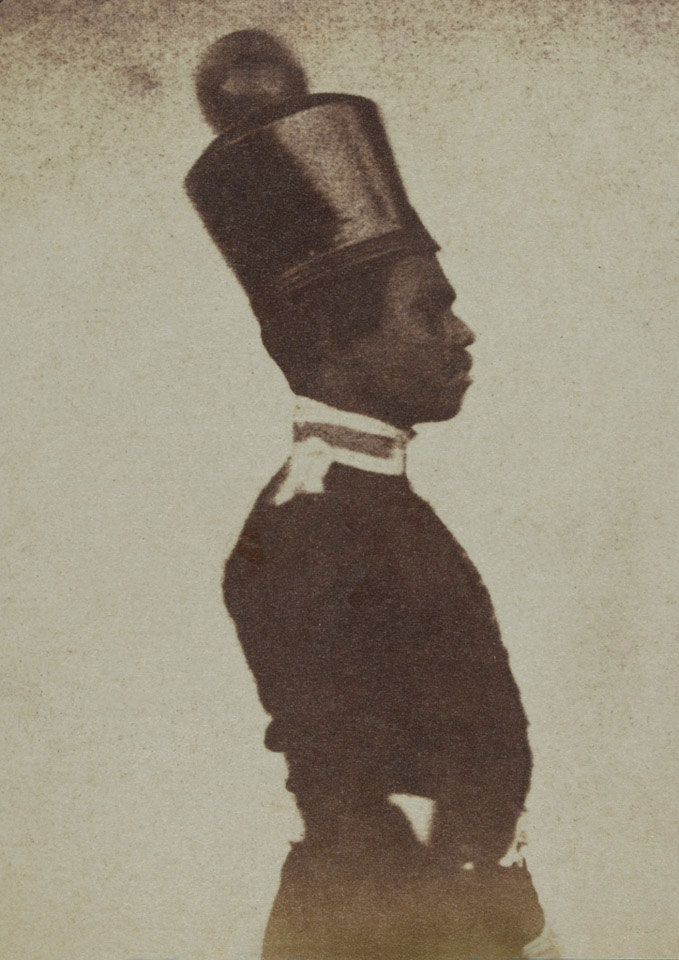
National Army Museum – NAM. 1962-04-3-179 – Out of Copyright
Captain Gerrard arrived at daybreak and without any delay, made his plans. The position he was to attack was “somewhat resembled a serai. ” It was approximately 150 yards long 100 yards broad, and as he would find out, had one large house with a few smaller dwellings inside the compound. The rooms which ran around the enclosure were covered in a “high tiled roof” and just outside the wall, was a trench “so as to give it a slight flanking defence.” He noted that parts of the outer walls were loopholed. Attacking the serai directly was not, however, his interest, for villagers had informed him, when he was still 3 miles away from Debreheah, that 100 insurgents were encamped in a tope of trees a short distance from the enclosure and Gerrard decided he would deal with both positions at once.
“I detached Lieutenant Freese, with the 4th troop of Cavalry to the left, and Subadar Ameenoodeen, with the 3rd troop to the right, with orders to make a circuit, and take up position from which they might be able to cut off the enemy’s retreat when expelled from the tope by the infantry. The infantry were still a mile from the entrenchment, when I heard heavy firing; the enemy had retired from the tope on the approach of Lieutenant Freese s party, and taking up a position just in front of their entrenchment, were firing at and abusing the troopers. That officer placed his men under shelter until I brought up the infantry. I immediately occupied the tope they had vacated; the fire between my skirmishers and the rebels (who now lined their advanced trench) was brisk, but the distance was too great for effect.”
Gerrard now pushed on towards a small collection of huts directly in front of and 200 yards from the main gate of the serai. The firing continued for a few more minutes until the insurgents, without warning, withdrew. Gerrard decided it was time for a “closer attack” and was making his plans when suddenly, the insurgents,
“…unexpectedly appeared in the open, retreating in a compact and orderly body across a morass towards a small village. They numbered about 120 or 130, and whilst I pursued with the infantry, Lieutenant Freese charged down with his troop, and succeeded in cutting up 5 or 6 before they could enter the houses. Out of these they were driven by the infantry, and were then charged a second time by Lieutenant Freese. Those who escaped succeeded in reaching a second village, from which the infantry a second time expelled them. For a third time the same scene was acted, and the affair might be called over; upwards of 40 killed, and 9 prisoners were the result. One zumbooruk, two or three muskets, with many matchlocks and swords have been taken, and the entrenched buildings burnt and partially levelled.”
One of the prisoners, upon questioning, informed Gerrard that Bisram Singh was in fact not at home. He had gone out the night before with some of his men on a “plundering expedition” and had not as yet returned. When he did come back, he would have been in for something of a shock, for Gerrard ensured that when he left, there were nothing but bare, blackened walls remaining of his once comfortable serai. Allowing his men to rest, Gerrard penned his report to Rowcroft with glowing praises for his men:
“I cannot speak too highly of the behaviour of both cavalry and infantry; (the Burkundazes were not employed further than a baggage guard.) Lieutenant Freese always led his men with the greatest gallantry, and on one occasion, I saw him, supported only by one man (trooper Mahomed Ali,) charge a body ten times his number, cutting down two of them with his own hand. This officer, who I regret to say, is severely wounded, speaks very highly of the conduct of trumpeter John Dore, in leading a charge down the steep bank of a difficult nullah into the very ranks of the enemy, who were about to make a stand, imagining no cavalry could reach them. The farrier Betreen with troopers Mahomed Akbar and Mahomed Ali were foremost in this, as in every encounter. Lieutenant Shaw, attached to the infantry part of the force, rendered me every assistance, and I have already mentioned the gallantry of all ranks under him, most of them just off an 18-mile march.”
List of Casualties in an affair with rebels at Debreheah.
1 horse killed.
Lieutenant Freese, 6th Madras Cavalry, sword cut on knee-cap, severely wounded
1 farrier, 1 trooper, slightly.
4 horses.
For his part, Brigadier Rowcroft was not oblivious to Gerrard’s sterling work and the way in which his men had conducted themselves. In his own dispatch he added:
“I have thanked Captain Garrard, and the officers and men, in field force orders, and I beg to recommend all engaged to the favorable notice of his Excellency Sir Colin Campbell.
I beg to solicit of the Commander-in-Chief, that some mark of favor and reward may be shown the two troopers Mahomed Ali and Mahomed Akbar, and also to trumpeter John Dore, and farrier Betreen, of the 6th Madras Light Cavalry, to such extent as his Excellency may deem proper.”
According to the The Hobart Town Daily Mercury for Thursday, 18 November 1858, (https://trove.nla.gov.au/newspaper/article/3251621/835099)
where the Gerrard’s dispatch and Rowcroft’s recommendation appeared in full, Sir Colin Campbell “contented himself with forwarding the despatches for the information of the Right Hon. Governor-General, and the Right Hon. Governor-General was “pleased” to direct their publication.” And so ended the affair at Debreheah.
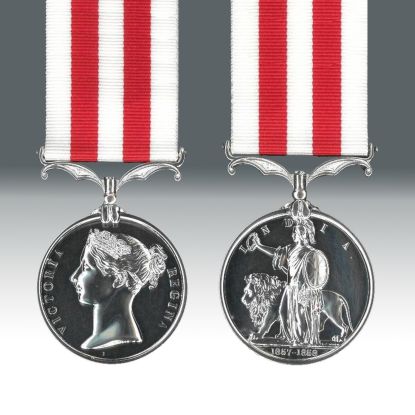
For the Sarun Field Force, there would be no medals. The men who survived the Trans-Gogra Campaign, as it was called, received the Indian Mutiny Medal with no clasp. Before it was over, they would have fought over 20 separate actions in one year (some sources say as many as 28) and a further two under Sir James Hope Grant until they were dissolved in February 1859. Although mentions in despatches were numerous, not a single man serving with the Sarun Field Force received a Victoria Cross.
Sources:
Behan, T. L. Bulletins and Other State Intelligence for the Year 1858. 4 parts/vols. London: Harrison & Sons, London Gazette Office, 1860.
Behan, T. L., ed. Bulletins and Other State Intelligence. Parts 1 & 2 [1857–1858]. London: Harrison and Sons, 1858–1859.
Malleson, G. B. History of the Indian Mutiny, 1857-1858, Commencing from the Close of the Second Volume of Sir John Kaye’s History of the Sepoy War. Vol. 2. London: W.H. Allen, 1879.
Malleson, G. B., ed. Kaye’s & Malleson’s History of the Indian Mutiny of 1857-8. Vol. 4. London: W.H. Allen, 1889.
Nash, John Tulloch. Volunteering in India: An Authentic Narrative of the Military Services of the Bengal Yeomanry Cavalry During the Indian Mutiny and Sepoy War. London: George Philip & Son, 1893.
Nevill, H.R. Gorakhpur: A Gazetteer, being Volume XXXI of the District Gazetteer of the United Provinces of Agra and Oudh. Allahabad: Government Press, 1909
Williams, E. A. The Cruise of the Pearl Round the World, with an Account of the Operations of the Naval Brigade in India. London: Richard Bentley, 1859.
To follow the Sarun Field Force and the Trans-Gogra Campaign, FIBIS has complied a modern day map which can be found at this link:
https://www.google.com/maps/d/viewer?f=q&source=s_q&hl=en&geocode&ie=UTF8&hq&hnear&t=p&msa=0&z=8&mid=15gZy_L1UvFXW6LR4B7wguNF3y9U&ll=26.423502737961396%2C83.0807882357232
 Mutiny Reflections