Sindh Tranquil?
“Of course, in the most contented Mohamedan population, a fanatical outbreak is never impossible, but I see no reason to apprehend one here. . . . Moreover, the Mohamedans here, both Beloochees and Sindees, are a manly race, far superior to the town population in the Deccan and Guzerat. . . . Information was given me that Sher Mohamed, the ex-Ameer of Meerpoor (Sir C. Napier’s ‘Lion’), and another old chief had been sounded as to what they would do if the Mutiny extended to Bombay. They replied that no Belooch had any objection to a good stand-up fight, but the deeds of the mutineers were worse than those of traitors. To murder women and children was the act of the sinners of Sodom and Gomorrah.” (Frere to Elphinstone, July 1857)
Bartle Frere was completely confident that the province of Sindh would not mutiny. The people, as far as he could tell, were content, and most of the tumult following the annexation had been smoothed over by a new prosperity in the province. Although it was more difficult to gauge the feelings of the townspeople, Frere kept his eyes open and, above all, his ears, listening keenly to reports from his local informants. If there was anything to be grateful to Napier for, it was his admirably organised police force, whom Frere now used to his advantage, finding them beyond reproach and perfectly capable of taking care of any criminal activity on their own. At his suggestion, two further regiments – called Baluchi – were raised, composed almost entirely of Sindhis and not exclusively of Baluchis. They were trained to act as an auxiliary, semi-military force of Police, and when recruitment opened, it proved so popular that men applied in droves. Swamped by eager applicants, Hutt and the other officers soon found themselves having to turn men away. They could have recruited for four regiments if Frere had wanted.
Elphinstone was certainly as confident as Frere that Sindh would pose no problems, and with this in mind, he requested Frere to send a wing of the 2nd Europeans to Bombay for service in the Deccan. He must have known that this would deplete Frere’s European bayonets to a paltry 139 men, but as it was, Frere was willing to take the risk. Writing to John Lawrence, Frere said,
“I had rather have sent it (the wing of the 2nd Europeans) to you for many reasons, of which I will only mention the selfish one that they would have passed through the province, and before they were all out, we might have hoped for the news, at least, of overland reinforcements. However, I cannot say they cannot be spared, though a weak wing of a sickly regiment is a small force of Europeans for this whole province; but we are quiet, and I hope may continue so; and when every part of the Empire is so pressed, we must take our share of the risks, and if any danger arises, meet it as best we may.”
Frere sent two companies of the 2nd Europeans, 200 men in all, to support Elphinstone, who would send them onwards by sea and land them near Goa. They then marched over the ghats to Poona, where they reinforced General Le Grand Jacob, who would in the coming weeks be tasked with bringing a final end to the mutiny in Kolhapur.
The Karachi Alarmists
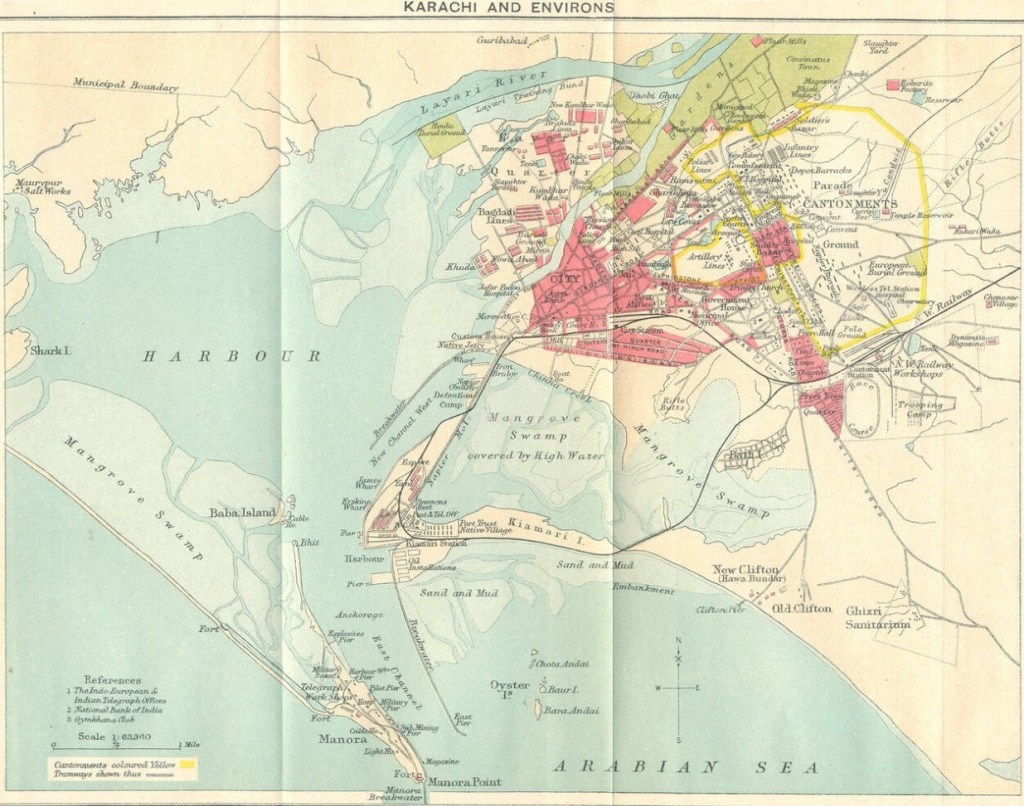
Until now, Frere had not paid much heed to the two regiments of Bombay troops stationed in Sindh, even though he was mindful of the fact that the 21st Regiment had mostly recruited from Oudh. It was therefore not surprising when a petition landed on his table, signed by a clergymen and 19 other nervous Europeans who believed they would shortly be murdered in their beds by the native troops and requesting permission to form themselves up as a voluntary corps. Frere assured the men that until now, there had been no signs of dissatisfaction in Sindh, and he himself had no guard at all except a regular sepoy sentry at his house and the formation of such a corps would only “embarrass the military and promote panic without affording much real security.” The petitions kept coming, and finally Frere needed to explain himself to Lord Elphinstone, first in August and again in September.
“Here all is very quiet, though there is a vague alarm about the Mohurrum; and it is dangerous to go near the houses of Parsees and English clerks, I hear, after dark, for the inmates are armed to the teeth, and apt to explode like a box of rockets. The Bohras have made arrangements to flee to the houses of European sergeants in camp in case of alarm. It does not look like intended rebellion on their part. The common people about the bazaar, if anything, are more than usually civil and good-humoured. (August, 1857)
The station stretches in an irregular area of four or five miles, along the whole extent of which the dwellings of European inhabitants are scattered, seldom at any great distance from the bazaars. Very early in the present crisis, I found that many of the places, such as the jail, the police lines, etc., which I should have considered most secure, were regarded with indefinite terror by the alarmists. It was out of the question to provide European guards to separate places of refuge for persons at a distance from the small force of Europeans in the barracks, and no single spot would answer the requirements of all parts of the station. No one could say from what quarter they apprehended disturbance, and it seemed to me that the general safety, in case of any disturbance, required that the small European force should give as few detachments and guards as possible, and should be kept compact and free to move rapidly in any direction, and prepared to sweep the wide straight roads of the camp, where unarmed persons rushing to distant places of refuge would only impede the action of troops, and perhaps meet their own destruction.
So, as regards volunteer guards, almost every man here has business to attend to during the day, and a family to take care of at night. To arm, drill, and employ such men in guarding the camp would, as a general rule, only take them from their regular work, promote panic, and hamper the military with ill-disciplined allies, who, in the event of their services being really required at any particular point, would find themselves drawn by even stronger calls to stay at home and defend a helpless household.
In reply, therefore, to numerous applications on this subject, I have generally advised applicants to keep in their own houses, and calm, by reason, religion, and example, the fears of their own families, to provide such arms as they could use, and in case of disturbance to defend their houses till the aid which could not be long in coming should arrive.” (September 1857)
One of the main causes of alarm, besides vague bazaar rumours, was the local English and Indian press. The English editors were publishing, with some abandon, false stories and unverifiable statements with such glee that Frere told them if they continued in this dangerous mischief-making, he would be obliged to shut them down. The editors had managed to terrify not just the public but each other, and finally they came to Frere, begging him to provide for their safety. Frere replied he had a bungalow on Kimari, which at the time was an isolated, low-lying mangrove island, separated from the Karachi mainland by tidal swamps and a creek, where he was sure they would be perfectly safe.
He had thus dealt with the English press, but with the native press, Frere decided a cautious approach was better. Although their stories of panic and alarm were no less fantastical than those of the English press, Frere felt they were more capable of causing real harm. He set Mr Gibbs, his Assistant Commissioner, the task of unravelling fact from fiction – and Gibbs wisely decided to take in confidence a native Karachi merchant, Seth Naomul, who was trusted by the Bombay Government and had proved himself a useful information gatherer in the past, with extensive connections throughout the western frontier. He was also this administration’s ear on the ground in Karachi itself.
Naomul reported that the press was receiving its news from a Hindustani paper in Madras, extracts of which were translated by Major Goldsmith and sent on to Bombay. The articles Naomul chose had been carefully worded texts, insinuating that animal bones were being mixed in the flour that was being distributed to the sepoys, and that it was the government itself that had approved of the scheme. More worrying, however, was an article reporting that the mutiny had backing from the Shah of Persia while a poem, republished from a Persian paper, “described the signs preceding the Day of Judgment in language strikingly applicable to the present time and place, it was doubtless calculated to unsettle and excite men’s minds, and prepare them for some sudden disturbance, but it read so like a free translation of a sermon by a popular English preacher on the same subject, as to render it rather puzzling to know what to do with it.“
Frere, Gibbs and Naomul realised that shutting down the Native Press would only reaffirm to its readers that the stories must be true and the government was trying to suppress the truth. So it was decided that all papers would be read daily by “trustworthy persons” and any seditious or “objectionable” passages would be brought to Frere directly, who would decide whether to pursue the matter through the Karachi courts. He would also direct the press to publish his explanations of events, free of gory details and based on the facts, as far as he knew them. He further desisted from issuing proclamations in Sindh, but finally relented, sending one to his district officers to be read out, at their discretion.
“It has been suggested to me on various occasions to issue some proclamation or public notice relative to the mutinies in the Bengal army. I have hitherto abstained from complying with such suggestions, from a conviction that notifications often do more harm than good, by unsettling people’s minds and creating a panic. As, however, it appears certain that emissaries have been despatched in this direction with a view to disturb the public peace, and that alarming rumours have been put in circulation in various parts of the province, I have drawn up a proclamation, of which an English translation is enclosed.
Where the people know little and care less for what has occurred, any public notification on the subject would be not only superfluous but mischievous, by creating alarm. But where exaggerated reports have been current, or where emissaries are likely to appear, the proclamation may do good, by showing the people that Government is aware of the danger and prepared to meet it.
Much more can be done by district officers in their personal intercourse with the natives than by any proclamation. A plain statement of the real facts of the case will generally prove less alarming than the native reports in circulation, and almost every one you converse with will be able to call to mind instances within his knowledge when the danger which threatened our rule was much greater, and was nevertheless met by the British Government with signal success.
Probably, few natives really doubt the sincere intention of the British Government to rule them for their own good and to secure them perfect toleration and the fruits of their own labour. It may not, however, be amiss occasionally to remind Jagheerdars that they hold their estates on service tenure, and that no service is more imperative than that of assisting Government to check disaffection and apprehend traitors.”
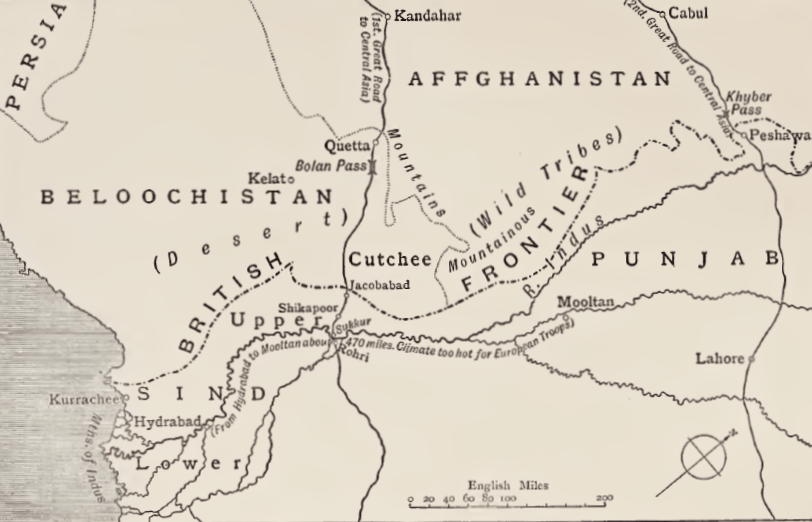
The geography of Sindh left the province to a new kind of invader – emissaries from Persia, Ghazis preaching jihad from Afghanistan, a whole host of religious fanatics and agents of the Nana Sahib who crossed Sindh in the guise of priests and mendicants. From Delhi came instigators sent presumably by the Mughal court and these all “swarmed through the country, appealing each to his particular race or sect; letters from the mutineers in Delhi, in Oude, and elsewhere, some enigmatically, some plainly worded, came by the post to their relations and friends in the Native Regiments in Sind, calling on them to make common cause with them.” While there was little Frere could do against this particular menace than to hope his police would keep the peace, he also relied on Jacob’s Sindh Horse for another task.
Stationed with them on the frontier was the 6th Bengal Irregular Cavalry. It was open knowledge that they were ripe for mutiny, and nearly every letter they received in the regiment (as in the Punjab, all correspondence was being monitored) spoke of sedition in some form or another. The Bengal Government was too afraid to recall them, and the only option Frere had was to leave them under the watchful eye of the sowars of the Sindh Horse. As Jacob had still not returned from Persia, Captain Merewether had been deputed in his stead as commander of the Sindh Horse. He was so uneasy about the 6th Bengal Irregulars that, upon hearing that Jacob and the other Sindh Horse regiment were back in India, he wasted no time in requesting they be returned to Sindh with all haste. His concern with the 6th was not so much a mutinous spirit but their disorderly habits that were setting a bad example to his men. He asked Sir John Lawrence if he could send his detachment of the 6th to Multan, but although he lacked troops, in this case, Lawrence declined.
When it became clear that General Jacob and the regiment of Sindh Horse had been deputed after the Persia Campaign for further work in the Deccan, Merewether was so worried he would lose control over his men, that Frere held back a detachment in Karachi, including some who were sick and unfit for duty – no more than 110 men – and sent them to Jacobabad to add to the number of men Merewether could rely on, ” …and as the number of the body returning from Persia will not be diminished by report as they go through the Hills, their return will probably have more effect than their actual number warrants, and even a few returning to give an account of the absentees to the families, etc., at Jacobabad will be satisfactory to all parties.” Frere could not help being struck by the behaviour of an old Risaldar, who asked Frere why the regiment was being sent to the Deccan. Frere told him that their loyalty was being questioned, but rather they had been chosen for further service because of it. While the Risaldar appeared to be satisfied with Frere’s reply, “his first impression seemed to me to have been that there must be some reason beyond what he had heard.”
The absurdity of the entire situation was beginning to tell on Frere’s nerves. To Lord Elphinstone, he wrote that the sepoys appeared puzzled whenever he spoke to them, as if they expected any minute to be either disbanded, disarmed or blown from guns “…and it occurred to me that the effect would, in every way, be good if a small detachment went back to Jacobabad, carrying news as eye-witnesses of doings in Persia, and able to assure the wives, families, and comrades at Jacobabad that we have neither eaten the rest of the 2nd Regiment, nor inveigled them beyond sea for any sinister purpose.”
He was horrified to find that a rumour had spread in Karachi that the British were planning to round up all the natives of the city and execute them, piecemeal, as revenge for the atrocities committed in Cawnpore, he had to contend with nervous ladies who claimed their ayahs had told them, in full confidence, that some unknown body of natives was going to cut their throats and he found this “mischievous nonsense” was being spread by not only “half-caste clerks …but many men and officers who ought to know better, though usually the responsibility of originating the story is so divided that it is not possible to get hold of any one who can be made an example of.”
Frere continued on his course of open frankness with those around him, and he saw some results. The seditious articles in the newspapers lessened, and his district officers were less apt to jump at their own shadows. Business continued as usual, without disturbances and panics throughout Sindh. He was hoping Sindh would be able to ride out the worst of it, but unfortunately, in this case, Bartle Frere was wrong. Mutiny would eventually arrive in Sindh in September 1857, testing not just the wisdom of Frere’s policies, but the entire province.
Sources:
Aitken, E.H. Gazetteer of the Province of Sind. Karachi: Mercantile Steam Press, 1907.
Hughes, Albert William. A Gazetteer of the Province of Sindh. London: George Bell & Sons. 1876
Martineau, John. The Life and Correspondence of Sir Bartle Frere, in Two Volumes. London: John Murray, 1895
Nabi, Aftab. “The 1857 Army Revolt in India: Sind Incidents and Impact on Policing in India.” Pakistan Horizon 70, no. 3 (2017): 37–47. http://www.jstor.org/stable/44988336.
 Mutiny Reflections