On 1 May 1858, Sir Colin Campbell left Shajahanpore to face Khan Bahadur Khan at Bareilly. As soon as his back was turned, however, Moulvie Ahmed Ullah Shah found an opportune moment to attack the station. There was little Campbell could do; invested in taking Bareilly, he could not, for the moment, spare any men as reinforcements for Colonel Hale. His orders from the C-in-C were clear: defend the post to the utmost but not to engage the insurgents directly.
Hale’s force was not a considerable one. At his disposal, he had 500 men of the (right wing) 82nd Regiment of Foot, De Kantzow’s Horse, and a small detachment of artillery, consisting of two 24-pounders and two 9-pounders. The only building left standing in Shajahanpore had once served as the gaol, and it would now serve Hale as his garrison. It was hardly an admirable position, but the only one with a compound wall that was at least partially intact. The building itself no longer had a roof, but at least the lower rooms still provided some shelter from the sun for the sick, and ample protection from the weather for the ammunition, stores and supplies.
Hale pitched his camp in a tope of trees directly adjacent to the jail and proceeded to “put the jail in a state of defence.” There was very little he could do, however. A ditch was dug along the partially destroyed south wall, and he positioned his guns to sweep the front and sides of what was now an entrenchment of sorts.
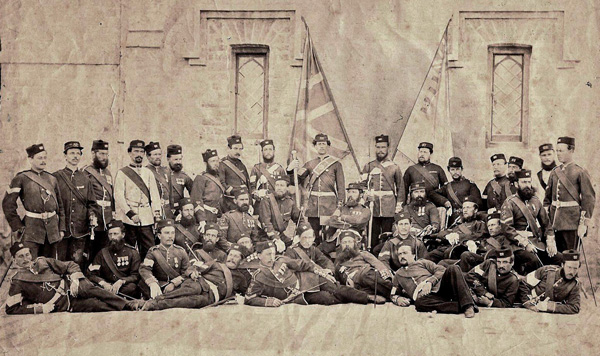
On 3 May, Mr Money, who had remained in Shajahanpore in his position as civil magistrate, informed Hale that his spies had seen a considerable rebel force moving towards the town, and at the time of their report, the rebels were hardly four miles distant, approaching from the Mahomdi Road. Hale immediately ordered the camp to be struck and everything removed into the entrenchment; at the same time, he ordered four companies of the 82nd to protect the camp while it was being moved. However, he quickly thought better of it. They had not proceeded 200 yards when Hale ordered them to stop while he mounted his horse and went out to reconnoitre. It was just as well he did, for the rebels were no longer four miles away, but were, at a leisurely pace, already crossing the Kunhout River. They then moved to Hale’s left and picked up their pace, showing every intention of attacking the entrenchment. The 82nd was swiftly ordered back into the entrenchment, and Hale quickly followed them.
Lieutenant De Kantzow, that rather impetuous young man who had attempted to stave off the mutiny at Mainpuri, was posted with his cavalry off to the right of the entrenchment and, without warning, “gallantly charged the enemy,” but even he, in his ardour, realised after a few hundred yards that should he proceed, neither he nor his sowars would see tomorrow. As bravely as they had started, De Kantzow’s Horse turned and raced back. Hale, while praising this rather foolhardy charge in his dispatch, ordered De Kantzow into the entrenchment.
What the rebels planned to accomplish that day is somewhat curious. There was no outright attack on Hale’s position; instead, they satisfied themselves with bringing up their guns and shelling the jail. Their matchlock men quickly began to shoot at anything that moved, and their cavalry prowled listlessly outside the walls. Instead of storming Hale and overpowering him with sheer force of numbers, they simply besieged him. They would continue to do so over the next few days — Hale would send increasingly urgent missives to Sir Colin Campbell at Bareilly and receive the same reply – he was to hold his position until Bareilly was taken.
With Bareilly considered won on 7 May, Sir Colin Campbell was finally able to address Hale’s problems at Shajahanpore. His answer was to send Brigadier John Jones to the rescue. For the expedition, the force was given the moniker, the Shajahanpore Brigade and consisted of
Two squadrons, 6th Dragoons
Cureton’s Multani Horse
No 7 Light Battery, Bengal Artillery
detachment of heavy guns and Sappers
HM’s 60th Rifles
HM’s 79th Highlanders
left wing, HM’s 82nd Regiment
22nd Punjab Infantry.
Sir Colin Campbell sent Jones off with full discretionary powers, free to attack Mahomdi if the opportunity allowed for it. The 79th Regiment marched to Faridpur at 2 am on the 8th of May, and Jones followed with the remainder of the brigade some hours later. They fortunately reached their destination before the dust storm, which would level tents in Bareilly, thus narrowly avoiding being caught out in the open. However, they felt its full force regardless, and their camp fared no better. The army spent the night, cold, wet and cheerless among a mass of mangled tents. As a result of this particular chaos, the march did not resume until 4.30 in the afternoon of the 9th and only marched for four hours. After a rest, Jones ordered the march to resume early on the 10th to ensure his men were under shelter by 11 am at Tirhall. Jones only arrived before Shajahanpore on 11 May at daybreak to find the insurgents had taken control of the town and the fort. Jones was still holding out in his beleaguered entrenchment with increased desperation, and as far as Jones could see, there was nothing for it but to fight his way in. He decided to try the direct route to the jail by crossing the ford. With the cavalry and No. 7 Battery covering the crossing of the main body, things seemed to go well, but as luck would have it, the guns began to sink in the sand, and the rebel cavalry decided it was high time to pay him a visit. They crossed the bridge of boats and quite swiftly appeared on Jones’ right flank, and much like at Bareilly, began harassing his baggage in the rear. There was nothing for it — Jones changed his mind and decided he would take the bridge of boats instead.
He withdrew the guns and cavalry which had already passed the ford, and formed a line of infantry with the 60th Rifles and the 79th Highlanders in the advance. He positioned the Light Battery and the Multani Cavalry on the right, with the left covered by the heavy guns and the Dragoons. In support, he placed the 82nd and the 22nd Punjab Infantry. He opened fire on the rebel cavalry, who quickly changed their minds about the baggage, and a considerable number scattered. However, others, more persistent than their brethren, continued their attack.
“The 79th was advancing in line at the time, when the Grenadier and No. 1 Companies were ordered to change their direction half right and extend. This was done just as the enemy came within 400 yards, but after a few rounds from the two companies, the Sepoys retreated quickly towards Shahjehanpore.”
The field guns now pushed on rapidly and continued to fire on the insurgents as they rushed over the bridge. With the bank clear, Jones then ordered the heavy guns forward to the head of the bridge, and for the next two hours, shelled Shajahanpore, while his infantry waited in any shelter they could find from the blinding sun. Although he directed his fire at the fort, by the time he was done, much of Shajahanpore was in flames. Unprepared for quite such an onslaught, the insurgents retreated through the town. As soon as Jones felt he had done enough to show the insurgents what he was about, he ordered the 82nd to advance with two guns and take the fort. The 82nd rushed up the main street and took not only the fort but also claimed the head of the stone bridge on the opposite side of the Shahjahanpore with no opposition at all. He then ordered the 60th, the 79th, the four light guns and the Dragoons to advance. As at Bareilly, they found the town empty. Cureton’s Multanis had been detached to “occupy the attention of the enemy” while Jones passed through the town. The cavalry swiftly dispersed the rebels to Jones’ rear and then pushed on towards the jail to find the besiegers had moved off, enabling Cureton to open communication with Hale. As it turned out, Hale was badly wounded with a shot through the leg.
The 79th, in the meantime, continued through the town and by 9 in the evening halted on the side facing the Mahomdie road. Picquets were now thrown out, and the regiment settled down to a very belated breakfast – no one had eaten anything throughout the day — while no one was killed in the engagement itself, 23 men of the 79th collapsed from sheer exhaustion, three of whom died. As for Jones, he encamped on the grounds adjacent to the jail and by 7 in the evening, the tents were finally pitched. Several men were carried off to the hospital suffering from the effects of the sun. Jones reported 2 men killed of the 60th Rifles, 1 horse wounded for the Dragoons, with two sowars and two horses wounded for the Multani Cavalry.
The Moulvie and his army, booted out of Shajahanpore and chased for some miles by the Dragoons, were now several miles down the Mohamdi Road – they might have received a licking, but they were not gone. Instead, for the next two days, they regrouped and surreptitiously began surrounding Shajahanpore, while Jones considered his options. If Sir Colin Campbell thought Jones would take Mohamdie, he was sorely mistaken, for Jones would now have his hands full, for, instead of relieving the garrison and moving on, he was now effectively one of the besieged. Realising the peril of his position, Jones quickly sent a message to Sir Colin Campbell for reinforcements. It arrived just in time, for on the 15th the Moulvie attacked the entrenchment. This time, he was out for blood.
Money’s spies had fortunately been kept busy, and on the evening of the 14th, they arrived in the entrenchment with the news that the Moulvie was planning an attack the next morning. Jones paraded the 79th at 1 in the morning to take up a position to the front of the camp with the heavy guns, with De Kantzow’s Horse a little to the front. Then, for the next few hours, nothing happened. The Moulvie appears to have taken Tantya Tope’s adage, of never attacking the British before 10 in the morning, to heart, for promptly at noon, two bodies of his cavalry “debouched from a wood” and fiercely charged the 79th and the guns, taking De Kantzow by surprise; before he could mount a counter charge, he and some of his sowars were wounded. De Kantzow was effectively hors de combat with a sword cut to the arm and a slash across the face. He had his own spirited telling of the event, as printed in an Australian newspaper:
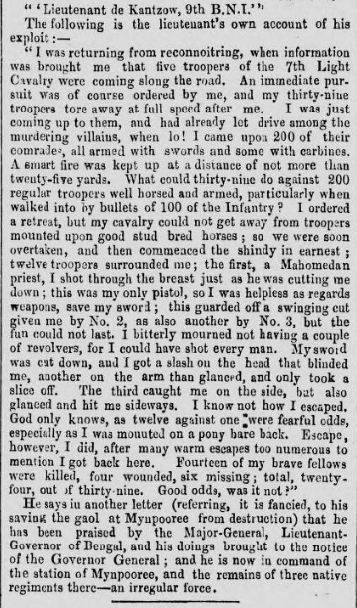
The 79th rapidly formed square and “received the rebel cavalry with volleys”, inflicting considerable damage in their ranks, momentarily driving them back. “The enemy displayed great courage, charging right up to the muzzles of the guns, and the artillerymen were fortunate in being able to reach the 79th square before the cavalry were upon them.”
The rebel guns opened up on the entrenchment at long range, as their cavalry continued their attempts to turn both of Jones’ flanks, which covered two miles. While thus keeping Jones occupied, they crossed the river, which served as the border between the two armies, and once again charged the 24-pounder; the Rifles responded by peppering the attackers with such precision they emptied many saddles and sent the attackers scurrying back over the river, “faster than they came.” For several hours, the attacks continued on different parts of Jones’ position – then, without warning, at dusk, the battle suddenly stopped. The rebels retreated again over the river, but Jones bivouacked his troops where they stood for the night. By morning, it was clear that the Moulvie had once again retreated down the Mohamdi road but he left enough men behind to continue harassing Jones’ line for the next two days.
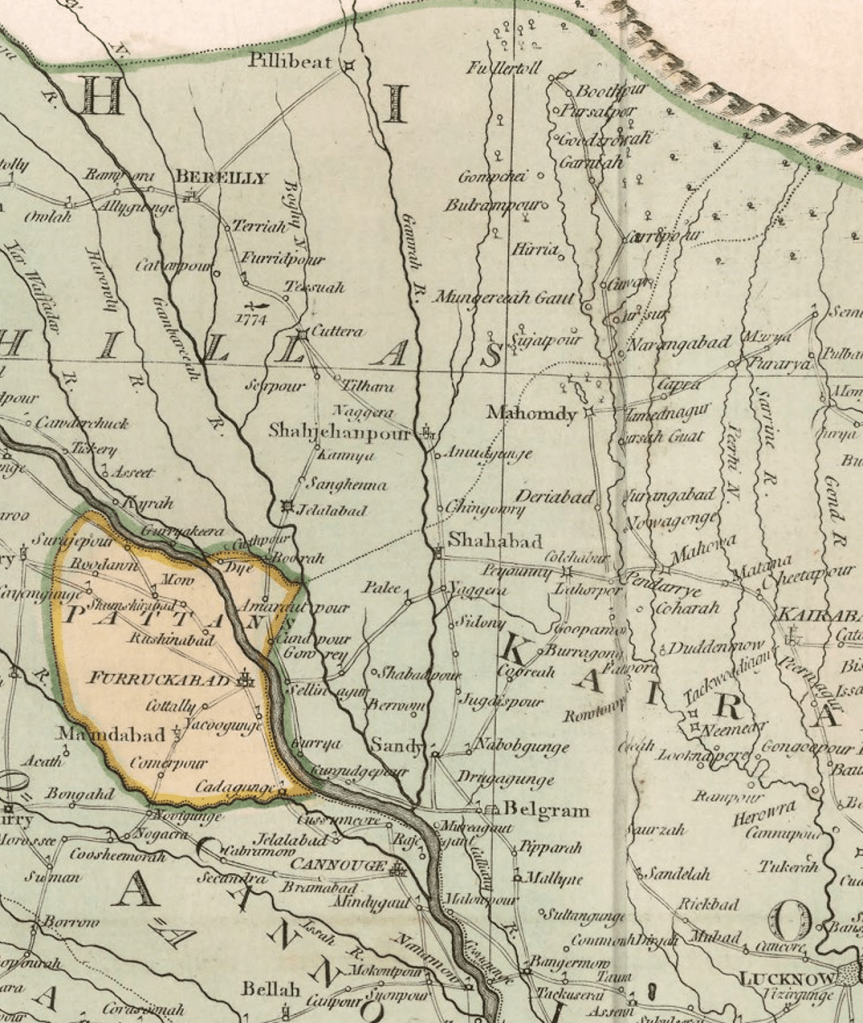
Back in Bareilly and a Return to Shajahanpore
As we have seen, Sir Colin Campbell was confident his Rohilkhand Campaign was winding down. When he had sent Jones to Shajahanpore, he was of the conviction that the Moulvie would be put to task and Jones would certainly not just relieve Shajahanpore but take Mohamdi as well. Thus, considering Rohilkhand as practically settled, he began making his further arrangements. He broke up his force into smaller columns, with some remaining in Bareilly and others sent back to Lucknow and Meerut. As Khan Bahadur Khan had indeed made his escape from Bareilly, Campbell organised a new column, under Brigadier Coke and consisting of the 42nd Highlanders, the 4th Punjab Rifles, the 1st Sikh Infantry, a portion of the 24th Punjab Infantry, a detachment of the 17th Irregular Cavalry, a squadron of the Dragoons and considerable artillery with a month’s worth of supplies to follow Khan’s line of retreat to Pilibhit.
Campbell intended to leave the field and return to Fatehgarh with the remainder of the force – his headquarters’ staff, the 64th Foot, two troops of the 9th Lancers, the Balochi Battalion and both Tombs’ and Le Mesurier’s artillery. On 15 May, he was on the march. As there was no possibility of sending off the sick and wounded with any safety from Bareilly, it was decided to take them along with the intention of eventually packing them off to Simla. For now, they would be packed in their doolies and among them was a very disgruntled William Russell. Russell had been informed by the doctors that he would likely not be in the saddle for many months to come: with some reluctance, he sold off his horses to the 9th Lancers. Campbell, it seems, wanted rid of Our Special at this point and ventured to leave him in Bareilly, insisting that the commissioner would make arrangements to eventually send him to Naini Tal, but Russell was having none of it. As uncomfortable as it was, he refused.
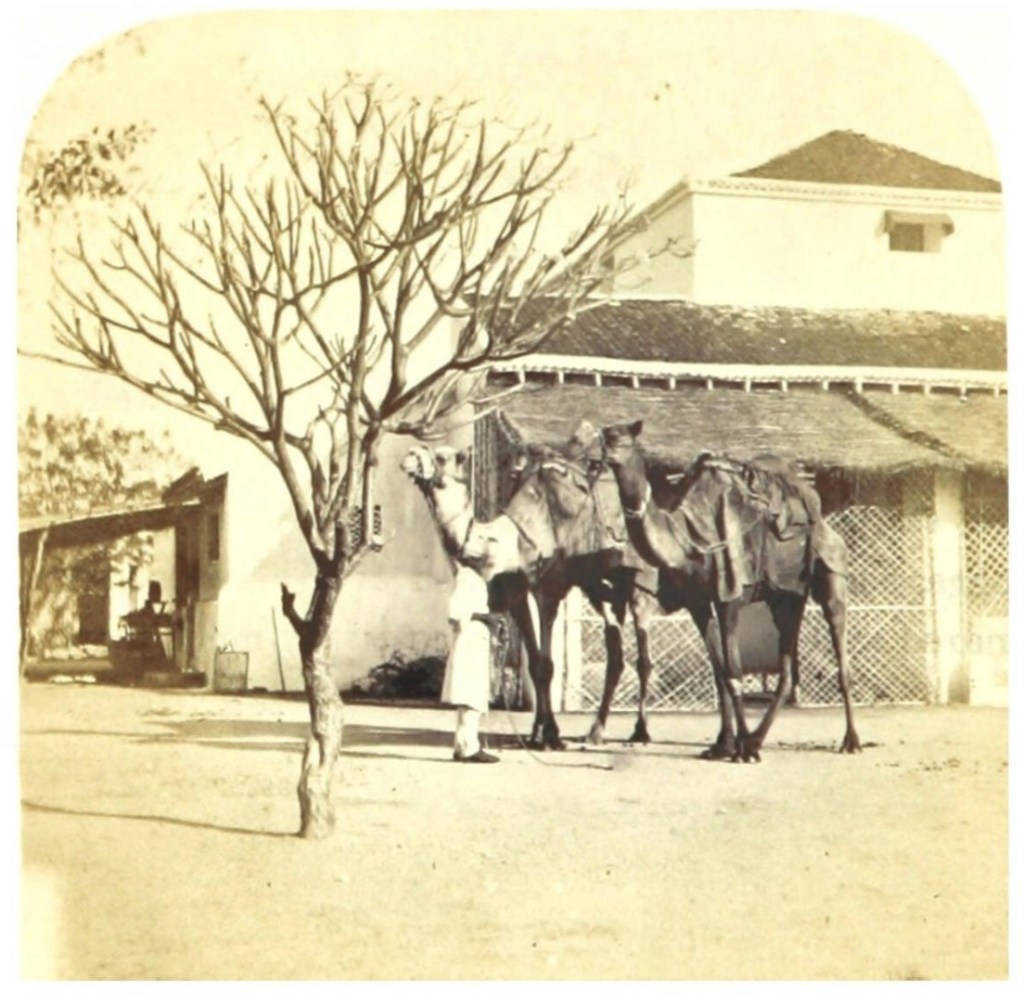
May 15th.—At 1.30 this morning, the Chief and Head-Quarters’ Staff marched from Bareilly en route for Futtehgarh… Baird, Alison, and myself, and a number of sick, were carried off in doolys. We left behind, in addition to Coke’s column, the 42nd and 93rd Highlanders, two regiments of Punjaub infantry, cavalry and guns, under Walpole, who is to command in Rohilcund. Marched all the morning, and encamped in the tope of Fureedpore at 8 a.m. The Chief was lying down beside my dooly, taking a nap while his tent was being prepared, with his head resting on his hand, for he refused to accept the loan of my pillow, when a camel driver came by, leading a huge dood (a camel carrying milk) so carelessly as to bring him right across Sir Colin. One great flat pad was about descending on the Chief’s head, when he started to his feet, and ere he was quite awake had his sabre out of the sheath, and was flourishing it in the air as if he was going to slay all the doodwallahs (milkmen) in camp.”
The march resumed on the 16th. The last message from Jones was on the 11th; he had relieved Shajahanpore. It was with some surprise then, just as the camp was breaking up, a messenger arrived with a request for reinforcements from Brigadier Jones. Campbell continued on with some caution towards Tilhour, all along making his plans; the Moulvie was rapidly becoming a thorn in Sir Colin’s side, and on 18 May, Sir Colin Campbell would once again be standing before Shajahanpore.
The day had opened not with gunfire but with a thunderstorm as the force broke camp and proceeded through the rain and lightning. After a march of six hours, the force passed over the bridge and through the main street of Shajahanpore, marching directly to the cantonments, where a halt was called to rest the men and pitch the camp. At three in the afternoon, without warning, the Moulvie’s artillery opened fire. Russell, who had been asleep when the first shots were fired, was woken up by a hand shaking his shoulder and a voice telling him to “…look sharp, or you’ll miss the fighting.”
” I could not mount a horse in the orthodox way, but I was helped up on a substitute for a side-saddle, and managed, though in great pain, to ride to the left of our camp, where I found the 60th Rifles occupying a house and the bank of the river, on which two 18-pounders were in position. At the other side of the stream was a very wide plain, dotted with trees, and gradually rising to a ridge in front of us, which was covered with groups of horsemen, extending for miles along the horizon. The 1 8-pounders, at a high elevation, were plumping round-shot into them, which those bahadoors dodged, with their active horses, in wonderful style. Sir Colin stationed the Rifles, H.M.’s 64th, H.M.’s 79th, with his cavalry and guns, along our front, and made an advance on the plain, which brought out more cavalry of the enemy, and a number of their guns, so
that, at one time, there were at least 4,000 horsemen capering about in front of us, at the distance of a mile or so, under the fire of the heavy guns and of a field battery on our left.
Presently, we saw the enemy’s guns opening, and a troop of artillery replying fervently, and our infantry advancing and occupying a large village, from which they opened fire on the horsemen. As Sir Colin rode across the plain with Mansfield and his Staff, he had almost as near an escape as Norman had at Bareilly, when the heel of his boot was carried off by a round-shot. We saw a shot strike the earth so close to him that it seemed impossible he could escape, but on the dust clearing away, the Chief was seen trotting along as usual. As our men advanced, the enemy fell back on a fort, which we could see crowded with men, but it was too late to press them; the soldiers were much fatigued, and so, posting strong pickets all along our front and exposed flank, we retired before sunset, having gained a large accession of position without any material loss.”
The action had not been in Campbell’s plans for the day; instead, it was forced on him. Colonel Herbert, in a move quite unknown to Sir Colin, had proceeded out of the entrenchment with a small body of De Kantzow’s Horse, with the intention of reconnoitring the rebel position; instead, he passed too close to their guns, and these opened fire. Herbert dashed back to the entrenchment, and the rebel cavalry rode out in pursuit, only to run slap bang into Sir Colin Campbell, who opened up on them with his guns to aid Herbert’s retreat. Then, for good measure,
“The 82nd pushed forward, occupied the village of Panhat, on the right front. They were followed by the horse artillery, a field battery, and part of the 9th Lancers and the Irregulars. The 79th then took possession of a grove of trees in the centre of the position, near a small rising ground, on which were posted a couple of heavy guns; whilst a heavy field battery, supported by a wing of the Rifles, with parties of the Carabineers and Biluchis, covered the left flank. It was a strong defensive position, on which the enemy could make no impression. In the artillery and cavalry skirmish which followed, the rebels displayed more than ordinary skill and courage, and although in the end they gave ground, no attempt was made to pursue them.“
Sir Colin Campbell rightly asserted that his force was numerically too weak to hope for a decisive result; he did not have enough cavalry, and he was not willing to risk what he had on a battle which might well prove futile. Satisfied that for now the insurgents had been repulsed to a safe distance, he quickly sent a message to Brigadier Coke; Pilibhit could wait, he needed him with all speed in Shajahanpore. The situation was rapidly becoming ludicrous. Coke turned back as soon as he received the new orders and arrived on 22 May; two days later, on the 24th, Sir Colin Campbell was ready to attack the rebels. That is, if there were anyone to attack. Like at Bareilly, where Khan Bahadur Khan had baffled him, so the Moulvie at Shajahanpore. He had decamped at some point in the last two days and was well on his way to Mohamdi.
Sources:
Behan, T. L., ed. Bulletins and Other State Intelligence for the Year 1858. Part 3. London: Harrison & Sons, 1860.
Forrest, George William. A History of the Indian Mutiny. Vol. 3. London: William Blackwood & Sons, 1912.
Jarvis. Historical Record of the Eighty-Second Regiment or Prince of Wales’s Volunteers. London: W.O. Mitchell, 1866.
Mackenzie, T. A., J. S. Ewart, and C. Findlay. Historical Records of the 79th Queen’s Own Cameron Highlanders. London: Hamilton, Adams & Co., 1887.
Malleson, George Bruce. History of the Indian Mutiny. Vol. 2. London: William H. Allen & Co., 1879.
Russell, William Howard. My Diary in India. Vol. 2. London: Routledge, Warne, & Routledge, 1860.
 Mutiny Reflections