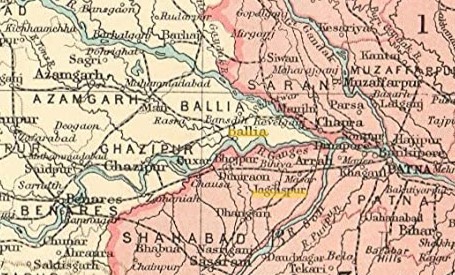
Kunwar Singh’s strategy of evacuating Azamgarh before becoming entangled in an all-out battle with Brigadier Lugard had given the British a moment’s pause. It was mystifying as to why, with his superior army, he had not taken either the entrenchment or attacked Lugard with vigour. It was not the only surprise he had in store for the British.
Brigadier Lugard realised that his only option at this juncture was to divide his force. Having taken complete command of the Azamgarh Field Force, he now had a sufficient number of men of all arms to mount not just a pursuit of Kunwar Singh, but to continue operations in the district.
After the fight on the 15th, Kunwar Singh had halted at the village of Naghai, not 15 miles from Nathupur. Here, he occupied a small but well-defended fort, in the belief that the British would pursue him. He planned to strike them such a crippling blow that they would be forced to not only retreat but be dissuaded from keeping up the pursuit, so he could cross the Ganges in peace. Before Douglas arrived, Kunwar Singh had put his forces in order. His position was well-shielded by a grove of trees and breastworks, while his guns were so positioned to greet Douglas with considerable destruction. If things worked out, Douglas was walking into a trap.
Brigadier Douglas set out from Azamgarh on the 15th of April with:
Three guns, E Troop Royal Horse Artillery
Four guns, Major Cotter’s Battery, Madras Artillery
Two 5-inch mortars
Detachment of Punjab Sappers
One Squadron Military Train
Two Squadrons 3rd Sikh Cavalry
One Wing HM’s 37th Regiment
HM’s 84th Regiment
One company, Madras Rifles
Naghai – 17 April
It would not be until the 17th, however, that Douglas was ready to march. At 3 in the morning, the force set off from Nuthupur and, as expected, found Kunwar Singh at Naghai. He sent the cavalry and horse artillery of the advanced guard through the village along the road, with the infantry cutting across the fields and as soon as practicable, opened with artillery. While the barrage was swift and should have been lethal, the insurgents’ breastworks were holding, and they were able to stand their ground. Coming up to the edge of the trees, it became clear to Douglas that Singh had posted a considerable number of men in the grove; now, as if to repay the compliment, Singh’s artillery opened fire. Any attempt to charge Singh’s guns at this juncture failed; however, for their part, the insurgents were unable to capture Douglas’ guns either, although it was not for lack of trying. Douglas threw part of the 37th, 84th and the Madras Rifles into skirmishing order with supports and under a very heavy fire, they rushed Singh’s positions, driving them off at the point of the bayonet. For their part, the rebels retired “in good order from tope to tope, followed by the infantry, a number were bayoneted in their trenches, and a colour was taken by the 37th”.
While the infantry was clearing the front, Kunwar Singh sent a “considerable force” to Douglas’ left. Hence, he kept them at bay with the Horse Artillery and Cotter’s Battery while the Sikh Cavalry charged. It would take “several charges” before the insurgents finally fell back.
“I followed the enemy for some distance, and a number were cut up; they were very determined, and evidently trained soldiers: in their retreat they divided into two bodies, and I halted for some time, till I could ascertain which was the main body; I then started in pursuit along the lower Ghoosee road, passing through Chuprah and Etawah, at which latter place the enemy seemed to have united; our force bivouacked at Ghoosee, within four miles of the enemy, after a march of twenty miles; from information afterwards received, the enemy, on our arrival, moved six miles further on.“
What Kunwar Singh had managed to do was secure two lines of retreat for his main columns, which he had divided, and although the loss of life in the retreat was considerable, his men maintained their discipline throughout. As soon as Douglas had called off the pursuit, the two columns reunited and halted for the night. It must have been an interesting night indeed – the two armies were bivouacked within 6 miles of each other across a vast and silent plain.
 Mutiny Reflections