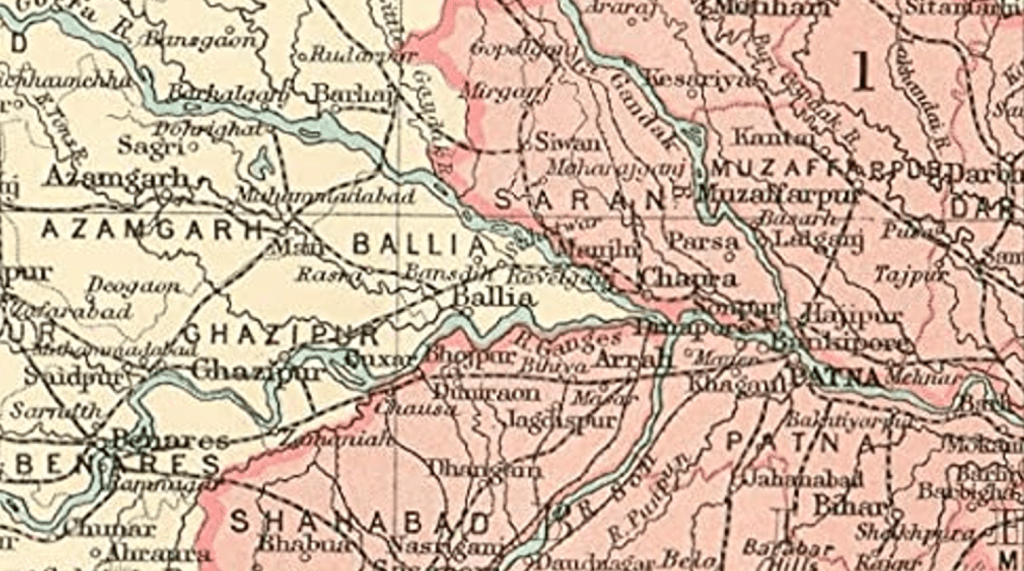
On 22 April 1858, Brigadier John Douglas halted his force on the banks of the Ganges. While he wrote his report to Brigadier Lugard and then waited for further orders, Kunwar Singh retreated to Jagdispur. The objective had been to drive Singh out of Oudh and as far away from Benares and Allahabad as possible. The road to Cawnpore was once again secure, but here the British displayed a certain sense of folly. Instead of following Singh to Jagdispur, they allowed him to retake his jungle fortress and form a juncture with his brother, Amar Singh. Their combined army now numbered anywhere upwards of 7000, all ready to restart hostilities in Bihar. Their cause was not a pan-India cry of freedom. What was happening in other quarters of northern India was not their concern – their objectives had started with and had always been securing their own territories in western Bihar.
Since the beginning of November 1857, a body of European mounted police had been patrolling the Bihar district, and they would be reinforced by 250, and then a further 300 by January, all of whom were low-caste, local recruits. In January, 100 sailors of the Naval Brigade took up their station at Gaya and HM’s 85th Regiment was sent on a march through Bihar, as much to make their presence known as to put an end to some of the lawlessness that still prevailed. This particular violence was not directed at the British but was of a homegrown nature, with various local rajas plundering and pillaging their neighbours. The Rani of Tikari, who had managed to stay out of the way during the mutiny, had been forced to take up arms for her own protection, something which the British, in their single-mindedness, viewed as a threat. Although they did not dismantle her fort, they certainly relieved her of her ammunition and guns. When Futteh Singh began creating a ruckus in western Bihar, the Deo Raja and the Sonepura Raja took it on themselves to give him a thrashing, putting an end to his pillaging ways.
“The so-called rebels like Hyder Ali Khan, Kosheal Singh, Jodhur Singh and Futteh Singh indulged in indiscriminate plunder. The result was they could not enlist the support and sympathy of the people in general. The Zamindars, on the whole, were well disposed towards the British.“
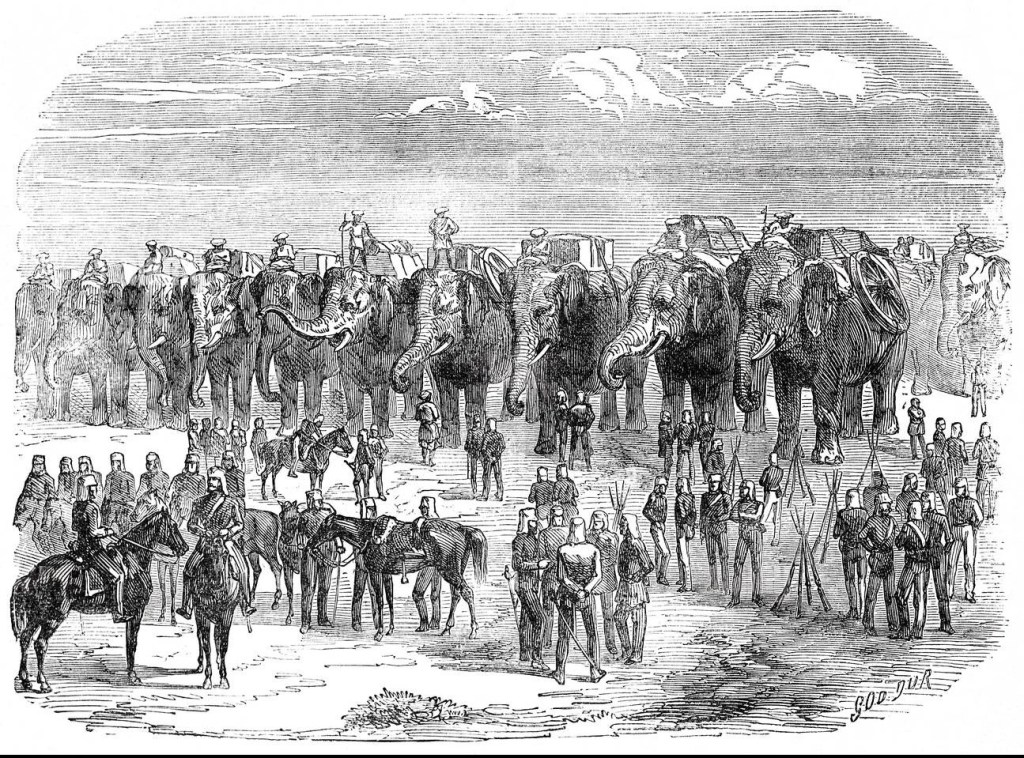
Three zamindars raised their own levies, with Deo Raja keeping the peace on the stretch of the Grand Trunk Road that ran through his territories at his own expense. Others furnished the British with volunteers for local police forces, and even granted them use of their personal elephants for service against the rebels. In all, 41 elephants were thus loaned out to the British. As it was, their interest was to prevent any further lawlessness against their own people, who were heartily sick of being robbed by either mutinous sepoys crossing Bihar or by any of the other gangs who traversed the province at a whim and plundered them indiscriminately. While British rule had not been in the interests of the Bihari people, this kind of chaos was not either. They saw no benefit in supporting the rebel movement, which had proved itself to be both disorganised and violent.
As for the British, they secured their interests where it was thought most necessary, ensuring that they were never wholly absent from the district. Dinapore and Patna had never fallen into rebel hands; Gaya, although there would be three outbreaks at different times, remained under their control; the stud farm at Buxar and even Arrah had never been empty of British forces. They also held critical posts along the river and the roads. While the peace in Bihar was fragile, it was still holding. However, the return of Kunwar Singh could certainly change that. His circle of influence was wide and his followers many. However, in his last encounter with Douglas, Singh had been critically injured, something his compatriots were eager to keep secret from his followers and even more so from the British. When Singh and his men reached Jagdispur, they were dispirited, and another encounter with the British was not on their cards. That is, of course, until a man as stupid as Captain Le Grand tossed them a temptation they could not fail to take, for on the 23rd of April 1858, Le Grand attacked Jagdispur.
And what a mess he made of it, we shall now find out.
The idea that Kunwar Singh would make for Jagdispur eventually had been a probability not lost on the British since his encounter with Milman in March. As Arrah was situated some 20 miles from Jagdispur, it was seen as prudent to ensure the station’s safety and for this purpose, on April 9, Captain Le Grand and Lieutenant Massey’s companies of HM’s 35th, comprising in all 150 men, accompanied by five artillerymen and an officer with a complement of 2 small pound 12-pounder howitzers, marched out from Dinapore, arriving at Arrah two days later. They were joined a few days after by 150 of Rattray’s Sikhs and 50 sailors of the Naval Brigade. Nothing happened at Arrah over the next week, but on 21 April, the garrison could clearly hear the sound of guns firing a few miles away. During the day, the magistrate of the station was able to ascertain that Kunwar Singh had crossed the Ganges and was on his way to Jagdispur. Without ascertaining the situation for himself, Le Grand, who had been led to believe Jagdispur was only 12 miles away and not the said 20, immediately began making preparations to take on Singh, parading his entire force at seven the same evening.
He was just on the point of ordering the advance when a few planters arrived at the station, stating it was quite a pointless venture. Singh was not at Jagdispur; they had just passed that way. Where he was exactly, they could not say, but with no more information forthcoming from the magistrate, the force remained at Arrah. The next evening, on 22 April, the magistrate had finally heard from his informants that Jagdispur was once again occupied, and here, the story takes a strange turn. The return of Kunwar Singh had given Le Grand sudden delusions of grandeur. Perhaps the weeks of boredom at Dinapore and then at Arrah had addled his judgement, but Le Grand seemed to believe he was an officer of the same calibre as Major Vincent Eyre. Eyre had sent Kunwar Singh on the run in August 1857, when he had squarely booted him out of Jagdispur with a small force, but Le Grand failed to remember Singh had also annihilated Captain Dunbar and his superior force barely days before his ousting by Eyre. As it is, Le Grand completely misjudged the situation, ignored the warnings of the Arrah magistrate who thought that attacking Jagdispur with inaccurate information was not wise, nor did Le Grand interest himself in telling any of his superiors what he was planning to do. What he believed was that he could recreate Eyre’s victory and gain for himself a few laurels, perhaps a knighthood and a promotion to boot. He was, after all, 39 years old and his career until now had been of the humdrum kind. Among his men, he was known to be something of a martinet, not unlike their old colonel, but not essentially a bad sort of officer.
So off they marched, the entire garrison of Arrah, under Captain Le Grand. They left the station on an oppressively hot night, even the badly trained artillery ponies were seen flagging beneath their loads and looked as if they would soon collapse from the strain. The men, with all their kit, in their red coats and pipe-clayed belts, were certainly not in better shape; only Rattray’s Sikhs, who flitted silently alongside the marching army, seemed indifferent to both heat and hardship. At one in the morning, and still two miles from the Jagdispur jungles, Le Grand called a halt. He now realised that the 12 miles he had been led to believe was the distance to Jagdispur was in fact 20, and much of it from here on would be through thick woods, with barely a path and hardly any visibility in the dense undergrowth. While Le Grand pondered this particular obstacle, the force halted for a little rest. Barely four hours later, Le Grand ordered them to their feet. Not adverse to a little grumbling now, was Lieutenant Richard Parsons of the 35th.
Dalour Morcha, 23 April 1858, near Jagdispur
“Jaded and breakfastless, at a little after five, we resumed our march under the sickening influence of the morning sun. I commanded the advanced guard; the villagers turned out and stared at us as we passed, but nothing remarkable occurred till six a.m. About that time, I saw a native running breathless and frightened towards my party; he begged me to stop, saying there were four thousand Sepoys in front. I directed him to go to the column and report it to the magistrate and Captain Le-Grand, and I continued my march, the country in front being clear, and the main body about five hundred yards in rear. Shortly after this incident, we came in sight of the jungle, which stretched away to the right and left as far as the eye could reach, the road we were on leading direct to a village on its outskirts. On arriving within about eight or nine hundred yards of this village, we could see the gun barrels and bayonets of its Sepoy occupants glittering in the morning sun.”
Drawn up in column was a large body of sepoys, just outside the jungle to Le Grand’s left front; they had also taken care to line the entrance to the jungle to the right. Parsons advanced his party until he was within 400 yards of the village; until now, not a single shot had been fired, but the sepoys, some still in their red coats, were waving their tulwars and taunting Parson with shouts of “come on!”
“A small entrenchment had here been cut across the road, and the advance guard (by order of Captain Le-Grand) halted. The main body came up, the men were ordered to lie down, and the artillery opened fire on the village and the woods to the right with shell; a few straggling musket shots were the “only reply. The large body of Sepoys that were to the left front retired into the jungle; those on the right did the same; our party then made a rush into the village, only to find it deserted; a few straggling Sepoys, the remnant, as we thought, of Koer Singh’s flying and defeated force, disappearing at the end of the street. The excitement had up to this stimulated and supported our little force, but we all felt that to break our fast, after nineteen miles’ march with little or no sleep, would be not only judicious, but was absolutely necessary.”
If it smells like a trap, it is most likely a trap, or so thought the officers under Le Grand’s command. But not so Le Grand – “he made his dispositions to pursue the almost unresisting foe into his lair and the net he had prepared for us.” Without allowing his men a rest, Le Grand extended his company into skirmishing order with a sub-division on either side of the road, with Lieutenant Ross commanding the right sub-division and Parson on the left. The road was two miles long and led straight through the jungle to Jagdispur on the other side. The two howitzers now advanced along the road, with the remainder of the 35th with the Sikhs, the sailors all in column, followed by the elephants carrying the ammunition and the baggage and all the impedimenta of a British army in India, straggling along behind – doolies, camp followers and servants.

“We commenced our advance hungry and tired, but thankful for even the shade of the trees to screen us from the burning sun. A mile-and-a-half passed, and no trace of the enemy, in fact, not a soul to be seen, and not a sound but the rustling of the leaves, and the cracking of twigs as we walked leisurely, and now almost carelessly, along, satisfied in our minds that the enemy had gone. The trees are small, and not very close together; we know we cannot be very far from the other side of the jungle; we see a few cattle and an old man minding them; we ask him if he has seen anything of the sepoys, he says’ Yes, they are close,’ and sure enough there they are! and we perceive through the trees a low entrenchment, and behind it, thick as they can be, are scores, perhaps hundreds, with bayonets fixed, and this time evidently meaning business. We are still a hundred and fifty yards from them. I order my party not to fire until I give the word to Colour Sergeant Russell, who is by my side. Arrived within seventy or eighty yards, I say, ‘Now, Sergeant Russell, fire!’ which he does straight into the middle of them, and his example is followed by the men. Almost immediately, we receive a terrible return fire, not only from those in front, but from parties concealed in the bushes some distance to our left. The din is deafening, and how so many of us escaped the first volley is marvellous, but several of the men were hit, also Lieutenant Waller of the Seikhs.”
The skirmishers who had escaped the volley with their lives quickly darted for cover behind the slender trees and kept up a fire from their rifles. The guns off to the right had now joined in and were throwing shells at a hundred yards into the wall of sepoys. What Parson needed was reinforcements, but to his surprise, none came.
“The crash of the first volley over, I looked round to see the state of affairs with my own small party; some were behind trees, some were on the ground wounded, and one or two had actually got under the bank from behind which the sepoys were firing. I was puzzled what to do; but having heard that sepoys would never stand before the bayonet, I called out to the few men who were near me to fix bayonets and come on. I ran out from the cover of my tree with some of the men nearest me; some of the sepoys turned and fled. Our success was very short-lived. Before we had gone ten yards, we were between two fires. There was nothing for it but to retrace our steps to the friendly shelter of the trees. The remainder of our infantry had, up to the present, taken little or no part in the fight. They must have been all the time in column on the road, no doubt suffering severely from all the shots that passed us.”
Realising his position would be within minutes, besides being increasingly unbearable, would be wholly untenable, as they were partly outflanked, Parsons told Sergeant Russell to look after the men. He then ran across the road to ask Captain Le Grand for “instructions or assistance, and came to our two guns, which had been firing feebly for the last few minutes.” The reason was all too evident for Parsons now saw that four out of the five artillerymen were lying dead by the wheels, and at the very moment he turned up, Private Murphy of the 35th — one of the 12 men who had been chosen for gun drill — was shot in the head. “I saw in a moment that everything was confusion; neither the Sikhs, sailors, nor 35th were deployed, but were still in column, suffering from the enemy’s fire, but without replying to it. After a short consultation, it was decided to retire out of the jungle into the open country. For the next half-hour or so, I altogether lost sight of what must be called the main body of our force.”

Then, without warning a bugle sounded the retreat. It is unclear if Le Grand ordered the retreat out of fear of being surrounded, or whether some other signal had been misinterpreted, but within minutes the entire scene collapsed into confusion as men, animals, camp followers all began a mad rush towards Arrah. Parsons continues:
“The first thing I did on the retreat being ordered, was to run and tell my skirmishers, who were keeping up the fire as best they might at such close quarters. I then noticed that the guns had been abandoned. Getting three or four of my men and the fifth artilleryman, we seized one gun by the trail and wheel-ropes — the wretched ponies not being forthcoming — and although we drew a very hot fire on ourselves, we managed to drag off this one gun. With our tongues cleaving to our mouths, and our legs tottering under us, we succeeded, however, in bringing the howitzer with us for half a mile or so, till at last it upset over a stump. Efforts were made to spike it, and we left it to its fate and retreated. For some time, a solitary sepoy walked about seventy or eighty yards to my left, deliberately loading and firing at me.”
In the rush, there was no one to look after the wounded and the doolie bearers, in their terror before the advancing sepoys, had dropped their burdens and had run as fast as they could to get away from death. There was nothing Parsons could do to stop them, and he could do even less for the wounded. From the doolies came the screams of the wounded men, some begging for help, others begging to be shot. Some of the wounded tried to hobble along as best they could, using their rifles as impromptu crutches, but the heat of the sun, the loss of blood and their fatigued state saw to it that they fell along the road, some simply sitting down, resigning themselves to their fate, which was not long in coming for the sepoys were following the retreat, and their tulwars were blazing raw death on any in their way.
Parsons now saw Lieutenant Ross with a dozen of his men on the line of retreat, and he ran towards them. As he did, he suddenly heard the clatter of cavalry behind him and turned around. A party of rebel sowars, with lances pointing down, were galloping straight at him, and all Parsons could do was leap off the road, into the bushes on the side. As they rushed past him, he heard Ross shouting for his men to form up, though it was no more than a compact little group of men who held together as the cavalry bore down on them. When the sowars were no more than a few yards from the point of their bayonets, the men fired. The effect on the cavalry was as expected, as riders and horses tumbled to the ground, others tried in vain to halt their horses before they crashed into those on the ground, and others still managed to turn off and gallop back the same way they had come. Ross’ party continued their retreat, with Parson now rushing alongside.
Some of the skirmishers would turn and fire ever so often, with the hope that at least some of the main body would effect their escape.
As they emerged from the jungle into the open plain, they saw another charge of the rebel cavalry, this time on a group of men who had injudiciously rushed towards a tank of stagnant water, in which they tried to stay their thirst. Only Dr Clarke, the regimental surgeon, was aware of the charging cavalry — drawing his sword, he called out to his men to form square around him — some certainly heeded his call, for after one volley, the sowars thought better of it, and turned off.
Lieutenant Parsons continues his narrative:
“Shortly afterwards, with a sense of security and relief, I got out of the jungle and rejoined the main body of our little force, which was about two hundred yards from the edge of the jungle, behind a tolerably high bank; but they were soon outflanked and compelled to retreat once more towards Arrah, which was eighteen long miles away. If we were weary, hungry, and not fit to fight when we commenced firing on the village two hours before, what were we now completely exhausted, clad in English cloth clothes, protected from an April sun with forage caps, led into a jungle to fight a vastly more numerous foe, who had been crossing the Ganges at various points for thirty-six hours after we were told they numbered six hundred, we were, I admit (but even then, with proper disposition, I doubt if we should have been) defeated. From this time the retreat assumed a disastrous form; the men, sailors and soldiers, were panic-stricken, and the enemy received accessions of strength every moment, and when one of the retreating band fell wounded, he had to be left, and was murdered by the pursuers, who knew no mercy.”
It was indeed, every man to himself. The few commands that were issued were ignored, and according to another witness, the men were “raving wild” by the time they reached the main road. ” The European portion of the force was falling from apoplexy by sections, and no aid could be administered, as the medical stores were captured by the enemy; the dhooly – bearers having fled, notwithstanding the utmost exertions of the medical officers to keep them to their post. What was to be done? What aid could be given them? Nothing. There were sixteen elephants, but they carried the wounded; so the poor unfortunate beings were left behind to be cut to pieces.”
An hour into the retreat, Captain Le Grand was shot, and as he sank to the ground, he asked someone to shoot him, but before anyone could oblige, he fell dead into the arms of Drummer Bridger, who laid the lifeless body down. Corporal Barrett of the light company was likewise left behind, as there was no one to carry him on. Parsons, however, saw him “bayonet two sepoys and was cut down with the muzzle of his rifle pressing the second one’s chest.” Lieutenant William Glynne Massey suddenly stumbled on the road, eight miles from Arrah, but no one could ascertain if he had been shot or died of apoplexy; the brave Dr William George Clarke, his sword still in hand but suffering from the heat, could not keep up with the rest of the men. He fell behind and was run through with a lance by a rebel sowar. All along the retreat, they had become increasingly bold, especially after they realised that the men could no longer fire their rifles. Only Rattray’s Sikhs kept them at bay, forming up to charge and to give chase to any of the sepoys or cavalry who came too close to the retreating column. They received much praise for their splendid behaviour, for, like at Dunbar’s retreat back in July 1857, the Sikhs were the only ones who had managed to keep order.

“The wretched remnant of this badly-conducted and worse-advised expedition arrived at Arrah Fort about four o’clock in the afternoon; it is only wonderful that any escaped from the enemy’s fire and the sun. The loss sustained by the little force was fearful — that of the regiment being Captain Le-Grand, Lieutenant Massey, and Assistant-Surgeon Clarke; Colour-Sergeants W. Russell and H. Bush; Sergeants T. Morton, W. Johnston, and W. Britton; three corporals; and ninety-three privates. The artillery lost four men, the sailors twenty-five, and the Sikhs fourteen, altogether about half the force that started. Lieutenant Parsons, the next morning, volunteered and went out with a party to search for any men who might possibly be still alive; he found five or six, but all dead, among them Sergeant Britton, his face covered with blood, and the Crimean medals torn from his tunic.”
Different Leaders and New Plans
And where, in all this, was Kunwar Singh? According to reports, he had been severely injured at his last encounter with Douglas, suffering from gunshot wounds to the thigh and the left wrist. A story, still popular today, is that he chopped off his own hand and gave it as a sacrifice to the Ganges. There is no verifying that tale, although it does make for a good legend. As it is, the battle on 23 April was not under Singh’s leadership, but under that of Hare Krishna Singh and his brother, Amar Singh, who had undoubtedly done their dying chieftain proud. By 26 April, Kunwar Singh was dead in his fortress at Jagdispur.
For the British, Le Grand’s defeat was decidedly the one thing they did not need right now, and what followed it was a resurgence of unrest and strife in Bihar. Instead of being sent off for other duties in different fields, Brigadier Douglas was ordered to take his force with all haste across the Ganges and make directly for Arrah. However, like Le Grand, his force was nowhere near strong enough to attack Jagdispur, and he decided to risk nothing until Brigadier Lugard could join him. For his part, Lugard, who had been busy in the Azamgarh district, now set his sights on Bihar and crossed the Ganges on 3 May. Five days later, he was eight miles from Jagdispur.
Sending two companies of the 84th, with detachments of the Madras Rifles and 3rd Sikh Cavalry to reinforce Arrah, he proceeded the next day to an open plain, just west of Jagdispur. His plan was to wait for Colonel Corfield to march up from Sasseram with reinforcements, but the rebels, who had been watching Lugard quite carefully since he crossed the Ganges, decided any delay on their part was a folly. So on the afternoon of 9 May, a large body of them descended on Lugard from the jungle, apparently intending to harass Arrah. Lugard sent the cavalry and horse artillery after them, and they retreated back into the jungle. It would have been a well-planned distraction if Lugard had not been expecting his camp to be attacked. Just as the tents were going up, another body of rebels began firing on the camp. Lugard quickly divided his force into three columns and advanced straight to Jagdispur, which he took with hardly any resistance. The rebels retreated towards the village of Lutwarpore, taking Le Grand’s howitzers with them. Another chase was about to begin, but this time, there was no Kunwar Singh to lead them; Lugard would have to get used to a completely different style of fighting for the jungles of Bihar were perfect for the kind that Amir Singh excelled at – guerrilla warfare.
In the next post, we shall see just how Lugard met his new foe and how his foe would fare.
Sources:
Ball, Charles – The History of the Indian Mutiny, Vol II (The London Printing & Publishing Company, Ltd.)
Dodd, George – The History of the Indian Revolt and the Expedition of Persia, China & Japan (London: W.&R. Chambers, 1859)
Forrest, G.W. – A History of the Indian Mutiny, Vol III (Edinburgh & London: William Blackwood & Sons, 1902)
Kaye’s & Malleson’s History of the Indian Mutiny of 1857-8 – edited by Col. Malleson, Vol IV (London: W.H. Allen, 1889)
Malleson, Col. G.B. – History of the Indian Mutiny 1857-1858, Vol II (London: William H. Allen & Co., 1879)
Trimen, Richard – An Historical Memoir of the 35th Royal Sussex Regiment of Foot (Southampton: The Southampton Times Newspaper & Printing & Publishing Co., Ltd., 1873)
Singh, S. B. “GAYA IN 1857-58.” Proceedings of the Indian History Congress 28 (1966): 379–87. http://www.jstor.org/stable/44140459.
Kumar, S. Purushottam. “KUNWAR SINGH’S FAILURE IN 1857.” Proceedings of the Indian History Congress 44 (1983): 360–69. http://www.jstor.org/stable/44139859.