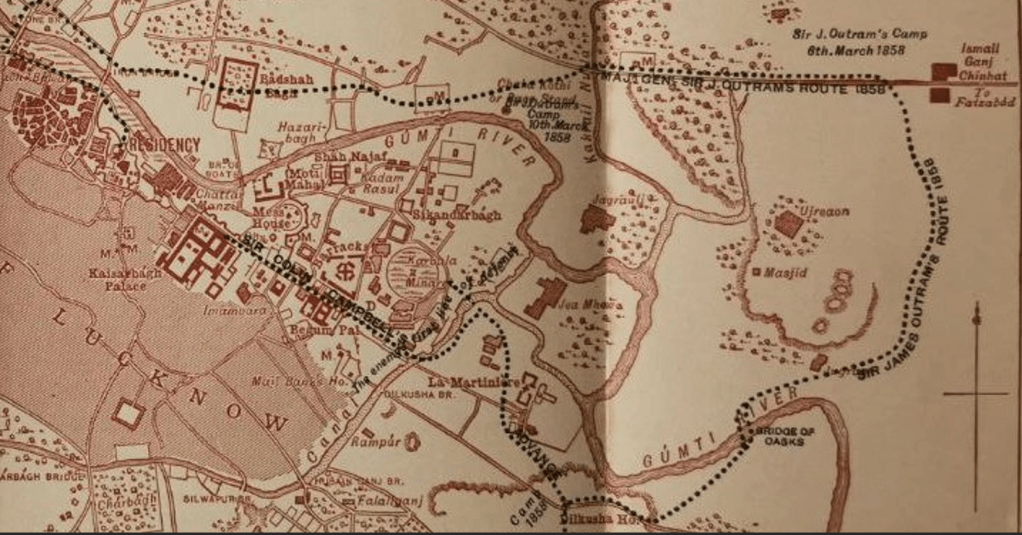
8th March 1858
Back in Sir Colin’s camp, the Sappers were busy.
On the night of the 6th, they had taken apart one of their bridges and rebuilt it further downstream to a point closer to Bibipur, thus successfully masking it from the rebels occupying the Martiniere who might have been perturbed, had they seen the siege train that then marched over it to join Outram’s camp. Similarly disconcerting for them would have been the field battery and cavalry, which included the 9th Lancers, that returned over it the next day. Both moves went unnoticed by the rebels.
On the 8th, the sappers were instructed to construct a battery on the left front of the Dilkusha to house six guns, which would be put into use against the Martiniere. Completed, Captain Peel then moved his guns to occupy it. He could have gone around the Dilkusha and come out on the left, but this was not Peel’s style. Instead, he marched around the right, in full view of the rebels. Looking on was that intrepid Crimea pressman, William Russell.
“It would have been a pretty sight, had it not been a matter of life and death, to see how solidly the blue-jackets marched with Peel and their officers among them, and how the sepoy artillerymen plumped shot after shot right across the line of their march» always contriving, however, to strike the spot over which a gun had just passed, or that to which a gun was just coming. It was a terrible game of cricket, and we
were all relieved when we saw the men and the guns safe behind their battery parapet.”
If that was not impressive enough, the sappers then constructed a further battery for four guns on the right front of the Mohamed Bagh; its only purpose was to fire on the Martiniere. To complete the day, they installed another battery on the right front of the Dilkusha, adding four more guns.
On the other side of the river, Outram received a visit from Sir Colin Campbell, who brought him his instructions for the next day; he was impressed to find that Outram had also been busy. On the 8th, the sappers in his brigade had constructed an entrenchment to house a 24-pounder and three 8-inch howitzers. During the night, elephants drew the heavy guns across the sandy road and by daylight, the guns were in position, ready to fire. The 9th of March would be a busy day for everyone.
The 9th of March
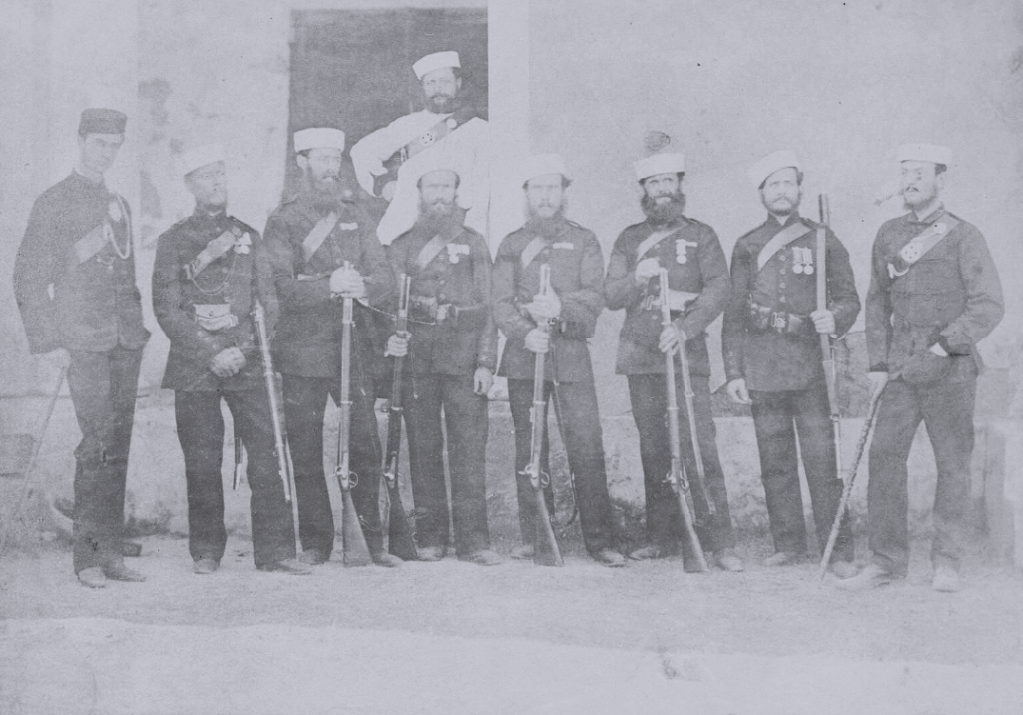
Opening the day’s proceedings was Sir James Outram. Assembling his force at on the ground occupied by the advance pickets, he instructed his men that their duty for the day was to flush out the rebels in their front and if all went to plan, today they would finally set foot in Lucknow. Operations, too, would be commencing simultaneously at headquarters, with their own objectives.
At daybreak, with the sun just rising on the horizon, the word was given and the advance commenced. The Rifle Brigade, in skirmishing order, were the first to encounter the rebels, and puffs of smoke could be seen as they approached a thickly wooded tope, first at a walk and then at a run.
“…a very pretty sight it was the green-coated Riflemen running quickly forward, and springing actively over the rugged nullahs and streams which crossed our path, loading and firing as they go, and ever and anon completing with the bayonet the work which the bullet had left half-finished.”
However, the woods checked the advance of the Rifles for a moment and Outram ordered the guns forward.
“…bang! go half a dozen shells, whistling and crashing through the trees and long high grass, bursting inside with a loud report, and scouring the wood effectually; this precautionary measure enables us again to push on. ‘Hark forward!’ and away we go, the little Riflemen dashing into the high vegetation, followed by the rest of the column, and pop! bang! crack! crack! with now and again the ping of an inimical bullet, soon tell us that the enemy are about.”
Fighting in the woods was quite unlike anything Majendie had ever seen. Besides the closeness of the trees, the ground was thickly covered in shrubs and vegetation, providing perfect cover for the rebels, and an unwitting trap for Outram’s men. The force quickly lost sight of each other in the trees, the Sikhs dashing off in one direction, the Highlanders in another and the Rifles to the fore. All around them, the constant, sharp firing and the shouts of injured men and those wild in the fight, are the only sounds that remind the men they are not alone.
“Then, breaking through the bushes, follows a hot and excited Rifleman, his rifle still smoking, his lips black with powder, biting another cartridge as he comes, and scarcely glancing, as he passes, on the man whom he has done to death. Ping! ping! close to your ears! Where are the enemy? -Who can see them? There, there, away to the right, see, lurking behind the mud walls of that village. Ping! bang!
‘Halt! action right!’
In a moment, the trail of a howitzer falls heavily upon the ground-ping! ping! ping! again close to your ear, and crack! bang! bang! from the responding rifles. ‘
Shrapnel- shell, my men-look sharp !’
Boom! almost splitting the drum of your ear, and there burst from the muzzle a gritty volume of smoke, and as it clears away, and the startling noise rings echoing through the wood, see the faint puff, and hear the report of the bursting shell, the fragments of which fly whistling into hidden nooks and corners-and ‘Hurrah !-now, riflemen, over with them!’
—crack! —bang! in quick succession, as a shower of bullets rattle in among the disorganised rabble whom the shells have driven from the village, and who are fleeing for their lives, few of them turning to exchange shots with their assailants.”
Coming out of the woods, the Highlanders, Riflemen and Sikhs now drove the rebels forward, flushing them out of the villages, until they were chasing them up the Fyzabad road, in the rear of a rebel battery which, to their intense annoyance, had already been emptied of its guns.
Capturing the Yellow Bungalow
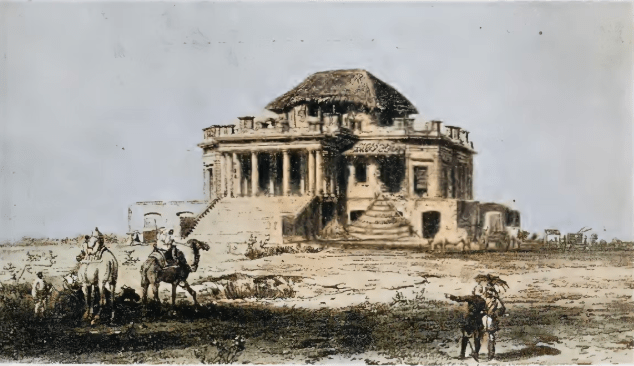
The building had been used by the Nawab of Oudh as a grandstand to watch the races at the nearby course.
In the meantime, the left column of attack, composed of the 1st Bengal Fusiliers, amply supported two companies of the 79th Highlanders who had been held in reserve on the left of Outram’s battery, together with Brigadier Wood’s Horse Artillery, which had been formed up in the rear of the Kukrail Bridge, now advanced. Together with the right column, they now attacked the Chakkar Kothi or the Yellow Bungalow. If they expected a fight, the men would be disappointed. The rebels, no less than 600 in number, take the exit out the back, deciding it was better to flee than stand and fight. Only a few remained behind, either unable to leave or unaware they had been abandoned by their colleagues, and continued to hide in the dark recesses of the ground-floor rooms, secure behind massive doors. Any man crossing the threshold was shot,
“Shells with long fuses were thrown through holes cut in the floor of the upper story into the rooms they occupied, but with little or no result, as, by moving from room to room, they were easily able to avoid them. An attempt was made to burn them out, which partially succeeded, one man being burned to death, while some others, driven out by the fire, were shot as they fled; two or three more also had been killed, but still there were some remaining.”
Thinking the building was now secure, Captain St. George of the 1st Bengal Fusiliers, accompanied by another officer, entered the house only to find it was by far not empty. He quickly shot two men dead with his revolver. Incautiously, he passed into a dark room, not realising two men had concealed themselves on either side of the doorway. One stepped out and fired a ball straight into his chest. The captain staggered back, trying to unbutton his own coat. His eyes glazed over, and he crashed to the ground, still clutching his revolver.
Outram, after three officers and nine men were killed, decided there was a better way to flush out the last remaining rebels. He brought up his artillery instead. Five guns were brought up close to the house and fired twenty rounds in quick succession at the windows and doorways. Before the smoke cleared from the last salvo, the Sikhs, who had been standing in readiness, dashed forward en masse.
“It was most exciting to see them racing up to the place, where, when they reached it, there was for a moment a confused scrambling at the doorways, then a sharp report or two, then a sort of shout and scuffling, then again bang! bang! sharp and distinct, and finally there burst from the building, with loud yells, a crowd of Sikhs, bearing among them the sole survivor of this garrison, who had made such a gallant defence, for gallant it was, be the source whence the courage sprang, fanaticism, despair, or whatever you may choose to call it. How many Sikhs had been killed inside, I do not know- not more, I heard, than two or three-but this one, alas for him! they had dragged out alive.”
In their rage, the Sikhs who had lost two men and one officer, Captain Anderson, killed in the Yellow Bungalow, dragged their prisoner along the ground, tearing his back over the stones, as they repeatedly stabbed him with their bayonets in the face and across his body. They then tossed him onto a fire and held him in place. The poor victim managed to struggle away from his captors and stagger away, but the Sikhs dragged him back and tossed him again into the flames. Then, under the eyes of the Highlanders and their officers, without any hope of mercy, the poor man burned to death. “Such was the state of excitement and rage of the Sikhs that it would have been quite impossible to prevent this act of torture; and many did make an attempt…but the whole business was done so quickly and with such noise and confusion.”
This particular incident was not related by Outram in any of his official reports, nor indeed by his staff; however, it did make it into the pages of other men who wrote about their experience. Although it might be laced with some imagination, especially on the part of Majendie, who laced his account with flourishing details but did not witness the act directly, there are enough accounts available to make this horrific scene plausible. When asked why the officers did nothing to prevent it, the consensus was clear – they did not want to risk angering the Sikhs any further. Had they done so, the officers believed their own lives would have been forfeit.
Meanwhile, on Outram’s orders, young Ensign Jones had climbed onto the roof of the shattered building. He then planted the heavy Colours of his regiment, 1st Bengal Fusiliers, in the rubble, signalling to Campbell that Yellow Bungalow was firmly in Outram’s hands. Only three times during the entire mutiny was a British standard unveiled in sight of the rebels, and this was one of those occasions.
Taking the Martiniere

The advance had taken longer than Campbell had anticipated, and as he watched from the roof of the Dilkusha, the dust clouds raised by the cavalry and the flashing of the infantry bayonets as they appeared and disappeared through the trees, beneath him, the artillery was busily engaged in a duel with the rebels. William Russell, too, was watching but rather closer to the ground than Campbell. Since early in the morning, the artillery and Naval Brigade had been smashing away at the Martiniere, attempting to silence the rebels’ right batteries. Their shot and shell tore holes in the walls and brought down a part of the Martinere’s parapet, while the Naval Brigade, with ten rocket tubes, swept the trenches and the enclosure. Russell decided he needed a closer look and went to find Peel.
Peel said, ‘Well, I think they are getting rather sick of it yonder,’ pointing towards the Martiniere. At this moment, a rocket was fired from his battery, which, after a few erratic twists, hissed away for the corner of the Martiniere Park and burst among the houses. ‘ That was well pitched,’ said he. I asked ‘Well, how are your rockets doing today?’ ‘Well, you know, rockets are rockets. If the enemy are only half as much afraid of them as we who fire them, they are doing good service.’
Robert Napier, prowling about the batteries in his usual fashion, pointed out to Peel a section of he wanted breached.
“Peel, with his usual indifference to danger, thinking only of the effects of his shot against the breach he was making, and taking no notice of the bullets which were buzzing about our ears, was standing upon a little knoll, a fair target to the marksmen. One could see the fellows lay their muskets along the top of the rifle-pit; then puff, a little white smoke; then bang and whew-ew-iz, then sput against some stone as the bullet fell flattened close to our feet. At last, one bullet, more true than the others, struck him, and he fell saying, ‘Oh, they have hit me! ‘ It passed almost through the thigh close to the bone. He was taken to the Dilkusha, and the bullet was extracted. His sole annoyance regarding the wound was that it kept him from the guns and the field.”
Even without their stalwart captain at their head, the blue-jackets continued to pour shot and shell into the Martiniere, receiving a barrage of replies from the rebels. Campbell could see Outram was still making progress, but it was still not fast enough; with no end of the artillery duel in sight, at 1pm, Sir Colin Campbell sent word to Brigadier Lugard to form up his men.
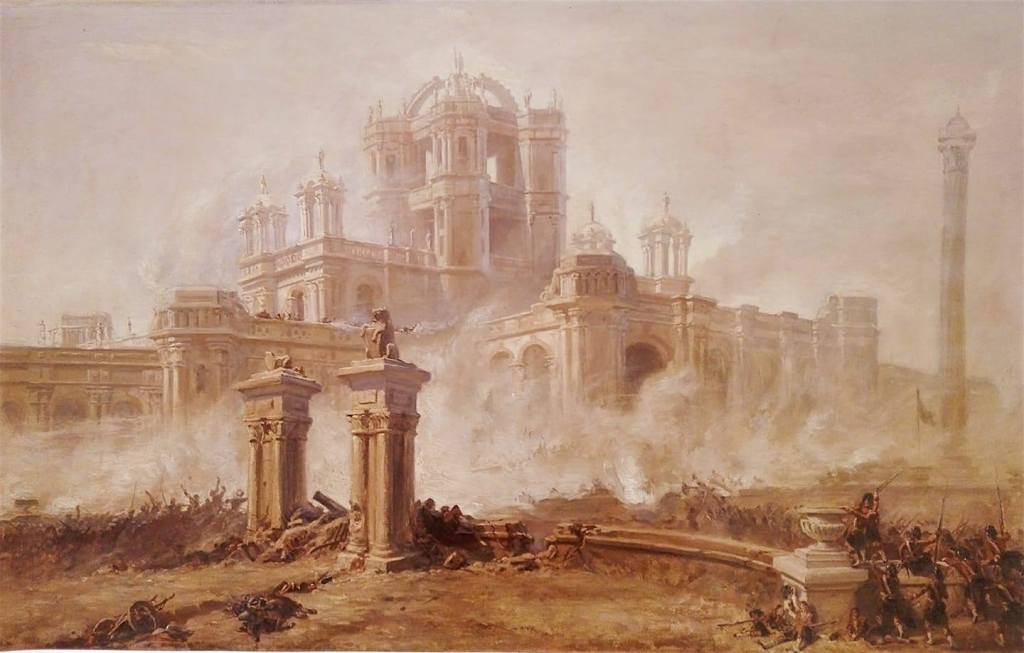
Lugard’s men had been waiting since early morning for the order to come, and time was wearing heavily on their hands: many had spent the time sleeping, others had taken the opportunity in the delay to eat their lunch. Screened by the Dilkusha, they had been listening to the progress from the right and the incessant artillery fire, but as for its progress, they had little idea. Now the 4th Brigade, with the 38th and the 53rd Regiments of the 3rd Brigade in support, leapt to their feet. The 42nd Highlanders would lead the attack.
Lugard’s orders from Sir Colin Campbell were very clear. The men employed in the attack were to use nothing but their bayonets. There would be no rifle work until the position had been carried.
“This must be thoroughly explained to the men,” said Campbell, “and they will be told also that their advance is flanked on every side by heavy and light artillery, as well as by the infantry fire from the right.”
At 2pm, the Colours were seen waving on top of the Yellow Bungalow – Outram had reached his first goal, and Sir Colin Campbell sent word to Lugard to begin the advance.
“Through the din of the cannonade rise the words of command in the courts below us, ‘Forward! Forward! Forward!’ tapering away from company to company. The columns with their supports, accompanied by horse artillery, emerged from their cover. The Punjabees and 42nd made a rush to take the enemy in flank, and the 93rd, extended in skirmishing order, supported by the 90th Light Infantry, swept down the front. Their batteries continued to play on the advancing column, and from the trenches and rifle-pits there came a wild fire of musketry. But they were quickly cleared, and the rebels, abandoning the Martiniere, fell hastily back on their first line of works, from which they poured a very sharp fire of grape and musketry on the Martiniere Gardens.“
Without firing a single shot, the Martiniere was carried, but it was a hollow victory. Sir Colin Campbell had seen the rebels fleeing the building and the grounds for at least an hour before the rush, and by the time his men arrived at the doors, it was already empty. On seeing the Highlanders reaching their objective, Sir Colin descended from the roof of the Dilkusha, mounted his horse, and, followed by his staff, rode over to inspect his newly won post. While the building might indeed have been evacuated, by no means were the grounds surrounding it. They fired a parting volley of round shot at Sir Colin and disappeared. Shortly after, he climbed the winding staircase of the Martiniere and, from one of its many balconies, watched as Outram’s troops continued to move in splendid order. His artillery had unlimbered on a patch of sandy ground on the banks of the Gumti and was pounding away at the rebel defences. Meanwhile, Adrian Hope’s Brigade, seeming not content with taking the Martiniere, pushed forward to occupy the ground between the Martiniere and the right bank of the canal, followed by the 4th Punjabis.
The Badshah Bagh
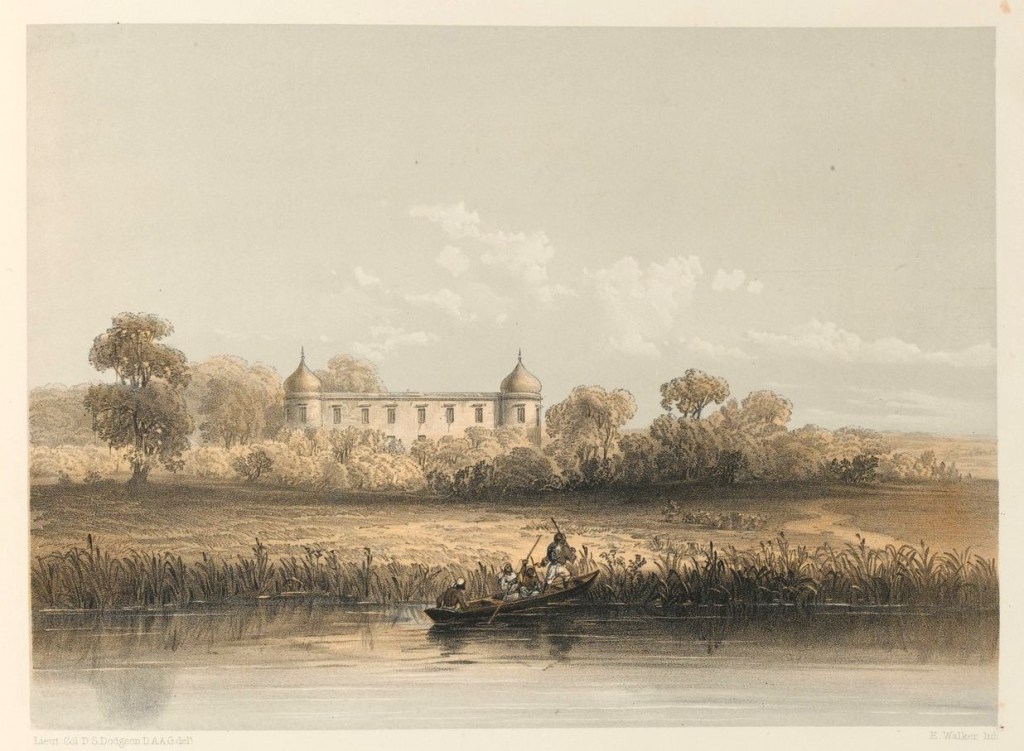
Outram had not stopped at the Yellow Bungalow and had instead driven the rebels through the old Irregular Cavalry Lines and the surrounding suburbs, all the way to the Badshah Bagh. With no hesitation, he ordered the heavy gates blown open, and his troops streamed in to find the rebels were not only gone but had left behind two of their guns. Surveying the position, it was deemed prudent to place in position on the extreme left at the bend of the river near the village of Jagauli, three guns and a howitzer to enfilade the outer line of the rebels’ defensive works along the canal. He then ordered two 24-pounders and two 8-inch howitzers to be positioned closer to the river to keep down the firing from the city.
Two companies of the Bengal Fusiliers under Captain Salisbury then moved to the left to protect the guns now busily enfilading the works along the canal. It was Major Nicholson of the Royal Engineers who noted, when the guns opened fire, that there was something quite odd about the works. He believed the lines were, in fact, deserted. Captain Salisbury now took a closer look with his spyglass and concurred with Nicholson’s observation, but felt someone needed to take a closer look. He proposed getting some boats and sending a party across the river. Nicholson considered this for a moment, but then decided it was too risky to diminish the force protecting the guns. Out of the blue, up came young Lieutenant Adair Butler of the Bengal Fusiliers. He would take four men down to the riverbank and call out to the Highlanders, barely 600 yards opposite them on the other side. They could then bring word to Sir Colin Campbell. The plan seemed like a good one.
Butler and the others reached the bank with no problems and commenced shouting at the Highlanders and the 4th Punjabis, but these took no notice. Seeing there was nothing for it, Butler took off his coat and, rolling up his sleeves, plunged into the river. It was only 60 yards wide, but the water was running swiftly – fortunately, Butler was a good swimmer and after a short struggle, he emerged on the other side. He quickly entered the works from the rear and leapt onto a parapet. There, waving his handkerchief and his arms furiously, managed to attract the attention of Sir Colin Campbell and his staff on their balcony at the Martiniere.
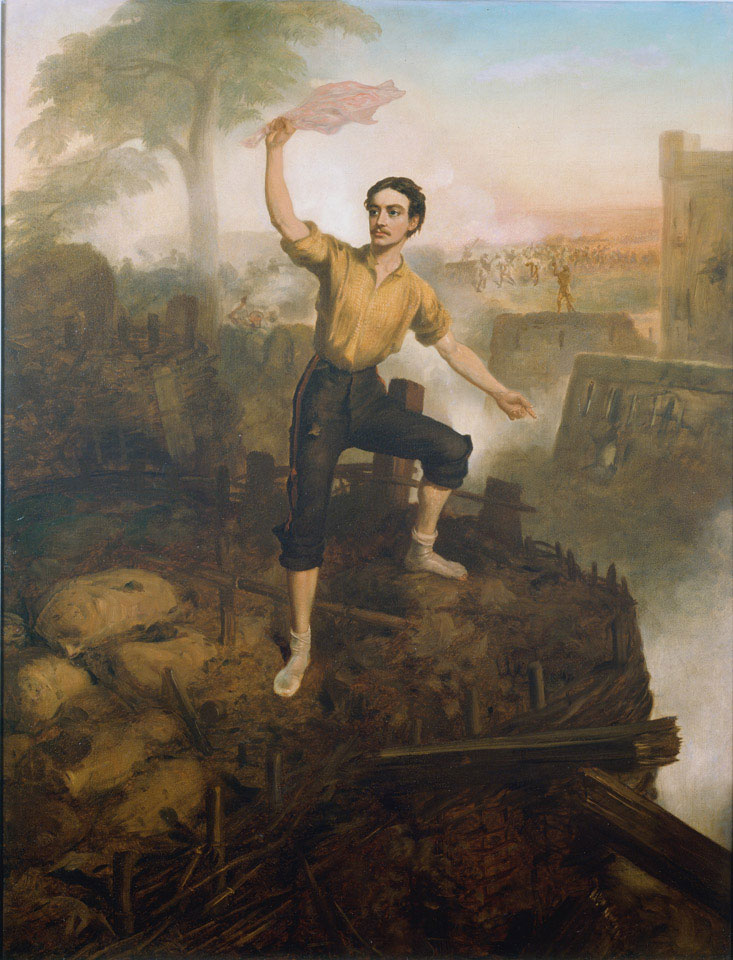
Sir Colin sent down a staff officer to find out what Butler was on about. The man arrived shortly after, and the lieutenant told him the works were abandoned and it would be prudent to send someone down to occupy them before the rebels attempted to return. The staff officer considered his words and then rode off to get instructions from the chief. In the meantime, Butler remained on the parapet, wet and cold with no means to defend himself, a perfect target for the rebels, one of whom, from a safe distance, took two shots at him. Butler signalled again; the situation was becoming hairy, even for someone of Butler’s cool demeanour.
Now, an officer of the 4th Punjabis advanced and asked Butler what on earth he was on about. The lieutenant repeated his observations and once again pointed out that someone really should take these lines. Without any delay, the officer ordered up a detachment of his men and those of the 4th Punjabis to secure the lines, and Butler, having handed over his charge, leapt back in the river and swam back to his own side.
While all this was well and good and Butler would receive the Victoria Cross for his actions, the next events did not please Sir Colin Campbell. The officers of the 4th Punjabis decided, on their heads be it, so they thought, they needed to discover if the lines were well and truly abandoned. With some caution and without orders from the C-in-C, they felt their way along the ramparts for some way in the direction of Bank’s House and then returned to the bastion nearest the river. If Campbell was angry with the Punjabis, he would be even angrier with others before the day was over.
“That night, pickets from the 42nd Highlanders were posted along the edge of the canal, supported by the rest of that regiment bivouacked in line some little distance in rear, and the 93rd Highlanders, also in line along the outer wall of the Martinière park. The next morning, we learnt that, notwithstanding Sir Colin’s orders, a picket under a Subaltern had crossed the canal during the night, and, not having heard that the enemy had deserted their works, established itself in one of the deserted bastions, under the impression that they had captured it. We heard that Sir Colin was very angry and pointed out, on the morning of the 10th, to those concerned, that the position had been abandoned the day before, and that he knew it. As in the case of the 53rd Foot at the Kali Nadi, however, it now became necessary to follow up this advance, although made contrary to Sir Colin’s orders. This was accordingly done, the 42nd being directed to occupy the first line of works early on the morning of the 10th .”
Another man was awarded a VC for the 9th of March, in a rather dubious claim by Alexander that a young Subaltern belonging to the 42nd had led his picket into the abandoned works, which would have been contrary to orders on the night of the 9th. He had crossed the canal had stumbled upon a position held by the rebels, and had valiantly cleared it before occupying it for the rest of the night. Sir Colin was given to believe that this was true and the young man received the VC for leading what was now being called a storming party up to a formidably defended wall, loopholed no less, defended at the top by “fierce and truculent turbaned warriors, in a storm of shot and bursting shells (three or four bursting all about his head!)- shells which would certainly have done as much damage to the defenders, who were supposed to have fired them, as to their British assailants.” No one credited that part of the story, and Alexander mistakenly attributed the picture he saw of the action as belonging to this action. This particular VC will be looked into in more detail in a following post. However, at the moment, no one was too concerned; there would be time for recriminations later. For now, Sir Colin Campbell had achieved his goals, and his plan for the taking of Lucknow was well underway.
Sources:
Forrest, G. W. A History of the Indian Mutiny. Vol. 2. Edinburgh & London: William Blackwood & Sons Ltd., 1904.
Gordon-Alexander, W. Recollections of a Highland Subaltern. London: Edward Arnold, 1898.
Grant, Hope. Incidents in the Sepoy War 1857-58, Compiled from the Private Journals of General Sir Hope Grant, K.C.B.. Edited by Henry Knollys. Edinburgh & London: William Blackwood & Sons, 1873.
Jocelyn, Julian R. J. The History of the Royal and Indian Artillery in the Mutiny of 1857. London: John Murray, 1915.
Kaye, John William, and G. B. Malleson. Kaye’s and Malleson’s History of the Indian Mutiny of 1857–58. Edited by G. B. Malleson. Vol. 4. London: W.H. Allen & Co., 1889.
Majendie, Vivian Dering. Up Among the Pandies: Or, A Year’s Service in India. London: Routledge, Warne & Routledge, 1859.
Outram, James. Lieutenant-General Sir James Outram’s Campaign in India, Comprising General Orders and Despatches Relating to the Defence and Relief of the Lucknow Garrison, and the Capture of the City, by the British Forces. London: Smith, Elder & Co., 1860. Printed for private circulation.
Russell, William Howard. My Diary in India, in the Year 1858-9. Vol. 1. London: Routledge, Warne & Routledge, 1860.
 Mutiny Reflections