Kotah was taken on the afternoon of 30 March, but not without loss. Pockets of insurgents continued to hold out in houses, and others made their valiant last stand on the city walls. The tenacity of one man to sell his life dearly certainly left an impression on all those who saw him.
He displayed “an instance of antique heroism…” As insurgent leaders were endeavouring to rally their men for one more charge, one of them rode his horse up with considerable difficulty to the top of the fortifications. All he could see was his men flying in every direction from another merciless onslaught, this time by the 95th Regiment of Foot.
“It became evident to him that before he could descend, the enemy would be upon him, and escape would be impossible. Choosing death, rather than the disgrace of falling alive into their hands, he gathered his reins and, plunging his armed heels into his horse’s sides, rode him at the parapet wall. The horse rose bravely at his last leap, and falling headlong with his rider a depth of 120 feet, both were crushed in one mangled mass together.”
The act, though horrifying to those who witnessed it, elicited respect from the British officers and men; it would have been honourable, they thought, to have this brave man and his horse buried with honours, but they were not the ones to do it. Instead, he was left at the bottom of the wall, as food for carrion birds and pariah dogs.
He was not the only man who had endeavoured to have a noble end, or at least not one at the end of a British bayonet. Near one of the towers, two men and their three horses were found — the horses’ legs were hobbled and tied together, as if an attempt was made to lower them from the top of the tower. Even Roberts noted in his official report that many of the insurgents were shot and bayonetted when his force entered the city but many more escaped by letting themselves down by ropes attached to the walls — others, he says, chose, like the man with his horse, to throw themselves over to be dashed to pieces below.
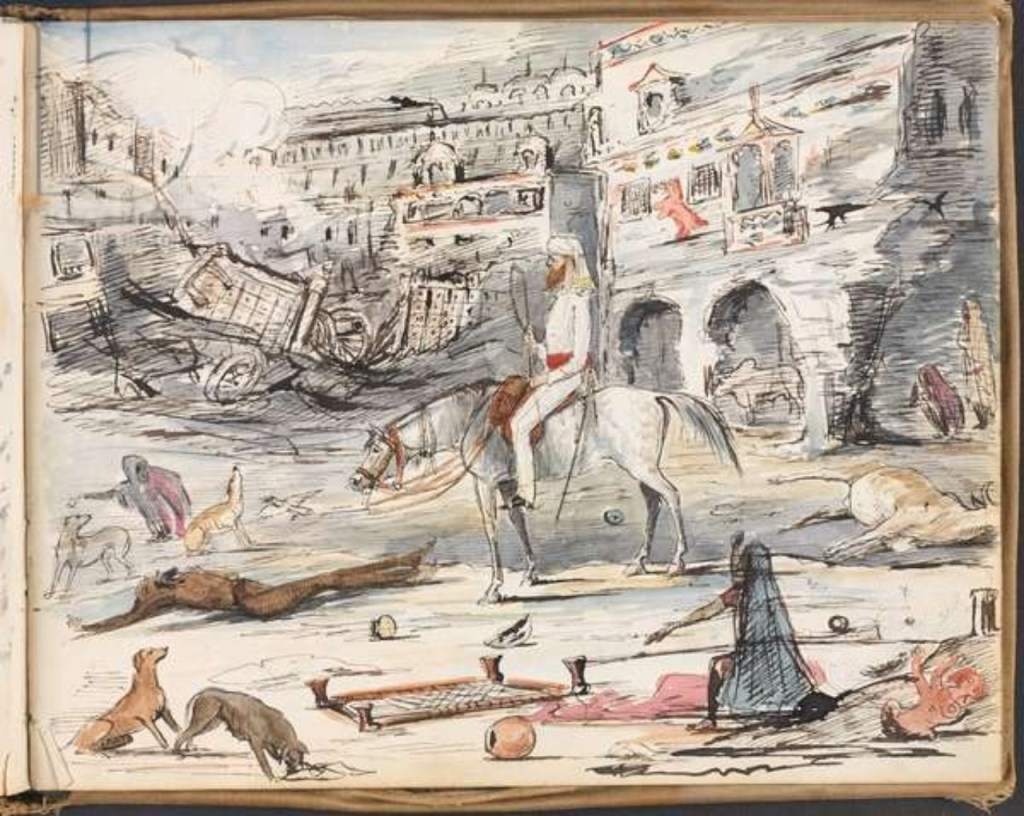
Kotah, after the assault, one of the street barricades, 1858 (drawing) by John North Crealock (95th Regiment)
The scenes in Kotah were dreadful. It was not just the horrors of war but the destruction of the place which shocked a young lieutenant of the 95th – John North Crealock – when he first entered the captured fortress.
“The first thing that came to my view was a sentry of the 95th standing over a huge pile of loot nobody being allowed to carry any away, pugarrees, brass chatties, cooking utensils, firearms, tulwars, spears, in fact everything from a parrot to an idol — beyond that such a scene of desolation not a square yard on the houses not broken by round shot, shell, or bullet. The stench thro’ the whole place was frightful; not a soul to be seen by wretched old women, haggard and wrinkled, groaning, moaning and shouting…”
The danger, as he had been told was far from over — every officer was told to only enter in the company of others, for well into the second day after the assault, officers, and men were still coming across final pockets of resistance as an officer and two men found out to their consternation when, employed in the disgraceful work of looting, were suddenly attacked and cut down.
Mrs. Duberly, too, entered Kotah on 1 April with her husband and two other officers. She was struck by the masses of plunder strewing the streets, causing their horses to pick their way gingerly over and around “cushions, garments, bedsteads, sofas, and Persian manuscripts.” The horses were unhappy with the path, and constantly shied and snorted — it did not help that the route was lined with old men and women, wailing in the misery of their surroundings, “alone left to mourn the city.” Bullocks roamed about, and boars, with tusks gleaming, vied with the pariah dogs to gorge themselves on the corpses lying unburied in the streets.
Kotah, before the advent of the mutiny, had been a city famed as an emporium of jewels, opium, and all manner of valuable merchandise; however, before Roberts’ men were let loose on it, the insurgents had done their best, over months, to plunder the place dry. All the prize agents managed to gather together after five days of looting turned out to be “inferior value, and hardly worth the miseries they cost the poorer classes, to whom they mostly belonged.” If the Rajputana Field Force was expecting to enrich themselves on plunder, they were much mistaken. All Kotah had to offer in abundance now, was the stench of death.
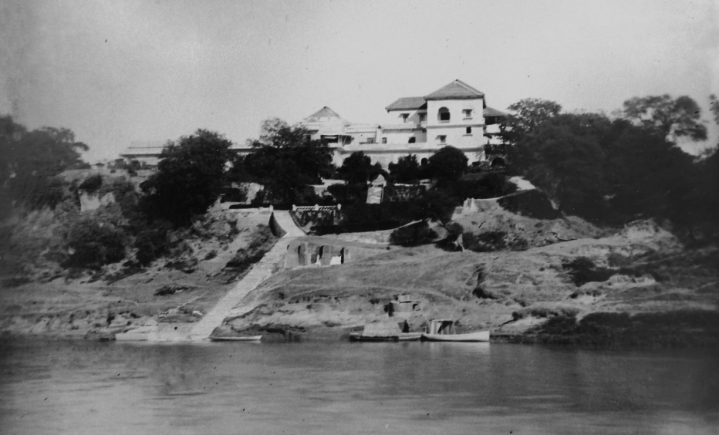
Mrs. Duberly and her party ventured to the Burton’s residency, and wandered through the rooms, and saw the “…supper room all smeared with blood…the blood stains are still visible on the floor where they fell,” she wrote, “and across which they were dragged, that their bodies might be flung to the populace below.”
Although the fighting in Kotah was ferocious and the retribution merciless, the Rajputana Field Force suffered astonishingly few casualties: officially, the returns noted the following:
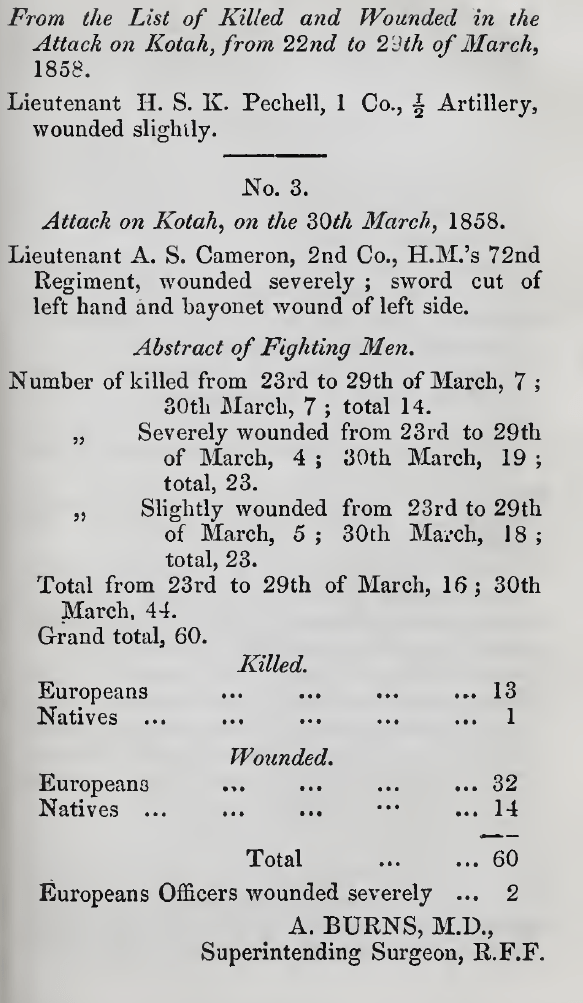
Of the casualties, those of Captain Bainbrigge and Captain Evelyn Bazalgette were most unfortunate. During the night of 31st, the third column was ordered to pitch their camp two miles down the river on the right bank, but hardly were the tents up when the 95th and the 10th Bombay NI were ordered to supply a company each for picket duty to the east, to occupy a village and entrenchment that been abandoned by the insurgents. With the company of the 95th went Captain Bazalgette.
On closer inspection, Bazalgette and Lieutenant Parkinson found the village was full of combustibles and had been used as a magazine by the insurgents. They had not been the most orderly of military men, for the powder was found to be lying about in heaps on the shed floors and in open bags. Bazalgette immediately sent word to Brigadier Macan, who answered by sending Brigade Major Bainbrigge to see what arrangements could be made regarding the explosives. The two men entered the village together when, quite unexpectedly, a native was seen running out of a long, low woodshed near where they were standing. A few moments later, came a blinding flash of light and a dull roar, which was said to have made the earth tremble.
“….suddenly from the woods on our right a bright lurid glare and a column of smoke first white then curling over and over in black volumes – we looked at each other with a nameless presentiment at our hearts…we knew from Bazalgette’s notes that the magazine was full of powder…it was soon confirmed that poor Bazalgette and Brownrigg had been blown up and killed with seven sepoys killed and wounded. The magazine there seems, but little doubt, was fired by a native, one was caught with a torch, he was instantly cut down and with three others caught and shot without benefit of judge or jury.” (Crealock mistakes Brownrigg for Bainbrigge.)
Mrs. Duberly, too, noted, concerning the same explosion, that, “A havildar and two men forming part of the guard, who happened to be in a shed inside the yard where the powder was, were blown to atoms. Two native sentries outside the wall never moved from their posts. They stood firm, although to have done so must have appeared to them certain and instant death. Strange to say, neither of them was hurt. They were especially recommended to General Roberts.”
Following the explosion, several ran out of the outlying areas of the village; many were sabred by Lieutenant Jenkins of the 8th Hussars, who happened to be riding nearby at the time. Lieutenant Parkinson, who was not with Bazalgette at the time of the explosion, killed the man who had set off the explosion; he died with the burning fuse still in his hand. He then proceeded to round up another 50 insurgents who had barricaded a neighbouring house. After a brief resistance, they were all captured and brought to the camp.
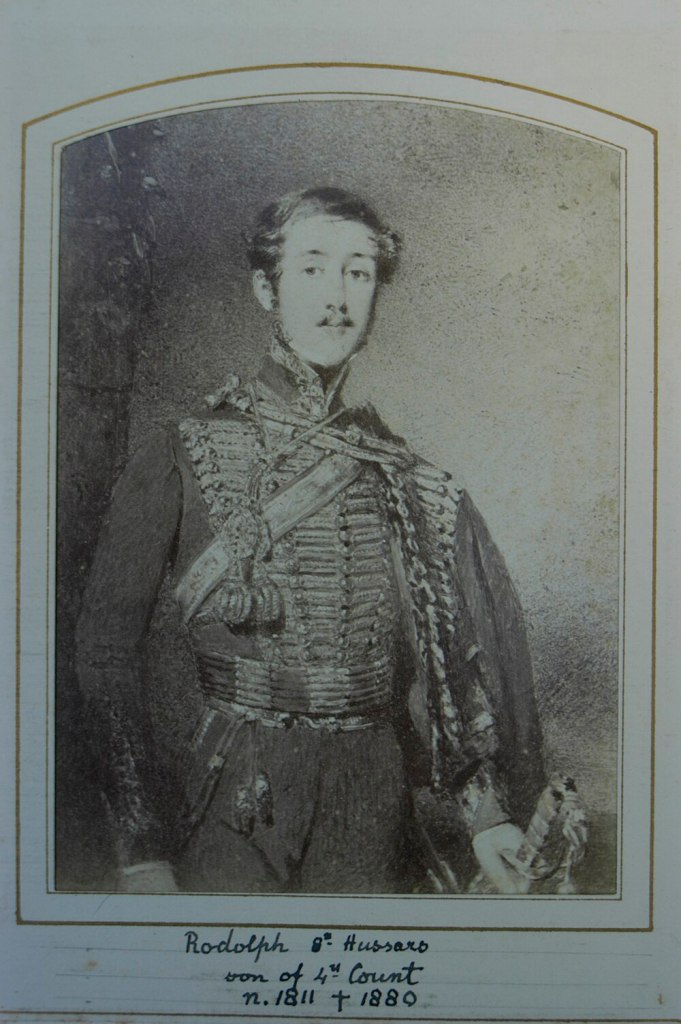
8th Hussars
Lieutenant Colonel de Salis – as a vicious stallion had broken his hand, he was unable to take part in any of the operations of the 8th Hussars before Kotah. (p. 452, History of the VIII).
The Hussars lost two men on the march to Kotah –
Lieutenant Helme – killed in a hunting accident at Bhuj. He was carrying his gun over his shoulder at full cock when he stumbled. The gun flew from his hand and hit the ground with such force it exploded, depositing the contents in Helmes’ body. He died instantly and was buried at Bhuj. He had only been wit the regiment for a year.
Sergeant Major Wilmer – seriously wounded, 4 March. Broke both legs below the knees by a vicious horse. He was sent back to Deesa by dhoolie, and although he recovered from the broken bones, he died subsequently at Mount Abu of pneumonia.
10th Regiment, Bombay Native Infantry
A sentry of the 10th Bombay NI – Shaik Kuddum – was distinguished for his courage and coolness following the explosion of the magazine that had cost Bazalgette and Bainbrigge their lives. He had been on guard over some tumbrils nearby, which continued to explode for another 10 minutes following the initial firing. Several of his guards had been killed, and although the very stores he was guarding could very well have spelt his end, he stayed where he was until he was found by Captain Ballard (AQMG), who galloped up on hearing the blast. He found Kuddum “marching steadily up and down on his beat, though covered with dust and rubbish and bruised by falling stones.”
23rd Bombay Native Infantry
Captain Robert Bainbrigge — Aged 33. Son of Colonel Bainbrigge, of Guernsey. Killed when the magazine was exploded by mutineers.
Robert Bainbrigge was commissioned as an ensign in the 23rd Bombay Native Infantry on 17 March 1841, promoted to lieutenant on 11 May 1843 and captain on 11 June 1854. Before proceeding to the Crimea, he had served as second-in-command of the Sawunt Warree Corps in 1853 and as their commander from 1 February 1854. In General Orders, dated 14 August 1855 at Sevastopol, he is listed as Captain Bainbrigge, attached to the 50th Regiment and is confirmed on the medal roll of the 50th Queen’s Own Regiment as “23rd Regiment Bombay Army, attached per Genl. Order 14 August 1855.” Following Crimea, Bainbrigge returned to India; in 1858, he was appointed Brigade Major, 1st Brigade Rajputana Field Force by Major General Roberts. His death, as that of Bazalgette, was horrifying.
“When the dust and smoke had cleared away, it was found that the shed had disappeared, while the bodies of the two officers had been literally blown into shattered pieces of humanity and were quite unrecognisable. Captain Bazalgette’s hand was identified, both by the ring which was found on his finger, and by the traces of the wound received at the Alma when carrying the Colours of the 95th…The remains of the two unfortunate officers were placed in one coffin (there being no possibility of getting more than one made in the time available) and were buried by torchlight that night in a grove of palms, Captain Carmichael, who had succeeded Bainbrigge as Brigade Major, reading the burial service. The funeral was attended by the whole of the 95th Regiment and the 10th Native Infantry, by all the officers of the Brigade, and by detachments from every corps in camp. The regimental Colour of the 95th, still stained with his blood when wounded under it at the Alma, was used as a pall to cover the coffin containing poor Bazalgette’s remains.’ [and those of his companion, Captain Bainbrigge].
His parents erected a memorial at St. Andrews Church, La Route de St. Andre, Channel Islands – “To the memory of Captain Robert Bainbrigge, 23rd Regt Bombay Native Infantry, second son of Colonel Bainbrigge of the Rohais Manor, in this parish, killed April 1st 1858 in his 34th year in the zealous performance of an important duty, by the treacherous explosion of the enemy’s magazine, after the assault and capture of the fortress and city of Kotah. This excellent and energetic young officer, after an active service with his regiment in India, or in charge of an irregular corps, the Sawant-Warree, obtained leave of absence, joined the Allied Army in the Crimea, commanded a Company during the latter part of the siege and fall of Sebastopol. On the breaking out of the mutiny in Bengal, Capt. Bainbrigge returned to his own Presidency and was appointed to the Staff of the Bombay Army as Major of Brigade in the Rajpootana Field Force. This tablet has been erected by his sorrowing parents.”
72nd Regiment of Foot
Lieutenant A.S. Cameron – severely wounded in the hand – Cameron was wounded when leading a small party of men against a determined party of insurgents, who had barricaded themselves in a house. One man of the 72nd, one of the Royal Engineers and one of the 83rd, who happened to be with the party, were killed. One private of the 72nd was wounded.
Privates
Elders, John – killed in action
Fraser, Alexander – slightly wounded
Gibson, James – dangerously wounded. Died of wounds, 31 March
King, James – severely wounded
McKenzie, Colin – slightly wounded
Noble, William – killed in action
Risk, Robert – slightly wounded
Roach, David – slightly wounded
Steele, John – slightly wounded
White, Thomas – slightly wounded
83rd Regiment of Foot
Sergeant James Abbott – slightly wounded, 28 March
Privates
Bee, Christopher – slightly wounded
Beehan, Patrick – slightly wounded, 28 March
Cooper, John – severely wounded
Dobbie, James – killed in action, 28 March
Dunn, John – severelyy wounded, 27 March
Haddick, Thomas – severely wounded
Hensan, Edward – slightly wounded
Hughes, Patrick -killed in action, killed in action, 28 March
Murphy, William – killed in action 27 March
Sullivan, Edward – severely wounded
Temple, Robert – killed in action
Williams, John – slightly wounded, 27 March
95th Regiment of Foot
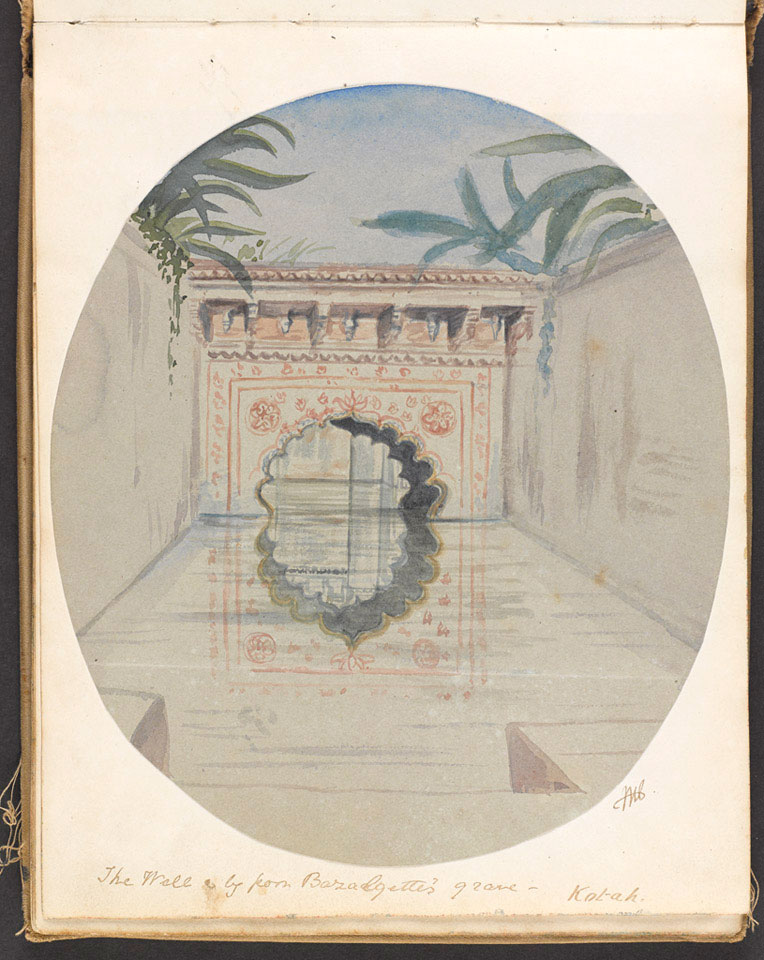
Captain Evelyn Bazalgette – killed in action – son of Colonel Bazalgette, who was for many years a resident of Halifax, Nova Scotia, had in all six sons, all of whom joined the army, Canadians in the Imperial Service.
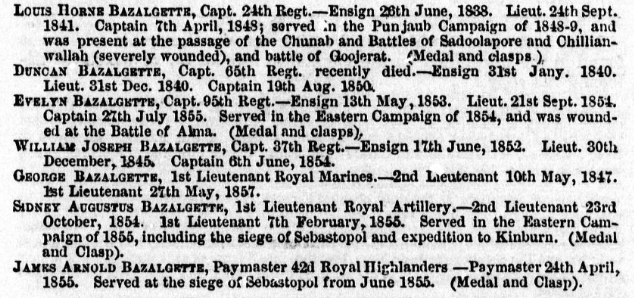
The night before the assault on Kotah, Bazalgette told Colonel Raines he felt sure of being killed the next day and asked him to see to it that his sword and other personal items would be sent to his relations. The colonel laughed at the “presentiment” but Bazalgette apparently shook his head and said he was certain he was going to his death.
Once the assault was over, Raines was pleased to find Bazalgette alive and well, but the captain was certain it was only a respite – he had had a narrow escape when his right-hand man had been badly wounded; he felt his number, as such, was as yet to be called.
Memorial at Kotah
Sacred to the Memory of Captain Robert Bainbrigge, 23rd BNLI Brigade Major and Captain Evelyn Bazalgette, HM 95th Regt, who on the 1st April 1858 in the execution of their duty together met with a sudden death by the explosion of one of the enemy’s magazines in the neighbouring village two days after the assault and capture of Kotah under the command of Major General Roberts.
Privates
Grady, Owen – dangerously wounded at Rowa, 6 January
Green, George – killed in action
McQuirt, Bernard, VC – dangerously wounded at Rowa, 6 January
O’Neill, Patrick – mortally wounded
Royal Artillery
Lieutenant H.S.K. Pechell – slightly wounded (attached, Bombay Artillery)
Gunner James Darby – killed in action, 26 March
Royal Engineers
Lieutenant J.P. Mcquay – wounded at Rowa, 6 January
Sappers
Bones, Charles – wounded at Auwa, 21 January
Bowman, Thomas – wounded at Auwa, 21 January
Brown, James – killed in action
Henderson, Robert – dangerously wounded. Died of wounds 4 April
Lambert, Joseph – dangerously wounded. Died of wounds.
McColl, John – severely wounded
Pound, William – wounded, 28 March
Shergold, James – severely wounded
Thomas, James P. – severely wounded
Walker, Edward – severely wounded
Williams, Johnathan – severely wounded
Young, John – dangerously wounded
Bombay Engineers
Second Lieutenant Charles Hancock – mortally wounded in an explosion. Died of wounds 15 April. Aged 21. Son of Major-General Hancock, Bombay Army.
I have lived my life, and that which I have done
May he Himself make pure! But thou,
If  thou shouldest never see my face again,
Pray for my soul.  - Morte d'Artur
Sources:
Behan, T. L. Bulletins and Other State Intelligence for the Year 1858. Vol. II. London: Harrison & Son, London Gazette Office, 1860.
Duberly, Mrs. Henry. Campaigning Experiences in Rajpootana and Central India during the Suppression of the Mutiny, 1857-58. London: Smith, Elder & Co., 1859.
Forrest, George W. A History of the Indian Mutiny. Vol. III. London & Edinburgh: William Blackwood & Sons, 1902.
Hill, George William. Nova Scotia and Nova Scotians: A Lecture Delivered Before the Literary and Debating Society of Windsor, N.S. and Afterward at the Temperance Hall, Halifax, in Behalf of the Athenæum. Halifax: James Bowes & Sons, 1858.
Historical Records of the 72nd Highlanders, 1777-1886. Edinburgh: William Blackwood & Sons, 1886. Printed for private circulation.
Intelligence Branch, comp. The Revolt in Central India 1857-59. Simla: Government Monotype Press, 1908.
Memoirs and Services of the 83rd Regiment from 1793 to 1907. London: Hugh Rees Ltd., 1908.
Murray, Robert H. The History of the VIII King’s Royal Irish Hussars 1693-1927. Vol. II. Cambridge: W. Heffer & Sons, 1928.
Raines, Julius. The 95th (The Derbyshire) Regiment in Central India. London: Swan Sonnenschein & Co., 1900.
Links:
Captain Robert Bainbrigge: https://www.noonans.co.uk/auctions/archive/past-catalogues/505/catalogue/351878/?keywords=Bainbrigge&x=0&y=0
 Mutiny Reflections