The 31st of May
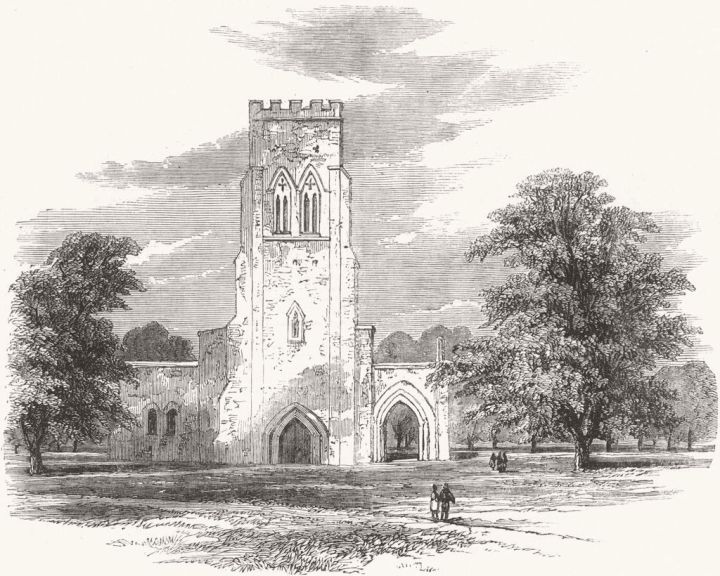
As it was Communion Sunday, a larger-than-usual congregation was expected at the Church of St. Mary. The churchgoers rose and dressed, ready for the service, which, owing to the hot weather, would begin at 6:30. Promptly at 6, the bells rang out. Some made their way to the church in their buggies or on their horses; others proceeded on foot. The church was situated on the south boundary of the cantonment, in an old mango tope, known as Dundabagh. It had three entrances: one to the south, with its attached portico overlooking a large compound known as Bullers; another to the west, just under the steeple; and the third was the vestry door to the north. The only other openings were windows. A narrow staircase led up to the steeple from outside the west face of the church; to the east were only open fields.
To the west, across an open field, lay the civil station, while the parade ground stretched away to the north, all the way to the lines of the 28th. The officers’ bungalows were scattered along the edges of the parade ground, and all of them lived there, except Captains Lysaght and Sneyd, who preferred residing in the Mess, which was conveniently located in Buller’s bungalow, south of the church.
As soon as the congregation assembled, the sepoys of the 28th BNI made their appearance. Fortunately for the congregation, it was but a half-hearted attempt at murder and mayhem.
A small party of the 28th BNI, some six or seven men armed with swords and lathis (long, stout sticks), stormed into the church. Reverend John MacCallam attempted to remonstrate with his attackers, but to no avail. Injured in the confusion, he managed to flee to the river with Assistant Magistrate and Collector of Shahjahanpore, Mr Arthur Chester Smith, where they remained hidden until nightfall. Mr Mordaunt Ricketts, slashed by a sepoy, managed to gain access to the outer vestry door. Here, he was cut down and slain. He had been verily cut in two – a blow from a tulwar had descended diagonally through his trunk, taking his head and right hand with it. A clerk in the Magistrates’ office, Mr John Robert Le Maistre, was killed where he sat. A writer, Mr Lavater, was killed in the church, but in the confusion, his wife, sister-in-law and daughter were saved by the regimental band master, who bundled them out of the building. Inside, while the congregation rushed about, the sepoys entered and made one swift run up the aisle – one sepoy aimed a blow at Lieutenant Scott, but his mother threw herself over him, receiving a blow to the ribs that was smartly turned by her corset. Several of the congregation, somewhat swifter on their feet than others, managed to get to the vestry and barred the doors while the officers bundled the ladies into the belfry. Outside, Lysaght and Sneyd, who had emerged from their bungalow, were heard shouting to the men, “Bàbá log, bábá log kyá karta? – “My children, what are you about?” The sepoys who had come out of the church were not listening. They had just realised that, armed as they were, they could not smash their way through into the vestry, and returned to their lines to collect their muskets. It was a brief respite but a vital one. Lysaght and Sneyd quickly gathered up their arms, buckled on their swords and rushed to the church.
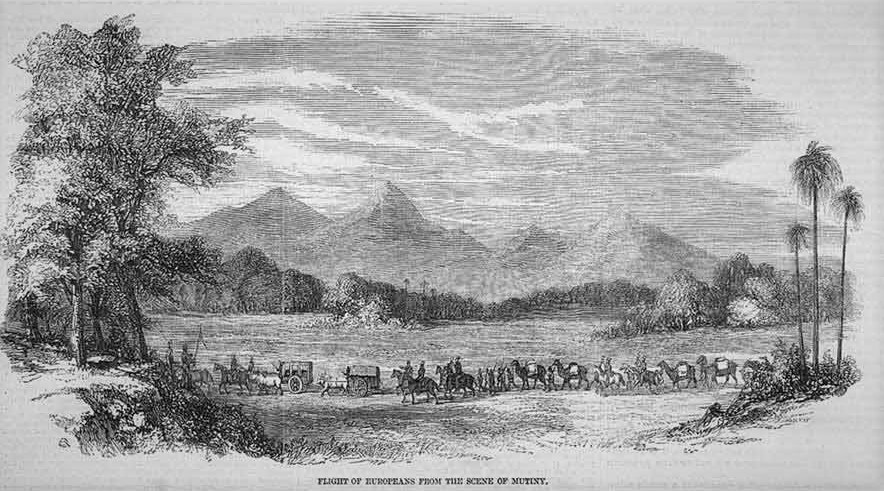
In the lines, Captain James was shot on the parade ground, as he too tried to reason with the men. “They asserted that they were not such great traitors, for they had served the Government faithfully for 20 years. As he turned away in disgust, they shot him.” Surgeon Henry Hawkings Bowling was returning from his morning visit to the hospital, unaware as yet of the outbreak. Finding the regiment in rebellion, he quickly organised an escape with his wife, child and European servant. His idea was to make something for the church. Mounting the carriage beside the coachman, he was shot dead by a sepoy. Another bullet wounded his wife, but she managed to reach the church on time to join the other fugitives on the flight from Shajahanpore.
As to the reverend and Mr. Smith. Waiting until nightfall to leave their hiding place, Mr. Smith went to the house of Mr. Ricketts. Here, he was found by the sepoys and murdered. The clergyman decided to try something different. Seeing some men weeding in a nearby field, thought he might induce them to help him. “He accordingly left his hiding place and offered them money if they would assist him…No sooner did they see the money than they rushed upon the unfortunate man with their sticks and, knocking him down, commenced beating him to death. His cries attracted the attention of a Pathan in a neighbouring village who, armed with sword, rushed up a severed his head from his body…”
Killed at Shahjahanpore:
Mordaunt Ricketts, Esq., Civil Service. Magistrate of Shahjahanpore.
” Syud Amjad Ali, Tahsildar, who, on hearing the firing, had hastened to the spot, found Ricketts’ body in the church. The sword cuts on the head and neck were so terribly severe that death must have been immediate. The bodies were treated with all respect and carefully buried by the Syud.”
His wife, Jean Mary (née Tayler), had been sent to Naini Tal in May, as her husband was concerned for her safety. They had married in Agra in May 1852. She was the sister of Elizabeth Helen Grant, the wife of Sir James Hope Grant.
Dr Bowling, Civil Assistant Surgeon – killed while driving up to the church
Captain Marshall James, 28th BNI – aged 37 and the only son of Lt-Col. James, EICo, of Saltford House, Bath.
Mr Shields, Timber Agent
Mr Brand, Sugar Boiler
Mr LeMaitre, Clerk, Magistrates’ Office and sister
Mr Smith, Head Clerk
Mr Lavater – writer
The following made their escape from Shajahanpore:
Captain Henry Wilder Lambie Sneyd – He was born in India in 1823, the son of Captain Edward Carncross/Cairncross Sneyd, Bengal Army. He joined the service in 1840. Captain Lysaght was married to his sister, Anne. Their father drowned in Akyab, Burma, in 1826, serving with the 6th BNI.
Captain Cornelius Lysaght and wife. His wife was Anna M. Sneyd, whom he had married in Ambala in 1854. She was the daughter of the late Capt. Edward Carncross Sneyd of the Bengal Army. He was the son of J. Lysaght of Ennistymore, County Clare, and was born in 1819. He became an ensign in 1840.
Captain Mordaunt Money Salmon was the son of Lieutenant-Colonel William Broome Salmon of the 58th BNI. He was born in India in 1823. He became an ensign in 1842. Captain Salmon was related, through his mother’s side, to the family of Andrew Wilson Hearsey.
Lieutenant Alexander Key and his wife, Mary Ellen Jane, second daughter of the late Lieut-Colonel Walter Rutherford/Rutherfurd, Bengal Army 28th BNI. Key was the Eldest son of John Key, Grosvenor Place, London, born in London in 1833 and educated at Chudleigh and Rugby. They married at St Mary’s Church Shahjehanpore on the 12th of November 1856, the Reverend F. Fisher, Chaplain of Fatehgarh, officiating. Lieutenant Colonel Rutherford died Allahabad on 22 May, 1856.
Lieutenant George James Johnston
Lieutenant Colin Alexander Robertson
Lieutenant Charles Frederick Scott, mother and sister. He was the son of Major Thomas Hare Scott, 38th BNI, the superintendent of family money and paymaster of the Native pensioners in Oudh and Cawnpore from 1842 until his death at Lucknow in 1851. Charles Frederick was born in Calcutta in 1832 and was educated at Rurki.
Lieutenant William Wilberforce Pitt – the son of W. G. Pitt, a banker and was born at Cheltenham in 1883.
Lieutenant George William Rutherford– the son of Lieutenant-Colonel Walter Rutherford, 28th BNI, born at Neemuch in 1837. His sister was married to Lieutenant Alexander Key.
Lieutenant John Hope Spens – Aged 21. He was the only son of Dr. Thomas Spens of the Bengal Establishment, born in Edinburgh in 1836. His father predeceased him, succumbing to disease in Calcutta, aged just 33, where he lies buried.
Lieutenant Edmund Cadell Scott – Aged 18 years and 2 months. Son of Major George Dennistoun Scott, of Winkfield, Berkshire. His father had served at Seringapatam, Mysore and resigned his commission in 1829. The young lieutenant had some rather large shoes to fill – his grandfather was Major General James George Scott of the Madras Artillery.
Assistant Quartermaster Sergeant Grant, his wife and three children
Bandmaster of the 28th Regiment
August Schlottauer, drummer boy
Mrs. Lillie
Mrs. Bowling and her child, a daughter named Effie
Mrs. Pereira and four children
Lieut. Shiels, Veterinary Establishment, and his wife
Mr. Charles John Jenkins, C.S.
Mr. Hurst
Mr. A.C. Smith, Assistant Collector
 Mutiny Reflections
Another extraordinary episode.
LikeLiked by 1 person
Shahjahanpore ended in dreadful tragedy, and every single one of those who escaped was murdered on the road. While the main focus of 1857 has always been Delhi, Cawnpore and Lucknow, many of these small miseries are forgotten. The story continues here: https://mutinyreflections.wordpress.com/category/shajahanpurmuhamdi-and-sitapur/
LikeLike