Etah in May
“I was suddenly cured of my state of nervous depression, and restored to perfect health, by the Sepoy Mutiny of 1857.” – A.L.M. Phillips
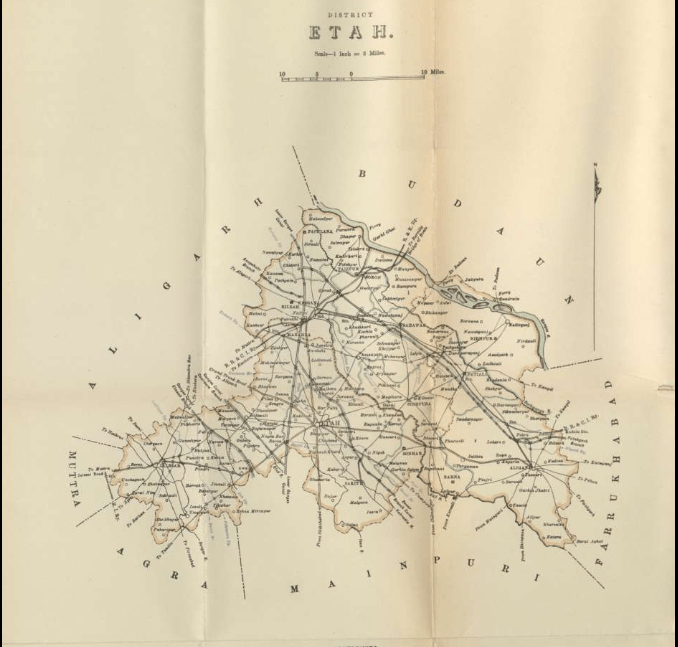
Since January 1856, Mr. Phillips had been overseeing the Etah district, midway between Aligarh and Etawah, as Magistrate and Collector — it was his first independent posting, and he was on his own. He was in charge of “the whole administration of the district, in all the different departments, including police, criminal, revenue, rent, roads, bridges, public buildings, jail, prisoners.” The workload, as we have seen in “District Collectors and Magistrates,” was not unusual for civil officers at the time, and it was expected that they should manage their districts competently, quietly and, above all, economically. His office hours were “fixed by a very simple rule, being just as many hours as I was not in bed.” Though gruelling, the work was interesting, and Phillips meant to make the best of it. He lived in solitude, and his life was his work. Even in a place as lonely as Etah, Phillips had heard of the outbreaks at Barrackpore. He was aware that if the regiments in the North-Western Provinces were to follow their example, he and the other civil officers would have no means of stopping them.
Between March and May, they did put on a brave face and worked as if nothing at all had happened. Phillips had one bit of luck — there were no regiments stationed at Etah, and the nearest infantry regiment, the headquarters of the 9th BNI, was at Aligarh, some forty miles away to the west. There were detachments at Etawah to the east and at Mainpuri to the north. However, Phillips knew if mutiny broke out at Aligarh and Etawah, his district would certainly go up in flames. For now, all he could do was double the patrols along the roads, arrest anyone who behaved suspiciously and keep up steady communication with the other stations nearby.
What the telegraph was for the larger stations like Delhi and Meerut, the post did for Mr. Phillips. Every day, he received messages from Aligarh. Mainpuri, Agra and Fatepur via express service and answered in return by the same. On the 20th of May, however, the express did not arrive from Aligarh, and he knew the game was up. A sergeant from one of the patrols returned and informed Mr. Phillips he had met a body of sepoys of the 9th BNI, and they were on their way to Etah.
Still at his post in Etah, Mr. Phillips waited for news from Aligarh. He was no longer alone, having recently been sent an assistant, a nervous man, whose company Phillips would rather have done without, named Mr. Hall. They had been warned already that the mutineers were on their way to Etah, and late in the evening on the 21st of May, a native officer of the 9th BNI paid a visit to Mr. Phillips at his home.
“He was civil enough. He told me the regiment had risen, but they had not hurt their officers. He and his company were on the way Mynpooree, and then, when all were united, he would march to Delhi. He, he said, had to report himself on the way. I was not sorry to see him and his company depart.”
Realising the precarious nature of his position, Phillips used the next two days to organise himself. He entrusted his books, horses, valuables and the terrified Mr. Hall into the care of Raja Dilsukh Rai. The patrol came back on the 24th and informed Phillips the mutineers were no longer keen to talk. Finding it safer to put some distance between himself and them, Phillips gathered his small force together and left Etah to wait for further intelligence, placing just three miles between himself and the station to wait for news.
When it finally came, it was as he had feared. The mutineers had first searched Etah for him, but finding him gone, they had plundered what was left of his household and set the bungalow on fire. Then they opened the jail and released the prisoners before resuming their march to Delhi.
Phillips, with his escort of 18 magistrate’s police sowars — “quasi-military cavalry, armed but only partly disciplined” and their commanding jemadar, moved on to the village of Bilraon, a mere two miles from the next large town of Kasgunj, where Dilsukh Raj was still hiding Mr. Hill. In Bilraon, Phillips intended to rest and make plans, but an urgent message reached him from Kasgunj – “the people, entreating me to come to their relief, for that the men of the surrounding villages, headed by their zemindar and aided by numerous sepoys, had collected their forces and were preparing to plunder the town.” Of course, Mr. Phillips could have turned and run, as would have been sensible. Instead, the next morning, he would do something extraordinary instead.
“I got my sowars together as soon as possible and speedily reached the town. I had arrived at the centre of the town, where four crossroads meet, and was waiting for further intelligence when I saw a singular sight. This was a compact body of men, marching in my direction up one of the main streets of the town. The front ranks (for they marched in a kind of military formation) were armed with muskets and wore uniform belts. I suppose there could not be altogether less than 300 of them. They were a considerable distance off when I first saw them.
I asked the jemadar, ‘Who are these?’ ‘
These?’ said he, ‘these are the bulwah, (the levy), who have come to loot the town!’
Still, they advanced, till, when they caught sight of us, I thought I saw some hesitation in their front ranks. Calling on the sowars to follow, we made a headlong charge down the street. The levy (so to call them ) fired divers guns at us as we came on, but without any injury. The sowars and the jemadar behaved like trumps. A good many of the mob were killed, and among them two of their leaders, and the remainder entirely dispersed.”
Mr. Phillips stayed for three days in Kasgunj. He then crossed the Ganges to Budaon, the district under the control of his cousin Mr. Edwards. Phillips’ intention was to get help from the next largest station, Bareilly, with the hope of procuring a detachment of Irregular Cavalry and returning to Etah. Reaching Budaon on the 27th of May, Edwards disabused Phillips of his last hope; Edwards himself had been writing to Bareilly but had been repeatedly rebuffed — Bareilly had no troops to spare.
Sources:
Anecdotes and Reminiscences of Service in Bengal – A.L.M. Phillips (1859)
Narrative of the Indian Mutinies of 1857: Compiled for the Compiled for the Madras Military Male Orphan Asylum (1858)
Annals of the Indian Rebellion – Noah Alfred Chick (1859)
History of the Indian Mutiny, 1857-1858 – Colonel Malleson (1880)
A History of the Indian Mutiny, reviewed and illustrated from original documents, Vol. III – G.W. Forrest (1904-1912)
Etah: A Gazetteer, Vol XII by E.R. Neaves I.C.S. (1901)
 Mutiny Reflections