Budaon, May and June 1857
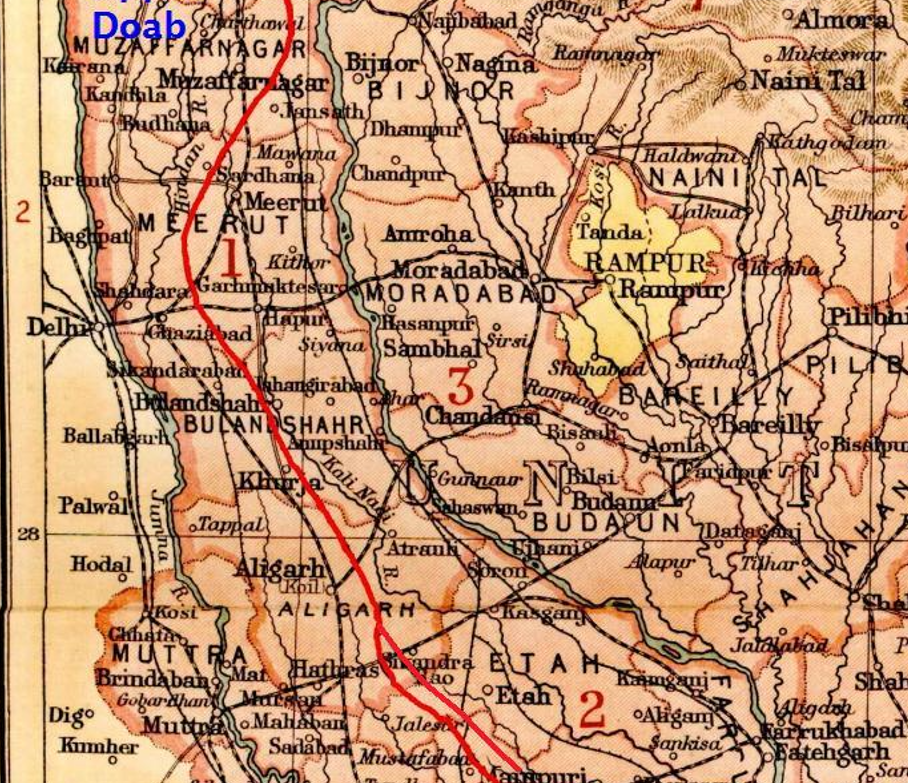
Around the 19th of May, the “spirit of disorder” showed itself in the Budaon district in Rohilkhand. Bands of marauders had started terrorising the countryside, plundering travellers and pillaging villages. Rightly alarmed, the magistrate and collector of Budaon, Mr William Edwards, packed his wife and children off to Naini Tal – not a moment too soon – they passed safely through Bareilly a week before the mutiny there, arriving with no adventures at the safety of the hill station.
Edwards had done all he could to protect his district – he doubled the police force, both horse and foot, but he was unable to contain the lawlessness. He was still in contact with his cousin, Alfred Phillips, in Etah. However, communication with Agra, Calcutta and the south had been cut, and the dak runners were unable to carry messages along any of the principal roads, but an ominous message from the joint magistrate of Moradabad did reach Edwards. He was informed that one of the liberated convicts was a “notorious villain” named Nujoo Khan, whom Edwards had personally arrested (having hunted for him for 2 years) after the man had tried to murder Mr Court, the previous joint magistrate. As he had succeeded in maiming Court for life, Khan was sentenced to transportation – now that he was free, he was intent on murdering Edwards and, according to Campbell, was on his way to Budaon. As the only European in a district of just over 1 million people, Edwards was more than overjoyed when, on the 27th of May, as Edwards sat down to his lonely dinner, his cousin, Alfred Phillips, rode up to his house.
Although he was no longer alone, the state of affairs in Budaon went from bad to worse. While rebels attacked the town of Bhilsea, Edwards, who had no force at his command except a few policemen and no officer to trust the treasury to, sent an impassioned letter to Bareilly requesting assistance. There was no reply. Budaon remained restless, and Edwards found that no matter how much he wanted to, duty prevented him from leaving. Saving his own skin, for the moment, was the last thing he could do. As long as his office remained open, Edwards hoped his presence would be enough to stave off an uprising.
On Sunday, the 31st of May, Edwards assembled his “little congregation” of Christian converts for what he felt was the last time on earth. As he closed the service, a note arrived for Phillips – the Joint Magistrate of Fatehgarh, one Mr Bramley, was to be at Patealee, in the Etah district, the next day. He was bringing with him 2 regiments to restore peace in the district. Overjoyed by the prospect, the two men decided Phillips should proceed immediately to Patealee, and as soon as he was done with punishing the rebels in his district, he should send the regiments to help Edwards deal with his.
The news only seemed to get better. A letter was received during the night from Bareilly; a company of the native infantry was coming to Budaon under the command of a European officer. Edwards was busy thanking Providence his station would be saved – he sent off a horseman with a note to the commanding officer of the detachment begging him to push on with all haste while he organised carts to bring the men the last half of the so they would not have to march through the night and would be fresh and ready to proceed to Bhilsea without any delay. Phillips, content that he was not leaving Edwards completely in the lurch, arranged to depart Budaon at 3 in the morning.
Williams woke early, intending to see Phillips off. Yet a note brought in from a chaprassi shortly after 2 in the morning changed everyone’s plans. The horseman Williams had sent out to meet the Bareilly detachment had just returned with the worst news possible – the road from Bareilly up to eight miles of Budaon was crowded with escaped convicts, and the brigade was in full march on Budaon.
The excited rider and his exhausted horse were soon standing in front of Edwards. The regiments in Bareilly had mutinied on Sunday morning, massacred the Europeans, destroyed the station and broken open the jail. They intended now to do the same to Budaon, and the few men Edwards had guarding the treasury were going to help them. Edwards immediately woke Phillips.
Phillips called for his horse and mustered the followers he had brought with him from Etah. In ten minutes, he was flying down the road, hoping to reach the ghats across the Ganges before the mutineers or convicts who would otherwise prevent his return to Etah. Edwards chose to stay in Budaon, a case of duty over life.
He gave instructions to the town policemen to keep the convicts out of Budaon as long as possible, at least in any case, until the Bareilly mutineers showed up. After that, Edwards knew the town would be lost.
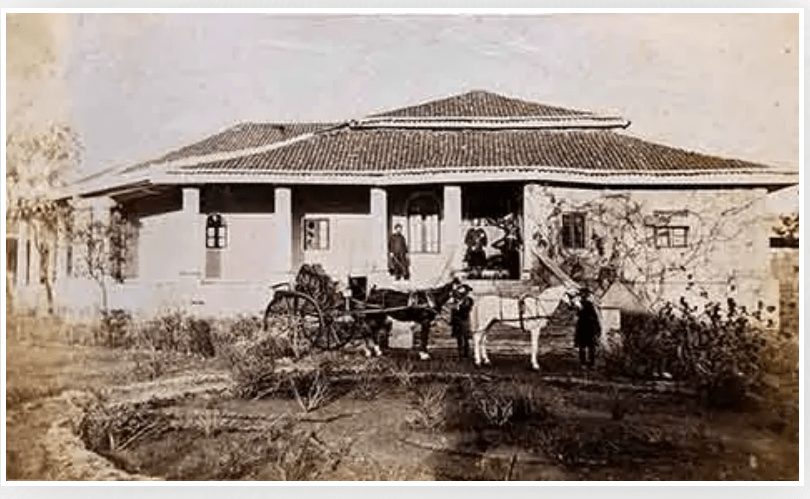
At 10 a.m., Edwards was suddenly joined by Mr Donald and his son, indigo planters. They had come to Budaon seeking protection – their factory and lives had been considerably threatened, forcing them to flee. Mr Gibson, of the Customs Department and on temporary duty in the district, put in his appearance, as did Mr Stewart, a clerk, with his wife and family; all came to Edwards, entreating his protection. He grudgingly let them into his house.
The situation now was different – alone, Edwards knew he could rely on his Indian friends in the district to protect him, and unencumbered, he was at will to flee or stay at his recognisance. Impeded as he was now by not just planters and clerks, he had women and children to consider. The group, in his estimation, was too large, and none of his well-disposed friends would now be willing to give all of the shelter. On the 1st of June, after collecting his guests in the drawing room, he “earnestly advised the 2 Donalds, Gibson and the Stewarts to leave me and make for the hills, while there was yet time, pointing out that our safety was far more endangered by remaining together and attracting attention than by separating.” Edwards tried to impress on them he was obliged to stay at his post as long as he could, but they were not and could leave at will to consult their own safety. Unfortunately, no one was willing to listen to Mr Edwards. To his infinite irritation, not a single one chose to leave, paralysed as they were by fear and seeking strength in numbers.
Towards sunset, the treasury guard broke into an open mutiny. The first objective was to open the gaol, after which they sent word to the Bareilly rebels that Budaon was theirs if they wanted it. At the same time, all of Edwards’ policemen threw away their badges and joined enthusiastically in the ensuing destruction. For the moment, no one thought about William Edwards.
Realising his ship had indeed sunk, Edwards mounted his horse, and followed by the indigo planters and Mr Gibson, he rode away from Budaon.
The road to Moradabad and the passage to the hills lay through the town of Budaon, now in a blaze and full of mutineers – the road around the town was full of convicts. His hope lay with the influential chief of Shikapura – a personal friend – who advised Edwards to forget either route and come straight to his house. Leaving the Stewarts behind in the care of a friend in the town who promised to protect them, Edwards rode on. Only his orderly, an Afghan named Sultan Mohamed Khan and Wazir Singh, a clerk in Edward’s office, went willingly with him – his groom disappeared, taking the only spare clothes Edwards had with him.
Their stay in Shikapura, as Edwards had imagined, turned out to be nothing. The brothers of his friend refused him entrance to the house, saying a party this large would bring the mutineers down on their heads, and bid him be off to one of their villages further off. The chief accompanied the little party for their safety, but “he was obliged…to send men ahead to each village as we approached it, to prepare the people for our coming, and prevent any attack on us.” As they travelled on, their way was lit not by the stars but by the lurid orange glare of the houses of Budaon burning behind them.
Reaching the village, as promised, the chief hid the men on the roof of his house, entreating them to remain hidden and quiet – the next morning, before dawn, they were back in the saddle and escorted to an old fort called Kadirchowk in the Etah district.
The owner, an influential Mohammedan, took charge of the men. His reception was kind, and he organised his retainers to guard over the room he was obliged to confine them in – not as prisoners but as guests and for their own safety. On the other side of the river, large bands of marauders were assembling, and the fort was preparing for an attack. Edwards managed to get a message off to Phillips in nearby Patealee – still hoping above hope that Bramley had indeed brought two regiments with him.
Phillips wrote back, but it was not the message Edwards had wanted. Bramley had men but only 60 sowars of irregular cavalry, conscripts from different regiments, and even the Bombay army, who happened to be on leave at the time of the outbreak in the neighbouring Fatehgarh district. Under the command of an old risaldar, their objective was not to help Edwards but simply to restore peace in the Etah district.
Edwards, under the cover of darkness, reached Patealee later that night, and he found Phillips and Bramley dejected and miserable. There should have been more men to assist Bramley, they said, but the body of Oudh cavalry, sent out by Henry Lawrence from Lucknow to join them, had mutinied on the way and murdered all their English officers, save one, just outside Mainpuri. The reinforcements were now marching to Delhi, while the men Bramley did have under his command were mostly a seditious lot, waiting as it was, to dispatch Bramley and Phillips at the first opportunity.
On the 5th of June, Bramley sent off over half the force under the pretence of guard duty to a treasury some 20 miles away. As he had suspected, the men, within days of arriving, helped themselves to the contents, and while most went home, others galloped off to join their compatriots in Delhi.
The same afternoon, Phillips received intelligence that 200 sepoys barely 10 miles away intended to attack Patealee the next morning, having been misguided into thinking the district officers hiding there were carrying the contents of their treasuries with them. There was nothing for it but to leave Patealee and try to reach Agra.
“We set off, the sowars with the old risaldar led, several half-armed Thakoors, furnished by the friendly zamindars, followed next, and we brought up the rear. We marched without interruption all night, only halting once or twice to rest the men and horses.”
At dawn, they entered a small fort, the owner of which, a zamindar, was a personal friend of Bramley’s. They then sent out information to ascertain if the road to Mainpuri was clear – the answer, when returned, led to a serious change in plans. A body of mutineers, on their way to Delhi, was currently encamped just outside Mainpuri and had command of the road. The zamindar, fearing an attack on his abode, immediately turned Bramley and his force out of the fort.
Their situation worsened when news came that the mutineers who had intended to attack Patealee had changed their minds and were now on the same road as Bramley. There seemed to be only one thing for it – head off cross country and return to Patealee, circumventing the sepoys who were now coming up behind them. This was a little too much for the sowars of Bramley’s force. Exasperated, they were becoming insolent – too insolent for Bramley, and he called up the old risaldar and told him the services of the Irregulars were no longer required. They were free to go home.
Continuing their journey without the irregulars, they finally halted in the late afternoon in a small village to rest.
“There, an old soldier, a pensioner of our Government, who had served in Afghanistan, greatly commiserated our position, and in answer to our request for water, brought us milk and chuppaties. We rested here an hour, and on going away, I offered the old man a little money in return for his hospitality. He flatly refused to take it, saying, with apparently real sorrow, ‘You are in far greater need than I am, who has a home, whereas you are wanderers, but if ever you Raj is restored, remember me, and the little service I was have been able to render you.'” (Edwards)
They reached Patealee at nightfall after 20 hours in the saddle.
Parting of Ways
From here, the narrative changes considerably.
William Edwards contends that he chose to separate from Bramley and Phillips as he was still encumbered with the Donalds, Gibson and his retainers – Bramley and Phillips on the other hand, had no one and Edwards “felt I had no right add to Bramley and Phillips’ risk by imposing ourselves upon them; I determined to leave the latter to go on to Agra by themselves, and with my party, endeavour to get back to Budaon, and if possible push my way through that district to the hills.”
Besides, Edwards had received a message from Budaon – the station had been thoroughly plundered, but the mutineers had left: it was his duty to return. Phillips and Bramley, on their part, tried to reason with Edwards. Far from having no one, they still had 18 police sowars and their jemadar at their command, who were loyal to a fault; while Edwards was the one with nobody- his party was small and above all, practically unarmed. The journey he proposed to attempt was dangerous to the point of recklessness, and his chances of reaching the hills were, in Phillips’ estimation, none.
They were a day’s ride from Agra; Bramley and Phillips knew the country well and had arranged a halt for the night at the house of a friendly zamindar whom they completely trusted. Edwards was obstinate and refused to go to Agra.
“The two Messrs Donald, Mr Gibson, and myself, therefore started from Putealee about 11 am on the 7th of June, to return to Kadir Gunge. Phillips, as I was leaving him, said in so marked a manner,’ I feel certain and confident that we shall meet again,’ that I felt quite cheered about him and myself.”
Reaching the first stop of their journey to Budaon, Kadirgunge, at 4 in the morning, they were met with grudging courtesy by the local zamindar – although he offered to find them a boat to take them and their horses (and Mr Gibson’s camel, as he could not ride) across the river, it came to nothing. A cry of an attack by a marauding band of badmashes delayed the supposed boat so long that by the time the news came, it was a false alarm, and all chances of crossing the river under cover of darkness were lost. They were further disabused from making another attempt by intelligence brought by a traveller that the mutineers had not pushed off to Delhi as Edwards had surmised, but were actively hunting the neighbourhood for him and were, in fact, on the other side of the river. Edwards now refused to leave, writing a note to a person in the town he considered staunch, to find out the real situation in Budaon. By nightfall, the host, exasperated by their long stay, insisted the boat had been found and, whether they agreed or not, they had to leave.
Whether it was luck or not, the boat proved to be too small, and the party turned back. The zamindar, by now at his wits’ end, told Edwards to forget going to Budaon, but he should proceed to Faruckabad instead – a station, he promised, that was still in English hands. It was only 60 miles away, and the road was safe. At the same time, he told Edwards the note he had received in Putealee was a trick to get Edwards to return to Budaon; “They had sent the horsemen to the bank of the river, in expectation of my crossing, to await my arrival and destroy me on landing. They had been greatly exasperated against me and determined to have my life, in consequence of finding only one lakh and half in my treasury instead of seven as they were led to expect…”
They left the zamindar and found themselves, a few hours later, on the road to Farrukabad. The guides thoughtfully provided, left them at this juncture, so Edwards and his party proceeded on alone.
It was by no means a simple journey. Forced to rely on the aid of a local Nawab to get across the river, who subsequently betrayed them, in the ensuing fracas, Gibson was murdered. “I passed close to poor Gibson: I shall never forget his look of agony, as he was ineffectually trying to defend himself from the ruffians who were swarming round him.” Edwards and the Donalds could not help him and only saved themselves by putting spurs to their horses, fleeing. They eventually reached Farrukhabad and the station of Fatehgarh, just in time to witness the mutiny. This time, Edwards listened to reason and joined George Probyn with his family under the protection of Hardeo Baksh. The Donalds, on the other hand, chose to take their chances and remain in Fatehgarh. They would subsequently be murdered in Cawnpore in July.
For the rest of the story of Mr Edwards, my readers can now turn to The Final Escape.
Phillips Rides to Agra
The day after Edwards left Patealee, Phillips, Bramley, the 18 sowars, and the jemadar started for Agra, estimating the journey would take, at the most, 3 days.
On the first afternoon, they arrived at the small fort of an Englishman, an adventurer of the old East India days, one Stewart Gardner, a thoroughly “orientalised European” as Phillips notes. A relative of Colonel James Gardner, then in the service of the Nawab of Awadh, Stewart had come out to India as an infantry cadet in the service of the EICo. Although he was the son of Rear-Admiral Francis Farrington Gardner, Stewart Gardner was a zamindar in Munowta, in the Etah District, when Phillips met him, better known as the Englishman nearly hanged for fraud by Sir Henry Lawrence.
They stayed at the Gardner for two days, recuperating from the strains of the past days and gathering much-needed information – Gardner had confronted a body of mutineers scarcely two days before Phillips and Bramley arrived, but their attack on the fort had been fruitless. Since then, there had been no sign of renewed aggression. Travelling to Agra was certainly less fraught with danger than the suicidal ride of William Edwards to Budaon.
Halting for one more night, this time under the protection of the Raja of Awah. Their journey proceeded without any molestation or adventure of any kind – a rare occurrence in 1857 – save a sandstorm under the darkness of which three of the 18 sowars disappeared. After spending one night at a police station in the Agra district, on the 11th of June, they arrived in Agra itself, still escorted by 15 of the 18 sowars. Phillips tried to induce the men to stay, but after receiving their back pay up to the date of arrival and a present from the government, they took their leave. Etah, they said, was their home, and their families needed protecting.
As for Phillips, now safely ensconced in the house of his father-in-law, Mr Harrington, who had long given up Phillips as dead. His adventures were far from over – a brief respite, and then Phillips would be catapulted into one of the oddest sieges 1857 would witness – The Siege of Agra. Another man would take his place in Etah – Mr E.J. Churcher, Civilian.
 Mutiny Reflections