Life After War
While he was recovering from his wound, Aikman received a promotion to captain on 26 April 1858; on 7 May, he sailed back to England with a sick certificate. The London Gazette announced his VC on 3 September 1858 (No. 22179, p. 4014), which Queen Victoria presented to him in June 1859, at Buckingham Palace. The following year, Aikman retired from the army on half-pay on account of his wound. It must have been a disfiguring injury to some extent, for though in keeping with the fashion of the day where whiskers were concerned, Aikman’s certainly were prodigious.
As it is, Aikman seems to have settled back into civilian life with some gusto. In 1862, he married Louisa Grace Hargreaves (daughter of Robert Hargreaves of Accrington, Lancashire). The marriage, however, would not produce any children. Three years later, Aikman was put forward by Lord Foley for a position in the Honourable Corps of Gentlemen-at-Arms, the Queen’s personal bodyguard.
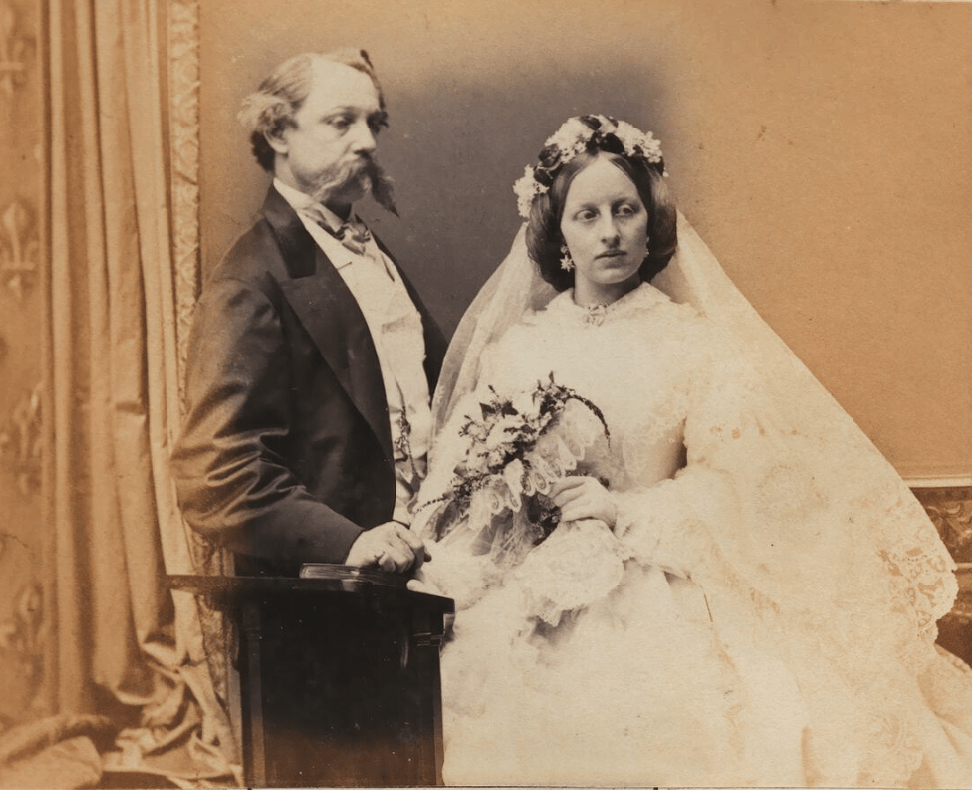
There is little information about Aikman at this time; in 1865 he took up the position of major in the e 2nd City of London Volunteers, (which, in 1872, was absorbed into the 48th Middlesex Royal Volunteer Corps, known by their nickname, Havelock’s Temperance Volunteers’) of whom, according to one of his obituaries, he was “some time Lieutenant Colonel,” curiously, another states he was an honorary colonel of the 4th Battalion, Middlesex Regiment.
Meanwhile, his family was becoming difficult. In 1859, his brother John (born 1820) decided he was not interested in waiting to inherit the Scottish property, then in the hands of the eldest of the Aikman brothers, George. George, though married, did not have any children, so next in line to inherit the Ross was brother Hugh. John decided he did not feel like waiting for his brothers to drop dead or watch his nephews inherit the Ross. Instead, John, a solicitor and Justice of the Peace, sued them. His case was a peculiar one:
“The pursuer and the two defenders were sons of Captain George Robertson, afterwards Robertson Aikman, and of Sarah Cumby, an Englishwoman, to whom he was married on 13th November 1820. The defenders were born in London before the marriage—George, on the 22d January 1817, and Hugh Henry, on the 5th March 1819. The pursuer was born on the 19th December 1820. The conclusions of the action were to have the defenders declared illegitimate, and the pursuer found entitled, as eldest lawful son of Captain Robertson Aikman, their father, to succeed to certain estates in Lanarkshire, consisting chiefly of the entailed estates of Ross and Broomhilton. The ground of action alleged was that the defenders had been born in England of parents unmarried and domiciled in England, and that the pursuer was the eldest son born after the marriage. The defenders pleaded that their father had never abandoned, or intended to abandon, his original Scottish domicile, and that they were legitimised by his marriage with their mother.“
The final ruling was given by the House of Lords in 1861, who found George Robertson-Aikman, though rather loose in his habits, had essentially never abandoned Scotland as his residence, and they ruled in favour of the elder Aikman brothers. John would never be Laird of the Ross – George died in 1879, leaving the estate to his brother Hugh, who died in 1882, the same year John himself died. One of Hugh’s sons then inherited the estate.
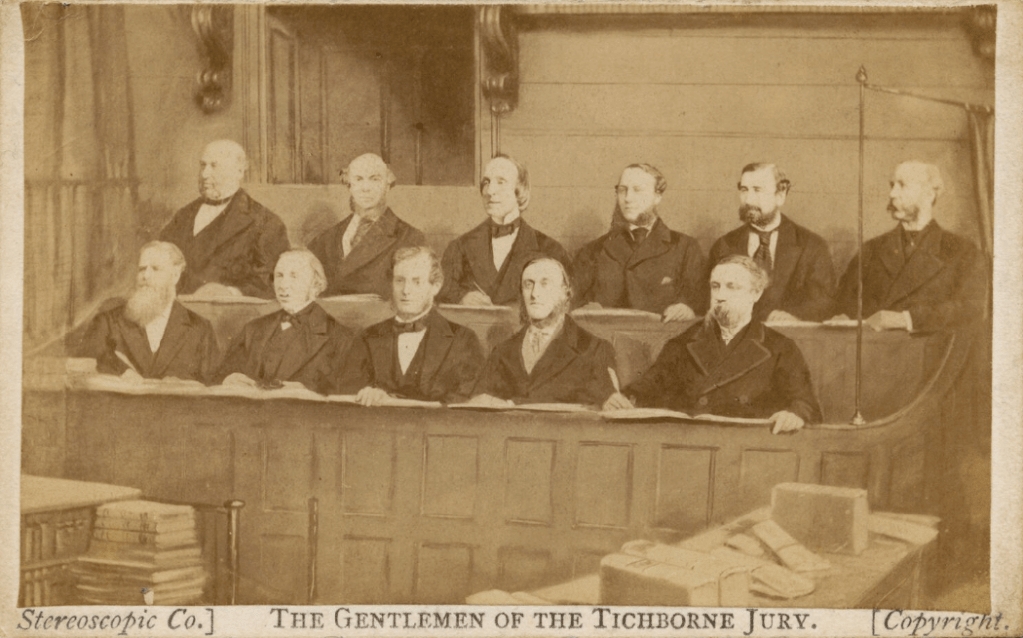
Frederick would be a member of the first jury on a case that received far more publicity between 1871 and 1872 than the bickering of his brothers had – the Tichbourne v. Lushington Case, a civil trial in which a certain Thomas Castro, also known as Arthur Orton, attempted to prove he was none other than Richard Tichbourne, the missing heir of the Tichbourne baronetcy. After months of listening to the evidence, the jury declared to the judge they had heard enough and rejected Castro’s suit. This did not end well for Castro, as he was now ordered to be arrested on charges of perjury. The criminal trial, which followed, did not end well for Castro – he ended up with a 14-year prison sentence.
Besides this rather public appearance, Frederick certainly still had enough time on his hands to take up other pursuits – one of these was to be a life-long member of the Coach Club. The club had been established by the Duke of Beaufort (MP, landowner and likely the inventor of the game of badminton) who founded the Badminton Library (The Badminton Library of Sports and Pastimes), a series of books on sports for the following reason, “…there is no modern encyclopaedia to which the inexperienced man, who seeks guidance in the practice of various British sports and pastimes, can turn for information”. Beaufort, acting as editor and assisted by Alfred E.T. Watson, chose authors who were considered authorities in various sporting fields. Now, none of this would have been significant had it not been for the Coaching Club.
Coaching in the 1800s can be compared to what car clubs are today, but with the obvious exception that the coaches were not just to be admired. They were for amateur coachmen whose interest in coaching was less as a means of transportation but as a sport. There seems to have been a perfect mania for coaching during the mid-1800s; the Marquis of Stafford established the Four in Hand Club in 1856 with the Duke of Beaufort as president. However, the sporting interests of the members were hardly satisfied by simply riding about with their own teams – what they wanted was adventure. They wanted to see “the real business” of coaching return and formed the subscription coach. With the costs covered by subscribers, the club was now able to offer “seasonal coaches to places of interest and take the reins themselves on certain days.” The idea proved so popular – leading to a near 50-year revival of coaching – that it was decided, since the Four-in-Hand could not possibly take on any new members, the Coaching Club was established in 1870 with the Duke of Beaufort, once again, nominated as their president. Membership was exclusive – a list of 50 eligible gentlemen was compiled, all of whom would become lifelong members; eventually, a further 50 were permitted to join. One of the first was Frederick Robertson-Aikman, who was also a member of the committee. It was obvious this was very much a club for men of means – an entrance fee of £10 was charged, followed by an annual subscription of £2/2s. If this was not enough to deter the rabble, then the necessity to be “proposed by one member and seconded by another, and be the bona fide owner of a Coach and Four Horses.” One of the rules of the club that members would have to adhere to was point 12:
“That the Committee shall have the power to decide any dispute arising out of irregular driving, or any other matter brought to its notice, when the Club assembles to drive to Races and other places; and that their opinion on such matters shall be accepted by the Members of the Club as final.”
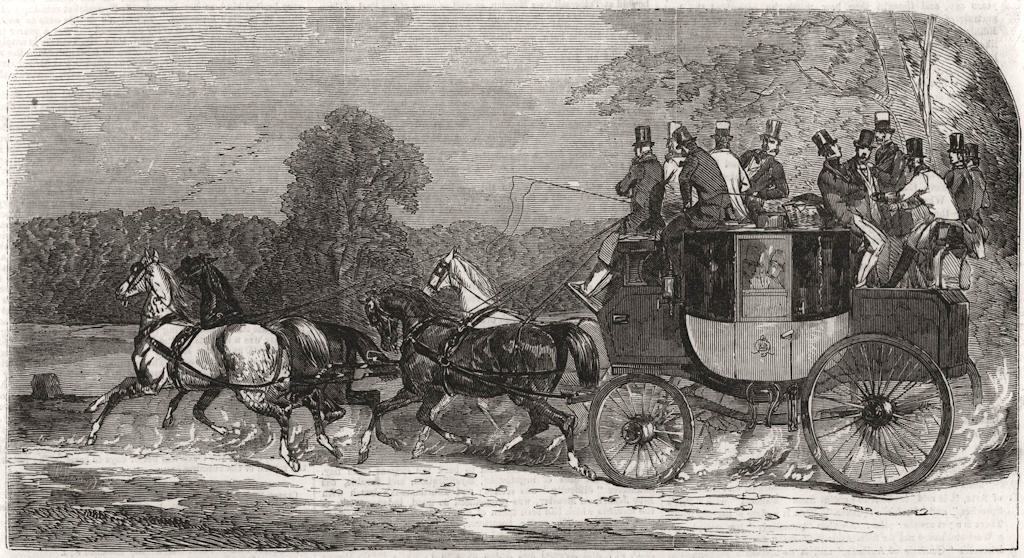
It leaves one wondering what the committee thought of Frederick Robertson-Aikman, who was charged, in 1877 with drunkenness and disorderly driving, while in charge of his four-horse coach.
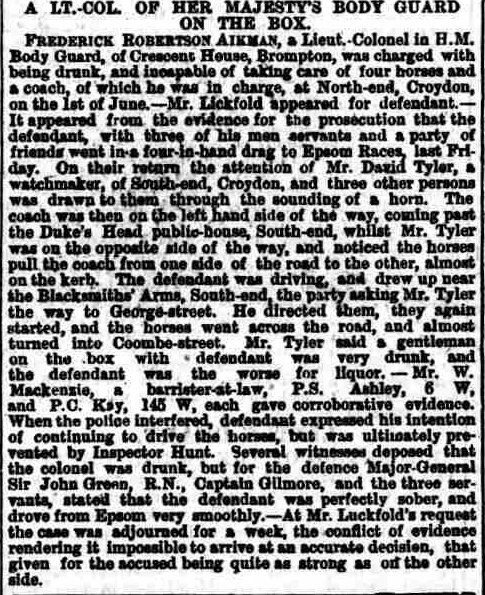
It can hardly be a coincidence that the Annual General Meeting of the Club took place during the week before the Epsom Derby – the Derby itself had taken place on the 30th of May that year, and the following is noted,
“Each club has two parades a year, the Four-in-Hand Driving Club generally meeting at the Magazine on the Wednesday before the Derby, and later in the season on the Horse Guards Parade; while the Coaching Club holds its first levee on the Saturday next but one before the Derby, and its last shortly after Ascot.”
The Badminton Library has a book entitled ‘Driving‘ which was published in 1889; perhaps out of deference to Aikman, one year after his death. The book itself does not mention the incident and yet is full of good and sensible advice on how to manage carriages and horses, including wearing sensible shoes and being in command of one’s senses at all times.
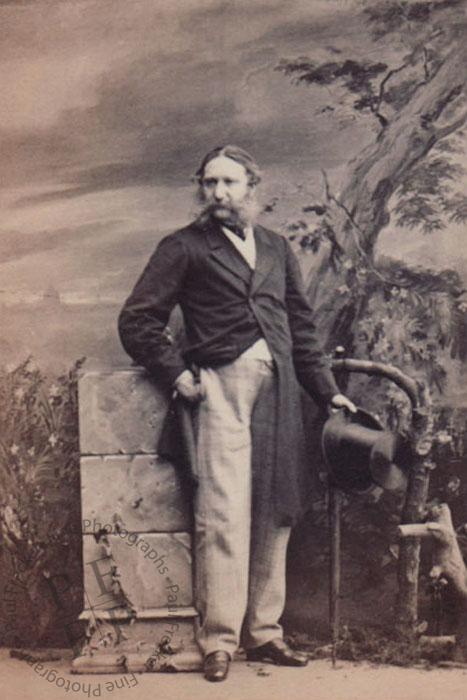
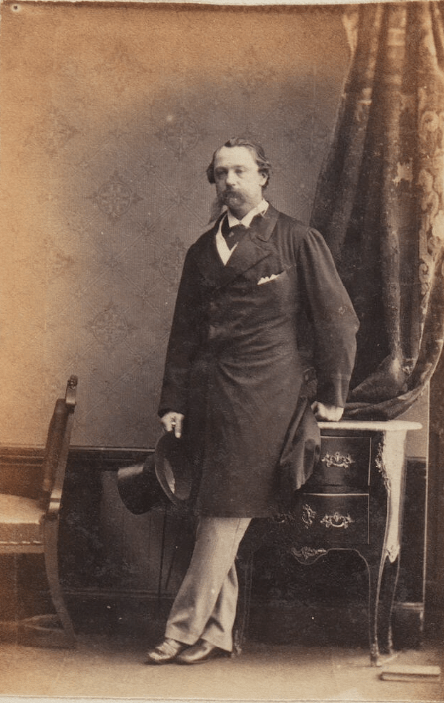
There is no doubt that there was something flamboyant about Frederick Robertson-Aikman, as can be seen in the portrait below. The previous portrait had been taken on 23 May 1861, according to the records left by the photographer, Camille-Léon-Louis Silvy. Aikman must have been pleased, for he returned on the 19th of December the same year, sporting his full-dress uniform.
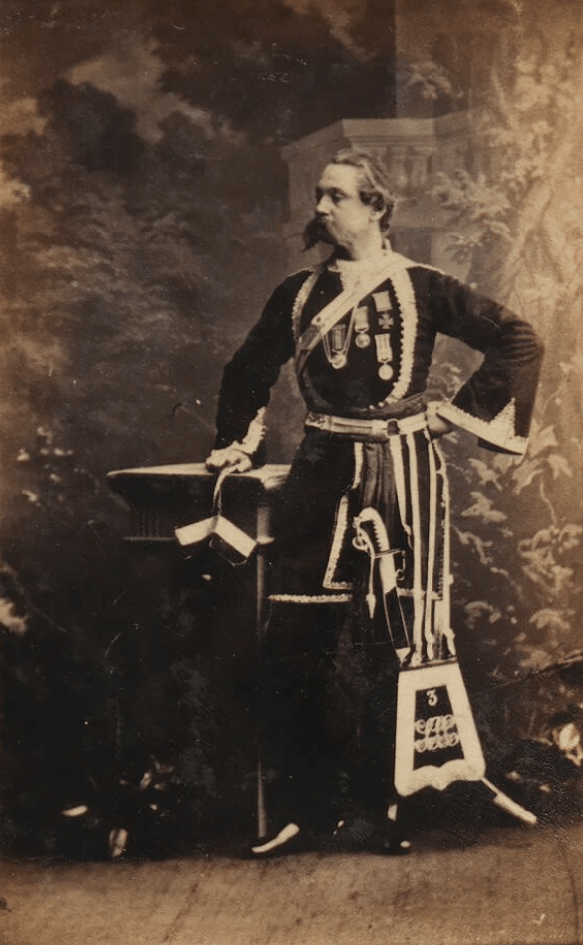
As “one of the best known men in society in London,” his death would likewise be an unusual one. A newspaper of the day called it the “Startling Death of a Colonel at Hamilton Ball.” Invited as the guest of Major Aikman of Ross, his nephew, to the Lanarkshire county ball, it appears that at 1 am, Aikman, aged 60, suddenly dropped down onto the ballroom floor. He was quickly assisted to a side room and laid out on a sofa; in attendance were “several medical gentlemen”, but there was nothing they could do. Like his father, who had died suddenly of a heart attack on a London street 40 years earlier, Frederick Robertson-Aikman only “survived a few minutes” and was shortly after declared dead. He was interred on the 11th of October 1888. A large number of his friends attended the funeral, as his flower-laden coffin was carried by the staff-sergeants of the 4th Battalion Middlesex Regiment to the family mausoleum in Kensal Green Cemetery.
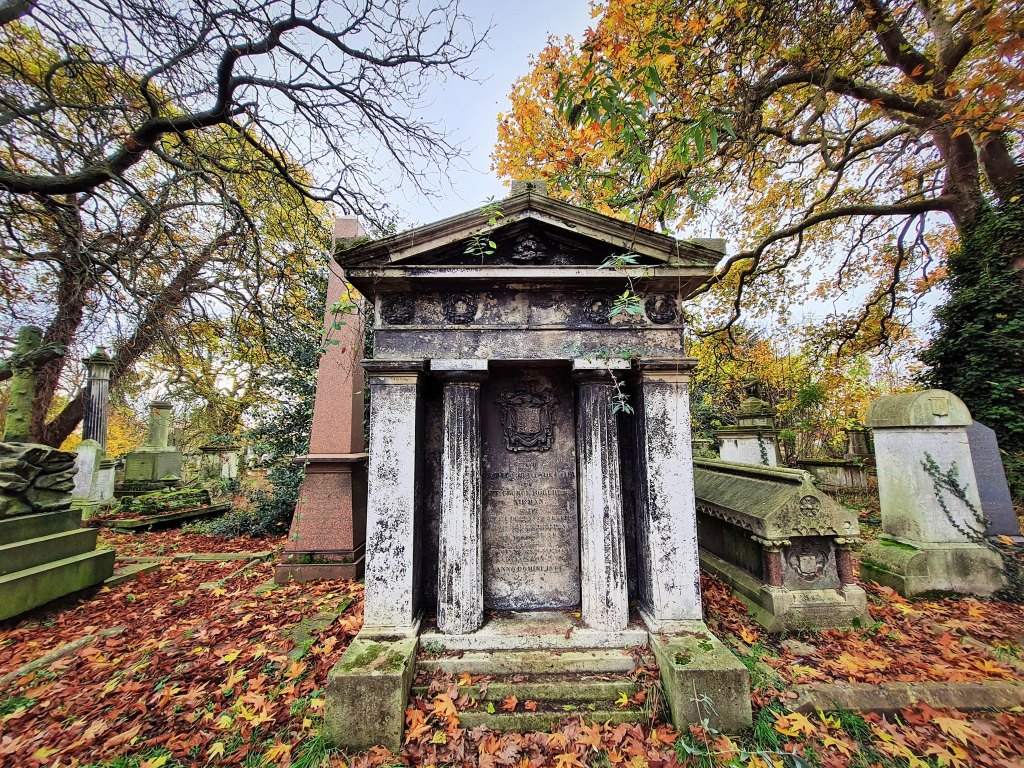
A further 12 Aikmans are interred here, the last in 1949.
Sources:
Beaufort, Henry Charles FitzRoy Somerset, Duke of. Driving. The Badminton Library of Sports and Pastimes. London: Longmans, Green & Co., 1890.
Cambridge, Marquess of. “Notes on the Armies of India: Part I.” Journal of the Society for Army Historical Research 47, no. 189 (1969): 23–32. http://www.jstor.org/stable/44222916.
Cave-Browne, J. The Punjab and Delhi in 1857. Vol. 2. Edinburgh: William Blackwood & Sons, 1861.
Franks, T. H. Operations of the Jaunpore Field Force and the Fourth Division under the Command of Brigadier-General T.H. Franks, C.B. in its Progress from Benares to Lucknow in the Months of January, February and March, 1858. London: Printed for Private Circulation, 1858.
Gimlette, G. H. D. A Postscript to the Records of the Indian Mutiny. London: H.F. & G. Witherby, 1927.
Great Britain. Parliament. Further Papers, No. 7 & No. 8, Relative to the Mutinies in the East Indies. London: Harrison & Sons, 1857–1858.
Malleson, G. B. History of the Indian Mutiny, 1857-1858, Commencing from the Close of the Second Volume of Sir John Kaye’s History of the Sepoy War. Vol. 2. London: W.H. Allen, 1879.
Malleson, G. B., ed. Kaye’s & Malleson’s History of the Indian Mutiny of 1857-8. Vol. 4. London: W.H. Allen, 1889.
Nicodemus, Frank Courtney. “The Tichborne Cases: The Story of a Bold Imposter.” American Bar Association Journal 45, no. 2 (1959): 165–68. http://www.jstor.org/stable/25720667.
Richards, Rhys. “The Easternmost Route to China and the Robertson Aikman Charts.” The Great Circle 8, no. 1 (1986): 54–67. http://www.jstor.org/stable/41562716.
With many thanks to Iain Stewart at https://www.victoriacross.org.uk
and to Catherine Arthur https://catherinearthur.com/
Links:
https://mutinyreflections.com/2025/10/12/the-robertson-aikmans-of-the-ross/
https://landedfamilies.blogspot.com/2013/08/60-robertson-aikman-of-ross-house.html
http://paulfrecker.com/index.cfm?page=home (the portraits of Aikman and his brother)
https://www.victoriacross.org.uk/cc912lan.htm
https://vcgca.org/
https://www.victoriacross.org.uk/
https://vlex.co.uk (for the entire Aikman v. Aikman judgement.)
https://en.geneanet.org/
“Deaths”. Evening Telegraph & Star. No. 417. British Newspaper Archive. 8 October 1888. p. 2.
“Obituary”. Cheltenham Chronicle. No. 4107. British Newspaper Archive. 13 October 1888. p. 3.
https://www.kensalgreen.co.uk/
https://collection.nam.ac.uk/detail.php?acc=2013-10-20-48-40
 Mutiny Reflections