The Relief of Lucknow and Beyond
Sir Colin Campbell assembled his force in front of the Alam Bagh on the 14th of November and they began their assault on Lucknow to relieve the garrison, first taking the Dilkusha Park and the Martiniere College. All went well and the rebels were none the wiser but they were spotted in the grounds of the Martiniere. Under cover of artillery, the 8th Foot and a composite battalion of infantry drove them out and the cavalry rushed off in pursuit. During the chase Lieutenant John Watson (VC) found himself separated from his men. Seeing he could not turn back without giving his men a false impression of retreat, he singlehandedly attacked an entire body of cavalry on his own. It was his luck that Probyn with two squadrons was only 300 yards away or else there might have been very little left of John Watson – Probyn and the others dashed forward and saved his life.
The relief of the Lucknow Garrison was finally accomplished on 17 November and Sir Colin Campbell withdrew not just the garrison but his troops back to the Alam Bagh by the 25th. He then set his sights on Cawnpore, where, to his intense irritation, the Gwalior Contingent had made their appearance. Due to the rather misguided efforts of Brigadier Windham to take on the entire rebel force on his own, he had succeeded in hemming himself into a small entrenchment, holding only the riverside and the Bridge of Boats while the rebels surrounded him on three sides. The artillery, and above all the Naval Brigade, would throw them back allowing Campbell to push his force over the bridge into Cawnpore – he would then go on the defensive for nearly a week, while he organised for the transportation of the sick, wounded and the women and children to Allahabad. With his impedimenta out of the way, Sir Colin Campbell drove the rebels, Gwalior Contingent, Tatya Tope and all, out of Cawnpore on 6 December. Unfortunately, Campbell’s staff caused him some consternation with their inability to follow up the advantage and the cavalry was sorely underused. However, Probyn did gain another mention in despatches.
By now, the 2nd Punjab Cavalry was being referred to as “Probyn’s Horse, ” and gained much attention, especially from the sailors, leading Lieutenant E.H. Verney of the Shannon to write,
“Two bodies of irregular Sikh cavalry are attached to main army; one is distinguished by wearing red turbans, is commanded by Captain Hodson of the Indian Army, and is known as Hodson’s Horse; the other wears blue turbans, is commanded by Lieut. Probyn of the Indian Army, and is known as Probyn’s Horse; their dress consists of the whitey-brown “kharki”; each man is armed with a tulwar and brace of pistols and one or two troops with lances. To command a regiment of these semi-barborous troopers requires no small ability, tact, and personal courage, as well as knowledge of the native character, and both Probyn and Hodson are beloved by their wild horsemen. They are generally splendidly mounted, and each horse is the private property of his rider.“
Probyn and the 2nd Punjab Cavalry would fight again on 2 January 1858 on the banks of the Kala Nadi (where Roberts won his VC) on Campbell’s advance to Fatehgarh. From here, when it was finally decided that an advance to Rohilkhand was not in the government’s interests, Campbell returned his force to Cawnpore for the recapture of Lucknow. On 23 February Sam Browne arrived at Cawnpore with the rest of the 2nd Punjab Cavalry from Mardan and Probyn rejoined the headquarters as second-in-command. The 2nd Punjab Cavalry remained at Cawnpore to act as Campbell’s escort. He now had at his disposal 30,000 men of all arms; the Mulvi of Fyzabad for his part had collected an even larger army to defend Lucknow and had spent a few weeks harassing Sir James Outram, who was holding the Alam Bagh. He commenced his advance on Lucknow on 2 March, with the 2nd Punjab Cavalry taking part in re-occupying the Dilkusha Park; then, with his army split in two, Campbell ordered one column to take the Kaiser Bagh and the other under Sir James Outram to cross the Gumti, take the village of Ismailganj, then proceed to take the Iron Bridge and the Stone Bridge. The 2nd Punjab Cavalry formed part of this force in Brigadier Little’s 1st Cavalry Brigade with the 2nd Dragoon Guards (the Bays) the 9th Lancers, a detachment of the 5th Punjab Cavalry and the Wale’s Horse or 1st Sikh Irregular Cavalry.
They crossed the Gumti on 6 March and by the 9th, had met their objectives. The 2nd Punjab Cavalry, over the next days after the fall of Lucknow, would be engaged in patrolling and would frequently be sent in pursuit of the rebels who were now fleeing in all directions but they only closed in on them twice with any result. As for Probyn, the rigours of the campaign were beginning to tell. Worn out in body and mind, the surgeons decided he would be best off returning to England. On 18 March he started down country carrying with him the standard Roberts had captured and a letter for his mother. Wrote Roberts, ‘We have been together the whole time … I could not send a better person to give you an account of this eventful year.’ Three days after Probyn left, the last of the rebels were dislodged from Lucknow. On 24 March, he was promoted to Brevet-Major.
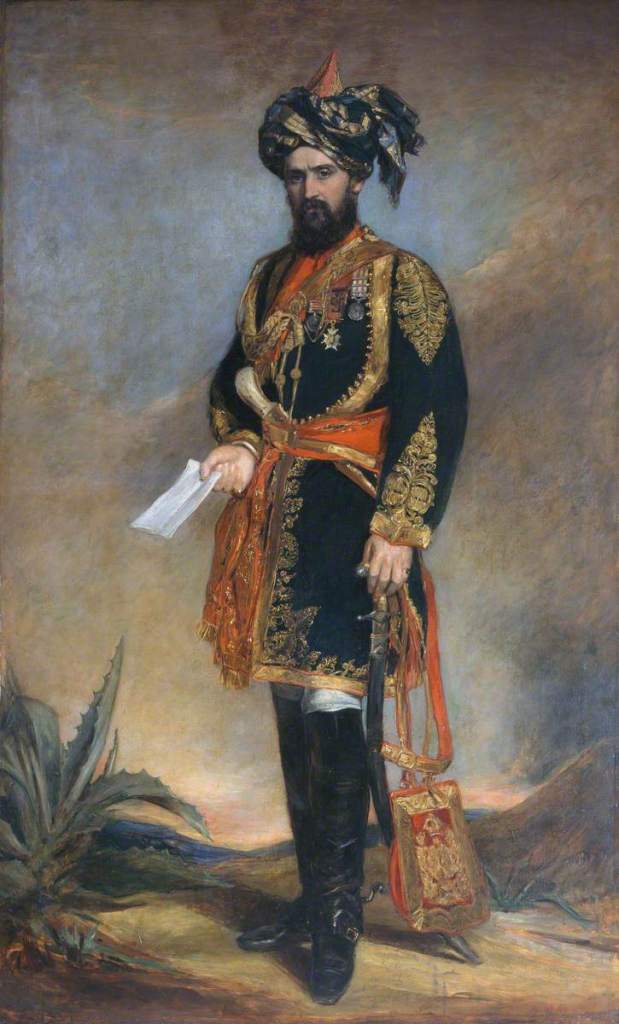
The same issue of the Gazette that announced his VC carried the announcement that he was to be created Companion of the Bath – he received his VC from Queen Victoria at a parade on Southsea Common on 2 August 1858. His sojourn in England was gaining notice – on 31 May, a newspaper noted he was seen at the “Queen’s Drawing room in London, attired in his splendid uniform of the Sikh Cavalry, ” leaving a friend to remark, “He could not help being showy in appearance – Nature made him so!”
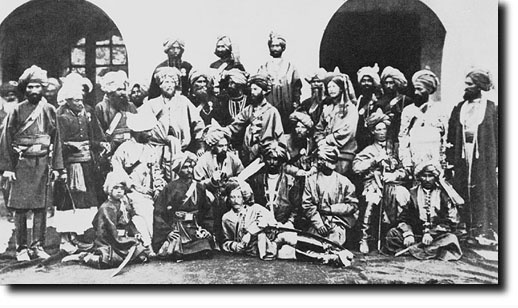
With his old regiment, the 6th BLC effectively struck off, his name was transferred to the rolls of the 3rd European Light Cavalry which was an amalgamation of his old regiment the 6th Bengal Light Cavalry and the 4th Bengal Light Cavalry, but Probyn received a special reward for his services during the mutiny and in January 1859 he was given command of Wale’s Horse – the 1st Sikh Punjab Cavalry. Wale had unfortunately been killed in the final stages of the Lucknow operations and Probyn now joined his new regiment, retitled, “Probyn’s Horse. “As a result of some personal lobbying, they would be included in the Anglo-French Expedition to China in 1860. All the men of the regiment were obliged to “sign or seal a paper” stating their willingness to go to China – without exception, every man signed. At the end of the campaign, the Commander- in-Chief reported,
‘The 1st Sikh Irregular Cavalry, under Major Probyn, and Fane’s Horse, under Captain Fane, have performed their work most admirably. On more than one occasion these Regiments have been opposed, and have successfully charged a vastly superior force of the enemy’s cavalry; and their conduct in the field excited the admiration of the French as well as of the English troops. It is not only on the field of battle that their services have been so important during the recent campaign but in performing the numerous other duties required of them of an infinitely harassing nature – patrols, escorts, reconnaissances, as well as the task of conveying letters almost daily between Tientsin and Pekin (a distance of seventy-five miles) for upwards of a month, during which they were frequently fired upon – their services have been of the utmost value to the expedition. I beg to recommend Major Probyn and Captain Fane to your Excellency’s most favourable notice.’
A dispute with the Army Pay Department showed the regiment had been paid twice for their China service. While inquiries were ongoing, the extra money was put aside. At the termination of two years and with no demands forthcoming, the money was used to set up a regimental stud and the town of Probynabad. The first Arab stallion at the farm was Probyn’s own charger, Clear-the-Line.
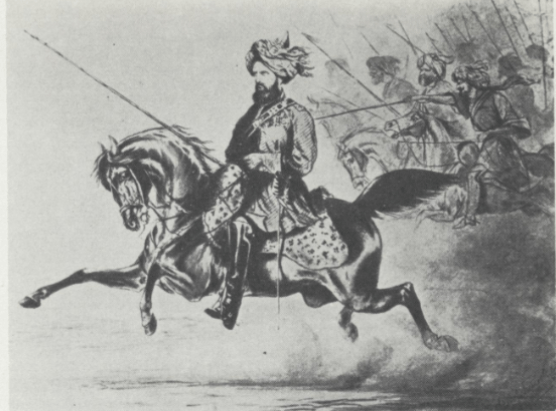
Following the end of the war, the Duke of Cambridge suggested Probyn be promoted to Lieutenant-Colonel by Brevet. Probyn returned to India in 1861 where, in Calcutta, he met his new regimental surgeon, J.H. Sylvester. Sylvester had been eager to meet the famed Probyn, but he seems to have been disappointed. He was “…a fine looking fellow…not so striking as I had anticipated,” and went on to complain in his diary, “Probyn has entirely changed the uniform from silver to gold and blue, the cut of everything is altered and the whole is very expensive indeed, he seems a most reckless, extravagant fellow and seems to expect the same of all his officers.”
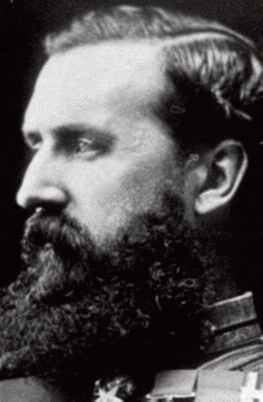
In 1863, Probyn’s Horse was selected for service with the 5’600 strong Yusafzai Field Force. Following the close of the Umbelya Expedition, the regiment returned to Peshawar. Probyn relinquished command of the regiment in 1866 and sailed home on furlough. In 1869 he replaced Sam Browne as the commander of the Central India Horse, a lucrative appointment consisting of the command of two regiments stationed 130 miles apart at Agar in West Malwa and Goona in Central India. The Central India Horse had been organised in 1861 from three regiments – Mayne’s Horse, Meade’s Horse and Beatson’s Horse, all of whom had served in the mutiny. They were mostly employed patrolling the Grand Trunk Road and chasing dacoits. As commandant, Probyn turned his hand to some political work, serving as an agent to several lesser states.
 Mutiny Reflections
Impressive
LikeLiked by 1 person