The 1859 Abor Expedition
In January 1859, Lewis was ordered to proceed to Dibrugarh, on the extreme North-East Frontier of Assam, to relieve another detachment of seamen, who, under Lieutenant Davies, had been quartered there since October 1857. Lewis took with him 62 petty officers and seamen and two officers – Assistant Surgeon White and Midshipman Mayo. The arrival of Lieutenant Lewis with his men was greeted with some relief by Davies – although he remained to fight in the next expedition, he was able to return his men of the 14th Detachment, most of them now time-expired and those of the Police Brigade (- their compatriots had given Seton-Karr much to complain of in Jessore) to Calcutta. He joined Lewis’ brigade for the duration of their stay in Assam.
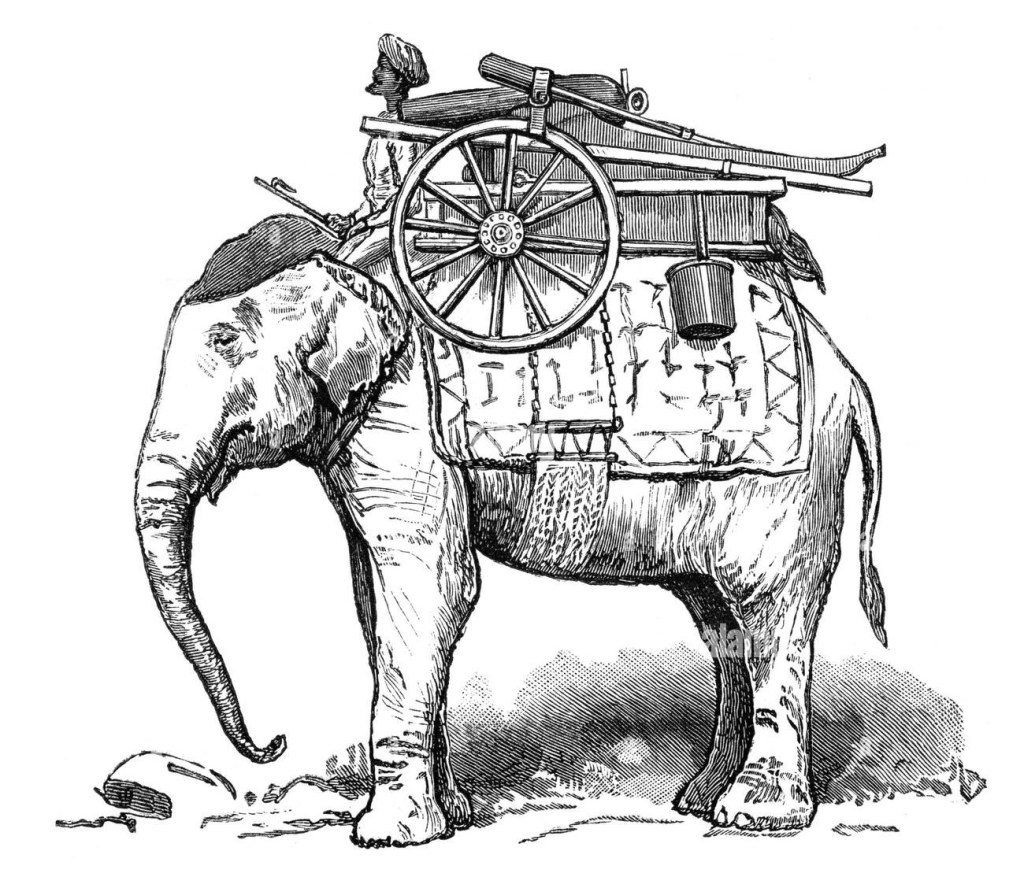
The second expedition against the Abors was certainly better equipped, better provided for and better manned than what Davies had had. It consisted of 75 men of the Naval Brigade, 300 native soldiers from the 1st Assam Light Infantry, two mortars, two 12-pounder howitzers, 25 gunners, 18 elephants, a corps of coolies and a boat convoy. Lieutenant Lewis commanded the Naval Brigade while the force overall answered to Lieutenant-Colonel S.F. Hannay. Their objective was to take the Abor stronghold at Romkang, which was perched on a hill and protected by no less than 11 stockades. With them went Lieutenant Davies, who could certainly impart some of the experience he had already gained against the Abors.
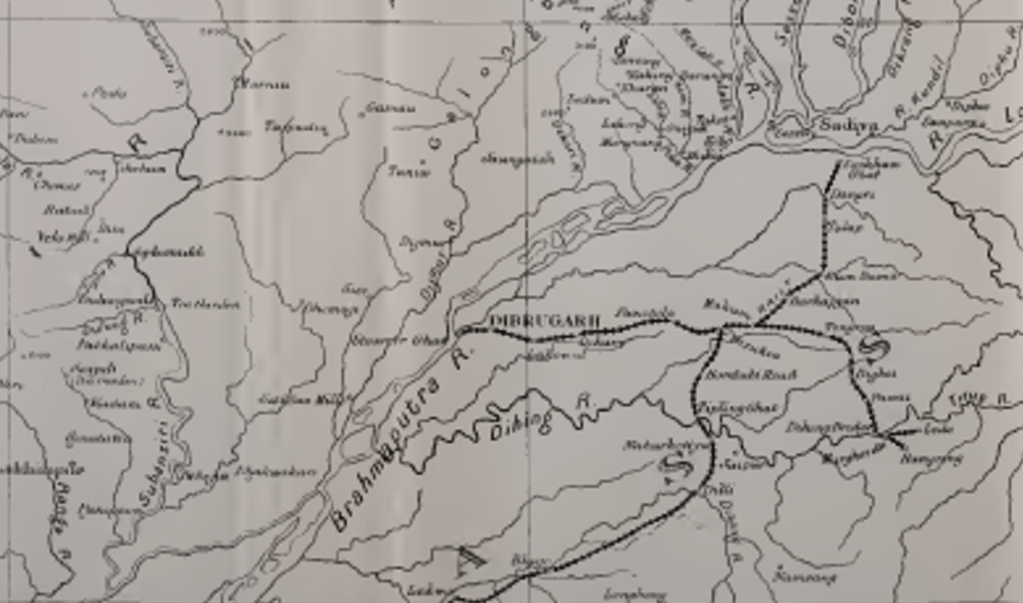
On the 26th of February, the expeditionary force reached the vicinity of Pashi Ghat, and the next day, they attacked the stockades, one after the other.
Hannay, in his official report, wrote that the resistance of the Abors was “obstinate and determined: which they were enabled to do, from their thorough knowledge of the ground, their peculiar skill as marksmen, and their formidable barricades and stockades, eleven in number, from the river bank, nine of which the enemy defended, and in three instances it was necessary to use a 12-pounder howitzer gun to open the way for the assault.” He further notes, “we had to contend against a formidable enemy, armed with a powerful weapon in skilful hands; the strong nature of the defences keeping the attacking party unavoidably exposed, not only to the fire from the front, but from both flanks and from trees and heights occupied by the enemy. However, all went down before the gallantry of the troops. The village of Romkang and three strong positions were carried at the point of the bayonet by our gallant band of Europeans, the Indian Navy, and the advance guard under Lieutenants Lewis and Davies, with Mr. Midshipman Mayo. The position of Pashee was taken by Major Reid and myself, the main body of Native troops, with the local Artillery and a 12-pounder howitzer gun. In such jungle positions, and with the prevailing practice of carrying their wounded, the loss of the enemy cannot be ascertained, but they must have suffered considerably, particularly in the defences of Romkang, where the conflict was hand-to-hand.”
Lewis wrote his own report.
For the first three miles of the march, they had not come across any opposition except for the necessity of scrambling over trees that had been felled to bar their way.
“…but at the stockade No. 4, the enemy offered a determined resistance; concealed in the jungle on both sides, they poured showers of arrows upon us, as also from the stockade in front.
A mountain howitzer was brought up by Major Reid, several rounds of grape were poured into the stockade, and then, by the desire of Colonel Hannay, the whole of the Europeans came to the front and carried the stockade. We then pushed on till we came to No. 5, a very strong stockade on the opposite high bank of a small river; part of the Indian Naval Brigade was extended undercover to keep down the enemy’s fire. Major Reid again brought up the howitzers, and after several rounds of grape, the Indian Naval Brigade crossed and carried the stockade. Considerable difficulty was experienced in getting the guns up the steep bank, and by the permission of Colonel Hannay, I then pushed on with Lieutenant Davies, I.N., the brigade and a sub-division of the Assam Light Infantry to the next stockade, marked No. 6. Part of the men kept down the fire of the stockade, and a charge was then made, and it was carried by the Brigade, supported by the sub-division of the 1st Assam Light Infantry. We then enfiladed the stockade marked No. 10 with the fire of our Enfields and drove the enemy out, the ground not being passable between them. Leaving a party of the 1st Assam Light Infantry to hold the ground until the main body came up, I went on up the road to Romkang and carried the stockades marked Nos. 7 and 8.”
Things, however, were about to get worse.
At the stockade, noted by Lewis as Number 8, the resistance was “most desperate”, and the Abors now used their rock chutes, sending formidable stones rolling down a steep hill onto the heads of the oncoming brigade, while all the while showering them with arrows. To Lewis’ horror, even when after his men charged, and got up to the stockade, the Abors thrust at them with their spears and shot poison arrows through the slits in the stockades. The palisades proved to be too tall to climb over, and it was first necessary to break down part of the stockade by hand before they could get in. Lieutenant Davies
was stabbed twice by a spear, once in the left breast and in the left arm, while Mayo, ever in front, was hit in the hand by an arrow. However, as soon as the stockade was taken, the Abors retreated. The force then moved to the next stockade only to find it was already empty; it took them five hours of hard fighting to take the village of Romkang. After setting fire to it, the men returned the way they came, torching all the stockades they had fought over. The Naval Brigade had four killed and twenty-one men injured; without exception, each man had been shot with a poisonous arrow. Nor was this the end of it.
The foot of the hills was liberally sprinkled with buried panjees, which had the added effect of laming the elephants who were carrying not only the ammunition but the mountain guns. The force then returned to camp.
In a private letter written after the expedition, Lewis was certainly less complimentary towards the 1st Assam Light Infantry.
“We returned to Dibrooghur from Pashee Ghat on Monday last, the 6th of March, having been away just three weeks, and I was very glad to get back, as it was terrible rough work about those hills marching in the rain, and encamping on sand-banks in small paul tents, leaking when it rained, and sand blowing in when it did not. The day after the fight no end of Abors came in they were not the villagers we had been fighting with, but other villagers, supposed to be friendly; they told us that there were all the fighting men of twenty-two villages assembled in the stockades that we took, making at the very lowest computation thirteen hundred men we had against us…. the Assam Light Infantry are of no use against such enemies as the Abors, provided they always fight the same….I do not think the Assam Light Infantry would ever have taken the stockades if we had not been there; they would have come to great grief, as they are just like so many sheep under fire, yelling and firing in the air, and sitting down in the pathway.
I had a very narrow escape at the last stockade, where Davies and Mayo were wounded. While I was trying to break in the door, an arrow was shot through a chink which went into my cap pouch; fortunately, it was one of the Punjaub’s Bombay ones, and the leather is like a board. The arrow went through two parts, and nearly through a third, and brought up against the leather waist belt; if it had been one of the new pattern pouches, I should have been dead in less than five minutes, as it was right over the spleen.
Davies is going on pretty well, Mayo all right; one man wounded, I am sorry to say, died today, I hope we are not going to lose any more, there are four more that cannot be considered out of danger. It certainly requires good men for the work, as, if you got repulsed at a stockade, you would suffer tremendously in the retreat if there was a muster of tribes like the last; besides, it would most likely have the effect of raising the whole of the hill tribes, who were only waiting to see which was going to win.
Colonel Hannay has mentioned us very handsomely in his dispatch; it was a very fortunate thing he kept our doctor (White) on, as, when he arrived here, he found he was ordered to return. There is only one doctor here, and if anything happened to him, it would be a long time before another could be got. I should think this ought to be one of the very last stations where Europeans should be left without a surgeon.”
For Mayo, the expedition would lead to his being mentioned in despatches, not only by Lieutenant Lewis but by Lieutenant-Colonel Hannay. Throughout the fighting, his wounded hand did not discourage him from remaining in the front right through to the last stockade.
Following the fight, the column made a reconnaissance of the Abor country and then withdrew, but not before they had torched several villages. The Naval Brigade was finally withdrawn from the northeast; Mayo and Lewis, their health shattered, returned home.
Lieutenant Davies, on his arrival in Calcutta, was ordered home, but he took his chance to see some more fighting at Chyabassa, where an officer was needed. Unfortunately for him, the wounds received from the Abors stubbornly refused to heal, and after a few months, he was sent to England. He finally retired as Commander.“Familiarly known in the Service as ‘Pat’ Davies, has been permitted to linger on in constant suffering from his wound, after having served his country with brilliant courage and devotion at Mooltan, in Burmah, China, and India.”
Lewis died shortly after reaching his native land.
Midshipman Mayo, in 1862, following the end of the EICo and with it, the Indian Navy, retired from service, his rank unchanged. He was only 22 years old, but it would appear the fighting life no longer held any appeal for him. Mayo was matriculated at Magdalen Hall, Oxford and was ordained as a deacon in 1866. He would continue his career in the church and eventually embrace the Roman Catholic faith. He died on his 80th birthday in 1920. As for his VC, there was never any grand ceremony for this young man – he received it, in 1862, by registered post. He was further given the Indian Mutiny Medal and the India General Service Medal 1854-95 with a clasp for Persia. The location of his VC remains unknown.
For the Abors, the second expedition had mixed results. The Pashi Abors, who had been the main targets of the fight, would, along with their neighbouring clans, sue for friendship with the British. The Meyongs, however, remained hostile, while the “Romkang braves” would begin their raids again in 1862. Another expedition was organised, and the outcome led to a treaty being signed, but again, it was of short duration. “In 1876, as if tired of their good behaviour, the Abors began again to cast covetous eyes on the possessions of their neighbours,” and everything started up again. For the next half-century, there would be intermittent fighting between the British and the Abors, until 1898, “…a blockade of the Abor Frontier was resorted to which lasted till 1900, when a general submission was made by the tribesmen.” Not so the Abors. In 1911 they murdered two Englishmen, their interpreter and nearly all of the soldiers of the Assam Rifles and the 47 coolies that had accompanied them. It was, in essence, the last straw. While the Abors would fight valiantly to the end, they were not a match for the British who came down on them with every modern weapon in their arsenal, burning village after village, until there was no war left to fight. It was the end of Abor’s resistance to that behemoth, the British Empire.
Sources:
Chakravorty, Birendra Chandra. British Relations with the Hill Tribes of Assam since 1858. Calcutta: Firma K. L. Mukhopadhyay, 1964.
Hamilton, Angus. In Abor Jungles: Being an Account of the Abor Expedition, the Mishmi Mission and the Miri Mission. London: Eveleigh Nash, 1912.
Low, Charles Rathbone. History of the Indian Navy, (1613-1863). Vol. II. London: Richard Bentley and Son, 1877.
Lubbock, Basil. The Blackwall Frigates. Glasgow: James Brown & Son, 1924.
White, Adam. Memoir of the Late David Scott, Esq., Agent to the Governor General on the North East Frontier of Bengal and Commissioner of Revenue and Circuit in Assam. Calcutta: Baptist Mission Press, 1832.
Links:
http://www.victoriacross.org.uk/bbmayo.htm
 Mutiny Reflections