Retaking Mahidpur
Their next stop was Noyla, and here, Timins and his exhausted band found them. It would be left up to Major Orr to take back Mahidpur. With 337 sabres of the 1st, 3rd and 4th Cavalry, Major Orr set off from Noyla. He marched the 60 miles to Mahidpur, arriving the next morning at 4 a.m., on the 12th of November, only to find the town had been abandoned by the insurgents.
They had taken with them all the guns, stores and ammunition they could lay their hands on and had left, taking the road to Kesari. All that they left behind at Mahidpur was one 12-pounder siege gun. They also dragged with them two guns from Barnagar to add to the armaments of Mandsaur, where the insurgents only had one gun of heavy calibre but no ammunition for it. Their plan was to lay siege to Neemuch, and guns were wanting. During the devastation of Mahidpur, the insurgents had fired the hospital, burning the sick and wounded inmates to their deaths. The corpse of Lieutenant Mills, badly injured in the cavalry charge, was found on the side of the road still in his doolie. He had been shot deliberately, a witness said, by one of Holkar’s sepoys.
As Orr stopped to water and feed the horses, he was surprised when, out of the ruins of Mahidpur, a lady suddenly arrived, dressed in “native attire.” She was Mrs Timins, she said, and she had been saved by her tailor, who had spent many anxious days hiding her in and around Mahidpur, keeping one step ahead of the rebels who were most interested in finding her. It would be gratifying if Major Orr could convey her to her husband who, in all likelihood, thought her dead. Mrs Timins was immediately sent off, with sufficient escort, to Noyla. For Orr, it was time to find the insurgents.
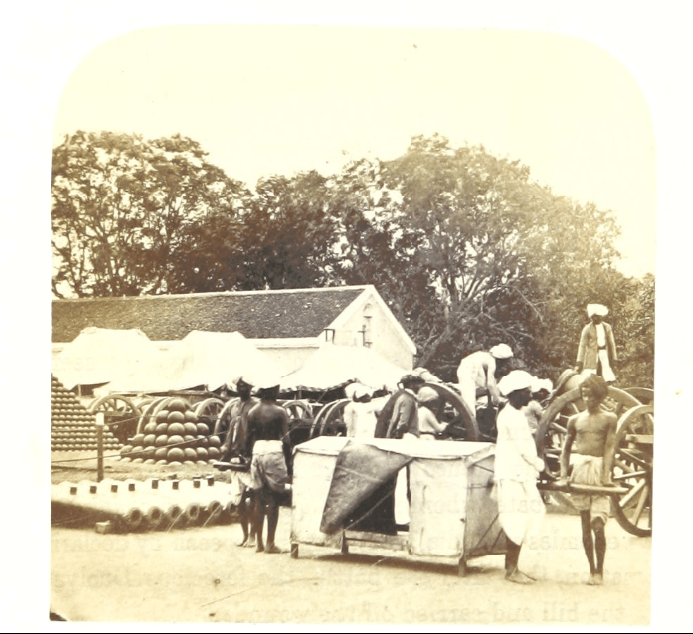
Two miles from the cantonment, Orr found the other 12-pounder siege gun of the Mahidpur Battery on the road, and then, further on in the bed of the River Sipra, he discovered two 12-pounder howitzers, complete with wagons, the two guns from Bernagar and several carts containing stores. Leaving a guard in charge of these, Major Orr proceeded with the column towards Rawal. After a pursuit of 12 miles, Orr finally caught up with the rebels at four in the afternoon.
Near Rawal Orr was informed that a large party of insurgents, numbering some 500 men and two guns, were encamped close to the village. Continuing his approach, Orr divided his force into two – one division under Captain Abbott was to attack from the right while Captain Murray, commanding the other, would advance with Orr from the left. The troops formed line as they advanced, then dashed at the guns. Caught off guard, the insurgents managed to fire off the guns only once before Orr’s men were on them, and the gunners were cut down. The ensuing hand-to-hand combat lasted until sunset, the insurgents putting up a desperate fight until they finally gave way. 175 lay dead on the field, and Orr took 74 prisoners.
The fight was heavy on Orr’s men – he had lost nearly 100 killed and wounded, including Lieutenant Samwell, shot through the abdomen (he would subsequently be invalided, and resume his career in the 42nd Highlanders). Lieutenant Hastings Fraser took his position as staff officer in the Hyderbad Field Force.
In the history of the Hyderabad Contingent, there is special mention of the men who fought at Rewal.
The despatch from Orr that reached Durand was immediately made over to Major Gall to be read out loud to the 14th Dragoons and the H.M.’s 86th. It would put to rest, once and for all, any doubts about the loyalty of the Hyderabad Contingent. The news of this gallant exploit had the desired effect and in the coming months, nothing more was said against them, with the British troops placing their “implicit and well-merited trust,” in men who had more than earned to be treated as comrades in arms.
Stuart would now march on Mandsaur and relieve Neemuch. He started his march on the 19th of November to conclude the brief, but brutal, Malwa Campaign of 1857.
Sources:
Burton, Reginald George. A History of the Hyderabad Contingent. Calcutta: Government of India Central Printing Office, 1905.
Durand, H. M. The Life of Major-General Sir Henry Marion Durand. Vol. I. London: W. H. Allen & Co., 1883.
Great Britain Parliament. Further Papers (No. 6) Relative to the Mutinies in the East Indies. London: Harrison and Sons, 1858.
Intelligence Branch, comp. The Revolt in Central India 1857-59. Simla: Government Monotype Press, 1908.
Luniya, B. N. “MAHIDPUR IN 1857.” Proceedings of the Indian History Congress 20 (1957): 281–85. http://www.jstor.org/stable/44304478.
Malleson, G. B. History of the Indian Mutiny, commencing from the close of the 2nd Volume of Sir John Kaye’s History of the Sepoy War. Vol. III. London: W. H. Allen & Co., 1888.
Watson, W. A. King George’s Own Central India Horse: The Story of a Local Corps. London: William Blackwood & Sons Ltd., 1930. Reprinted Uckfield: Naval and Military Press, 2005.
 Mutiny Reflections