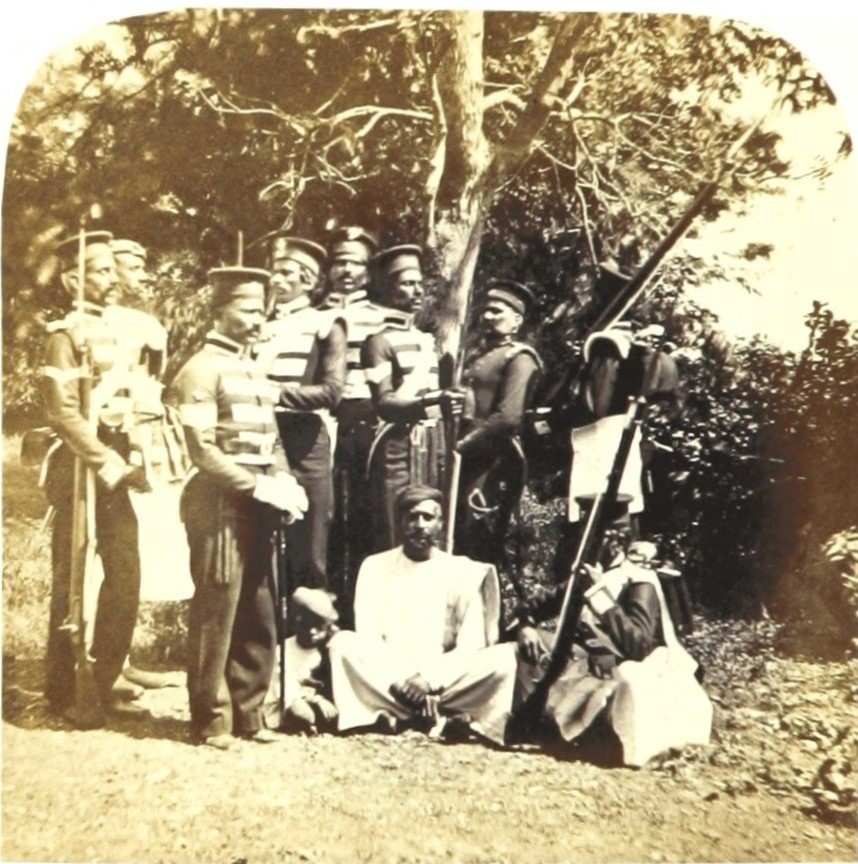
The Hyderabad Contingent Field Force had been assembled at Edlabad in July to protect not just North Berar but prevent any disaffected parties from entering the Nizam’s territories. Under the command of Major W.A. Orr, Commandant 1st Company Artillery, Hyderabad Contingent, the until comprised of
1st Cavalry, under Captain H.D. Abbott
4th Cavalry. under Captain Murray
1st Company Artillery, with four 6-pounders
4th Company Artillery, with a further four six-pounders, under Captain J de C. Sinclair
Two howitzers
1 wing of the 3rd Infantry, under Captain J. Sinclair
1 wing of the 5th Infantry, under Lieutenant G. Hare.
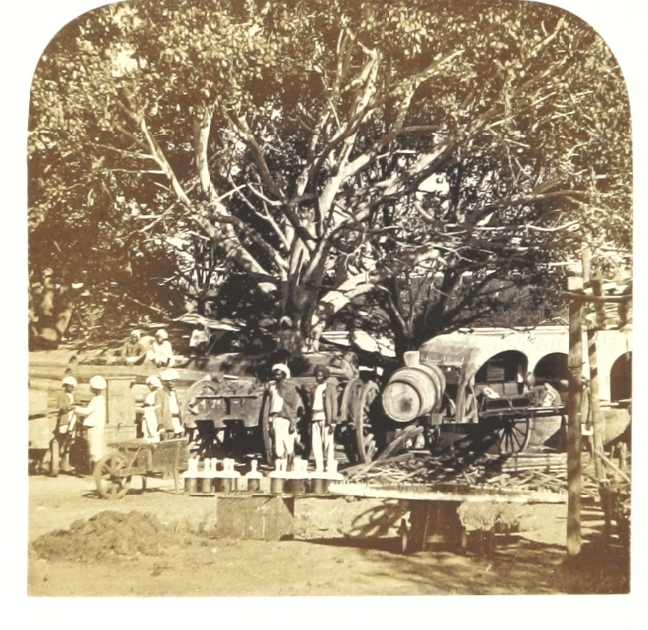
They remained at Edlabad for some time, observing and scouting. However, the same rains that had kept Stuart inactive at Mhow proved an equal hindrance to the Hyderabad Contingent Field Force, who would be unable to move until October, when Major Orr marched on Hoshangabad. From here and in communication with the Durand and the commissioner of Nagpur, Orr led raids against unruly Thakurs who had taken the unrest as an opportunity to plunder several villages in the Hoshangabad District. He then marched on Piplia and took the fort.
Acting on information received, Orr found out that Dowlat Singh, the openly rebellious Thakur of Raghagar, had thrown himself, with 500 followers, into the fort at Piplia, which was held by Thakur Suchet Singh. The thakur made no bones about where his loyalties lay and had been for months previously, supplying Dowlat Singh with arms and men. Dowlat Singh was already wanted by the government for the sacking of Satwas and Nimawar and for his “continued disorder.” The government had long since placed a bounty on his head.
Now that Dowlat Singh had made his camp in the Piplia Fort, Orr saw this as the moment to seize him and put an end to his marauding ways. By forced march, he arrived at Piplia on the 27th of October. Orr immediately deployed the 4th Cavalry under Captain Murray to surround the fort – and for their pains, they were very liberally shot at from the walls. As soon as Captain Sinclair and his guns arrived, Orr sent a summons to Thakur Suchet Singh, all the while putting his guns in place. With no answer coming, Orr ordered the guns to open fire.
Suddenly, the insurgents “affected to treat for a surrender” and sent out, on their behalf, Suchet Singh’s brother to lead the parley. Orr quickly realised they really did not intend to surrender and the talks were, as it was meaningless – all they wanted was for it to get dark enough for them to escape. Without a moment to lose, Orr sent Captain Sinclair of the 3rd Regiment Infantry to advance with a detachment of his men and take the gates of the fort. This they did, forcing their way through and, after a stiff fight from the insurgents, they took the fort. As for the insurgents, those who did not die in the battle tried to escape by scrambling down the walls at the base of which stood Orr’s cavalry to greet them who swiftly took them prisoners. Those that did manage to flee were quickly found by skirmishing parties of infantry and captured.
The brother, sent out to parley, Thakur Bhowani Singh, remained in Orr’s custody with 42 of his men while Suchet Singh, another brother, an uncle, other relatives and “all men of consequence” were all killed. He then handed them over to Deputy Commissioner Wood. As for Dowlat Singh, he, and a large body of his men, had not waited for Orr to arrive at Piplia but had attempted to stop Orr from crossing at the river. Owing to the dark and the thick jungle, Orr’s advance guard of cavalry had been unable to catch the wily thakur, who escaped. They did, however, deprive him of 32 men whom they made over as prisoners to Orr.
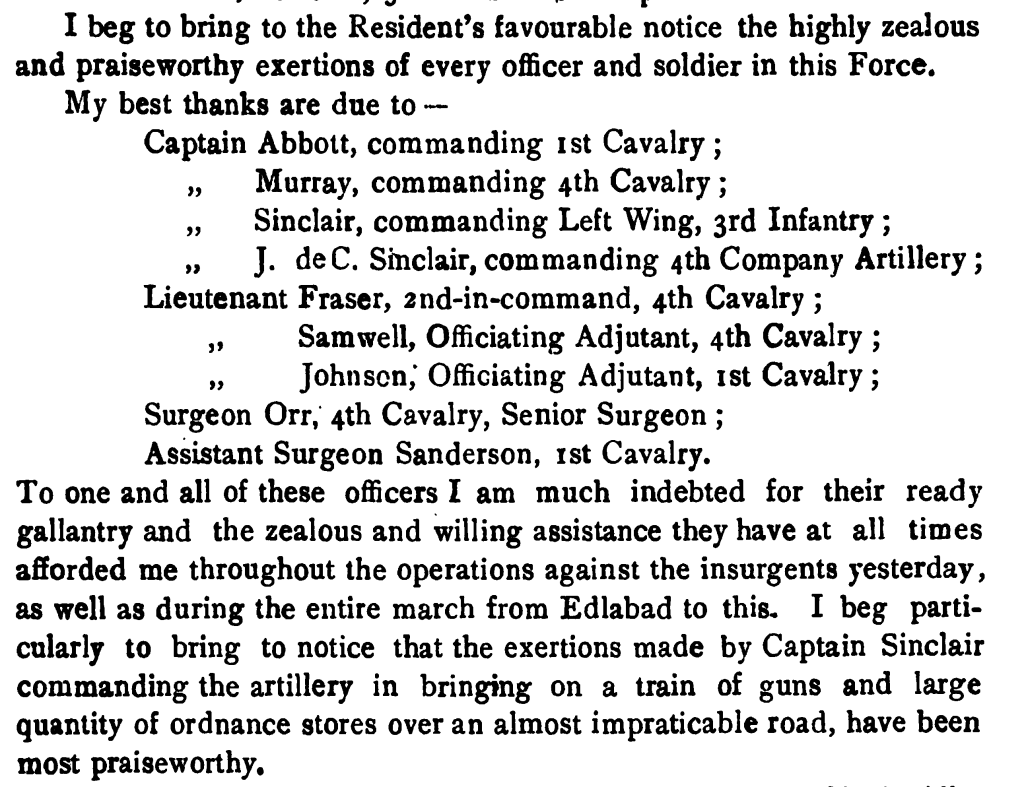
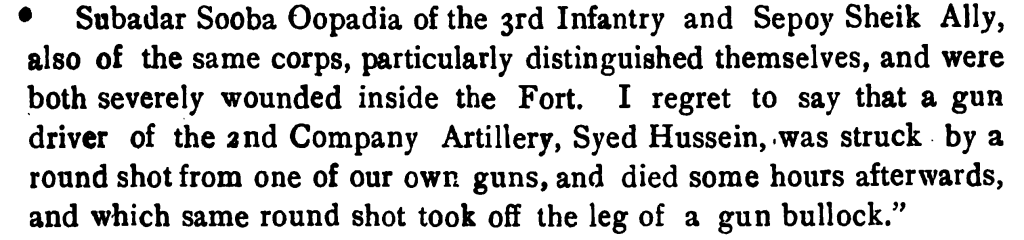
The Subedar mentioned in Orr’s report received the Order of Merit, Third Class and the sepoy was promoted to Havildar. It was a fine start, especially for the 1st Cavalry, who had given such trouble in June in Aurangabad.
From Piplia, Orr marched to Dhar, arriving two days after the fort had been taken. Their first order was to take Ajmehra and dislodge all the Waliyatis, Makranis and every insurgent they found to secure Stuart’s rear and left flank as he proceeded northwards towards Mandsaur. Lieutenant Hutchinson – the Bhil Agent and Political Assistant – was directed to proceed to Rutlam with a detachment of troops to take charge of Dhar and Ajmehra – this accomplished, Orr rejoined Stuart at Barnagar.
As for Lieutenant Hutchinson, with his detachment of the Hyderabad Contingent made short work of the hill fort of Lalgarh on the 8th of November, dismantled it and “hurled the guns down the hill” before following the rebel chieftain, who they captured three days later. Meanwhile, Captain Keatinge, political assistant, was likewise ordered to elicit the cooperation of the troops of the Ratlam, Silana and Jaora chieftains. With them, he marched parallel to Stuart for some 12 miles to ward off any attacks on the right flank and right rear, should the insurgents be prepossessed to do so.
Stuart marched from Dhar on the 6th of November with Captain H.O. Mayne of the Intelligence Department marching with a detachment in advance. He was able to report that Barnagar had been evacuated by the insurgents.
“On our coming into the main street, every shop was shut, and only a few loiterers with gloomy faces were visible. But on our reaching the Kotwali and announcing our errand, the populace swarmed up as bees from a hive, and in one minute, the whole place was densely crowded, as if by magic, and it was difficult to pass through the concourse.” While the force was wholly dependent on the Nawab of Jaora for supplies during their march, it was gratifying the find that Barnagar was equally solicitous.
 Mutiny Reflections