Woodburn Doesn’t March
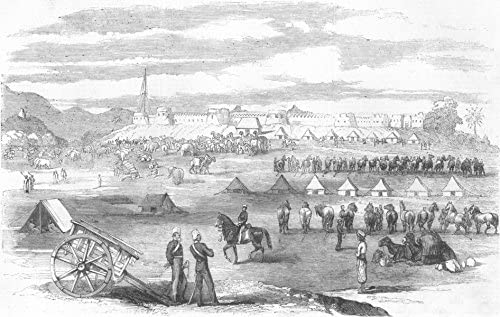
Woodburn’s Moveable Column had originally been deputed to march to Durand’s relief at Indore. Instead, with the assistance of the Hyderabad Resident, Colonel Davidson and Lord Elphinstone’s approval, they had been diverted to Aurangabad. On the 27th of June, they were still there.
General Woodburn was under the orders of the Commander-in-Chief of the Bombay Army, Sir Henry Somerset; however, it had been the opinion of Lord Elphinstone that any mutterings of mutiny in Aurangabad were too serious to ignore – a successful uprising in that district, so close to Bombay, would bode evil for not just Bombay but for South India. It was the weighing up of two evils, and unfortunately, Indore and, consequently, Mhow came up short. Elphinstone, in his turn, could not accept Woodburn’s delay.
“ I am persuaded,” he wrote to Woodburn on the 22nd of June, “that the local officers greatly exaggerate the danger of a rising in our own provinces. I have no fear of anything of the sort, and, if it should happen, I trust that we should be able to put it down speedily. But I feel confident that it will not happen, at all events, for the present. If you allow the insurrection to come down to our borders without attempting to check it, we shall almost deserve our fate, but if by a rapid advance, you can secure Mau, you will also, in all probability, save Mehidpur, Sagar, Hoshangabad…”
Not one to waste the momentum of his words, Elphinstone wrote a very pointed hint to Somerset,
“I am very much obliged to you,” he wrote, ” for the perusal of General Woodburn’s letter. I conclude that since it was written, he has received his orders to continue his march to Mau with all possible expedition.“
However, General Woodburn, convinced of his own importance at Aurangabad, wrote back on the 25th of June. His reasoning, though sound in his eyes, was tossed through with trivial worries. Explaining the contingent “might” mutiny if his force left Aurangabad any time soon, he was determined to stay where he was and conclude the court-martial of 64 prisoners. Elphinstone was not very impressed, and his reply was as close to a wigging as Woodburn would get.
I wish you to remember, ” he wrote to him on the 27th of June, ” that it was for the object of relieving Mau,
and not to chastise a mutinous regiment at Aurangabad, that the field force was formed. The latter is an incidental duty, which it was hoped would not interfere with the main object. I am perfectly aware that, in these times, circumstances may occur to divert your force from its original destination, but I do not think they have yet occurred...To allow twenty days for the trial of sixty-four prisoners is out of the question in these times.”
While it might seem unfair to throw such a burden on the shoulders of General Alexander Woodburn, at 54, he was not the youngest commander in the army and had spent most of his life on some duty or the other, mostly in the commissariat department. Only in 1842, after nearly 21 years in the service, did he have the chance to command a light battalion in Afghanistan under Major-General England at Pisheen. Shortly after, in 1843, he was raised in rank to Major and took part in the conquest of Scinde, commanding a brigade in the Battle of Hyderabad. He was noted for securing the Oomercote Fort without a single shot being fired, and for his services was appointed Lieutenant-Colonel and made CB. Woodburn was subsequently appointed commandant of the Asirgarh Fort and became a Colonel in 1854. In March of the same year, he was appointed Brigadier, 1st Class, in command of the Rajpootana Field Force. A brief year later, he stepped up in rank again to Major-General. In 1857, he was appointed commander of the Deccan Field Force.
Nor was all well with Woodburn. He was, in fact, exceedingly unwell and relinquished his command. In the interim, command of the field force devolved to Major Follett while Colonel C.S. Stuart of the Bombay Army, appointed by the government, made haste to join the force. Major Follett could have become, in the minds of many, a sterling commander – all he had to do was move forward. Instead, like Woodburn, he insisted the situation in Aurangabad was too precarious – he simply had to stay put. He had backing, to Lord Elphinstone’s dismay, from the Commander-in-Chief, Sir Henry Somerset. All the while, Durand was sweating it out in Indore, hoping beyond hope someone would finally turn up.
It was only on the 7th of July, a week after Durand had been forced to abandon his post at Indore, that Platt was dead in Mhow and Hungerford was held up in the fort there that Major Follett “convicted himself and the chief who supported him of a hasty and premature decision.” He would march after all and would be ready to leave Aurangabad by the 10th. He would leave behind, as a precaution, a troop of cavalry and two guns. Meanwhile, Colonel C.S. Stuart joined the force on the 8th of July and by the 12th, they were on the road to Mhow. Their journey would be far from pleasant.
Sources:
Burton, Reginald George. A History of the Hyderabad Contingent. Calcutta: Government of India Central Printing Office, 1905.
Holmes, T. Rice. A History of the Indian Mutiny. 4th ed. London: W.H. Allen & Co., 1891.
Intelligence Branch, comp. The Revolt in Central India 1857-59. Simla: Government Monotype Press, 1908.
Kaye, John William, and G. B. Malleson. Kaye’s and Malleson’s History of the Indian Mutiny of 1857-8. Edited by G. B. Malleson. Vols. III & V. London: W. H. Allen & Co. / Longmans, Green, & Co., 1889/1907.
Sylvester, John Henry. Recollections of the Campaign in Malwa and Central India under Major General Sir Hugh Rose. Bombay: Smith, Taylor & Co., 1860.
Links:
FIBIS Wiki. “Hyderabad Contingent.” Families in British India Society. Last modified January 21, 2026. https://wiki.fibis.org/w/Hyderabad_Contingent.
 Mutiny Reflections
My Great Great Grandfather was a Captain in the 2 nd Hyderabad European Infantry regiment . I wonder
if you have a record of himas my records show that he was promotwd
from enaign to lieutenant and then to Captain . However I saw a referwnce to him being court martialled under general ordwrs a d cannot fond out what were the charges. Can hou find any information on this? His name was Joseph Alleyne Foster
LikeLiked by 1 person
When was he in the regiment? I can see what I can find out.
Court martial was quite a hefty consequence and is usually well documented – if you know which year this happened, I can narrow down the search.
LikeLike
Dear Malcolm. I spoke to some of my historian colleagues and thr best bet to find the details is either through the British Library, India Office Records, General Orders of the Presidencies and the National Archives, WO71 is the reference. I am based in Switzerland so I can’t access these from here but it could help you on your way to finding out. I am also sure someone there can help you.
LikeLike