Translation of a petition from the Native officers ist Infantry,
Hyderabad Contingent, to the Governor-General of India.
“After compliments —
“We the native officers of the 1st Infantry, Hyderabad Contingent, represent that we have heard with sorrow of the disaffection and mutiny of some of the Bengal Regiments and the 1st Cavalry, Hyderabad Contingent, and on this account, no doubt, the Company Bahadur is dissatisfied; for this reason, we beg to state that we are ready to march wherever we are ordered and to fight faithfully against the enemies of the Government and to do our duty with devotion wherever we are placed, and to protect whatever is entrusted to us. We beg the Government will send us wherever our services are required because we are old servants and have long been expecting an order from Government; if Government will trust us, we shall consider it a great honour. May the sun of the English power ever shine upon our heads.”
Signed by the Native officers, Havildars, Naiks, and Lance Naiks of the ist Infantry Hyderabad Contingent, who were present. Signed by the Commandant (Capt. W. Hare) of the Corps for each company at the wish of the men,
21st June, 1857.
In June 1857, the Hyderabad Contingent was placed at the disposal of the Bombay Government for active service. Under the command of Captain S.G.G. Orr, they marched to Malgaon in Kandesh to rendezvous with the moveable column. The 1st Cavalry, Hyderabad Contingent, marched under the command of Captain Henry Dyett Abbott to Mominabad on the 11th of June, a troop of which was left at the latter station. They joined the other troops already at Aurangabad – the 2nd Infantry and the 4th Company of Artillery. While these were stationed in the cantonment, the cavalry was placed on the far side of the Kham River, a little distance off, on the other side of the bridge.
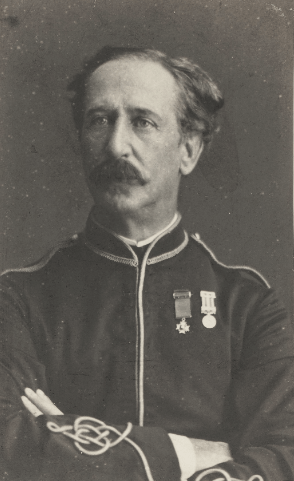
Abbott was neither a novice officer nor was new to the Hyderabad Contingent. He had served with the Nizam’s Cavalry in 1839 in operations against Kurnal, and again as Brigade Major with the Headquarters of the Nizam’s Cavalry Division in 1849 against the Rohillas – subsequently Abbott was present at the investment of Fort Rai in 1850, at the Siege of Dharoor in 1851 – in 1854 he was severely wounded in an engagement against the Rohillas while severing as Brigade Major to Brigadier Mayne’s Force, receiving a sabre cut to the left arm, and had two horses wounded under him. The men as such would have known Abbott, and he, in his turn, appeared to have understood his army.
On the 12th of June, Captain Abbott received the first news that something was wrong with the 1st Cavalry when a Sikh NCO and his brother reported the regiment was in a state of mutiny – they had, in their estimation, listed for service in the Deccan and would neither march out its borders nor join in any fight against the King of Delhi. They further claimed both the Hindus and the Mohammedans in the service had sworn an oath in this regard, insisting the 3rd Cavalry had been tricked into going on service. They also believed a report, then in circulation, that the 2nd Cavalry was to proceed to Momniabad, the 4th to Aurangabad, and the 1st to join “some column which was supposed to composed entirely of Europeans.” The two men further intimated the men were determined to murder not only Captain Abbott but Lieutenant Dowkar, his adjutant and an “obnoxious Rissaldar,” when they inspected the troops in the lines that afternoon.
Captain Abbott, calm and collected, did not disbelieve the information but wanted further proof. He sent for the Risaldar-Major, and the senior Ressaidar of the corps – the first maintained he was ignorant of any such plans, having been absent all morning but the Ressaidar, Muhammad Barhan countered him and stated, “that a great disturbance had been going on in all the Troops of the Regiment during the morning; it had commenced in the 3rd Troop, and meetings had taken place in all the others. A number of men had assembled and came to his tent, and spoke of the flag of their religion having been established, and expressed umbrage at Captain Abbott having spoken to a man on the march who had taken off his regimentals to pray.”
As to that incident, Abbott had the following to say,
“I halted the Regiment at a nullah about ten miles from Aurangabad on the morning we reached this station, to give the men time to rest a little and water their horses; after half an hour had elapsed I sent the Risaldar-Major to tell the Regiment to mount and form up, which they did in an open spot; and as I walked my horse up to the Regiment previous to sounding the march, I observed a man in the nullah with his regimentals off washing himself. I turned to my orderly and asked what the man was doing and was told he was washing himself previously to saying his prayers; and I replied that though it was quite right he should say his prayers, this was not the time to do so, and that he should put on his regimentals and join the men as soon as possible. This was all that occurred, except that I mentioned it to the Risaldar- Major when I joined.”
Abbott advised the two men to collect all the officers of the troop and inform them that this disaffection was spread by a few bad men and kept alive by a few others; he expected them to exert their personal influence to stop it from spreading further. That afternoon, Abbott went to the lines with Lieutenant Dowkar – they were met by the Ressaldar-Major and all the Ressaidars, who concurred it was as Abbott said, a few bad men trying the incite others. They sincerely hoped it would subside. Following the inspection, which went ahead as planned, Abbott and Dowkar, with the native officers, proceeded to point out “the folly and disgrace of such conduct” to the men. However, they were apprised of the fact that the entire 3rd Troop of both creeds would refuse to march from Aurangabad if ordered to do so.
“The 1st Troop Ressaidar stated that some of his men were disaffected, but that the remainder were loyal and would obey any orders given to them. The native officers promised to bring their men to reason, and Captain Abbott informed them that he was not aware that there was any probability of their being ordered to the North.”
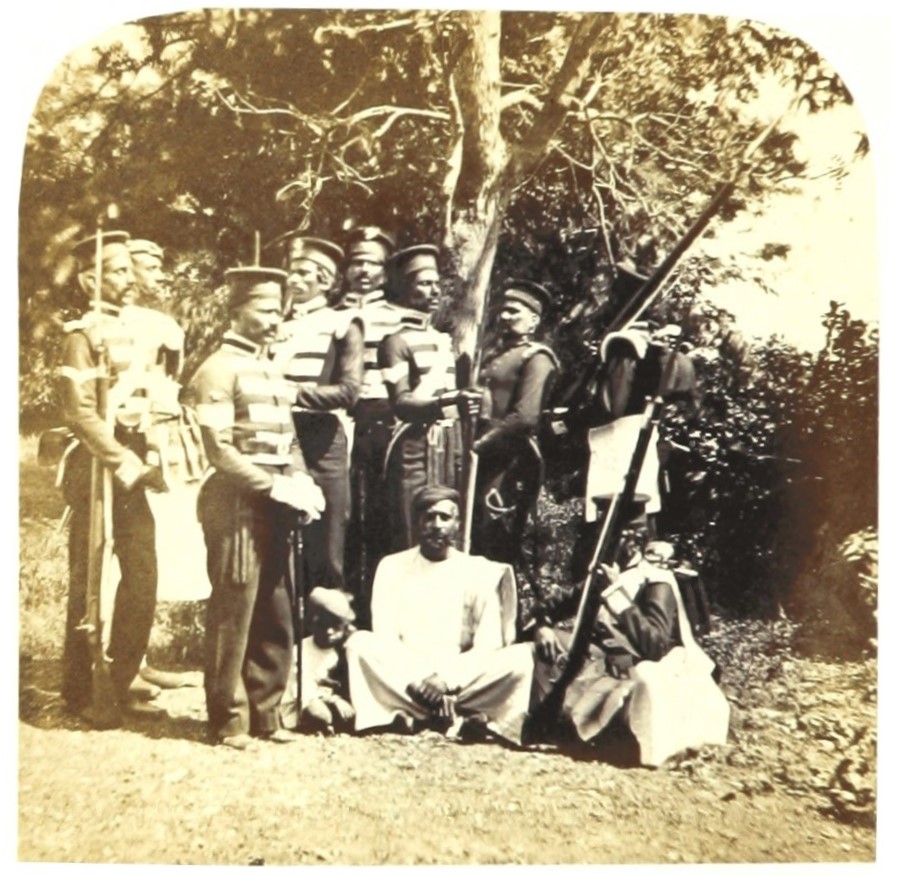
Assurances aside, some of the troops were becoming positively hysterical. At 10 o’clock at night, on the 13th, some attempted to saddle their horses and many men loaded their pistols; it was only the quick and stern action of the Native officers that prevented them from rising. However, the 1st Troop Ressaidar was not having such luck. He reported to Abbot his men had abused him, told he was “not a Mussalman, and declared they would not march from Aurangabad, and that they would not fight against their King.” The Native officers, under Abbott’s direction, again tried to control their men – they appealed to the Silladars (sowars or cavalrymen) and the more respected men of the corps to point out to the men what disgrace and ruin they were leading their corps to if they continued on this course of action. Unfortunately, though the regiment appeared more amenable to reason, it was impossible to ascertain who, in the case of an outbreak, would remain loyal. Not everyone was mutinous – a fact that did not escape Abbott.
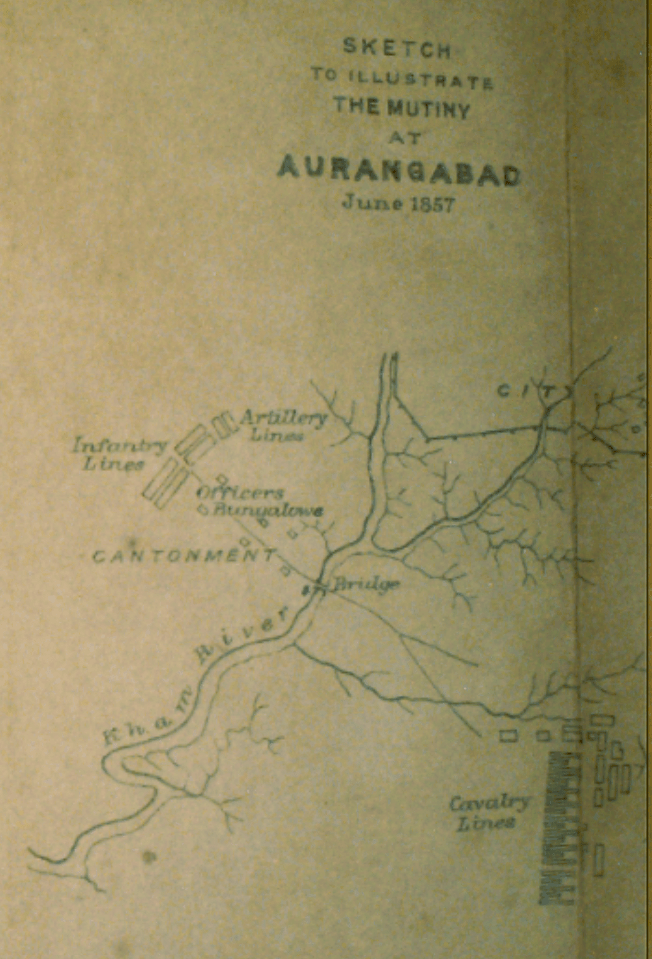
Two Naiks of the 2nd Infantry, that same night, besides being the first to turn out, led their men in exemplary order to the bridge – shortly after, when the light company was called into position, they volunteered to reconnoitre in advance. Receiving the highest praise from Lieutenants Dowkar and Lennox, they had, singlehandedly, by their bravery and unquestioning resolve, set a powerful example to their company. It also earned them the rank of Jemadar.
Matters did not improve on the 14th of June. A Sikh trooper reported to Abbott the regiment was mounting their horses and had every intention of coming to the cantonments. He had also heard they were planning to “plant a standard and that the Mussalmans had tied the Nara (pieces of red and yellow thread, usually used during the Muharram festival) around their arms.” The excuse for their disaffection now was because Abbott had placed an infantry picquet on the bridge from the Cavalry Lines to the cantonment. A rumour too had started, that the guns were to be turned on the Cavalry. Meanwhile, a jemadar of the cavalry, one Amir Khan, already known to be tied to the disaffection, tried to persuade Abbott to come to the lines to reassure the Regiment. Abbott, in this case, did not bite. He knew he could rely on at least some of his men but Amir Khan was not one of them.
Instead, he relied on Havildar Sankatuddin, who, at 8 that morning, while in command of the piquet at the bridge, saw a party of cavalry approaching his position. He directed his men to get under cover of the bank and load their guns. He then advanced alone towards the horsemen and challenged them, forbidding them from crossing the bridge. The leading sowar tried to push his way forward, but the Havildar kept his musket at the charge, and repeated he could not allow anyone to pass – it was contrary to his orders. He was subsequently promoted to Subadar. Abbott was carefully letting his men take the upper hand.
“On the morning of the 14th, Abbott had an interview with the Ressaidar of the 3rd Troop, a native of Shahjahanpur, said to be at the head of his clan, of whom many were disaffected. This native officer stated that he had tried all in his power to bring his men to a proper state but that the universal feeling in his Troop was that they would not move beyond the Nizam’s country, and that they would not act against the insurgents in Hindustan. The Troop officers were sent for, but refused to come on the plea that they feared to be arrested; but if they did come, they would make their own arrangements, meaning that they would bring a large body of disaffected men with them. At about 9 o’clock all the Res- saidars and Jemadars of the Regiment, accompanied by a number of troopers, came to the bridge, where they were stopped by the picket, and Captain Abbott went to converse with them. They were respectful in their demeanour but talked excitedly, and no change appeared to have taken place in their previously stated determination.”
Seeing his situation was becoming dangerous, Abbott consulted with Captain Speid of the 2nd Infantry and Captain Sinclair, 4th Company Artillery to position their troops in such a way so as to “coerce” if necessary the Cavalry, should they resort to mutiny. The people of Aurangabad too had gotten wind of the cavalry’s doings and started congregating in large numbers throughout the city, in anticipation of mutiny. The Cavalry had intimated they would march at 3 o’clock – at that hour, Abbott was ready, he ordered the infantry to take their positions as previously decided and took his place with the guns. For safety, he had already sent away the families of the European officers and the NCOs to Ahmadnagar under the charge of Captain Mayne – if there would be bloodshed, it would at least not be theirs.
These measures brought the cavalry, at least momentarily to their senses. By 5.30 that evening the Ressaidar of the 1st Troop reported his men were willing to accept any orders given them, furthermore, they were sorry for what had occurred and each man had placed their signature on a document to that effect. On Abbott’s order, the Ressaidar moved his men away from the rest of the regiment.
The next morning, apologies were fairly rushing in. The Hindus of the regiment requested Abbott to be allowed to join the men of the 1st Troop and the officers of the 2nd, 3rd, 5th and 6th Troops sent apologies on behalf of their men bringing with them a document that stated, “‘they had always done their duty and were still the servants of Government.” Abbott, rightly needing to assert his command, insisted that they should “acknowledge their offence and express their willingness to go where ever they might be ordered.” Although the regiment was by now behaving and above all quiet, he was not so naive as to trust them wholeheartedly. However, to show he some confidence in their conduct, 2 Daffadars of the cavalry were promoted to Jemadars for their exemplary conduct.
While there was some muttering in the Artillery Company, with one man having invited the Cavalry to send over a troop to take over the magazine, on a whole, their behaviour continued to be exemplary.
On the 16th Abbott reported to the Resident at Hyderabad – Colonel Davidson – that there was no longer any trace of mutiny in the Regiment and he forwarded all the papers signed by the men for his consideration. He further stated,
“I trust the Resident will allow me to intercede for them, which I do with all the earnestness that I can express; and to state on the part of Lieutenant Dowker and myself our perfect willingness to march with the regiment to any station or on any service that we may be required. I cannot speak too highly of the Artillery under Captain Sinclair and of the Infantry under Captain Speid and Lieutenant Lennox; their behaviour at such a crisis as that which has passed has been most praiseworthy. It must be very gratifying to the Resident to feel the l8S7. assurance this gives him of the perfect reliance to be placed on their courage and fidelity. They turned out with the greatest alacrity on Saturday night on the alarm being given, and from Sunday afternoon until this morning they have remained under arms and have manifested a most soldierlike spirit throughout.”
So was the state of affairs on the 16th. On the 14th, Abbott had not been so sure: he had written to the commanders at Ahmadnagar and Poona to send all available troops to his assistance – even though he countermanded the order the same day, Davidson at Hyderabad was disquieted enough to telegraph to Lord Elphinstone at Bombay to push forward a moveable column with all speed to Aurangabad. By the 16th, the Hyderabad Resident received the intimation that Woodburn’s column was at Ahmadnagar and he applied to Elphinstone to have them diverted from their march to Indore to the immediate succour of Aurangabad, with the view of having the mutineers punished.
On the 17th, Abbott was informed that some men of the infantry and the artillery were, in their turn, disaffected. They were mostly grumpy, feeling the Cavalry had betrayed them by not committing themselves to mutiny. If they had, these regiments would have followed their lead. Captain Sinclair, acting on the information, appealed to the subadar of his company – the man confessed he knew there were some rather mutinous men, but he had been afraid to report it “as he considered it inadvisable to take immediate notice of the circumstance.” He further said he knew which men had determined not to load their guns in case they were called upon to fire at the Cavalry.
Captain Abbott took the situation in hand and again visited the corps in turn. He found, though still respectful, many had taken on a surly demeanour – once again, he impressed on the Native officers to keep them in line – and as an additional incentive, they should be aware that General Woodburn was expected to arrive momentarily – it would be in their best interest to keep quiet and do their duty. During the night, the mutinous men congregated in stealthy groups, careful to exclude anyone who might take their doings to Abbott.
The next day, Abbott at least received some relief. Following a despatch from Brigadier Hill, commanding the Hyderabad Contingent, he was directed to send the 3rd Troop to the assistance of the commissioner at Buldana. The separation of the force had a good effect; they marched without incident on the 19th – Abbott had sent the mutineers to Buldana. Perhaps if someone had listened to Abbott or had the Resident rescinded his plea to Elphinstone or Elphinstone had countermanded his order and marched Woodburn to Indore instead of Aurangabad, the next shameful chapter could have been prevented.
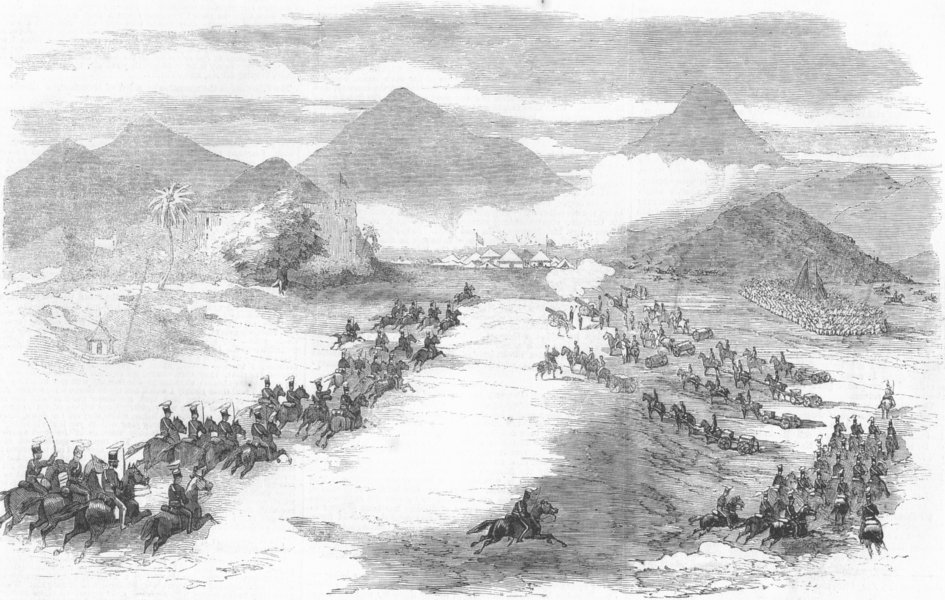
Woodburn wasted no time. On his arrival, on the 23rd of June, he first made precautionary arrangements for the protection of the cantonments, and then, without hesitation, he proceeded to the lines of the 1st Cavalry.
Captain Abbott had preceded Woodburn and had ordered the men to fall in for foot parade; they did so without hesitation. He then ordered the Ressaidar of the 1st Troop to read out the names of the men accused of being the instigators in what, until now, had been a failed mutiny.
The first name to be read out was that of Jemadar Amir Khan. He was not having any of it. Calling out, “This is very improper, and it is all false!” he called on his men to prime and load. Some men, taken with fear, dashed off the parade ground and saddled their horses. Abbott and the Native officers endeavoured to keep the rest of the regiment in order; a large portion remained and, when ordered to fall back to the rear of the force, did so without question. Others dispersed to the lines and refused to come back, although called on repeatedly. Instead, they mounted their horses and fled – and General Woodburn ordered the guns to open fire on them. The dragoons were then sent to pursue them, with Captain Abbott leading.
When Abbott returned to the parade ground, he again directed the Ressaidar of the 1st Troop to continue reading out the names of the men accused of mutiny. In reply, Daffadar Mir Fida Ali fired his pistol at Abbott but missed.
“The remaining Troops were dealt with in the same manner. Of the 2nd Troop, Ressaidar Muhammad Hashim, Jemadar Najib Khan, and five men alone remained. The Ressaidar was reported to have connived at the mutinous meetings of his Troop, and it was said that Jemadar Chhedi Khan of the 3rd Troop had asl^ed him to sanction his taking a few picked men and attempting the lives of Captain Abbott and the other officers in Cantonment.
The Ressaidar and Jemadar and the few remaining men of the troop were disarmed and confined. The 5th Troop was also greatly disaffected, and a Jemadar and some of the men were arrested and confined. The number of men disarmed and placed in confinement on the morning of the 23rd was —
1 Ressaidar.
3 Jemadars. 9 Duffadars.
76 Troopers.
4 Trumpeters.
In addition to these, a Duffadar and 6 men were arrested at Mominabad by the Troop left there to protect the station under command of Ressaidar Anwar Ali Beg, while 3 troopers were apprehended by the Naib of Bir.
A detachment was sent to Buldana the next day to deal with the mutineers of the 3rd Troop – they, however, preempted the force and the Ressaidar, two Jemadars, three Duffadars, seven troopers and two trumpeters deserted. All of them, with the exception of the trumpeters, were arrested later at Hyderabad. One Duffadar and a further ten troopers were arrested in Buldana, and the rest of the Troop was returned to Aurangabad.
While this was happening in Buldana, back in Aurangabad, Mir Fida Ali was found guilty of shooting at Captain Abbott and was hanged in the presence of all the troops. The rest, as was inevitable, were either shot or blown from guns. Satisfied with the result, the Resident reported to the Government,
” I beg to bring to the notice of the Right Honourable the Governor-General in Council the determination, and under the peculiar circumstances the great judgment displayed by Captain Abbott, commanding the 1stSt Cavalry and Station of Aurangabad, during the whole of this trying time, and the able manner in which he was supported by Captain Speid, Lieutenant Lennox, and Lieutenant Sinclair. The Native Commissioned officers of the 2nd Infantry, with the solitary exception of one Subadar, summarily dismissed, and those of the 4th Company Artillery have behaved with loyalty and devotion to Government.”
It is interesting to note that the cartridges, which had sparked such an outcry in Bengal, were not used as an excuse for mutiny in Hyderabad – the new drill, which would have required the men to tear off the end of the cartridges instead of biting them, had never been introduced. The Resident simply noted on the 18th of June that any such change to the drill would have caused unnecessary suspicion. The men of the Hyderabad Contingent were not concerned with cartridges or generally disgruntled but had been driven by mixed loyalties. On one hand, they had determined to serve the government, yet some were unwilling to fight against a king, Bahadur Shah, who they felt was their own. They were suffering, as it was, from a crisis of conscience; Abbott and his officers understood that. Until the advent of Woodburn, Abbott would likely have mastered the situation himself – he trusted his Native Officers and subsequently relied on them to bring the men back in line; by the 16th of June, Abbott was sure he had put an end to the disaffection. It was just unfortunate that Woodburn had not understood that.
A History of the Hyderabad Contingent sums up:
“No further trouble was experienced in any of the corps of the Hyderabad Contingent while the 1st Cavalry, made up to strength by transfers from the other Regiments, soon afterwards retrieved its honour by doing good and faithful service for the Government against the mutineers in Central India.”
Although there was a brief insurgence in Hyderabad itself, the detachment of the contingent stationed there did not revolt- they assisted in the short defence of the residency and the rebellion, in a day was crushed. Although a rebellious spirit did exist in Hyderabad, there was no one to provide the leadership – throughout the mutiny, Nizam, Afzul-ud-Daula and his minister, Sir Salar Jung I, remained staunch and consequentially prevented unrest from spreading into southern India. Any flame burning in Hyderabad was never allowed to be fanned into an inferno.
 Mutiny Reflections