Mandsaur Plots
Mandsaur, a large and important town on the tributary of the river Chambal, some 120 miles from Indore but barely 30 from Neemuch, had been occupied from July by some of the revolted troops of Gwalior, and these were continuously being reinforced by various levies, consisting of Afghans, Mekranis and Mewatis. Their prolonged immunity had given them a sense of overwhelming confidence, and in the beginning of August, they began to display “an aggressive temper”, bolstered in part by the compromised troops of the Holkar of Indore. After the mutiny in Indore on the 1st of July, the more “active and daring” of the mutineers of Holkar’s army had proceeded to Gwalior, but the “less energetic mass had remained sullen and dangerous, watching events…” still held in check in part by Holkar’s court. However, at Mandsaur, things were about to take a very swift turn.
The leader of the Mandsaur insurgents was one Firoz Shah, called by Showers the Preacher Prince. He was connected with the imperial family at Delhi and had for some time taken to making inflammatory speeches, calling for a crusade against the British. It was estimated that by September, he had 15’000 men and 18 guns rallying around his standard. Out in his field, Henry Durand urgently reported that “he had been advised by letters from Nagpoor, from Hydrabad, from Surat, from Bombay, from Gwalior, and from intercepted letters, that a general insurrection was planned to take place in Malwa.” However, they also planned to march into Rajputana, and their point of entry would be Neemuch.
We will explore the Malwa Field Force, to which Durand was attached as Political Officer and their dealings with the Mandsaur rebels in due time, but for now, Captain Showers deemed it prudent, with a purportedly imminent attack on Neemuch, to act. A letter on the 14th of September from the Nawab of Jaora bolstered his resolve.
“To Captain Showers,
My Dear Sir—
I beg to lay for your information that the Mundisore rebels intend to attack Neemuch; they will probably march after five or six days, as soon as the roads are a little dry. I have received this information of the rebels’ intention from a private source, and I hope you will be on your guard and send some more troops, either from Mhow or Nasirabad and take every precautionary measure. The rebels are somewhere about ten or eleven thousand strong. I object to your sending the Mehdipore Contingent, as I think no reliance can be placed on them. I hope this friendly communication of mine will reach you in due time and enable you to be on the alert.
I remain & c., Ghous Mahomed Khan, Nawab of Jowrah.
Nimbahera
At this juncture, Showers was further informed of disaffection at Nimbahera at only 16 miles from Neemuch and believed the headman to be in direct contact with Mandsaur. It appeared essential, therefore, that Nimbahera should be occupied to secure the lines of communication for the British. In Showers’ opinion therefore, ““To have awaited an attack from Mundisore on the south, leaving the post of Neembahera within sixteen miles of Neemuch on the north, and commanding the road with our supports at Nusseerabad, in hostile, or even doubtful hands, would probably have entailed the loss of Neemuch and the destruction of the garrison.” The guns at Nimbahera Fort, according to Showers’ information had been equipped as field artillery which was not “required for merely defensive purposes.” Neemuch had been left without sufficient ammunition for a protracted defence, something which both Showers and Colonel Jackson – commandant of the station – had brought to Lawrence’s notice but with no effect; Mhow was facing problems of its own and no troops could be sent from that station, the Nawab at Jaora clearly mistrusted the Mehdipore Contingent and while it was satisfactory for Durand to send letters in French to Showers informing him of imminent attacks, he had no solutions.
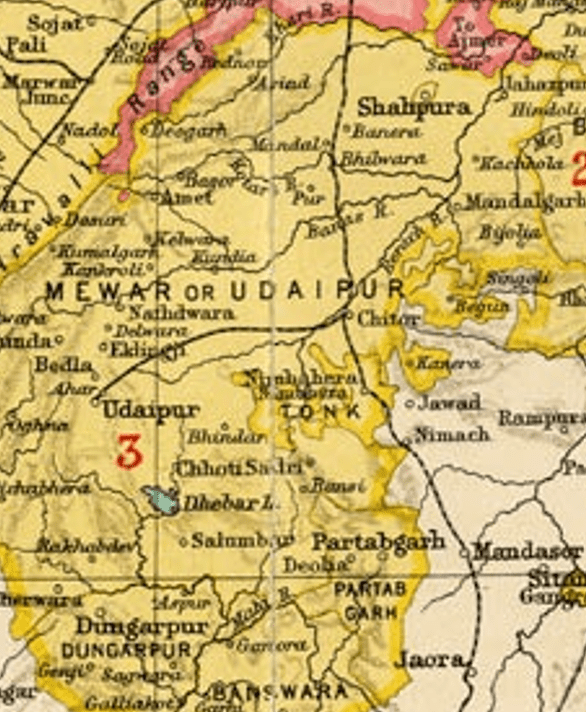
Captain Showers, who had by now decided that there was no use asking Lawrence for anything, who had ordered that, considering the precarious state of affairs, no station should be left unguarded, he voiced his opinions to Colonel Jackson instead. He concurred, according to the intelligence provided by Showers, that Nimbahera certainly could prove to be a problem because of its proximity to Mandsaur, and, leaving a small detachment to guard what was left of Neemuch, he gathered together the Indian troops he believed were most trustworthy while he and Showers organised an expeditionary force. It consisted of two 9-pounder guns, one 8-inch mortar, one squadron of the 2nd Bombay Light Cavalry, 60 men of HM’s 83rd, 80 men of the 12th Bombay Native Infantry and a parcel of volunteer gentlemen. They marched on the evening of the 18th of September.
The following morning, while in camp just outside the town of Nimbahera, a contingent of Mewar troops, sent by the Maharana of Udaipur at Showers’ request to lend credence to the expedition – it would show that the Maharana was on their side, “I thought might not be without its effect on such of our native troops as it had been found necessary to take on the service, and tend to steady them. It was for this object principally that the contingent was called out.”
If things were to go wrong, Showers could not have chosen a worse place.
Nimbahera, which was also the capital of the district in the princely state of Tonk, was a walled town fortified by 19 bastions, with good flanking defences, an eight-foot rampart of solid masonry, a wet ditch with a corresponding berm, a three foot hight stone parapet – the walls were, depending on the ground, between 12 and 20 feet high. Furthermore, there were four gates, three of which were covered by horn-works made of stone, with one defended by extensive outworks and outer gates, each capable of independent defence. Within the walls were no less than 1000 houses, some of which could mount independent defence. Besides the guns, which Showers believed were for more than decoration, he had no idea how many men he would have to face if it came to a fight – his intelligence was marred by his arrogance on this occasion. He simply believed he could march to the place, and it would fall in his hands.
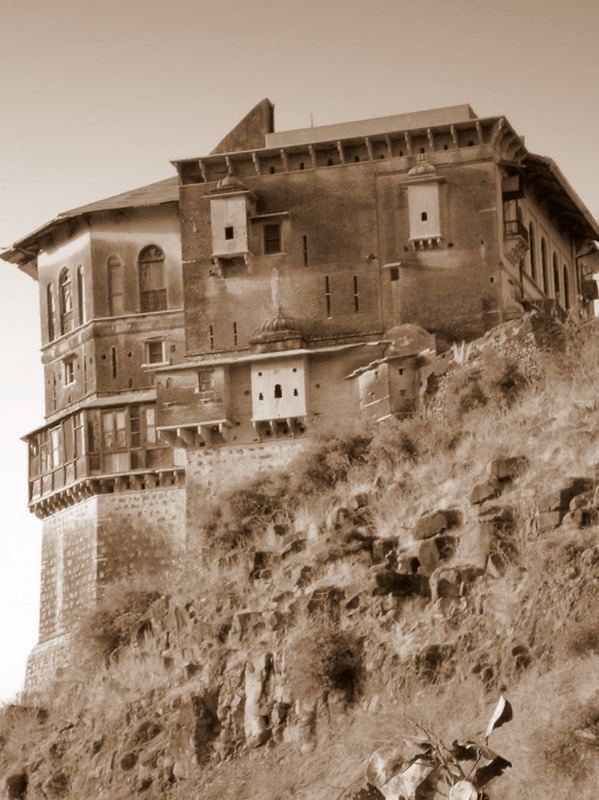
Halting his column on the opposite bank of the river Nimba that flowed by the town, Showers decided to try his hand at a little diplomacy. By the hand of a mace bearer, Showers sent a summons to the headman of Nimbahera, requesting him to surrender the place to the British Government until the troubles were over. He himself should proceed at once to Showers’ camp as a token of submission.
The headman duly acquiesced to Showers’ request, although he remained within the walls of the fort – but he had not been prepared for the next act of diplomacy Showers had planned. He now demanded that the troops of the Nimbahera Garrison be disarmed. The headman, startled and surprised by this request, said he could not guarantee his men would be willing and said their actions, in this regard, would be out of his control. As such, his assumption proved correct – his men opened fire. The poor mace-bearer that Showers had sent into the fort was cut down, and the gates were promptly slammed shut.
Showers viewed this as an open act of defiance. He brought his guns to 150 yards of the gates and sent his infantry forward in skirmishing order with the instructions to remain well under the walls. Corporal Young was deputed, with a powder bag, to blow up the main gate – he was shot before he could reach it.
“No lodgment had been effected nor any impression apparent made upon the place, when, within half an hour of sunset, Lieutenant Barnes, Horse Artillery, came up to the position I had taken up at the moment, with Lieutenant Couchman, Artillery, in the Mortar battery, and informed me that the Commandant, being hors de combat, a retreat had been ordered on Neemuch. I should under any circumstances have considered it my duty to remonstrate against a step which could not fail to prove more disastrous to British interests in Meywar, on account of the failure of the expedition, than if we had never moved out from Neemuch against Neembahera; but being senior in army rank to Captain Reade, the Officer next in seniority on the spot to the Commander in the field, and who had ordered the retreat, I exerted my military rank, and at once countermanded it.”
Showers called a halt to operations for that night – he thought it would be opportune to address the obviously depressed troops before they retired that the attack would be renewed at daybreak – while the 83rd might have cheered Showers, he fails to mention if the Indians agreed. During the night, intermittent shots were fired at his camp, but with watch fires prohibited to make it more difficult for the Nimbahera men to aim, at least on this occasion, no one was killed.
The next day, the troops were under arms at daybreak. As it had been impossible to take the gate, Showers determined to take the town at another point – it proved surprisingly easy. During the night, the Nimbahera Garrison had left – they had fired their parting shots at three in the morning. Showers ordered detachments of the cavalry to go in pursuit – only three town officials were captured – the headman was long gone, he and the rest of the men were well on their way to swell the ranks and Mandsaur. What Showers called a ringing success had cost him 24 men in casualties, including two British officers -Assistant Surgeon H.C. Miles, wounded and Corporal Thomas Young, shot dead, both of the 83rd. Charles Burton, (son of the major) in his capacity as volunteer, was wounded in the arm.
Showers, however, was not done yet with Nimbahera. He marched his men into the town “in procession and the British flag was hoisted on the walls with every observance calculated to enhance in the eyes of the Native troops the value of the service they had performed, and the estimation in which it was held by the authorities.” He then ordered an open Darbar in which a gratuity and special rewards were distributed to the men who had most distinguished themselves. While this might have been to the liking of the troops, Nimbahera would be treated less cordially.
The head putel (chief village authority) was blown from a gun at a public parade for “aiding and abetting” in the murder of Showers’ mace bearer. He also charged him with opposing Showers’ efforts to avoid hostilities and thus endangering the “peaceful inhabitants of the town.” He then promptly turned over the Nimbahera garrison to the Mewar troops and the administration of the district to the Udaipur darbar, where it would remain for the next two years until it returned to the rightful sovereign, the Nawab of Tonk.
Once again, Showers was acting within the limits of his own vision – he had failed to recognise the isolated nature of this problem and had ignored the fact that the Nawab of Tonk was one of the staunchest allies the British had, and he had been holding his own with very few troops. The disaffection at Nimbahera, whether the men there were in contact with the Mandsaur rebels or not, had, until Showers interfered, not been a matter of great importance. It would most likely they would have remained merely disgruntled. By his actions, Showers had risked isolating the Nawab of Tonk from the British by circulating the supposition that the Nawab himself was in league with Mandsaur when he had already incurred great personal risk by standing against the Neemuch mutineers on their march to Agra. Showers had embarrassed the Udaipur darbar by granting them, in favour for their services, a district they had no right to possess.
His actions at Nimbahera were viewed dimly by Calcutta and by George Lawrence. While he might have saved the loyalty of the Indian troops, secured the lines of communications and for a moment bolstered some of the prestige Lawrence had lost at Auwa, the expedition was considered unwarranted, having been undertaken against the express wishes of George Lawrence and above all, it was an “act of undesirable high handedness,” at a time when the British in Rajputana could ill-afford losing friends. It was only lucky that Showers was not defeated.
Returns for Nimbahera (partial)
83rd Regiment of Foot
Assistant Surgeon H.C. Miles – wounded in action
Corporal Thomas Young – killed in action
Bengal Horse Artillery
Sergeant Marshall – wounded by a bullet in the head
Volunteers
Sergeant Nesbitt – wounded slightly by a bullet in the knee (7th Gwalior Contingent)
Sergeant Lane – wounded slightly by a bullet in the thigh (7th Gwalior Contingent)
Charles Burton, son of Major Burton – wounded in the left arm.
 Mutiny Reflections