The 18th of September
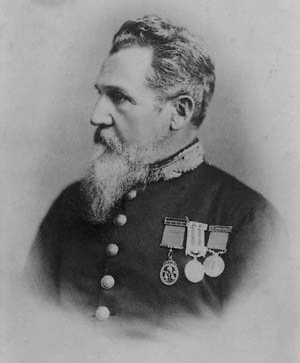
George Lawrence took to the field himself and led the force to Auwa – the road had been heavy after the rain; the vigilance of the rebels had thwarted his scouts’ attempts to get any accurate information about the place while the thick jungle that surrounded Auwa had made reconnoitring out of range impossible. Instead, Lawrence decided to “reconnoitre in force”, determined, if circumstances presented themselves, to attack at once.
His advance guard consisted of two Horse Artillery guns, one troop of the 1st Lancers, 50 men of the 83rd and 50 of the Mairwara Battalion – as Lawrence and the rest came out of the jungle, he sent 1 small party of the Lancers at a gallop with lieutenants Heathcote and Bannermann (adjutant of the Kotah Contingent) to find out where the rebels actually were. When they came into view, a few of the legion’s sowars, who had been acting as lookouts, beat a hasty retreat, with one man, who had dismounted to fire, being taken prisoner. Heathcote reported back to Lawrence that, from what they had seen, the rebels were out in force, close to the walls of the town.
As soon as the column came in sight of Auwa, the rebels opened fire. Lieutenant Swanson, of the advanced guard, quickly answered with his two guns while the main column moved up in support. Skirmishers were thrown out from the infantry, supported on their flanks by the cavalry. The five horse artillery guns, directed by Captain Petrie, now opened fire. This sent the rebels into a momentary confusion and sent them back to the walls, driven out of their entrenchments by the shot and shell that rained over their heads. However, it did nothing to silence their guns. Two 9-pounders kept up a steady fire into Lawrence’s right; one of his howitzers was disabled by its own recoil, at another gun, one man was killed and two were wounded, and its wheels were destroyed by round shot. Undeterred, Lawrence took ground to the left to get a better view of the rebel position and recommenced firing.
The courtiers in Jodhpur had been right – Auwa could not be taken so easily. Lawrence quickly realised that the small force at his disposal would be unable to storm the fort and while he was holding his own in front, parties of the rebels had made their way past his right and were now threatening his baggage at the rear. Lawrence decided to change direction, the idea being to place the column between the baggage and the rebels, and ordered a counter-march to the right. He then ordered two guns to resume firing on the rebels who were still trying to sneak past and get to the baggage. With his reverse flank thus secure, the battle suddenly ground to a halt.
In the midst of all this, Captain Monck Mason arrived. Officially, it reported he had “mistaken some of the enemy’s Horse for ours, and was shot down after going with them a short distance.” But Prichard and the Maharaja were not so sure.
“It appears he inquired of someone he met on the ground the direction in which the Brigadier-General was to be found and went off towards the spot indicated, saying he was going to speak to the General and would return to the place where he left his camel and attendants. He only took one pistol with him in his belt. He had not gone many yards before he was fired at from behind the bushes with which the ground was covered and wounded in the breast. He retired and sat down, and almost immediately after, a charge was made of a large body of the enemy’s horse upon the wounded officer, who was immediately cut down and killed. His death was described in the letter as the result of the merest accident. But it is scarcely possible to believe that an officer to whom a skirmish or an action was no new thing, who was in full possession of his faculties, should so completely have mistaken the direction he was going in, as to have walked towards the enemy instead of towards the British position, especially when firing was actually going on. At the same time, there was ample evidence to show that the spot where he fell had just before been ridden over by the General, accompanied by his staff; the enemy had selected that time, too, for making a flank movement upon the British right, and may have come accidentally upon the wounded officer. But by whom was he wounded? And how came the enemy’s sharpshooters so far in advance of their position and on the ground which the General had only just left? Whichever way the truth may lie makes, perhaps, but little difference now, for Captain Monck Mason died on the field of battle in the execution of his duty, as many as noble and brave, though none more so, had fallen before him, and have fallen since. The raja’s idea was that treachery had been employed, as I heard him, myself, subsequently express that opinion.”
The battle effectively over, Lawrence could not justify attacking the fort a second time, and he retired “leisurely on this place (the village of Chellawar), about three miles from the scene of action.” Whether he should have set out with such a small force in the first place or would have done better to sacrifice his baggage train rather than leave the work undone are two questions no one could adequately answer – as it was, the battle was a failure and Lawrence remained another two days in camp before returning his men to Nasirabad and Beawar, leaving the rebels in triumph. Prichard sums it up thus:
“Lawrence’s position was a painful one. If he had delayed to take the field at all, there was no calculating
the bad effect such inaction would have had on the country; if he took the field, he would have to march against a strong fortress and a powerful garrison with a mere handful of reliable troops. His own instinct would have led him to make a rush at the place and take it at all hazards, and had he been acting in any subordinate capacity there is no doubt he would have done so, but he was not only a general officer in command of the troops in Raj pootana, but Governor-General’s agent as well, and in this double character the responsibility of any step he took was infinitely increased. The small band of English soldiers he had with him was almost all that was available for the protection of the whole province; even had success attended his efforts, it would be necessarily accompanied by much loss, and the little band of Englishmen might have been so weakened as to be unable any longer to uphold British dominion in Rajpootana. Any great disaster then would have been followed by the loss of Ajmere, the defection of all the independent chiefs, and probably the mutiny of the Bombay army.”
Lawrence’s returns read:
2nd Troop Horse Battery Artillery
Killed
Gunner Frederick Montgomery – splinter of a shell through the chest
Wounded
Gunner James Smith – his leg shattered by a round shot, amputated above the knee, very severely
Gunner WIlliam Armstrong – left leg grazed by a ball below the knee, slightly
1st Lancers
Wounded
Trooper Chindee Persad, 6th troop, spent musket ball in the forehead, slightly.
Trooper Miriam, 3rd troop, spent musket ball in the left arm above the ulna, one inch above the wrist, slightly.
H.M.’s 83rd Regiment
Wounded
Private Patrick Dunn, 7th Company, wounded of the scalp by a spent musket ball, slightly
Private Michael Sweeney, 1st Company, splinter from a shell below the knee, slightly
Private James Thompson, 1st Company, musket ball left knee joint, ball extracted, slightly
Mhairwara Local Battalion
Killed
Private Burgea, 4th Company, division of popliteal artery by a musket ball
Wounded
Private Himtab, 4th Company, musket ball below right knee, severely
Private Khooma – spent musket ball over the left tibia, one inch above the ankle joint, slightly.
Camp Followers
Killed
Horse-keepers Ramoo, Andoo, Ramah and Grass Cutter Elapah, 2nd Troop Horse Battery, killed by round shot
Missing
Dhoolie bearers Bholia and Esrale.
Total: Europeans – 1 killed, 5 wounded
Natives: 5 killed, 5 wounded, 2 missing.
As it was, Lawrence received a severe scolding from Calcutta for his lack of judgment and failure to take Auwa. If this was not bad enough, they also had the mercenary attitude of Captain Showers to contend with, who, on the same day, had been waging a war of his own.
 Mutiny Reflections