Ludhiana – May-June 1857
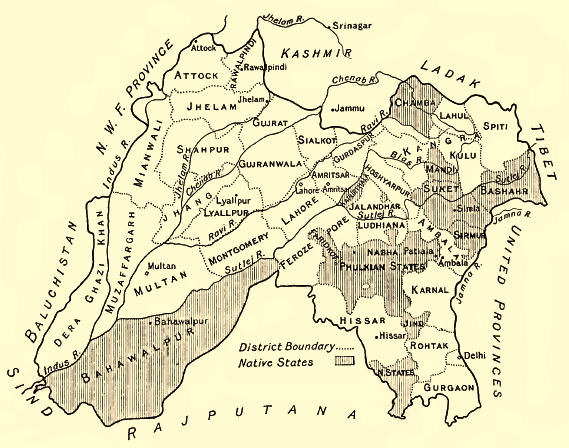
In February 1857, Mr George Ricketts was called upon by G.C. Barnes, Commissioner and Superintendent of the Cis-Sutlej States, to furnish a report regarding the events in Ludhiana District in the early part of the mutiny. He did so, in a methodical, clear and efficient manner, outlining what he did and how he did it – as reports go, it is rather dry but the life of Mr Ricketts in Ludhiana in 1857 was anything but – we will now follow the path of one civil servant from May until June 1857, the very busy Mr George Henry Mildmay Ricketts, aged 33. The news from Meerut threw his district into some disarray, but undaunted, Ricketts immediately set about reinforcing Ludhiana.
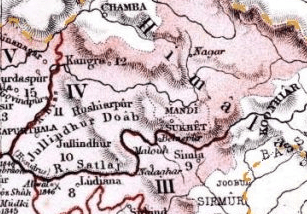
On the 15th of May, he sent off letters to the Jhind Raja requesting a troop of cavalry and two companies of infantry and to the principal sirdars, landowners and “men of influence” requesting them to honour their pact with the EICo and send for his disposal, 80 horsemen at once. He was not disappointed.
Mith Singh, the most influential of the Mullowdh Chiefs, came to Ludhiana personally to speak to Ricketts – he brought with him 50 horsemen and volunteered as many matchlock men as his estate could afford. He further offered the government, through Ricketts, a considerable sum of money as a loan.
From an estate on the Grand Trunk Road – Khiri which boarded on the Ambala district, Sirdar Busaunt Singh sent up 18 men, two of which were mounted on his own carriage horses – Ricketts kept the men but sent back the horses, realising the Sirdar would most likely need them himself; he then received 20 horsemen from the Budhour chiefs whose estates belonged to the Ferozepore jurisdiction – he sent most of them to that station where before long they would have work to do. Others, being pensioners and under no obligation to the EICo, sent men. One, Bhas Sampuran Singh of Bagraen, personally led his men to Ludhiana. Only to his disappointment, the Jhind Raja was unable to fulfil Rickett’s request. He and his men were otherwise engaged as he was marching to Thanesar. But the Nabha Raja was just as quick to answer and sent his available troops.
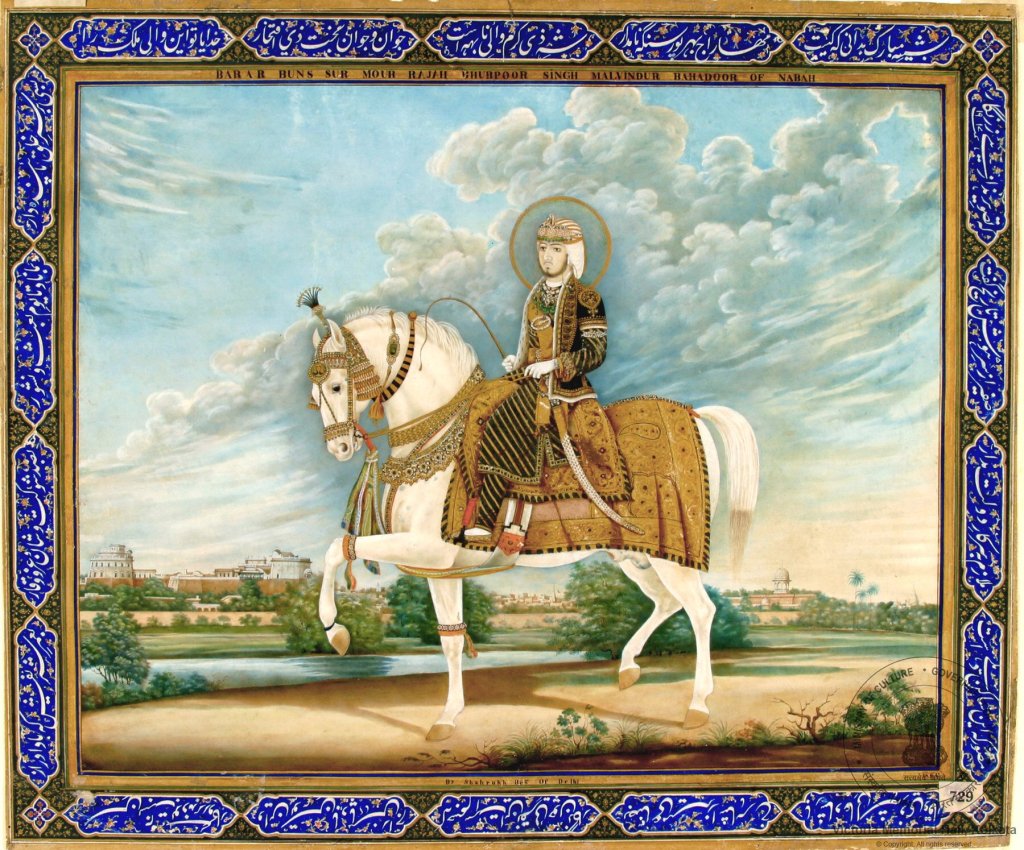
Raja Bharup Singh of Nabha had attained his majority in October 1856 – whatever misgivings there were about Nabha, whose history with the EICo was difficult, the young man dispelled them. Told by Ricketts to hold himself in readiness for service, he was placed in charge of Ludhiana on the 17th of May. He occupied the station with 350 cavalry, 450 infantry and two guns for the next six months. 300 men of Nabha escorted the Philour siege train when the Nasiri Gurkhas were having their tantrums in the hills. Under Sirdar Didar Singh, the 300 would serve through the Siege of Delhi. The young Raja had been anxious to lead his men himself as the Jhind Raja had done with his troops, but being very young, his requests were denied.
George Ricketts, just for the 15th of May furnished the following Memorandum of Orders and Letters:
15th of May 1857 “Wrote to Jheend Rajah for one troop, two companies. Wrote to Mith Singh, Ootum Singh, Bussunt Singh, Ludran Sirdars, Ahmad Khan of Raikote, and Wuzeer Khan, for 80 sowars amongst them.
Sent 20 rounds per man to Jugraon police; sent an escort for sowars’ arms to Ferozepoor and sent 45,000 rupees treasure to Phillour; wrote to Barnes, reporting, &c. Ditto to Montgomery.
Warned Baboo at post-office to open all daks in my presence. Called in four men from each thannah and tehseel two from each 1st class, one from each 2nd class chowkie.
Detained 16 return treasure carts for transporting ammunition.
Laid supplies for Goorkahs
Sent out for 300 hackeries and 200 camels.“
Unlike others, Ricketts was already convinced the mutiny was not a passing disturbance, and he was making preparations for what he expected would be a long fight. Besides men, what Ricketts needed was supplies and, above all, suppliers.
For this, he had the Lulton Chaudharis. The six brothers, being old soldiers themselves, were “conversant with the numerous wants and requisitions of troops, were exceedingly useful in furnishing escorts, arranging supplies, carriage of all sorts, in arranging and loading convoys of magazine stores-..” Later, as reinforcements started leaving the Punjab on their way to Delhi, they would be expedient in moving the heavy ordnance across the river and superintending both the Phillour bridge-of-boats and the ferry when troops were crossing. The Nabha Raja, for his part, would enlist hundreds of troops and provide much-needed carriages and supplies. When money was wanted, he loaned the government the very princely sum of 2,5 lakh rupees.
The first objective had been, however, before men and supplies could move anywhere, to secure the Grand Trunk Road. For this, George Carnac Barnes employed the Raja of Jhind – first moving his troops to Karnal, accompanied by Captain McAndrew, the assistant commissioner at Ambala. The Patiala Raja, at Barnes’ request, sent a detachment of all arms and three guns under command of the Raja’s brother to Thanesar, situated between Karnal and Ambala. Meanwhile, the Nabha Raja and the Nawab of Maleir Kotla marched with their men to Ludhiana and the men of the Raja of Fureedkote were placed under the command of the Deputy Commissioner at Ferozepore. With all main points of the road thus secured, the collection of supplies and their transportation could be ensured. To provide a faster line of communication, Barnes established a telegraph office at Karnal.
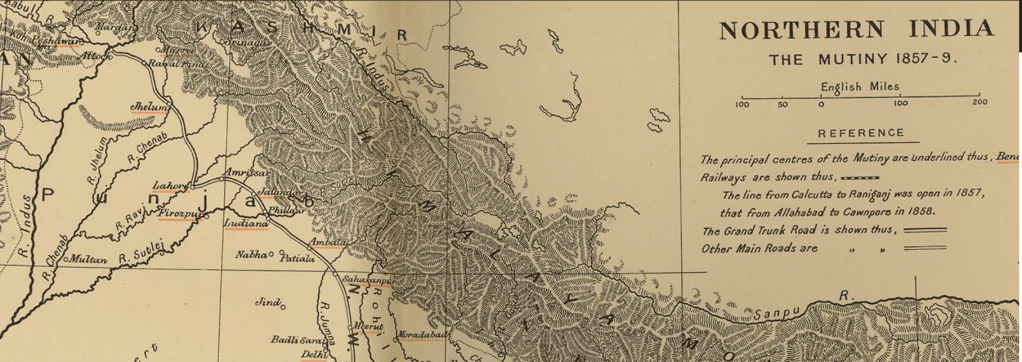
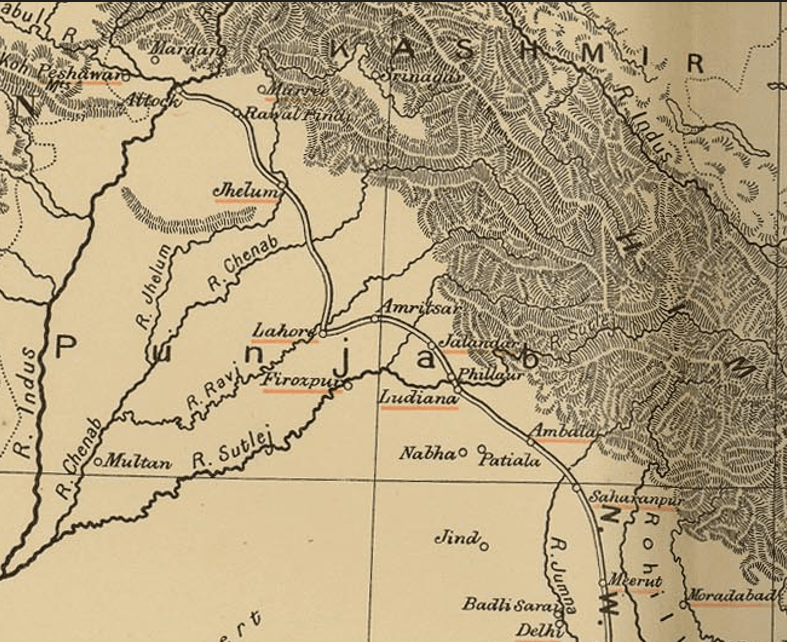
Then came the problem of securing the treasuries. At Ambala, the treasury was under a guard of the 5th BNI; at Thanesar, it too was under a detachment of the same regiment. At Ludhiana, Ricketts had to contend with the men of the 3rd BNI recently ordered to his station from Philour, while at Ferozepore, it was all under the watchful eyes of the 57th BNI. The Gurkhas were on guard in the hills. It became imperative to collect it and place it in less tempted hands. The men of the 5th BNI escorted the Ambala treasure themselves to the quarter-guard of the 1st Bengal Fusiliers recently down from the hills, while Captain McNeile at Thanesar sent his with some haste to Ambala as well. Ricketts, realising he did not have the manpower to send his any great distance, transported the treasury to Philour. At Ferozepore, it remained in the station but was moved to the fort and placed under a guard of the HM’s 61st Regiment.
Events in the first week of the mutiny worked quickly. The energies of John Lawrence, fuming in Punjab at the lack of resourcefulness from pretty much everyone, provided the mainstay of the Delhi Field Force. By emptying the Punjab of as many troops as could be spared, within five days of the news of the Delhi massacres, three regiments of European Infantry (the 75th Foot, the 1st and 2nd Bengal European Fusiliers) one regiment of Dragoons – the 9th Lancers – and two troops of Horse Artillery with 6 pounder-guns were assembled in Ambala. The problem now was supplies. Some of the orders generated by the Commissary General and Superintending Surgeon were wishful rather than realistic; the Commissariat Department paralysed by the enormity of the task and deserted by the usual retinue of camp followers, while regular army suppliers were found to be holding themselves aloof, the burden of supplying the army suddenly fell to the men of the Civil Department, with Mr Ricketts, Mr Forsyth and Captain McNeile expected to come up with everything the army would need. They did so in record time – “the first detachment of the advancing army marched on the 17th and was followed by the last on the 23rd May.“
None of this would have been possible without local cooperation, as Barnes points out:
“The ammunition was conveyed by a party of the district police, and so, throughout the campaign, the most important military stores were constantly sent down under the charge of contingents furnished by the Chiefs of the Cis-Sutlej States; their troops protected our stations, and patrolled the Grand Trunk Road from Ferozepoor to Phillour down to the very walls of Delhi.
The safety of this Province may be attributed to their loyalty and good example. The Raja of Jheend, with Captain McAndrew and a small but well-disciplined force, acted as the vanguard of the army…and kept always in advance. When the first detachment of Europeans reached Kurnaul, this little band proceeded 22 miles further to Paneeput, quieting the country, securing the road, and collecting supplies; and in this manner, they advanced boldly to within 20 miles of Delhi. A detachment of the Jheend troops seized the bridge at Bhagput and thus enabled the Meerut force to join headquarters. A part of the Jheend sowars, with Captain Hodson at their head, rode into Meerut and opened our communication with that station. The troops of the Maharaja of Putteeala guarded Thanesar and Umballa, and the safety of Loodhiana was entrusted to the Raja of Nabha and the Kotla Nawab…”
This does not mean that the civil department was sitting idle.
Captain McNeile at Thanesar took to the field himself, while Mr Levien, the Assistant Commissioner, took up a post on the banks of the Jamuna River. Lieutenant Parsons, the second Assistant Commissioner, headed off to the westernmost portion of the district to patrol the area towards Hansi. Mr Plowden from Ambala found himself deputed with two companies of the 5th BNI and a squadron of the 4th Bengal Lancers (an Indian regiment) to Jugadri on the road to Saharanpore to guard the Bridge of Boats. At Rupur, two companies of the 5th BNI under Captain Gardner (who had recently fled from Delhi) proceeded to that station, with Gardner given the authority of a magistrate under the instructions of Barnes. Unfortunately for Gardner, the men of the 5th, instead of keeping order, were among the first to disrupt it, turning the butchers out of the town and “maltreating the town-crier” as he announced orders from the district officer. Barnes recalled them to Ambala, but most of them deserted on the way back. He ended up hanging five of them for sedition.
The biggest problem facing the district was less from sepoys as with a mutinous bend than the local population. By mid-May, the neighbouring areas of Sirsa, Hansi, Hissar, Muzaffarnagar and Panipat were in chaos, with the civil authorities either fleeing for their lives or dead. Outside Karnal, the magistrate of Panipat had no control left, while at Sahuranpore, even with best efforts, the district was scarcely in anyone’s control. It became imperative then that the Cis-Sutlej states remain calm.
The ferries over the Jamuna were closed early in May, and the order expanded to include every river in the Punjab and was carried out by the 30th. The police forces were doubled and given orders to “attack and destroy any plundering band seen in the actual commission of a crime.” They were promised blanket exoneration if they actually killed anyone and rewards for “acts of prompt and retributive justice.” They were further instructed to break up any assembly of armed and suspicious persons, the order being to stamp out sedition, no matter what form it took. Every magistrate was given “full authority… to act fearlessly as an emergency might dictate…” Although these measures did much to lessen the problems facing the region, there was by no means peace. The Jamuna River was impossible to patrol or control completely, while the Rangurs of Hissar and Panipat had thrown off every yoke of restraint and were continuing their reign of pillage and plunder. Nor was the situation improved by the comings and goings of the mutinous sepoys of the 45th and 57th BNI from Ferozepore. Everyone seemed to have their own ideas – close to Ambala, an armed villager defied authority and took to plundering “at his leisure” while the villages in Thanesar headed by their chiefs turned out in broad daylight and raided weaker villages at will. Fights on a local level were so common the police were too cowed to report how bad things were. As such, Barnes ordered every “highway robber” hung and, from the 5th of June in the Thanesar and Ambala districts, was placed “under summary law, declaring highway robbery and daring outrages of that stamp punishable with death.” Although this did have some effect in curbing the wanton criminality along the Grand Trunk Road, it did not stop it. It is anyone’s guess how many lives were lost to rampaging bandits, blood feuds and murder.
Amid all the anarchy there was still an army before Delhi to supply.
It had been suggested early on to establish a bullock train which was to be “carried on by the district officers” but the idea proved defective in practice as it lacked the necessary supervision down the whole line. The idea was not wholly discarded and Captain Briggs was put in charge of a “military siege train” – his jurisdiction extended the full length of the road from Ferozpore to Delhi – 265 miles and consisted of a train of 30 waggons a day from each of the main stations – Ambala, Ludhiana and Karnal and a further 14 from Ferozepore, with the same number returning the same day. Briggs organised regular guards along the whole line – from Ferozepore to Ludhiana and Karnal the district police were in charge, while beyond Karnal the duty was given to the troops of the Cis-Sutlej Chiefs who had garrisoned Karnal, Panipat, Kasauli and Rhae. Once the siege train was fully operational on the 22nd of July, it would remain in use until mid-October.
Sir John Lawrence, and indeed the more competent civil servants in the Punjab, understood how vital it was to keep mutiny out of the region. It formed the medium through which supplies and troops had to pass to reach Delhi. The forts at Phillour, Kangra, Nurpur and Bajwara were all considered strategically important, while the hill stations of Dalhousie and Dharmasala housed two sanitoriums vital for treating the wounded. It further contained the transportation supply depot, which could provide carriage to troops marching to Delhi. In his district report, Captain Farrington placed much emphasis on this point – in this anxious and already harassing time, he was the only civil officer in Jalandhar as Major Lake was out of the station. In the middle of the preparations, unrest, strife and uncertainty, much to Farrington’s disgust, the troops at Jalandhar decided to have a mutiny of their own.
 Mutiny Reflections